
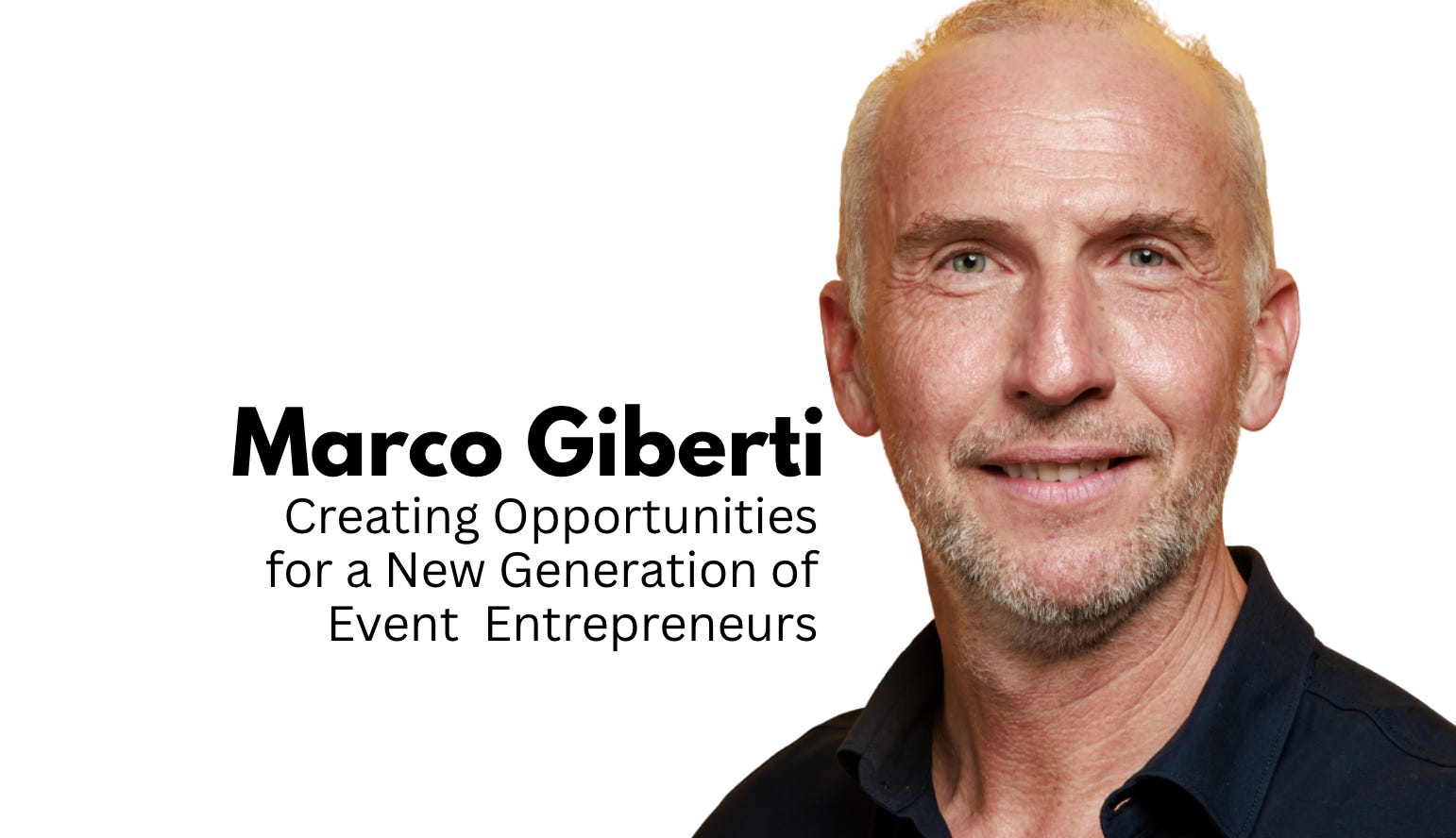
Marco Giberti and the Gathering That Funds
He built the fund the industry kept failing to build. And made it a salon.
Editor’s note: The author and Marco Giberti co-chaired the SISO Event Innovation Battlefield together for much of the 2010s. This is a profile, not a memoir, but the admiration is disclosed.
The Apple Show in Buenos Aires, early nineties. Marco Giberti was in his mid-twenties, hired to run marketing for Apple Latin America at a moment when Apple was losing the operating-system war on every measurable front and most of the Windows world had already stopped taking the company seriously. The room was small. A few hundred interior designers and architects, a scattering of dealers and distributors, an Apple user base in Latin America that was, in Giberti’s own accounting, a cult, and a minority cult at that. But when the doors opened he watched strangers recognize each other across the floor as if they had been waiting years for the signal. Dealers met distributors. Designers met the technologists who would build their next project. And Giberti, standing in the room, understood that the trust Apple had cultivated in its software had just been loaned, for three days, to a physical space. The cult had become a trade show. Within a year, he had quit.
What he built next matters less, in the long view, than the lesson he walked out with: that a well-sorted room, backed by a credible brand, is the most efficient marketing mechanism on earth. He has spent the thirty-two years since attempting to prove it. He went from Apple to launching Windows World in Latin America, then talked Comdex, the most important technology trade show on the planet at the time, into planting its flag south of the border. He built Mind Trainer, ran it as a long-term joint venture with Reed Exhibitions, and sold it to Reed Elsevier. He reinvented himself as Vesuvio Ventures, the Miami-based investment and advisory outfit he named after the volcanic soil that fertilizes the Gulf of Naples. He co-authored two of the most-cited strategy books the events industry has produced this decade. And in May 2024, alongside Greg Topalian of Clarion Events, Jonathan Weiner of HLTH, Monique Ruff-Bell of TED, and a handful of others, he finally lit the match on the institution he had been sketching in private for years: the Events Venture Group, a nonprofit deal-by-deal syndicate built to close the one gap in the events capital stack that the industry had, somehow, spent three decades failing to notice, and built in the only shape Giberti has ever trusted. A gathering.The House of Giberti
He was born in Buenos Aires on February 18, 1967, son of Horacio Giberti and Vanda de Michelle an Italian inmigrant to Argentina from Naples, Italy hometown of the Vesuvio which is the name of Marco’s company as a recognition to his Italian roots. His father was not a businessman. Horacio Giberti was a Doctor (pediatrician) and spend his life learning and practicing medicine and also enjoying technology gadgets (something Marco inherited from him).
This was the house Marco Giberti grew up in. When Marco eventually picked a field of his own, not his father’s medical and academic passion but the business of gathering, he brought both sets of instincts with him. He writes books, he teaches a masterclass, he drafts institutions the industry had somehow never built itself. The name of his venture firm, Vesuvio, after the volcanic soil that fertilizes the Gulf of Naples, is no accident. It is an agrarian metaphor deployed on the floors of trade shows. The soil is rich, the founders flourish, the fund is the fertilizer. Her mother Vanda would have recognized the frame immediately.
The First Ballroom
Giberti tells the Buenos Aires story the way people tell the moment they met their spouse. There is a before, and there is an after. The before was corporate Apple in the early nineties, what he calls the dream job at the perfect age. The after was Windows World, Latin America, built from nothing. “I moved to the other side of the technology,” he says of the pivot, “and it was a huge success, and I convinced Comdex to bring the show to Latin America, and that’s how my trade show career started.”
The insight he took from Apple was brand validation. In the early nineties, launching a show in the region required an outside stamp that buyers trusted. Comdex was that stamp. He worked the same logic in reverse: if the trade show was the most efficient marketing tool in the world, then the organizer, the person who signs the sponsors, books the stage, picks the speakers, and curates the guest list, was the most efficient broker of relationships in capitalism. The logic held through Mind Trainer, which he built into a regional juggernaut before Reed Elsevier bought the whole thing. It held through the second act, when he set up Vesuvio in Miami and began placing early checks into Grip, the AI-matchmaking platform he backed nearly a decade before anyone in the industry said the words “AI matchmaking” without laughing. It held through more than 50 early stage techh investments around B2B media, events and marketing.
And it held through his two books, co-written with Jay Weintraub and Denzil Rankine, which between them reframed the events business as a “community catalyst” inThe Prophecy, and Then the Pandemic
The books did real work. The Face of Digital landed in 2017, arguing that a $565 billion industry was about to be disrupted the way Airbnb disrupted hospitality and Uber disrupted transit. The thesis was dismissed, at the time, as alarmist. Three years later, in the middle of the pandemic, it read like prophecy. Reinventing Live, co-authored with Rankine in 2020, was the follow-up, and the praise lines on the back of the book read like a who’s who of industry command: Charlie McCurdy of Informa, Gary Shapiro of CTA and CES, Paul Miller of Questex, Simon Kimble of Clarion, Douglas Emslie of Tarsus. Giberti became the guy the C-suite called when they wanted to know what happens next.
He parlayed the authority into a classroom. The Business of Events Masterclass, through Leaderpass, is fifteen-plus hours of instruction across sixteen modules, with guest contributions from Monique Ruff-Bell, Carina Bauer, Lance Fensterman, Paul Miller, Aaron Levant, Hervé Sedky, Julius Solaris, and a dozen others.
The Problem He Could Not Let Go
None of this, though, answered the question that had been nagging Giberti since the early 2010s. The events industry had, by his count, two kinds of capital readily available to it. Private equity, which bought shows at scale once they were already throwing off healthy EBITDA, and the shows themselves, which funded their own growth out of operations. What it did not have, what it had never had, as far as he could tell, was strategic venture money for zero-to-one founders. “Strategic money before EVG was zero,” he says, flatly. “Money is a commodity. If you’re a good founder, you’re going to raise money sooner or later. But launching is different.”
He had watched friends try and fail. He had bet on event-tech startups himself, companies trying to crack post-event ROI measurement, that never found their legs. “I invested in some startups that were trying to fix that. Failed.” He says it without defensiveness. The failures were part of the tuition. What they taught him was that money alone does not launch an events business. Founders need the thing Apple gave him in 1993. Validation. The brand endorsement. The stamp that tells the market this founder is worth the room.
He had tried, in fact, to build that kind of stamp before. For much of the 2010s he co-chaired the Event Innovation Battlefield at SISO’s annual leadership conference, a pitch competition built in deliberate imitation of TechCrunch’s Startup Battlefield and planted inside the Society of Independent Show Organizers to see whether the format would take. The theft was the point. Silicon Valley had spent fifteen years teaching the world that a panel of investors grilling founders on a stage could anoint a company overnight, and the events industry, which sells the act of anointment for a living, had somehow never thought to do it for its own. So the co-chairs imported the shape. Concierge EventBot won one year; an AI matchmaker made the cut in 2020; the Battlefield did what it was designed to do, which was to give early-stage event-tech founders a stage and borrow the authority of a format the venture world already trusted. It told the industry what was coming. What it could not do was write a check. That was the gap that kept Giberti awake.
EVG was designed to be the stamp. Structured as a nonprofit, it operates on a deal-by-deal SPV model. Applications come in through the website. Members review on a Zoom call. A single-purpose vehicle forms around each approved deal. The check clears with a board of seasoned operators attached to the cap table. The offering is not money, exactly. The offering is the network: Topalian’s playbook of launching shows at Clarion, Weiner’s scale at HLTH, Ruff-Bell’s programming mind at TED, Emslie’s operating chops from the Tarsus years, Gumas’s Questex-era instincts, and Marilú Páez running point as Managing Director. “We will not only provide capital,” Giberti told Skift when EVG launched in May 2024, “but experience, advice, and help as well.” It is the venture arm the events industry should have built in decades ago and did not.
The sneakier point, the one that gets lost in the capital-gap story, is that EVG is itself a gathering. The members do not just review decks; they argue through deals on Zoom, bring each other into companies they would never have found alone, and compound their own network in the process. Which means Giberti has done the thing he has spent thirty years telling every other event founder to do. He built the venture arm using the methodology of the room. EVG is a nonprofit legally, an angel group operationally, a salon culturally, and, most importantly, an experience for the people who join it. Founders leave the pitch with a network. Members leave the meeting with two new friends who also know what they are looking at. It is, in the terms of Giberti’s own book, a community catalyst that happens to write checks. It is the only angel group in the events industry that behaves like an event.
To View Entire Portfolio Click Here
What He Is Betting On Now
Recently the doors open at the Fontainebleau Las Vegas on PEAK, the Global Home of SportsTech, a three-day conference built by Chad Wilton and Matt Williams under the Profluence Capital banner, with 1,000-plus founders, investors, and sports executives walking the floor. It is exactly the kind of launch Giberti has been betting on all along: a sharply vertical tech show with the three stakeholders he says every successful technology event requires in the room. Founders. Investors and incumbents willing to be disrupted. He is in the building. Profluence and EVG’s orbits overlap; the Profluence Hub sits inside the PEAK Tech Expo. Giberti is also working with RacquetX and the Racquet 360 platform, the padel and pickleball operation that straddles the B2B and B2C boundary he argues is where the next generation of event businesses will actually live.
The thesis he is running on right now, and which he will press on any founder who asks, is the one most of the industry is not ready to hear. “I would rather invest in a 2,000-person show that is relevant than a 20,000-person show that is becoming obsolete.” The loyalty, he says, will collapse the moment a valid competitor appears. He believes the big horizontal trade shows are going to have a hard decade. He believes return, not applause, is the metric that matters.
He also believes the next generation of attendees, his own kids among them, will not skip events. They will demand better ones. More fun, more ROI, less plastic bound for the landfill. The first time one of his kids walked a show, the reaction was, “What a waste.” By the fifth show, the reaction had shifted. “I could find a job here.”
And he believes the next generation of event entrepreneurs is going to come not from the events industry at all, but from the industries events serve. The tech founder who knows everyone in the vertical, who decides a show needs to exist, and who partners with an operator who knows how to actually build it. The person on stage at the Business of Events Masterclass who Giberti is arguing should exist. The person EVG was funded to back.
His bet is that the future of the events industry looks less like Vegas and more like Buenos Aires in 1993. A smaller room. A vouched-for list. A brand the room trusts. A few hundred people who recognize each other across the floor and shake hands like they have been waiting years for the signal.
Giberti has seen this movie before. He starred in it.


