
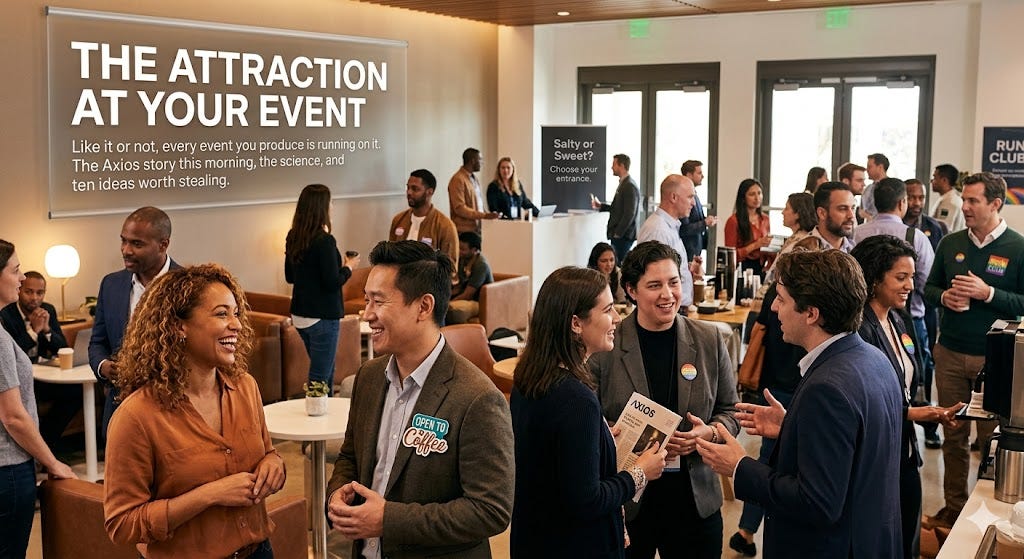
Leaning Into Attraction as An Event Asset
Like it or not, every event you produce is running on it. The Axios story this morning, the science, and ten ideas worth stealing.
Axios filed a story yesterday that names what every event organizer in America has been quietly designing around for forty years. Attraction. Singles events on Eventbrite doubled from 2022 to 2025, with 2024 as the peak year, a thirty percent rise in events and an eighty-five percent jump in attendance year over year. Run clubs are the new Tinder. Lesbian bars are reopening in cities that lost them twenty years ago. The dating apps lost. The room won. The piece is being read as a story about the romance economy, which it is, but the actual subject is bigger and more useful to the people who run gatherings for a living. The romance is just one expression of the larger force. The larger force is attraction.
Here is the part Axios was too polite to print. Every conference you have ever attended is an attraction event. Every trade show. Every industry dinner. Every after-party. Every Tuesday-night dinner that seats two strangers next to each other. The events business has been running the most successful attraction product in human history for two hundred years and pretending it was about the panels. The new wave of operators (Lunge Run Club, Thursday, the dyke renaissance bars, sex-positive Brooklyn brownstones, Pre-Dating senior speed dating) are not a trend. They are a confession. They are the industry admitting in public what every veteran organizer already knows.
We are not in the events business. We are in the attraction business. Call it goosebumps if you want, but the engine is the same.
Attraction is the broadest and most honest way to name what is happening in your room. Professional attraction. Intellectual attraction. Creative attraction. Romantic attraction. The whole spectrum, all at once, on purpose. The biology is not subtle. The science of attraction is settled, and every mechanism in it points to one conclusion. The brain forms a first impression in one-tenth of a second. Eye contact across a room releases oxytocin and dopamine before either person says a word. Mirror neurons synchronize two strangers’ posture, gesture, and speaking pace within seconds of being in the same room. Every one of those mechanisms requires physical proximity. None of them work through a screen. A screen has never given anyone goosebumps.
The Radar Is Always On
Ben Moorsom, the founder of Debut Group and the practitioner who has spent twenty-eight years arguing that events are behavioral systems rather than productions, calls this the cognitive budget every attendee shows up with. The brain, in his telling, burns more energy on peripheral scanning than on focal attention, because peripheral vision is the evolutionary survival system and it never turns off. Every person who walks into your room is running a radar already on, looking for threat, opportunity, allies, status, and the full spectrum of attraction in some proportion specific to their moment in life. The radar is not a metaphor. It is the cognitive default state of a primate in a room full of other primates, and the events industry has been pretending otherwise for forty years.
The work of the designer, in Moorsom’s frame, is to reduce friction so the radar has the cognitive room to find resonance. Every minute an attendee spends fighting your lighting, your sound, your wayfinding, your demo theater, or your registration line is a minute the radar is not free to do its work. That is why the badge scan at the door tells you nothing about whether anyone changed in your room. It is also why the operators who are actually moving the field forward are the ones engineering around the radar rather than against it. Grindr did this in two dimensions. The sapphic operators did it in three. The conference industry is the last to figure it out, and the producers who get there first are going to look like geniuses to everyone except the cognitive scientists, who will look like they were saying so the whole time.
The Operators Who Already Know
Two corners of the gathering economy have figured all of this out, well ahead of the trade-show industry, and they should be required reading for any conference organizer planning a calendar in 2026.
Start with Grindr, because it is the most uncomfortable proof point. The dating app that turned proximity into a product has spent the last three years rebuilding itself explicitly around the convention and travel use case. At any given time, twenty-seven percent of Grindr users are traveling. The company’s 2025 product roadmap, announced at its January investor day, was built around what CEO George Arison called the Global Gayborhood in Your Pocket. The new products are Travel Pass, a paid package designed for conference and convention attendees; Roam, which lets a user place their profile in a destination city before they have even arrived; and Right Now, an intent-based product for immediate connection that began piloting in Washington DC and Australia and rolled out globally by the end of 2025. At Citi’s 2025 Global TMT Conference in September, Arison told analysts the company is building out a travel and luxury experiences vertical as a parallel revenue line. The most digital of dating products has decided its highest-value moment is the in-person gathering. The events industry should read that sentence twice.
The most public confession came last summer. After persistent rumors that Grindr’s servers had crashed during the 2024 Republican National Convention in Milwaukee, Arison sat down with UnHerd’s Freddie Sayers in July 2025 and confirmed it on the record. Yes, it was actually true that there was a significant spike in usage in Milwaukee during the convention. Vice had reported a one hundred and twenty percent traffic increase before the first night of the 2016 RNC in Cleveland. The disgraced former congressman George Santos called the 2024 Milwaukee convention the Grindr Superbowl. Whatever the politics of the attendees, the technology mostly tells the truth about the room. A national convention is, among other things, a gathering of fifty thousand single-and-traveling adults in a single zip code for a week. The operators of every major B2B conference in America are running the same demographic profile and have refused, mostly for reasons of decorum, to acknowledge it.
The other corner of the gathering economy worth studying is the sapphic event scene, and the trade press should start there. Sapphic is the umbrella term for women-loving-women culture, encompassing lesbian, bisexual, queer, and trans women’s communities, and it is the operating vocabulary of an entire production industry the convention business has somehow managed not to notice. By every measure that matters for the events industry, the sapphic scene is decades ahead of the trade-show world on the design of gatherings around attraction.
The Dinah in Palm Springs has been compounding the model for thirty-four years. Founded in 1991 by Mariah Hanson, it grew from a weekend party that ran in parallel to the Dinah Shore LPGA tournament into what is now billed as the largest lesbian girl party music festival in the world. Past headliners include Lady Gaga, Katy Perry, Kesha, and Tegan and Sara. The 2025 edition was Hanson’s final one after thirty-four years at the helm, and in February 2026 BellaRose Productions, led by long-time staff members Bella Barkow and Rose Garcia, took over. The 2026 Dinah runs September 30 through October 5.
The Dinah is the headline, but the operator story is bigger. Pandora Events, the South Beach production company founded by Yesi Leon, Amy Alonso, and Alison Burgos, has been running compounding sapphic gatherings for twenty-six years. Their flagship, Girls in Wonderland in Orlando, celebrated its silver anniversary in 2025 and returns June 4 through 8, 2026 for its twenty-sixth edition, drawing more than ten thousand attendees annually. Pandora also produces Aqua Girl in Miami Beach, Shedonism in Las Vegas, the Women’s White Party, and the official women’s programming for Atlanta and Charlotte Prides. Twenty-six years of compounding under one production company is the kind of operating tenure most trade-show owners would kill for, and it has gone almost entirely uncovered in the events trade press. The Aqua Foundation for Women, founded by the same operators, is Florida’s first LGBTQ+ women’s nonprofit and the institutional layer the convention industry has spent decades pretending events do not need.
The wider scene reads like a map of the operational vocabulary the convention industry is still trying to learn. The Desert Legends Weekend, founded in 2022 specifically for forty-plus sapphic attendees, now runs in parallel to The Dinah in Palm Springs. Provincetown’s Memorial Day tea dances have made the town the sapphic capital of the East Coast. Stargaze, a music and camping festival designed for women, non-binary, and trans attendees, has built a destination model in the woods. The Lesbian Bar Project, founded during the pandemic by filmmakers Elina Street and Erica Rose, now counts thirty-six operational lesbian bars in the United States in 2026, up from a low of fewer than twenty-four in 2021, with new venues including As You Are in Washington and Last Ditch in Greenfield, Massachusetts. London is in the middle of what its organizers openly call a dyke renaissance, anchored by La Camionera on Broadway Market and a roster of producers including WET in South London, who built their model specifically around early Black and POC access to tickets.
What these operators have in common is what the trade-show industry has avoided naming for forty years. They design rooms specifically to make attraction legible. Sapphic event culture in particular, having spent five decades building its own signal infrastructure under conditions of political risk and commercial neglect, runs circles around the convention industry on every design move this column’s ten-ideas list will recommend. They invented the pin codes, the question-driven seating, the unprogrammed late-night room with the soft lighting and the one bartender, and the cohort table organized by something other than industry vertical. The trade-show industry, in 2026, is finally beginning to rediscover what these operators have been doing all along and to ask whether the rest of the convention business should be doing it on purpose.
The answer, as the next ten ideas argue, is yes.
So lean in. Design the entrance. Design the badges. Design the seating. Design the unprogrammed hours. Stop treating the social architecture as the gap between the panels and start treating it as the panels.
Ten ideas worth stealing
1. The Two-Door Entry
At registration, ask one playful binary question that reveals something true. Salty or sweet? Morning person or night person? Talker or listener? Coffee or tea? Build two entrance paths into the venue based on the answer. Each room sees the other through a glass wall but they only converge inside. Two-door entries do the work that name badges pretend to do. They tell every attendee something useful about every other attendee before a single conversation has begun. The salty-or-sweet question can be replaced by any binary that reveals something true about the attendee. The mechanic is the same, and the attraction application is built in by default: attention is the precondition for everything.
2. The Open-to-Coffee Ribbon
Ribbons or pins that signal explicit social intent, beyond the standard first-time attendee or speaker badges. Open to coffee. Open to mentoring. Open to introductions. Hiring. Looking. Returning after ten years away. Steal from queer event culture, which has been making the unspoken legible with color systems and pin codes for fifty years and is decades ahead of the trade-show industry on signal design. The simplest version is a row of ribbons at the registration desk. The attraction application is the most direct of any move on this list. A ribbon that names what the wearer came here to find shortens the social distance between strangers from minutes to seconds.
3. The Birthday Table
The registration form already asks for date of birth and the data goes nowhere except into a CRM. Use it. Seat people born in the same year or decade together at one curated dinner each night. Cultural reference points do the icebreaking work that no professional host can replicate. A 1971 cohort and a 1988 cohort will have radically different opening conversations and both will be better than the assigned-seating dinner you ran last year. The attraction application is the cohort one. Most attendees, when they are honest about it, are looking for connections inside their own peer band, which is statistically where most pairings happen at conferences anyway.
[INSERT IMAGE: 04-reverse-introduction.png]
4. The Reverse Introduction
Ask each attendee at registration to name one person at the conference they would like to meet, and why. The organizer becomes a matchmaker for the twenty most thoughtful answers. Twenty intentional introductions are worth two hundred awkward ones, and the attendees who get matched will become evangelists for the show. The attraction application is the unstated one. Some of those twenty introductions will be professional. Some will be intellectual. Some will be neither. The mechanic does not need to acknowledge what each introduction is for. It just needs to make the introduction.
5. The Hometown Walk
A pre-event opt-in: meet at a designated coffee shop the morning after arrival, grouped by city of origin. The Lunge Run Club logic transposed onto the conference circuit. People who fly in from the same city often have not met each other at home. The reunion of strangers who share a zip code is its own kind of magic, and it costs you the price of one barista pre-pour. The attraction application is the long game. A forty-minute coffee walk with seven strangers from your zip code is the single best filter for the downstream local meetings that happen after the conference ends, which is when half the actual relationships of any gathering are formed anyway.
6. The Hat
The Polish wedding churches of the early twentieth century had figured out something the dating apps had to relearn a hundred years later. Married women wore black head coverings to social functions. Single women wore white. Nobody discussed it out loud. The signaling was complete before the music started, the boys did not get into trouble they had not signed up for, and the radar Moorsom describes had something useful to scan. The running clubs that replaced Tinder are doing the same thing with safety pins and rubber bracelets. I am single, run with me. The conference industry, which prefers to pretend none of this is happening, has nothing in between a name badge that announces what company someone works for and a four-hour reception that hopes the radar figures out the rest. The fix is a hat, or a pin, or a colored lanyard, or whatever the cultural register of the event will support, that telegraphs one simple piece of intent before any introduction is required. Open to a new role. Hiring. First-timer. Investor. Founder. Writing about this in public. Looking for a co-author. Looking. The vocabulary is the organizer’s choice. The principle is older than the trade show and works harder than every networking app currently on the market.
7. The Anti-Networking Hour
One hour on the program where badges come off, business cards stay in the bag, and the explicit instruction is to talk to one person about something that is not work. Codified permission to be a whole person. The post-event survey will tell you this hour was the best part of the conference, and the conversations attendees remember a year later will all come from inside it. The attraction application is the most direct on this list. The badge is the single biggest obstacle to genuine attention at a conference. Take it off for an hour and watch what happens.
8. The Late-Night Salon
Instead of a third afternoon panel, build a room for the unprogrammed hours. Low lighting, comfortable seating, one bartender, no agenda, and no microphones. The chemistry happens here whether you design for it or not. The smartest move is to design for it on purpose and stop pretending the cocktail reception is doing the same work. The attraction application is that you are bringing the hotel bar inside the venue. Every veteran attendee already finds the hotel bar by the second night. Pull that emotional center into your footprint, on purpose, and the entire chemistry of the conference relocates inside your room.
9. The Plus-One Stranger
Allow attendees to bring one person from outside the industry whom they have not introduced before. Cross-network mixing collapses the echo chamber. The most interesting conversation at any major gathering is often the one with the outsider, and the easiest way to import outsiders is to let your most loyal attendees do the curation for you. The attraction application is the cross-network one. Pairings happen far more often across networks than within them, which any veteran organizer who has watched their attendees pair off with their plus-ones for twenty years can confirm.
10. The Returning-Attendee Reunion
Identify attendees who came last year, or five years ago, or ten, and design a structured way for them to reconnect on Day One, before the keynote. Cross-event memory is the most underused asset in our industry. The reunion is the cheapest retention mechanism ever invented and the most under-deployed marketing tool in the trade-show stack. The attraction application is the long-game one. A returning-attendee reunion is also a meeting of people who have circled each other for years across the same industry. Some of those circles tighten when given a room, a glass of wine, and a reason to stay past the keynote.
Close
The ten ideas on this list are not gimmicks. They are the design vocabulary of an industry finally willing to admit what its product has always been. The Surgeon General can call it the loneliness epidemic. Axios can call it the dating-app exodus. Every operator who has been doing this for thirty years has a different name for it and we all know what it is.
The room is the product. Attraction is the engine. Goosebumps are the proof.
David Adler is the founder of BizBash and the Curator in Chief of GatheringPoint.news. He is the author of Harnessing Serendipity.


