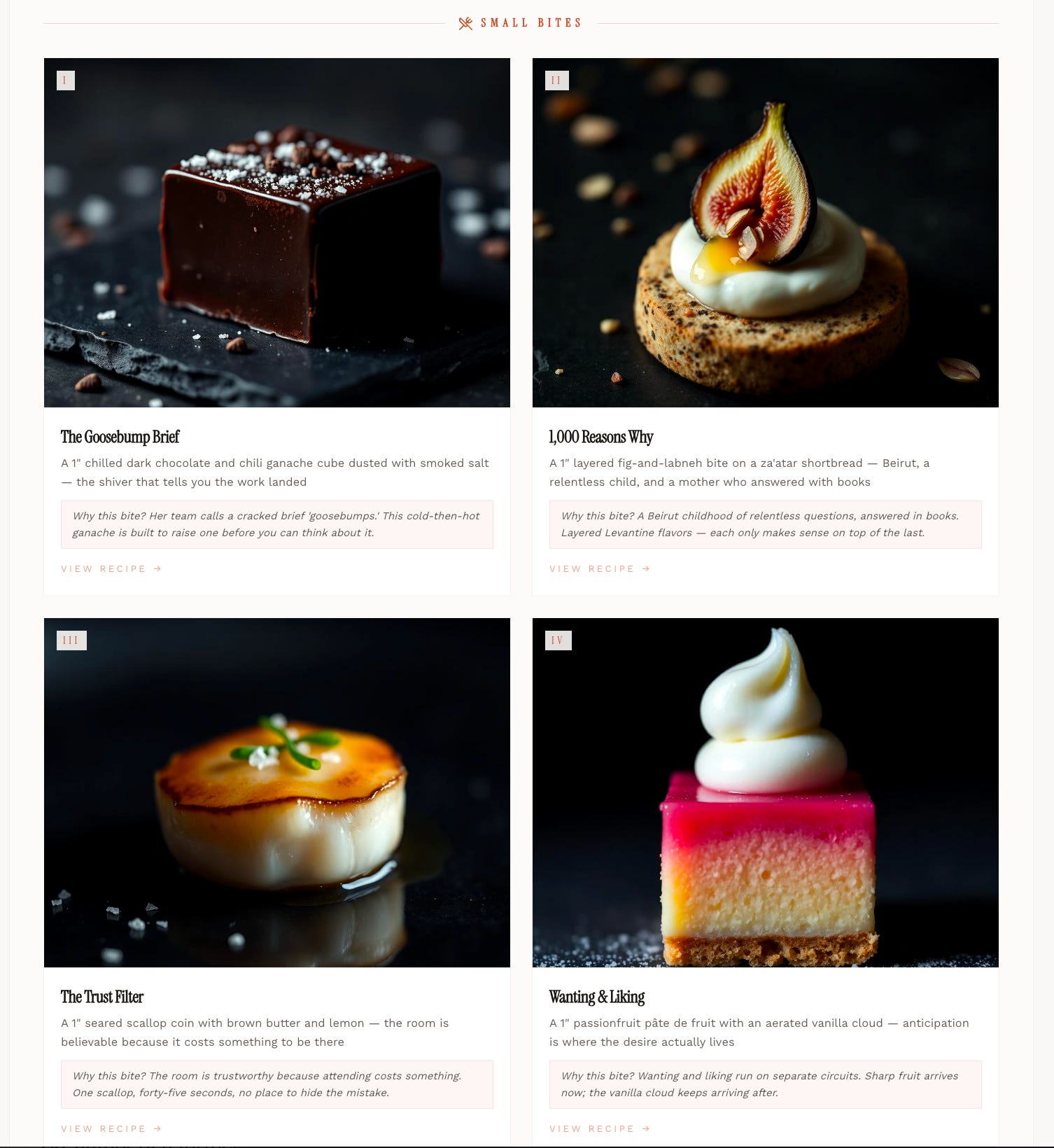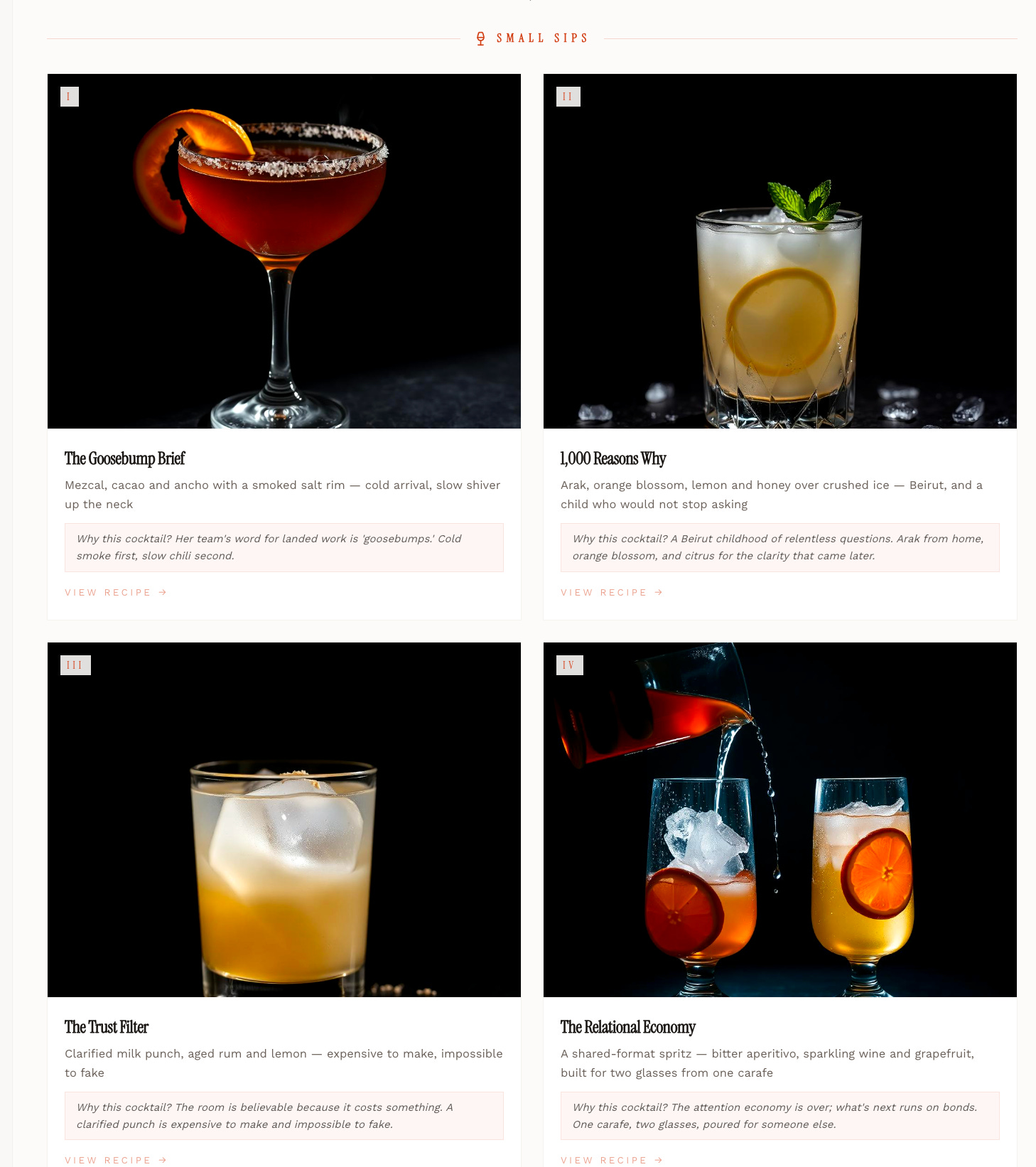
Lea Karam‘s company has a word for the moment its work lands. Put a theory to her, half a hunch really, that the whole business of bringing people together is the business of raising the hair on someone’s arms, and she does not hesitate. “We are,” she said. “Do you know that every time we crack a brief, the thing we do in our team is goosebumps? It’s a thing. It’s like a recurring inside joke.”
A behavioral scientist who advises Google, TikTok, Snap, and the BBC keeps a private vocabulary organized around a physical shiver. That is not a charming detail. It is the whole thesis, and it is why her work keeps pulling her toward the one industry that trades in shivers for a living. Karam runs Mindscope, the London consultancy she built to answer a question the marketing world has been getting expensively wrong: not what makes people click, but what makes them feel enough to move. A goosebump is the receipt that something moved. And the place it is easiest to raise, and nearly impossible to fake, is a room full of people who chose to be there.
She did not come up through events. She came up through behavioral science and advertising, and then watched her platform clients pour money into live experience until she followed the spend to understand it. What she found became central to how she works. In a culture she says has been optimized into sameness, the physical gathering has become the last place trust is expensive enough to be real. She calls it the trust filter. You vote with your feet, your calendar, and the mental tax of showing up, and that cost is exactly what makes the room believable. It is also, she suspects, why valuations across the events business keep climbing while so much of what happens on a screen quietly loses its worth.
Her clients do not come to her through a deck or a cold email. They come because they watched her take a stage and describe, out loud, the thing they had been failing to name. “We never pitch once,” she said. “We get referred.” The demand has become its own logistics problem: five talks at Cannes Lions, keynotes at MIPCOM and South by Southwest London, a Q&A line at the World Experience Organization that ran long because the room would not stop asking.
The kid who wouldn’t stop asking
Karam grew up in Beirut, inside the French school system, which she describes with the specificity of someone who has thought about exactly why it worked. Her parents are entrepreneurs, retail franchise operators, brick and mortar, the physical world of getting people through a door. Sunday lunches were business conversations she was allowed to absorb. When she was nine or ten, before chatbots and before Google had fully colonized childhood, her mother handled her relentless questions the analog way. “My mom used to buy me 1,000 Reasons Why books, because I kept asking her questions,” she said. “You don’t really learn it. You’re just born with it, and then you cultivate it.”
The cultivation was cross-cultural by design. The French school in Beirut, then the American University of Beirut, then Imperial College London, each system stacking a different way of reading people onto the last. At Imperial she sat an exam in consumer behavior where the class average was 34, brutally low by British marking. She scored 80. “I love consumer psychology and behavior,” she said, as if that explained the gap, which it did. She loved statistics and probability, never geometry. She specialized in economics in high school. The through-line was never math for its own sake. It was pattern.
Ask her what she was actually good at as a child and she does not say reading, or numbers, or nerve. She says observation. “The best entrepreneurs are those that observe, found a pain point, and then fixed that pain point,” she said. “Observation is the most underrated skill.” She learned as much in a high school band and on a sports field as in any classroom, which is why she now lectures the industry about getting soft skills and digital literacy into secondary schools before the algorithms get there first. The girl who could not stop asking why grew into the scientist whose entire product is the answer.
What she actually sells
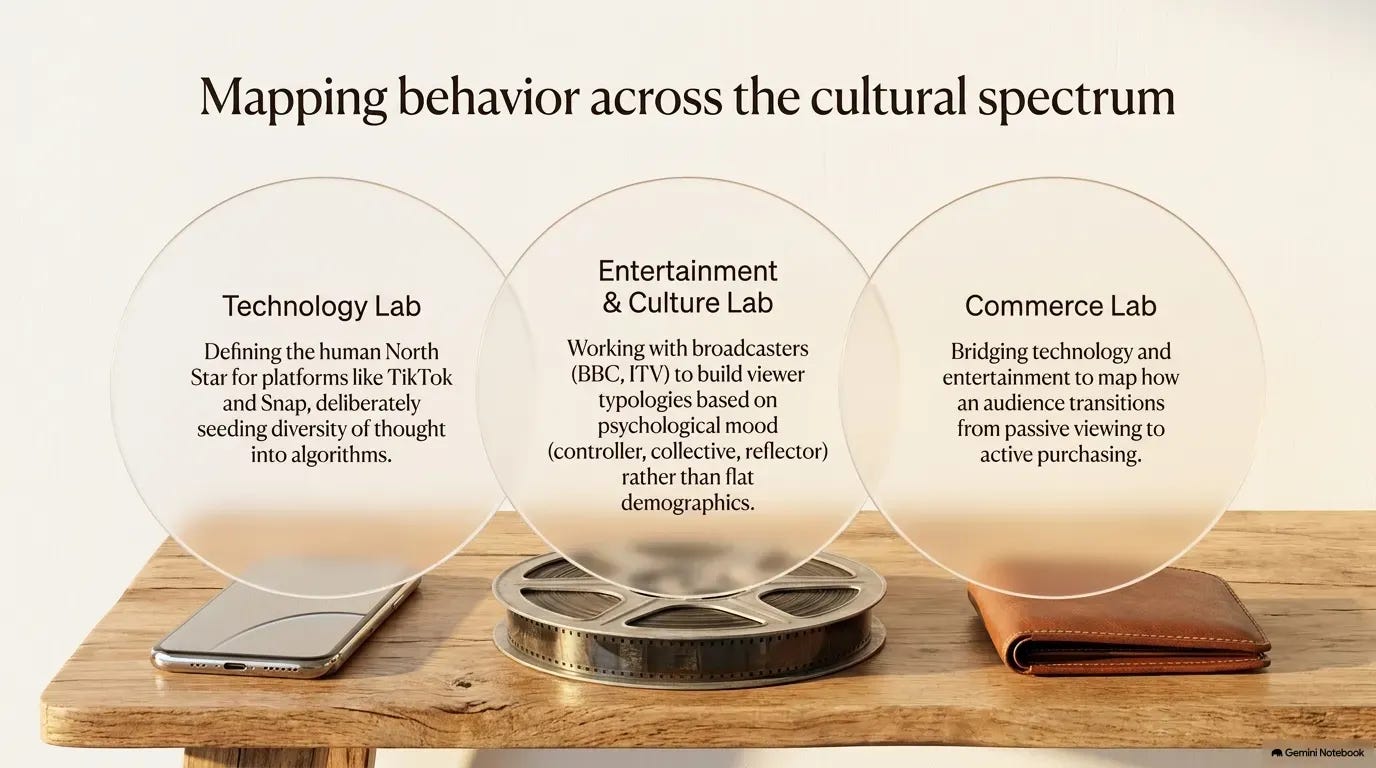
Mindscope is built as three labs, and the architecture is the pitch. A technology lab, where the platforms live, where her team rebuilds what she calls the north star a company like TikTok can stand for and works out how an entertainment app becomes a place people shop. An entertainment and culture lab, working with broadcasters and studios and creators, the BBC and ITV among them. A commerce lab that bridges the two. She calls the output not insights but foresights, and the distinction is not vanity. Insight tells you what happened. Foresight maps the psychology of who these people are before they have done the thing you want them to do.
The method runs backward from how the industry works. Everyone else quantifies first and asks questions later. Karam does the qualitative work first, the observation and the experiments, and only then reaches for the numbers. “We validate with quant, not the other way around,” she said. It is the same instinct that makes her suspicious of the field’s data obsession. “The future belongs to the people that find what the data is too coarse to see.” Her newest work, a set of trademarked viewer typologies she built for a major broadcaster, sorts audiences not by age or income but by the mood they are in when they watch, a controller mood, a collective mood, a reflector mood, each predicting behavior that no spreadsheet cell can hold. She had released it publicly only days before we spoke. It will not reach her own LinkedIn for weeks.
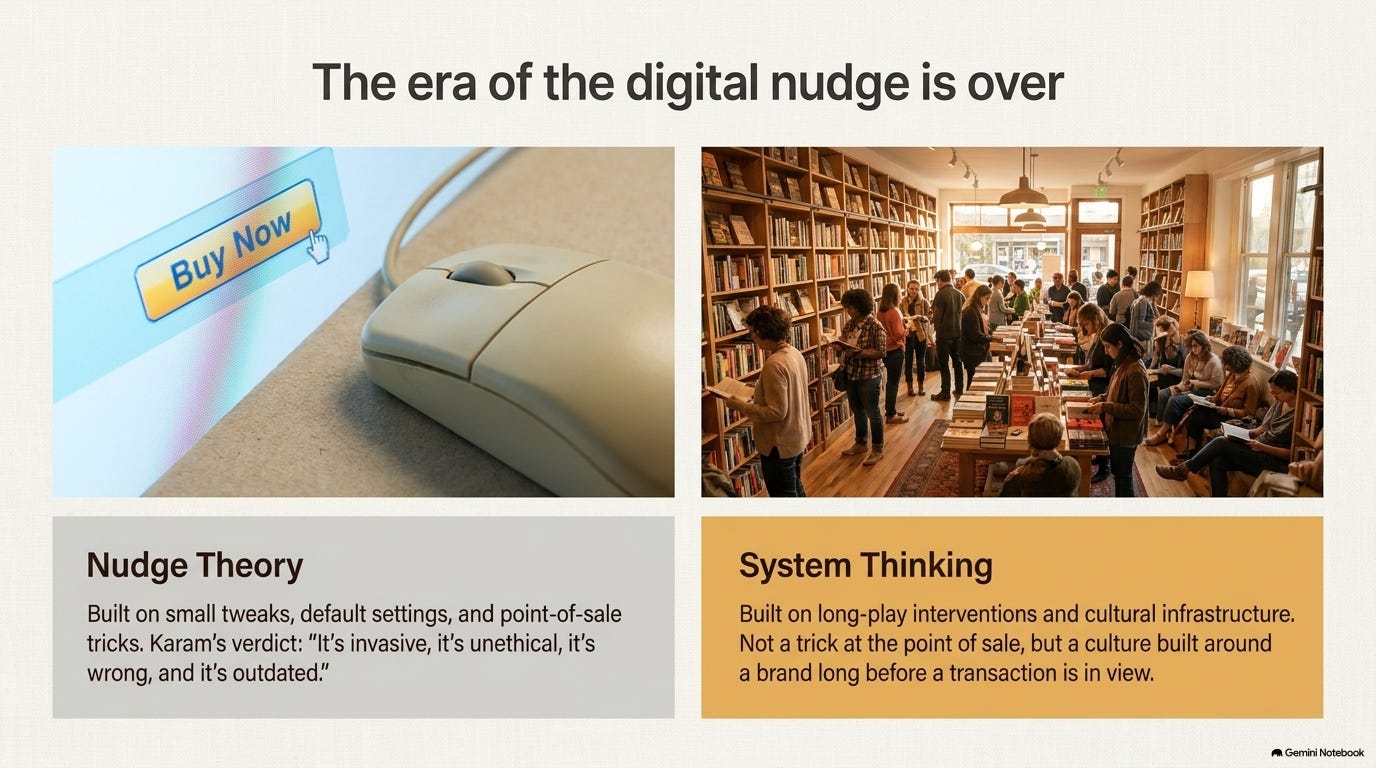
And then there is the argument she has built a reputation on, which is that the industry’s favorite tool is dead. Nudge theory, the decade of small tweaks and default settings and one clever button, she considers finished. “It’s invasive, it’s unethical, it’s wrong, and it’s outdated,” she said, in a single breath, as if she had said it many times because she has. What replaces it is bigger and slower. “It’s about system thinking now. You have to build long-play intervention.” Not a nudge but an infrastructure. Not a trick at the point of sale but a culture built around the brand long before the sale is in view. The reason it works, she said, is the reason all of it works: “Human impact equals commercial impact.”
The only constant
Underneath the labs and the trademarks is a single conviction she returns to like a tuning fork. Human behavior is the only thing that does not change. Technology turns over every few years and culture drifts every few months, but the wiring underneath, the need to belong, to connect, to be recognized, has not moved in millennia. This is why she refuses to build strategy on the technology itself. “People are treating AI as a tech challenge,” she said. “It’s a human challenge.” Understand the psychology sitting behind the tool and you can future-proof against a tool that has not been invented yet. Whether the model hallucinates, what the next interface looks like, none of that is where she places her bets. The bet is always on the constant.
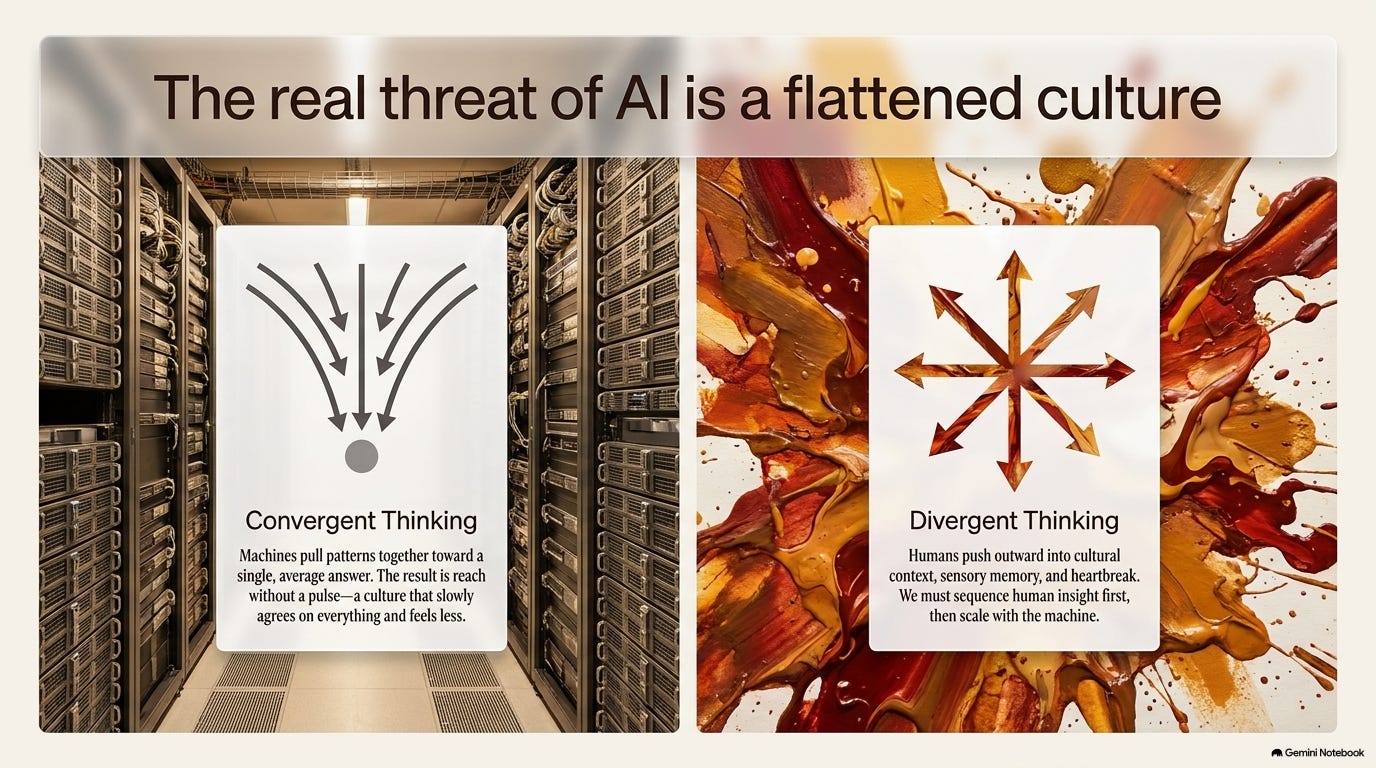
Her sharpest worry about artificial intelligence is not that it will replace people but that it will flatten them. She splits thinking into two kinds. Convergent thinking pulls patterns together toward a single answer, which is precisely what a machine does best. Divergent thinking pushes outward into the places a machine cannot follow, the cultural context, the creativity, the heartbreak, the sensory memory of a song. “We need more divergent thinking,” she said, because the hazard of a tool that only converges is a culture that slowly agrees on everything and feels less and less. The evidence is already in the numbers she watches. Engagement on Instagram fell sharply through 2025, she said, because the feed went AI-first, and content built machine-first “biases you from the start.” The right sequence is human insight first, then scale it with the machine. Reverse the two and you get reach without a pulse.
Why any of it works comes down to a piece of neuroscience she treats as bedrock. “The brain is not a deliberation engine, it’s a prediction engine.” People do not reason their way into wanting things. They predict their way there, out of habit and anticipation, long before the moment of choice arrives. Her favorite illustration is the gap between wanting and liking, drawn from decades of research at the University of Michigan showing the two run on separate circuitry. You can want something before you have liked it, before you have even had it. Brands, she argues, have poured everything into the moment of consumption and almost nothing into the anticipation that precedes it, which is where desire actually lives. It is the thesis she helped the agency Havas build into a global proposition they named the science of desire, and it is why she insists desire is the most human feeling there is. Any brand can be wanted. Most simply forget to make themselves anticipated.
Why the young trust her
Karam is careful about the word generation, which is unusual for someone whose business depends on it. She does not call herself Gen Z. “I’m on the cusp,” she said. “A late millennial.” She prefers a different label entirely, one that describes a posture more than a birth year. She is a perennial, positioned in the seam between the generation that remembers three television channels and the one raised inside infinite ones, fluent enough in both to translate. That seam is where her value sits. “No one understands the youth,” she said, “and I’m here to also bring that.”
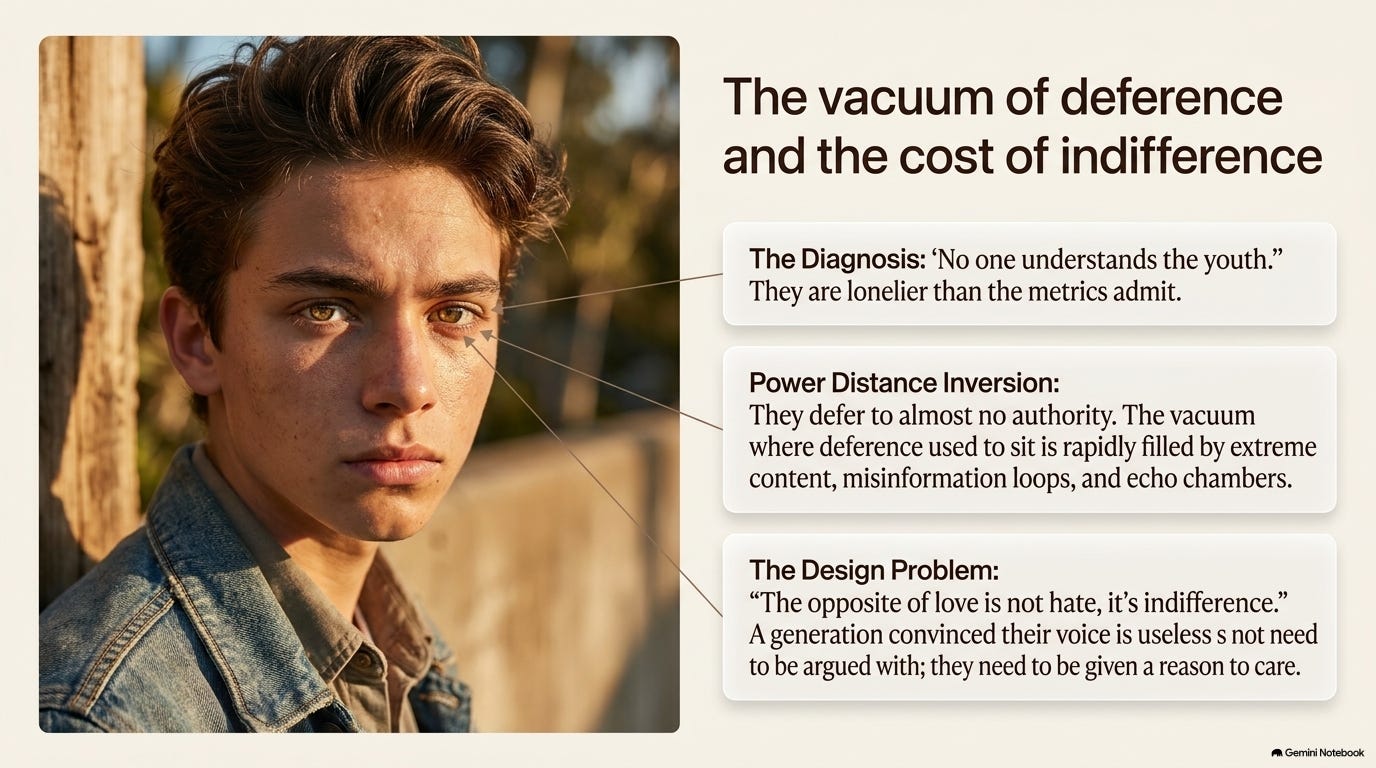
What she understands about the youth is that they are lonelier than the metrics admit, and that the platforms blamed for it are also the only tools large enough to fix it. She got neutral broadcasters, the BBC and ITV and Channel 4, placed at the top of the TikTok algorithm, deliberately seeding diversity of thought into feeds she watched calcify into red-pill and incel and misinformation loops. She champions Snap not out of loyalty but out of design, because it is built around a camera and small circles rather than public performance. “The camera is a vessel of emotions,” she said. “Text is information.” Her read on the whole arc is generational and blunt. The broadcast economy gave way to the attention economy, and the attention economy is over. “Everyone’s done with it.” What comes next she calls the relational economy, and it runs on connection rather than reach. Brands no longer push. Audiences pull.
She reaches for the World Cup to make it concrete, because it is the last time she watched strangers manufacture belonging at scale. It landed in a country that does not love soccer and it bonded people anyway, and now, she said, they miss it. “How do I fill my time?” The behavioral name for what they lost is a bonding tie, the deep kind, as opposed to the bridging tie, the wide shallow kind the internet mints by the billion. The world has too many bridges and not enough bonds. That gap, she believes, is the entire opportunity of the room.
Make humans more human
Ask her where all of this is heading and she frames her own career as a two-part project. Right now, she said, she is trying to make technology more human, dragging behavioral psychology into platforms that had optimized it out. The second act is the larger one. “Eventually, what I want to get to is make humans more human.” She means a behavioral science lab built around health and wellness, a natural turn for a family steeped in it, with a brother doing a master’s in AI and health at Oxford and a sister finishing a neuroscience PhD at the Paris Brain Institute. Performance, wellness, and communication, she argues, have quietly become the same conversation.
The urgency behind that second act is a bet about work itself. As automation hollows out the satisfaction people once drew from their jobs, she expects them to go looking for meaning in what they do off the clock, which is why she tracks the rise of wellness, longevity, and what urbanists call third and fourth spaces, the places that are neither home nor office. She reaches, unexpectedly, for the Lebanese poet Kahlil Gibran, who lived out his years in New York and wrote that work is love made visible. “Society has made work so weak and redundant and negative,” she said, “and that’s not the case.” Strip the purpose out of labor and people do not stop seeking purpose. They seek it somewhere else, and the somewhere else is not always benign. “It could be new vices or new cults or religion,” she said, anything that hands a person a compass. The work, as she sees it, is to build the healthier somewheres before the darker ones fill the vacuum. Gatherings, designed around genuine human need rather than reach, sit near the top of her list.
The power, and the fear of it
The demand unnerves her a little. Karam is always, by her own description, the vessel; every client relationship begins and ends with her personally, a flattering problem and a dangerous one. “I’m scaling so quickly,” she said, “and there’s so much demand for what we do.” The bottleneck is not clients. It is finding people as good as she is to hand the work to.
The deeper unease is about what the work can do in the wrong hands. Push the science of belonging far enough and you arrive at the places the conversation kept circling back to, the cults and the movements and the conferences that become religions. She has a lot to say about it. Belonging, taken to its extreme, stops being a feeling and becomes an operating system. “It becomes so ingrained in your identity that it’s your way to encode information and decode it,” she said. “You only see with those echo chambers and those lenses.” She can run the machine in reverse. After one keynote about surprise and tribes and hooks, a stranger approached her and said she had just explained why Donald Trump was elected. “Yep,” she told him. “I know the thought process behind it. I can re-engineer it.” The style that wins that way, she said, does something worse than persuade. “It gives people permission” to drop the filter, and with young brains it does not merely enable, it conditions.
The mechanism has a name she borrows from cross-cultural psychology. Power distance, the measure of how far below authority people place themselves, used to describe whole countries. Now, she argues, it describes tribes. Inside a political movement the power distance runs enormous, the followers looking up at a single figure for their compass and their coordinates. The young invert it. They defer to almost no one, which sounds like immunity until you notice what rushes into the space where deference used to be. They consume extreme content instead, and it is misinformation, not obedience, that pulls them to the edges. Her line for their political drift is bleak and precise. “The opposite of love is not hate, it’s indifference.” A generation convinced its vote is useless does not need to be argued with. It needs to be given a reason to care, which is a design problem, not a moral failing.
What saves the argument from cynicism is that it clearly costs her something. “Because I know it so well,” she said, of the manipulation she can diagnose in seconds, “I’m like, there’s no reason for you to act this way.” She has made peace with the scale of the problem by refusing to try to solve all of it. “Pick a part of the world,” she said, meaning a domain, not a map, “and try and fix it.” Hers is the youth, and the platforms, and the rooms.
The last honest room
The trust filter is where the whole argument comes to rest. If the room is believable because it is expensive to attend, it is also, for the same reason, quick to convict. “You’re voting with your feet,” she said, and a vote that costs a flight and four days is a vote the voter takes seriously enough to regret. Spend all of that and you are entitled to decide, fast, that the thing was fake. She says the industry “mistook intelligence for efficiency” and optimized itself toward sameness, and the gathering is the correction, the one place a person can still feel something a feed cannot counterfeit.
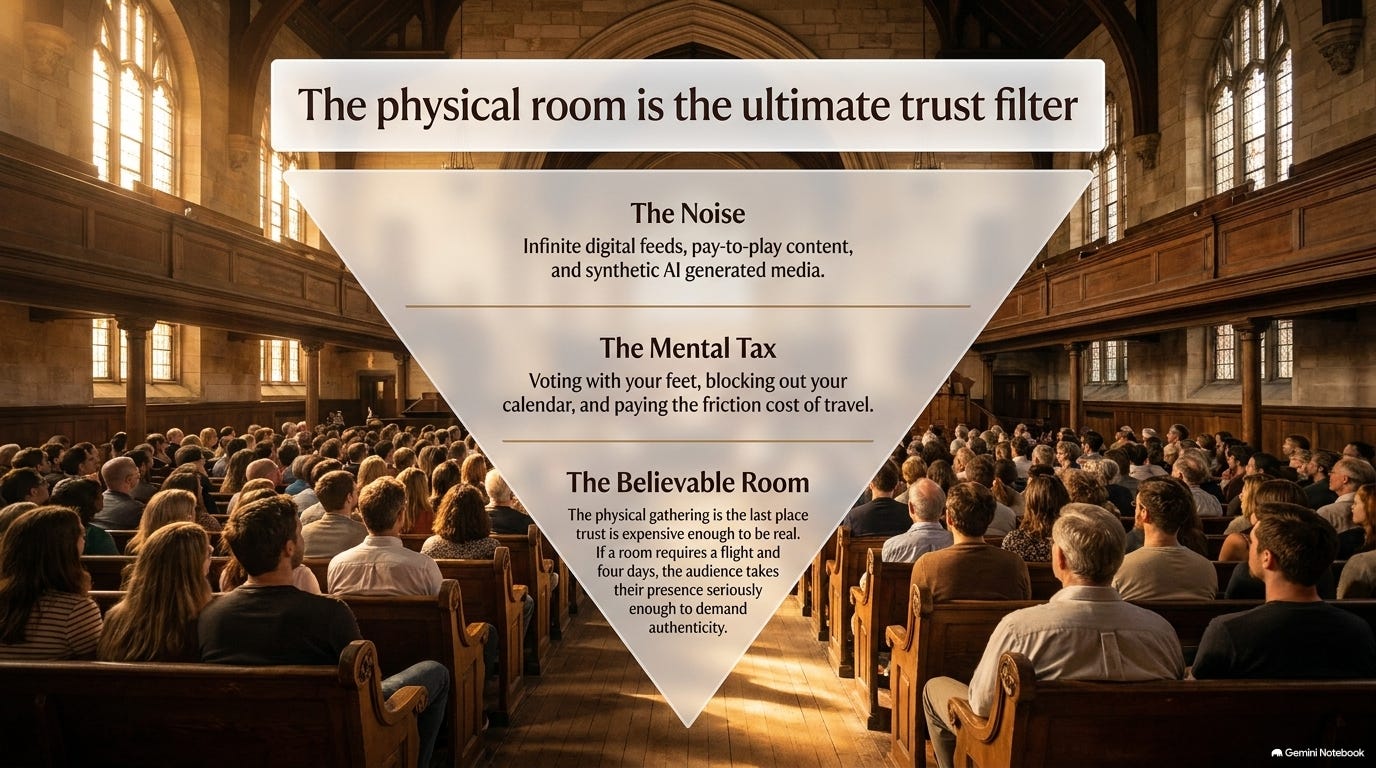
That verdict is the danger she sees coming. Pay-to-play programming, hollow awards, margins thin enough to tempt shortcuts. “The minute the private equity people start looking at the trust factor and seeing the fakeness in the learning,” she said, and let the sentence finish itself. Her antidote is to treat the event less like a product and more like a living thing. When the metaphor of terroir came up in conversation, the wine idea that no vintage repeats and the older years are often the best, she seized it. Counterintuitive and yet obvious, she said; the bespoke thing, the one not built to a fixed purpose, is “even better because it’s more historic.” An event, by that logic, is a lab you get to rerun every season, built around behavioral tribes rather than demographics and fed real connection rather than reach. Do that, and it becomes the one space the relational economy cannot fake and cannot livestream.
Across a long afternoon, Karam kept giving away things she said she had never told anyone in public. The conversation was, in the end, a small proof of her own thesis. Two people who had never met before found the rare thing they had in common, and the reference point was high enough that the connection took. A bonding tie, formed in a room. You could almost feel the goosebumps.
Lea Karam, in her own words — ten ideas to keep
On what the work is for
“We’re in the goosebump business.” If it doesn’t raise the hair on your arms, it didn’t land — the shiver is the proof no metric can fake.
On artificial intelligence
“People are treating AI as a tech challenge. It’s a human challenge.” Study the psychology behind the tool, not the tool.
On the death of the nudge
“It’s invasive, it’s unethical, it’s wrong, and it’s outdated.” Replace small tricks with system thinking and cultural infrastructure.
On data
“The future belongs to the people that find what the data is too coarse to see.”
On desire
“The brain is not a deliberation engine, it’s a prediction engine.” Invest in the anticipation, not only the moment of sale — you want before you like.
On the new consumer
Brands no longer push; audiences pull. Put the human at the centre, because “human impact equals commercial impact.”
On tribes
“I call them behavioral tribes.” Stop targeting individuals and map the group they belong to.
On the room
Events are the ultimate trust filter. “You’re voting with your feet,” and that cost is what makes the room believable.
On the young
“The opposite of love is not hate, it’s indifference.” A generation that thinks its vote is useless needs a reason to care, not a lecture.
On the mission
“Pick a part of the world and try and fix it.” First make technology more human; then make humans more human.
Sources
More on Lea Karam and Mindscope.
Edible Profie of Lea Karam