James Lancaster and the Rules of Engagement
The editor of Association Meetings International, on why conferences still matter in an age of algorithms and AI.

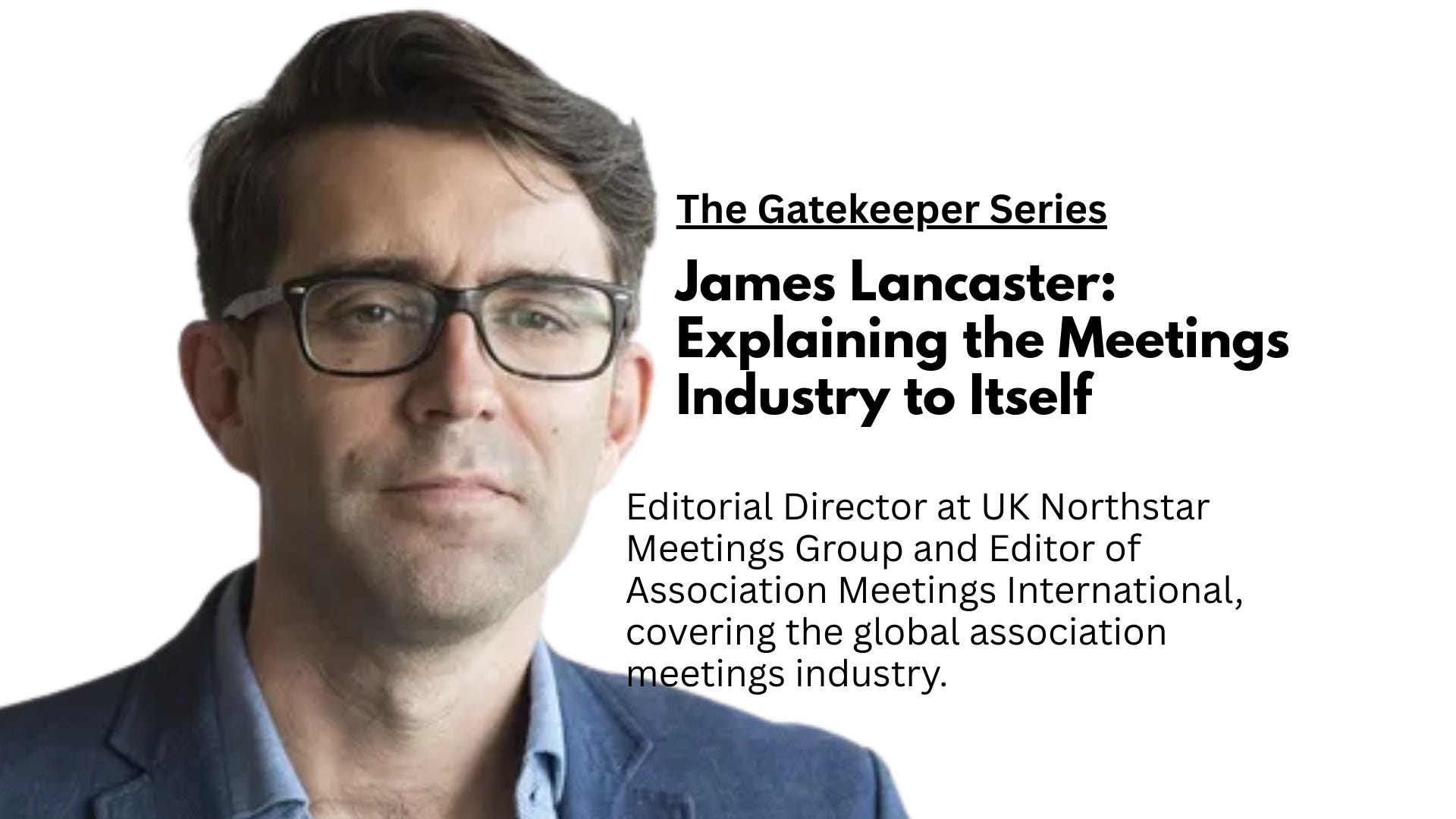
Editor’s Note: Over the past several months I’ve been exploring a simple question: who are the gatekeepers of the gathering economy? Not the people who organize the events themselves, but the observers, editors, analysts, and platform builders who shape how the industry understands what it is doing. Every field develops these figures over time. They sit slightly outside the day-to-day mechanics of the work, watching patterns emerge and occasionally translating those patterns back to the people inside the system. Earlier pieces in this series looked at the editorial influence of platforms such as Skift and the evolving role of Convene in the venue world. Both have become important voices in how the meetings and events ecosystem thinks about itself. James Lancaster occupies a different vantage point. As editorial director for Europe at Northstar Meetings Group and editor of Association Meetings International, he has spent years sitting in the back rows of international congresses and conferences watching how knowledge moves through the rooms where experts gather. His job is not to organize those meetings but to observe them closely enough to understand how they work—and sometimes to question whether they are working well. When we spoke recently, our conversation moved quickly from journalism and storytelling to conference formats, sponsorship pressures, artificial intelligence, and the changing rules of engagement shaping how people gather and pay attention. What emerged was less an interview about events than a reflection on how ideas travel through rooms, institutions, and cultures. — David Adler
James Lancaster has a habit that surprises people at conferences. When a speaker takes the stage, he often stops writing.
Around him, journalists and delegates are scribbling furiously in notebooks or typing into laptops, trying to capture every quote before it disappears. Lancaster, who has spent much of his career covering the international meetings industry, sometimes does the opposite. He puts the notebook down and simply listens.
The reason, he explains, is that writing too much can interfere with understanding what is happening in the room. When people are busy transcribing every sentence, they are no longer absorbing the conversation itself. The brain becomes occupied with recording rather than interpreting. In a conference hall, where tone, reaction, and subtle disagreement often reveal more than prepared remarks, that distinction matters.
It is a small observation, but it reveals something about the way Lancaster thinks about gatherings. Conferences are not simply places where information is transmitted. They are moments where ideas collide in real time, where people respond to one another’s arguments, and where the dynamic of a discussion can matter as much as the words being spoken. To understand that dynamic, sometimes the most useful thing a reporter can do is stop writing and pay attention.
Lancaster has spent more than a decade doing exactly that.
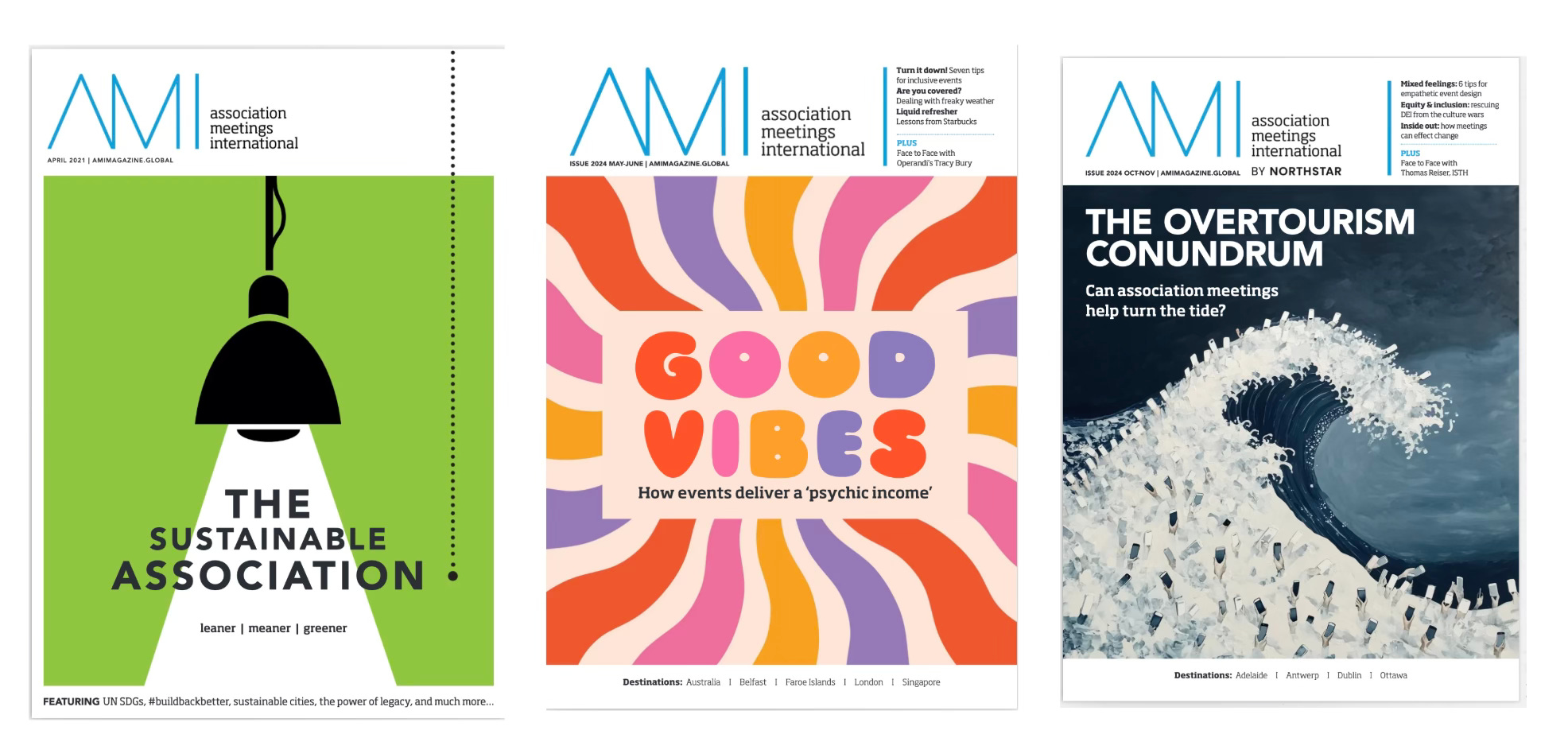
As editorial director for Europe at Northstar Meetings Group and editor of Association Meetings International, he sits in the back rows of congress halls and conference centers around the world watching how experts gather to debate the issues shaping their professions. His beat is not product launches or experiential marketing activations but the quieter, more consequential meetings where surgeons debate procedures, scientists present research, and professional associations shape the standards of entire industries.
When Lancaster first took the job covering the meetings industry in 2010, the entire concept struck him as faintly absurd. The phrase “meetings industry,” he recalls, sounded almost like something from a Monty Python sketch. How, he wondered, could there be an entire industry built around people sitting in rooms together?
Over time, however, the scale of the ecosystem became impossible to ignore. Behind every international congress sits a network of associations, host cities, professional organizers, sponsors, and suppliers. What appears to be a few thousand people sitting in a ballroom often represents years of planning and a global infrastructure designed to bring experts together at exactly the right moment.
Lancaster’s role is not to organize these meetings but to observe them closely enough to understand how they work and, occasionally, to question whether they are working well at all.
His perspective is shaped by the way he learned journalism. Before he began covering conferences, he worked for a small local newspaper outside London, the kind of newsroom where young reporters learned the craft through experience rather than theory. Some of the first assignments involved what journalists in Britain call “death knocks”—visiting families after tragedies and asking if they were willing to speak about what had happened.
It was not glamorous work, but it taught Lancaster something fundamental about storytelling. Every article had to be structured in a way that made readers want to keep going. The opening paragraph set the scene. The second paragraph deepened the story. Somewhere early in the narrative there had to be a detail that created curiosity.
Intrigue, he learned, keeps people engaged.
That same instinct now shapes how he watches conferences. When a session unfolds on stage, Lancaster is listening not only for what is said but for how the conversation develops. A good discussion has tension, curiosity, and movement. A dull one feels predictable before the first question has been asked.
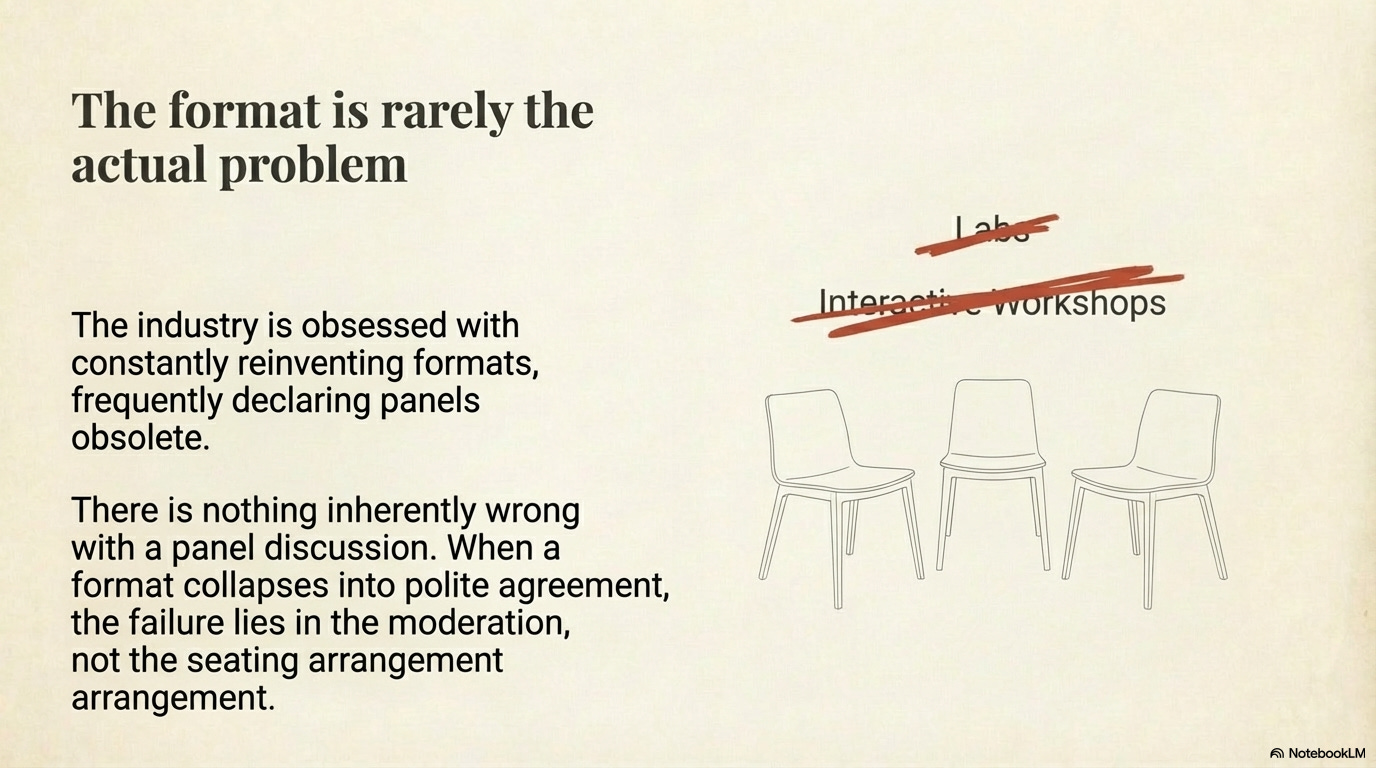
This is one reason he is skeptical of the conference industry’s obsession with constantly reinventing formats. Panels are frequently declared obsolete, replaced by workshops, labs, or interactive formats that promise to energize audiences. Lancaster believes that debate sometimes misses the point.
There is nothing inherently wrong with a panel discussion. What matters is how it is moderated. When the moderator understands how to guide a conversation and ask difficult questions, a panel can be compelling. When the moderator simply allows speakers to deliver prepared remarks, the format quickly collapses into polite agreement.
One solution, Lancaster suggests, is surprisingly obvious: conferences should use more journalists as moderators. Reporters spend their careers learning how to ask the questions that audiences are already thinking but have not yet heard voiced. They know how to build tension in a conversation and move it toward the issues that matter.
At one point during our conversation I asked Lancaster a question that often reveals how someone really sees an industry. If he suddenly had $100 million to invest in the events business, where would he put it?
His answer was immediate.
Event marketing.
For many organizations, conferences already function as marketing engines. They create communities, strengthen relationships, and shape how industries see themselves. Yet the professional infrastructure connecting marketing intelligence with the events ecosystem remains surprisingly underdeveloped.
Inside many companies, large marketing teams spend enormous amounts of time promoting conferences and shaping messaging around them. Yet those teams do not necessarily have dedicated media or analytical platforms focused on how gatherings function as marketing tools. If Lancaster were placing a bet on the future of the industry, he would look at that intersection.
As the conversation continued, Lancaster kept returning to a phrase that captures the broader shift he sees taking place: the rules of engagement are changing.
For decades the mechanisms through which people discovered information were relatively stable. Trade publications reached readers through subscriptions and mailing lists. Conferences attracted audiences through reputation and professional networks. Digital platforms have disrupted that equilibrium.
Today journalists, marketers, and conference organizers find themselves negotiating with algorithms they do not control. Content creators try to anticipate what social feeds will reward, adjusting headlines, formats, and timing in the hope of gaining visibility. Yet even those producing the content cannot always explain why one story spreads widely while another disappears almost instantly.
The same dynamic appears in conferences. Organizers talk endlessly about hooks—the first few seconds of a presentation designed to capture attention. Lancaster understands the importance of intrigue, but he believes the industry has begun confusing attention with engagement.
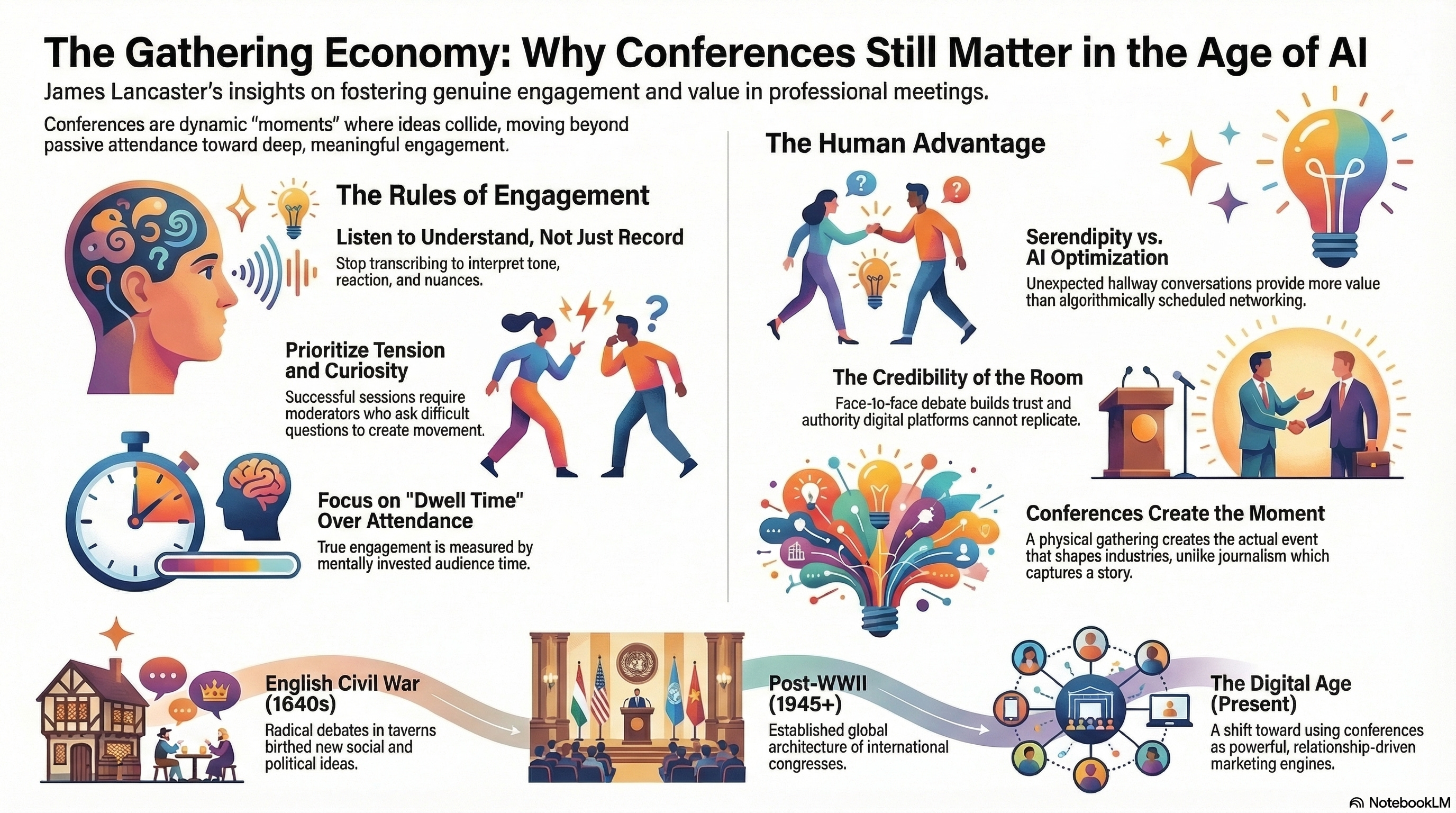
In journalism, he explains, the real measure of engagement is dwell time: how long someone stays with a story before moving on. The same principle applies to conferences. A packed room means little if the audience mentally checks out five minutes into a session. People will stay engaged with complex material when the substance rewards their attention.
This insight also explains Lancaster’s skepticism about turning conferences into year-round digital experiences. The value of a gathering lies in the fact that it happens at a specific moment in time. Participants show up because the conversation happening in that room matters now.
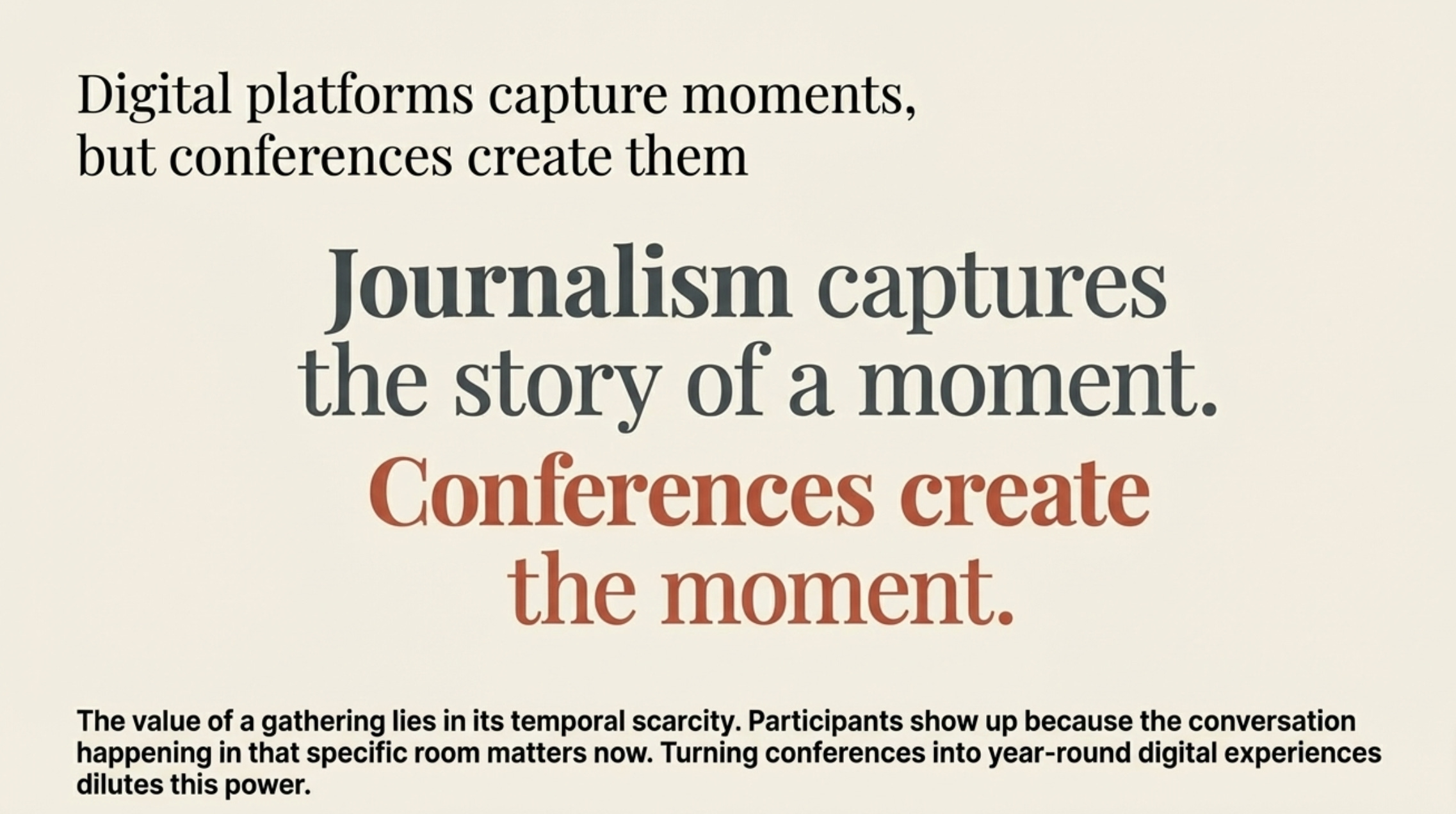
Journalism captures the story of a moment. Conferences create the moment.
That distinction becomes even more important as technology reshapes the way events operate. Artificial intelligence tools are already being introduced to schedule meetings, recommend sessions, and map out networking opportunities before attendees arrive. Lancaster worries that too much optimization could erase something essential.
Many of the most valuable moments at conferences occur unexpectedly: a conversation in a hallway, a session someone attends on impulse, a debate that develops spontaneously on stage. Those moments of serendipity are difficult to design in advance, and they are part of what distinguishes a gathering from a digital platform.
Trust is another fragile element. Conferences rely heavily on sponsorship, and sponsors understandably want visibility. Yet integrating marketing messages into conference programming creates a delicate balance between commerce and credibility. Delegates are often more perceptive than organizers assume. They can recognize when a presentation functions more as an advertisement than as a genuine contribution to the conversation.
In a digital environment saturated with misinformation and algorithmically amplified noise, conferences may possess an advantage that online platforms struggle to replicate: the credibility that comes from people debating ideas face to face.
Toward the end of our conversation I asked Lancaster a question that felt both playful and revealing. If he could travel back in time as a journalist covering gatherings, which moment in history would he choose?
His first answer took us to the English Civil War.
Between 1642 and 1651 England experienced one of the most turbulent periods in its political history, culminating in the execution of King Charles I. Beyond the battlefield, however, the era witnessed an explosion of political debate. Religious sects, radical movements, and intellectual factions gathered in taverns and meeting rooms across the country arguing about the future of society.
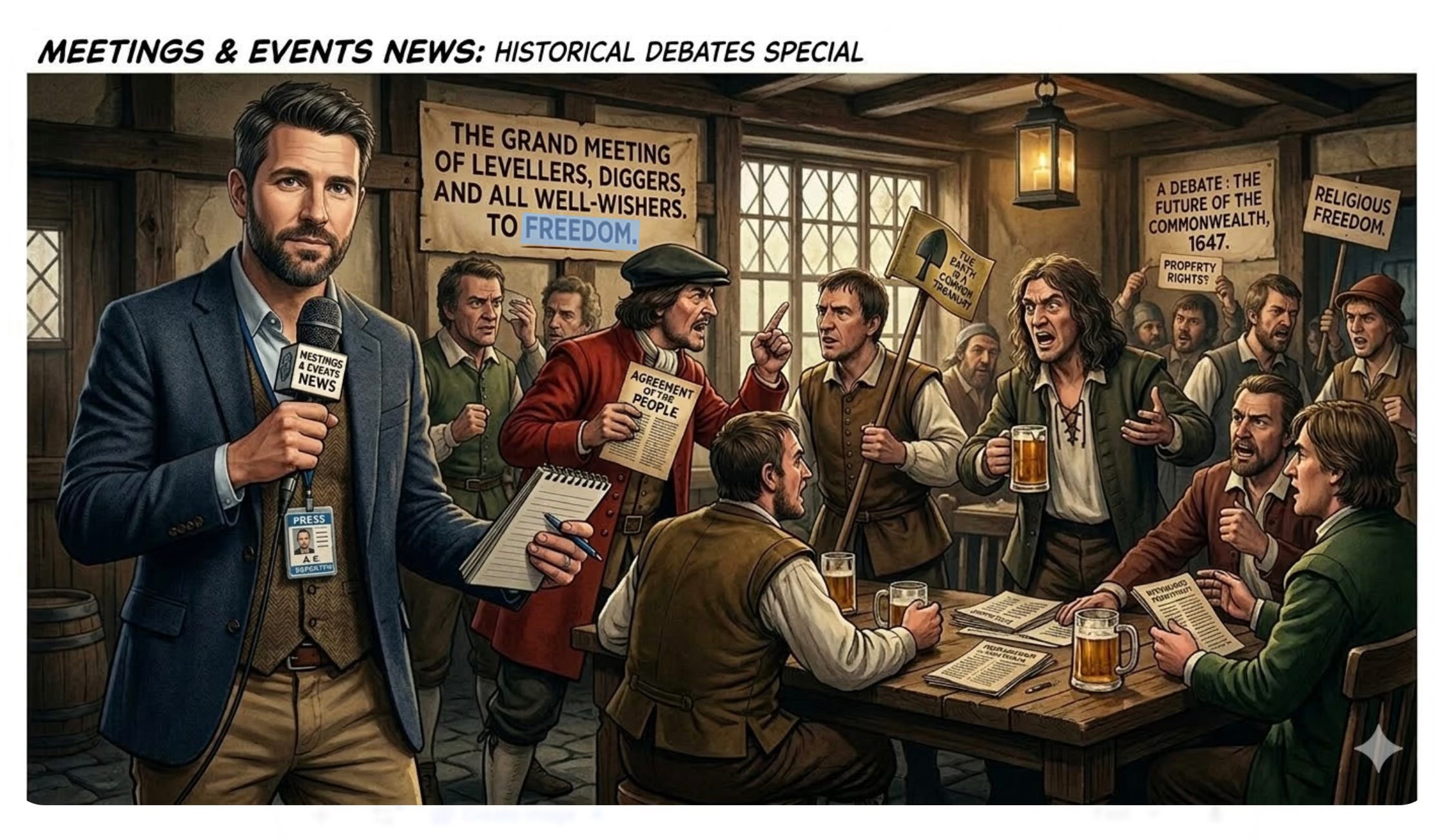
Groups such as the Levellers, the Diggers, and the Ranters debated everything from property rights to religious freedom to the authority of the monarchy. These gatherings were not conferences in the modern sense, but they represented an early form of the phenomenon Lancaster spends his career observing: people assembling in rooms to debate ideas that might reshape the world.
Another period he would have loved to cover came three centuries later.
The decades following the Second World War produced the architecture of international conferences that still shapes global cooperation today. Institutions such as the United Nations, founded in 1945, began convening assemblies where diplomats from dozens of countries debated the political structure of the postwar world. At the same time the Bretton Woods institutions—the International Monetary Fund and the World Bank—hosted meetings that helped establish the financial framework governing international development.
Scientific and cultural collaboration accelerated through organizations such as UNESCO, which brought researchers and educators together across national boundaries.
Many of the association congresses Lancaster covers today exist because that postwar period established the expectation that experts from around the world should gather regularly to exchange knowledge and debate policy.
Seen from that perspective, the modern conference hall sits within a much longer continuum. The rooms may look different, but the impulse is familiar. People gather because they believe that bringing minds together in the same place can shape what happens next.
Lancaster spends his professional life watching those rooms.
Although he still spends much of his time watching conferences from the back of the room, but that vantage point has begun to change. In recent years he has found himself increasingly invited onto the stage to moderate discussions, particularly panels where organizers want someone capable of asking sharper questions than a sympathetic colleague might. It is a role that fits naturally with the instincts he developed as a reporter. A journalist’s job, after all, is to guide a conversation toward the questions the audience actually wants answered. In that sense Lancaster is now doing in real time what he has long argued conferences should do more often: bring a journalistic eye to the stage. He does not see himself as running the room so much as helping it think more clearly. After years of observing how ideas move through the meeting halls of the association world, he has discovered that the same skills that shape a good story—curiosity, structure, and a willingness to challenge assumptions—can also shape a better conversation.
For someone who once wondered how an entire industry could exist around meetings, he has come to appreciate how consequential those rooms can be.
Watching them closely is the work he has chosen to do.

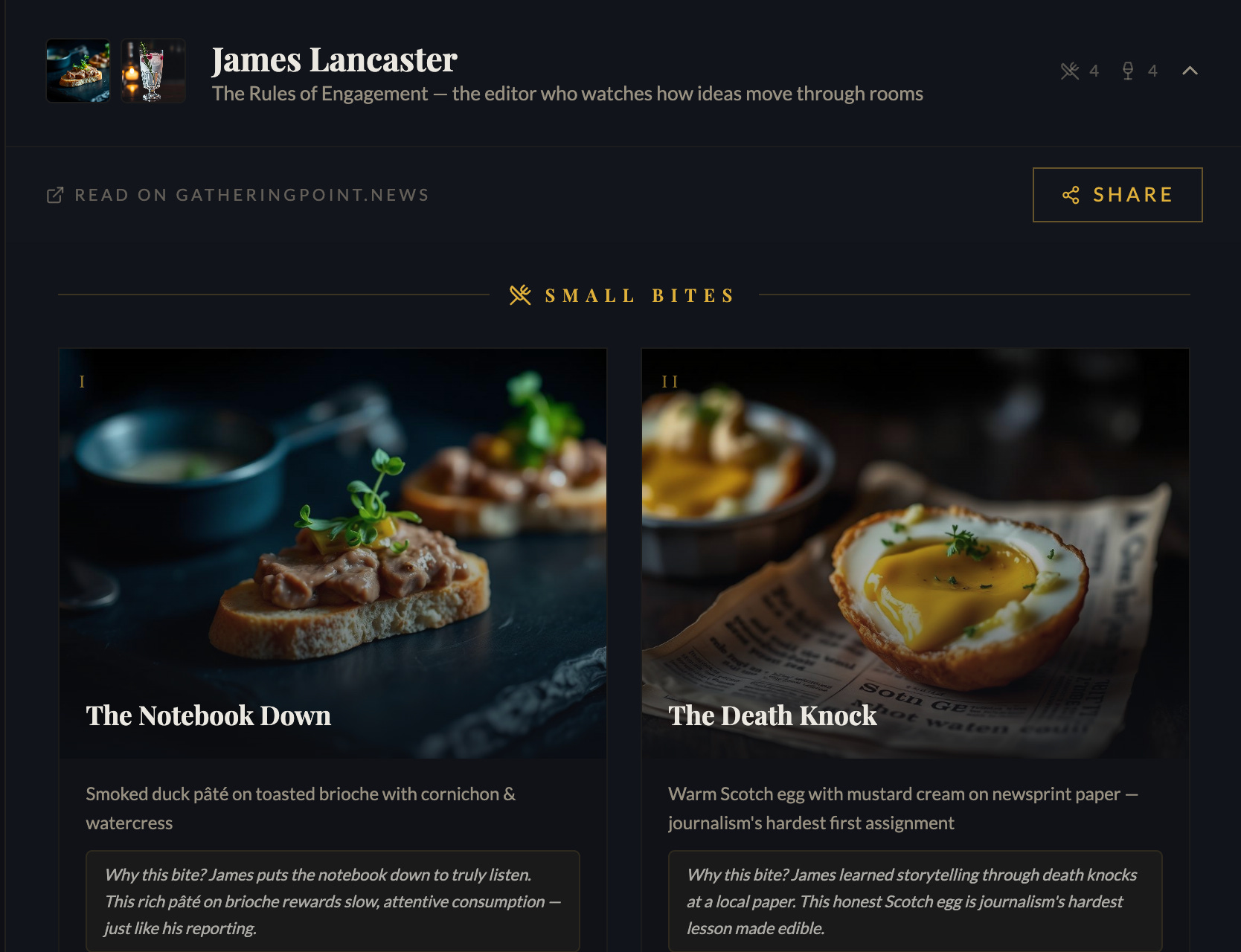
James Lancaster: The Rules of Engagement — the editor who watches how ideas move through rooms. Edible portraits designed to capture who they are in a single taste.
Small Bite Architecture is the idea of transforming the hors d’oeuvre from a simple food-and-beverage offering into a moment of personalization, storytelling, and memory.
For decades, passed bites at receptions have mostly been about logistics—feeding guests quickly while people circulate. Small Bite Architecture suggests something different: each sip or bite can carry a small story. It can represent a brand, a culture, a place, a person, or an idea.
Instead of anonymous trays moving through a crowd, the bite becomes a micro-experience—a tiny moment that invites conversation and leaves a trace of meaning. A flavor tied to a destination, a recipe connected to a founder, a sip that signals a partnership, a bite that reflects the theme or purpose of the gathering.
The shift is subtle but powerful. What was once just catering becomes part of the narrative of the event.
In this way, the smallest element of hospitality—the hors d’oeuvre—becomes one of the most personal tools for creating memory and connection. Her is the ultimate in personalization with Liz’s edible profile of small bites and sips.