
Inside the Hiring Room of the Gathering Economy
What a recruiter sees, what candidates never realize, and the stories that never make it to LinkedIn
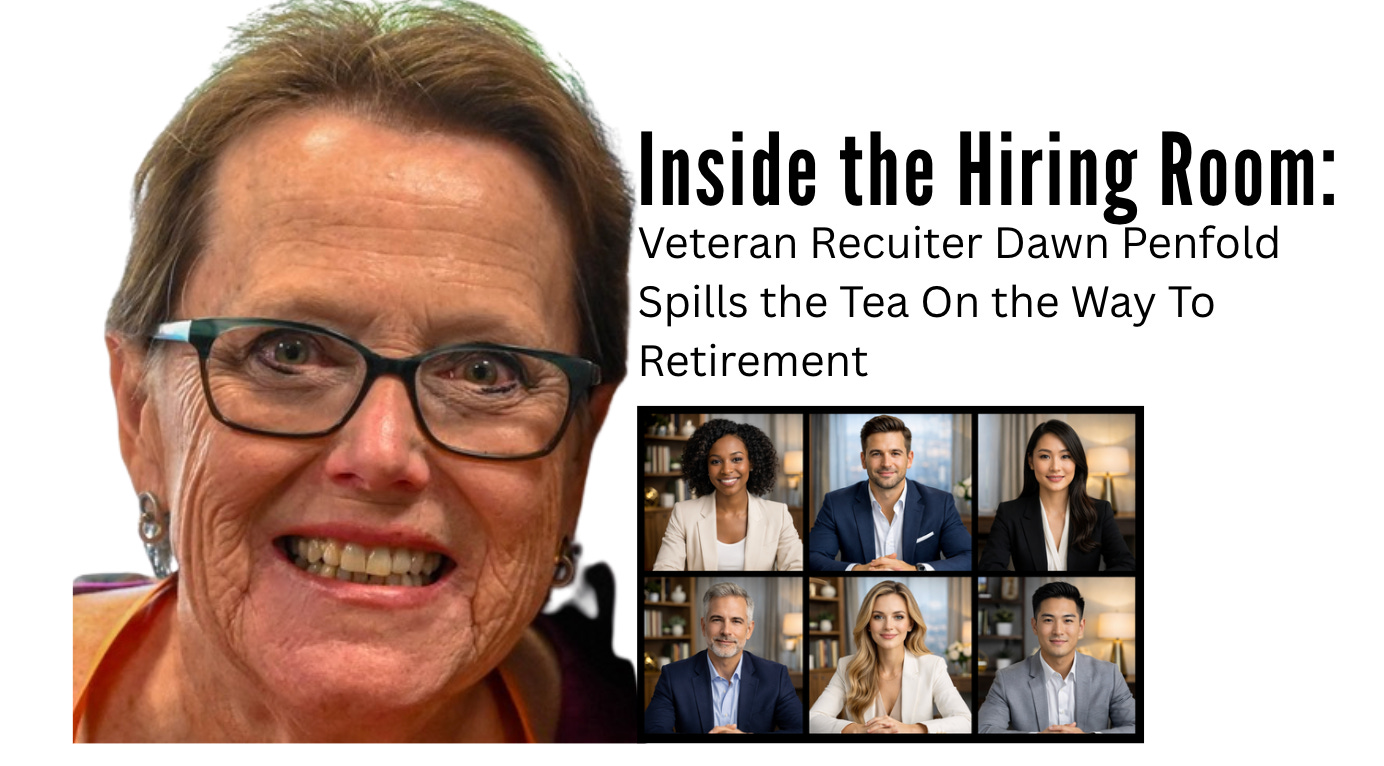
There is a point in the conversation with Dawn Penfold when the tone shifts, subtly but unmistakably, from analysis to memory. This is where the theory gives way to lived experience, where the abstractions of hiring collapse into moments so specific they still make her wince. These are the stories that recruiters trade quietly with one another, never on panels, never in public forums, because they are too revealing, too human, and too close to the fault lines everyone pretends are not there.
She has learned, over time, that every “great candidate” exists in parallel with a horror story waiting just offstage.
There was the planner who insisted she had run multiple large-scale meetings in Orlando, spoke confidently about attendance numbers and budgets, and then, when asked the simplest anchoring question — where did the meeting take place — froze. Not because she was nervous, but because there was nothing underneath the claim. Dawn asked about the hotel, the room flow, the dinner, the thing that went wrong, the moment where the plan cracked. Silence. The résumé looked immaculate. The memory did not exist. Dawn remembers thinking, not angrily but sadly, that this person could say anything and there was no way to prove otherwise unless you knew where to press.
Another candidate spoke proudly about international experience, describing the logistical nightmare of securing translators for a meeting in Ireland. Dawn paused, gently, because Ireland, of course, speaks English. The candidate doubled down. At that moment, the interview was no longer about experience but about judgment, and judgment, once exposed, is almost impossible to rehabilitate.
Then there were the lies that surfaced later, after everyone thought the hard part was over. A candidate sailed through interviews, references glowing, hiring manager enthusiastic. Dawn warned her, as she always does, that a background check was coming and asked if there was anything — anything at all — that should be disclosed now rather than discovered later. The candidate assured her there was nothing. When the background check revealed two DWIs, the explanation was offered without irony: she had forgotten. Dawn still marvels at that sentence. Forgetting a typo is understandable. Forgetting an arrest is not.
Some stories end without explanation at all. One candidate, when asked to verify education credentials, claimed she was part of a witness protection program and therefore unable to provide documentation. Two days later, her phone was disconnected. Her email bounced. She vanished entirely, leaving behind only the uncomfortable realization that in recruitment, reality sometimes disappears faster than fiction.
And then there are the stories that test empathy as much as professionalism.
Dawn remembers a candidate interviewing during the depths of the 2008 recession, a time when desperation was not an emotion but a condition. The hiring manager called afterward to say the interview had gone poorly — the candidate was sweating excessively, visibly uncomfortable, distracted. Dawn called the candidate the next day and learned that he had gone straight from the interview to the hospital with appendicitis, determined to finish the interview because he could not afford to miss the opportunity. He was hired. He stayed for years. Dawn still thinks about how close that moment came to becoming a different kind of horror story.
The Zoom era, she says, has generated an entirely new category of quiet disasters. Candidates interview from moving cars, from bedrooms with unmade beds and laundry piled behind them, from kitchens where children wander in and out of frame, all while insisting they are serious about the role. Dawn watches hiring managers absorb these moments silently, forming judgments they will never articulate. The tragedy, she notes, is that event professionals of all people should understand staging, should understand that environment communicates before language ever does, and yet somehow forget that the camera is a room they are responsible for.
Resumes, too, have their own small catastrophes. Degrees that never existed. Titles inflated beyond recognition. Experience described in language so vague it could belong to anyone. Dawn has learned that the most dangerous resumes are not the sloppy ones but the polished ones that cannot withstand follow-up. The moment she asks a candidate to walk her through a day, a decision, a crisis, the façade either holds or collapses.
Bias, of course, produces its own horrors, though these tend to linger rather than explode. Dawn has had hiring managers tell her explicitly not to send candidates who are heavy, gay, tattooed, Jewish, too religious, or too old, statements delivered casually, as though discussing menu preferences. She learned early where the legal boundaries were, and how to push back just enough without detonating the relationship, but she also learned something more corrosive: that even when you shut down the language, the bias often survives intact beneath it. Recruiters, she says quietly, do not change people. They manage damage.
She has also watched candidates sabotage themselves in subtler ways, insisting on absolute flexibility from employers who have not promised it, framing every answer around what the job will do for them rather than what they will do for the job, misunderstanding that while values have shifted, expectations have not vanished. These interviews do not end in explosions. They end in polite emails and quiet rejection, the kind that leaves candidates baffled and employers convinced they are living on different planets.
You add your own horror stories to the mix, the moments when someone looks perfect on paper and collapses in person, the times when first responders outperform MBAs because they understand pressure rather than theory, the interviews where you know within minutes that no amount of coaching will close the gap. Dawn nods. These stories, she says, are not exceptions. They are the curriculum.
This is why she bristles when hiring is reduced to platforms, hacks, or shortcuts. Behind every posting is a human being trying to make a decision that will cost them months, money, reputation, and sleep. Behind every application is someone projecting a version of themselves they hope will be believed. And in between sits the recruiter, absorbing the friction, translating disappointment, carrying stories they rarely get to tell.
By the time Dawn talks about retirement again, it feels less like an ending and more like an exhale. She is not stepping away because she has lost respect for the industry, but because she has seen it too clearly to pretend that there are easy fixes. Hiring, she knows, will always be messy, personal, biased, hopeful, heartbreaking, and occasionally miraculous.
The horror stories are not proof of failure. They are proof that the work is human, that judgment still matters, and that no system yet invented has replaced the need for someone who knows which questions to ask — and how to listen when the answers begin to unravel.
Hiring in the Gathering Economy: What’s Changed — and What Hasn’t
Dawn’s stories aren’t just recruiter folklore. They are signals about the Gathering Economy itself. What has changed is the visibility of failure. Events today are brand-defining, revenue-critical, and instantly public. A weak hire doesn’t quietly underperform — they can destabilize a moment that thousands of people are experiencing in real time. The cost of misjudgment is reputational, not just operational.
What has also changed is projection. Digital profiles are polished. Titles inflate. Language is confident. It has never been easier to look experienced. That is why Dawn presses for lived detail. In a business built on staging, hiring now requires piercing the stagecraft.
But what hasn’t changed is more important.
Judgment still outranks credentials. Composure still beats theory. Integrity still reveals itself under pressure. And no platform — however sophisticated — replaces the human ability to ask the one question that causes a façade to crack.
Hiring in the Gathering Economy is not harder because it is digital. It is harder because the consequences are public.


