



Go Directly to the White Paper
Editor’s note: this story is the short version of a longer piece of work. GatheringArchitecture.com is where I publish the Gathering Architecture Papers, research papers on the gathering industry that carry their sources and data, and each paper goes up there first and is taken up here afterward. The papers look at the structure underneath the gathering economy, meaning who organizes the gatherings, who hosts them, who supplies them and how buyers find them, and this one asks who owns the rooms. Throughout, every figure is tied to a source or labeled as my inference, and anything that depends on Informa, which had not commented when this was published, is marked as unconfirmed.
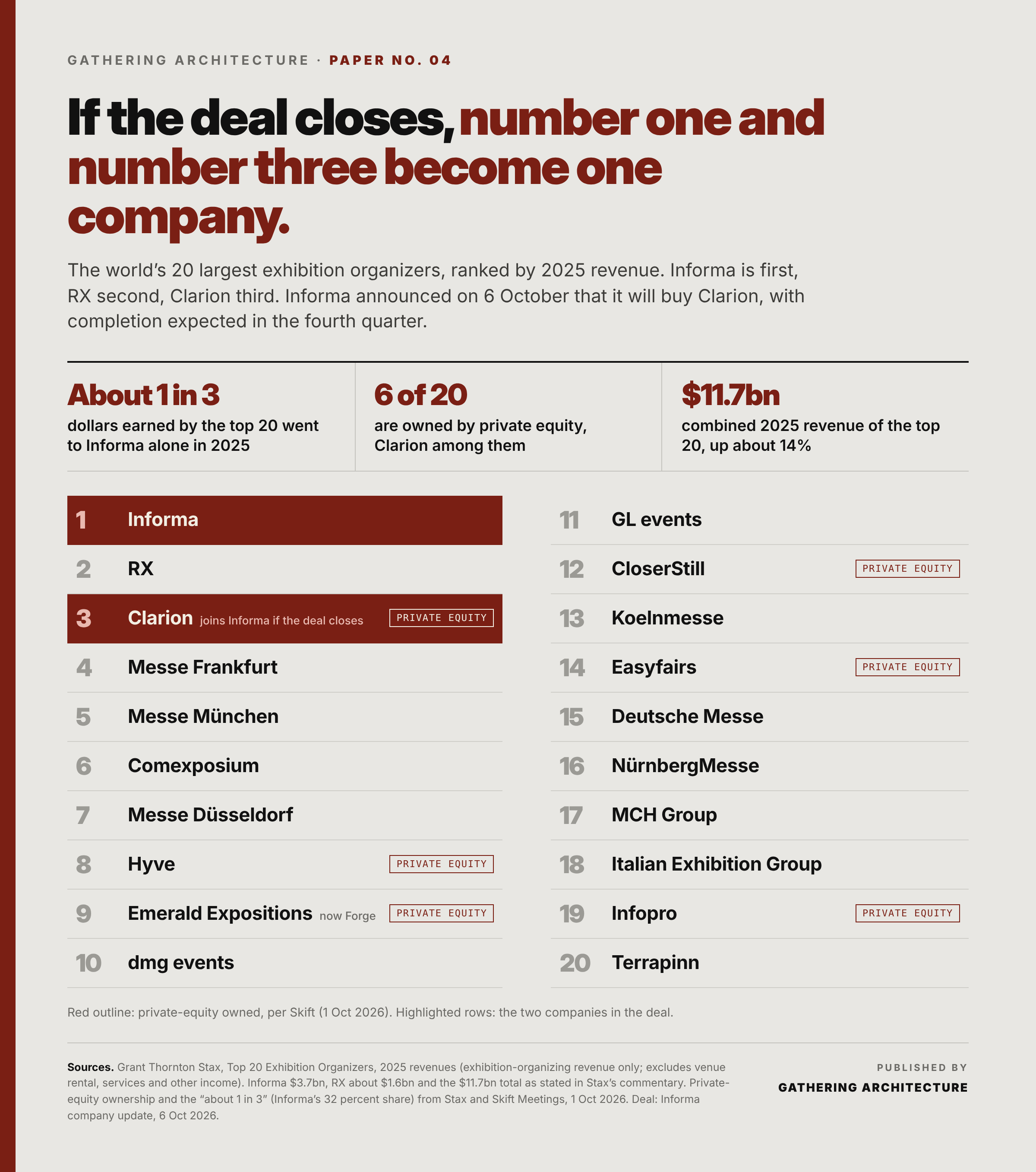
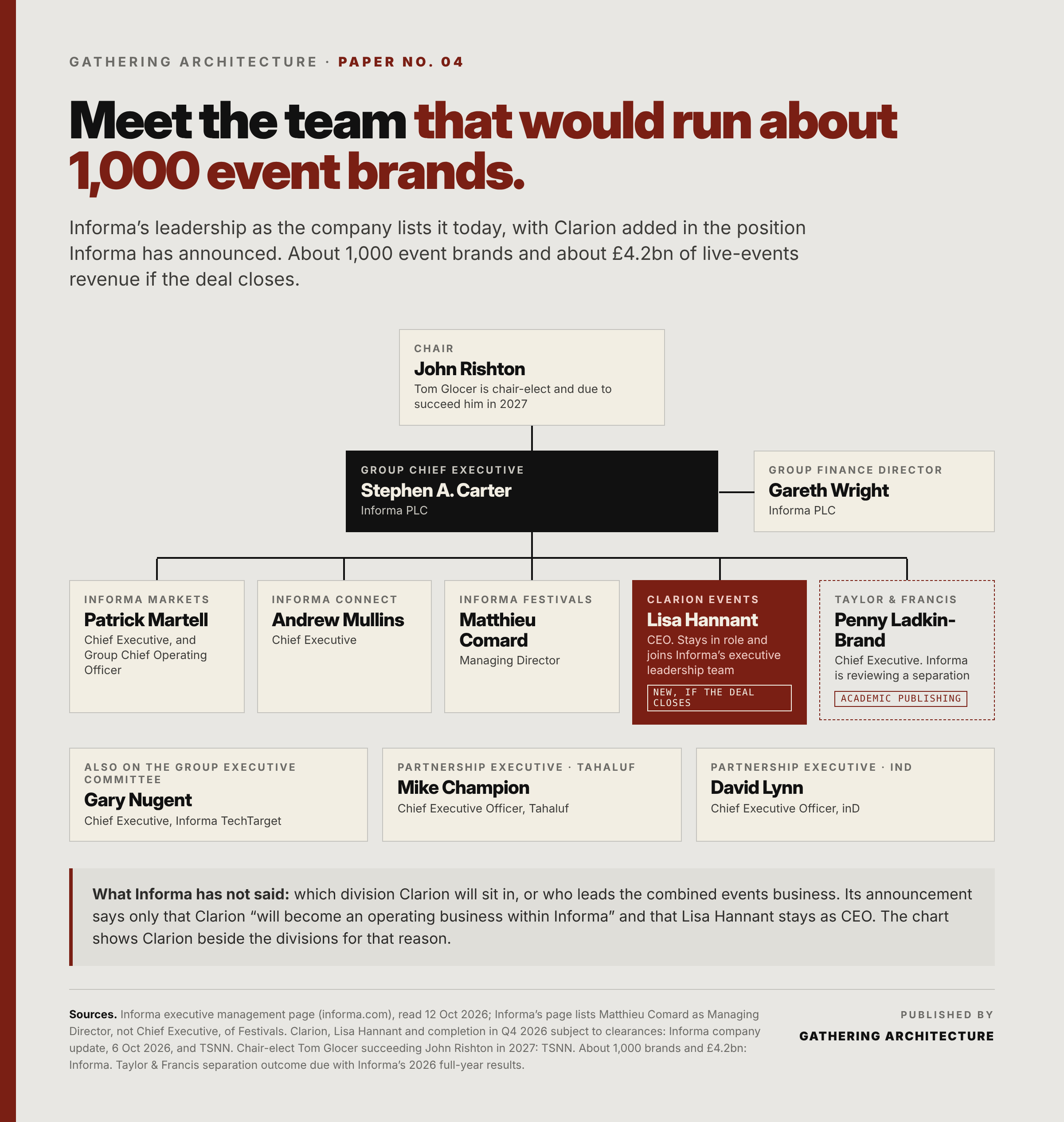
Informa, the biggest trade-show organizer in the business and a publicly listed company, agreed last Tuesday to pay £2.24bn for Clarion Events, which runs more than 100 brands from defense and gaming to energy transition. The enlarged group will have B2B live events revenue above £4.2bn across about 1,000 brands, and Informa already held more than twice the exhibition revenue of its nearest rival before the deal, according to Skift’s report on Grant Thornton Stax data. This piece asks what that means for the people who pay for the rooms (exhibitors), the people who host them (venues) and the people who run the shows, and it sends you to a white paper with the full sourcing.
The price has a history. Clarion began inside the Earls Court & Olympia group, which ran two London exhibition halls and the shows held in them, and in October 2004 a team led by Simon Kimble bought it out for £45m. Earls Court closed in December 2014 and was demolished, while Clarion changed hands four times in 18 years and rose in price at every stop: £120.5m to Veronis Suhler Stevenson in 2008, £200m to Providence Equity in 2015, and a reported £600m to Blackstone in 2017. Informa puts the enterprise value at 11.1 times Clarion’s expected 2027 EBITDA, roughly 3.7 times the 2017 price, though the comparison is loose because Clarion bought other businesses along the way. The early prices come from Buyouts Insider and SBC News, and the 2017 figure is a trade-press report, since Blackstone’s own release named no price.
The power moved from the hall to the show
That chain of prices is the argument. The old model kept the hall and the show under one roof, and Messe Frankfurt still does, owned by the city of Frankfurt and the state of Hesse. The 2004 sale separated them, and the four sales since have moved the value toward whoever owns the shows. Informa now wants the hall’s advantage back by contract: its own list includes a Saudi joint venture with venue exclusivity, preferential rates in Frankfurt, a memorandum with the Hong Kong Tourism Board and a joint company with Dubai World Trade Centre, and it says it wants hotels and cities to “participate more directly in the value we create.” My reading, which is inference, is that this is the venue owner’s old bargain without the building. The question that follows is whether a hall that has pledged its dates to one organizer can still be neutral ground for everyone else.
The biggest owner is still a small slice
Informa’s October investor deck describes the group in 2028 as hosting over 9 million attendees a year. As I read it the figure includes Clarion, because Informa’s own 8 million-plus added to the 1.2 million on Clarion’s website comes to about 9.2 million, but that arithmetic is mine, the deck’s number is a forecast and not a count, and Informa had not commented when this was published. Nobody defines “attendee,” so read it as visits and not people, and none of it is audited.
The Events Industry Council and Oxford Economics count about 318 million trade-show participants worldwide in 2025 and $179bn of direct spending. Nine million is roughly 3 in 100 of those participants, and Informa’s £4.2bn of projected live-events revenue is about the same share of the spending. Both comparisons are loose, since one is organizer revenue and the other is everything participants spend, hotels and flights included, but they point the same way. It is also why “too big” cannot rest on market share: UFI commentary in 2018 put Informa and UBM together at around 6 percent of the global exhibition market, and the UK’s competition authority decided not to refer that deal for review. I found no regulator review of Informa and Clarion, only the phrase “customary regulatory clearances” in the announcement.
Where the concern lives
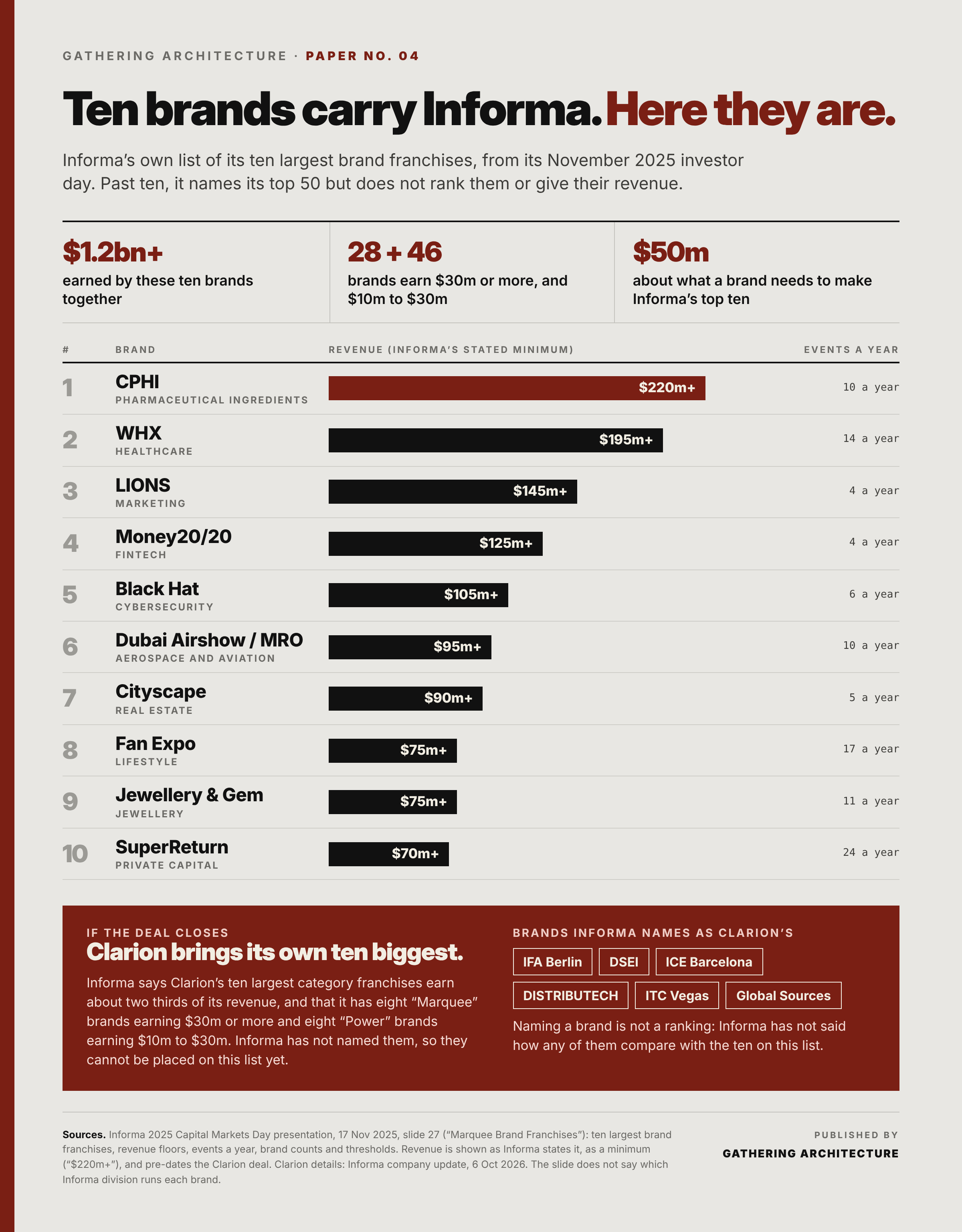
The honest case for concern is narrower and sits in the niches, where a single show can be the place an industry meets. On organizer figures, Informa’s Game Developers Conference outdraws its nearest rival 20,000 to 5,804, CPHI draws 59,000 against BIO’s 21,600, and ICE Barcelona, which Informa’s deck lists among Clarion’s brands, draws 65,000 against 30,000 for SiGMA Central Europe. The map is not uniformly kind to Informa, though, because RSAC reports nearly twice the attendance of Black Hat and DSEI trails Eurosatory. Every one of those numbers is an organizer’s own and unaudited.
GDC is the case people will cite. After Informa redesigned it as a “Festival of Gaming,” the cheapest pass rose to $649, the $200 to $399 expo-floor pass was dropped, and attendance fell from about 30,000 in 2025 to about 20,000 in 2026, according to Skift. The name, the format and the prices all changed at once, so no one can say the pricing caused the drop, and Informa has not said what did. My inference is that a community event is where a bigger owner’s pricing shows first, which makes GDC’s 2027 pass prices and attendance the first numbers to watch.
What the exhibitor, the venue and the boss should do
For an exhibitor the first test is the 2027 price notice. CEIR’s survey of exhibitors, as reported by PCMA, puts about 4 in 10 marketing dollars into trade shows, though benchmarks of all B2B marketers put events at roughly 5 to 14 percent, so the figure belongs to exhibitors and not to marketing in general. Informa says a pricing calculator covers about 85 percent of its B2B revenue and that prices for its Top 50 brands are signed off centrally, and eight Clarion brands are due to join that group. It also says its roughly £50m of annual cost savings takes the price to about 9 times earnings; my inference is that savings come from purchasing, duplicated back offices and venue terms, and that the revenue synergies it counts on come from exhibitors and sponsors, through price and add-on services. Phil Soar, chairman of CloserStill, told Exhibition News in 2025 that organizers price at roughly inflation plus two to three points and that shows rarely face a direct rival. I found no study of exhibitor prices after a trade-show merger, so that is a description of the mechanism an acquirer buys and not proof that mergers raise prices.
For a convention-center or tourism-bureau executive the thing to watch is dates: whether a company with preferential arrangements in four cities asks for first call on the calendar where Clarion is strong. That is inference, and it is the first question I would put to a venue sales director. For the organizer’s boss, or anyone who has to convince one, the case is not that the show will get worse. The research supports one core idea, that meeting in person forms ties that would not otherwise form (about 16 percent fewer co-authorships followed the cancellation of a conference by Hurricane Isaac), but I found no independent study that ties deal counts to a particular trade show, and the figures organizers publish, such as Dubai Airshow’s $202bn in announced deals, are list prices and memoranda, not closed sales.
The conundrum. A show is worth the most to an exhibitor when it has no rival, and that is the moment the exhibitor has the least power to refuse the price. The owner who raises it is behaving rationally, and so is the exhibitor who pays. Nothing in the deal documents resolves that, and no study I could find measures it (inference).
New on the shelf: Gathering Architecture Papers
Two to start with. No. 01, The Disclosure Economy, is about agents deciding which events get attended. No. 04, Who Owns the Meeting Rooms, is the full version of the story above: the Informa and Clarion price chain, the 2022 to 2026 roll-ups, the industries these rooms serve, the niche-by-niche comparison, what changes for the people inside, and who could change hands next.
Here is how to use the two together. Read the story for the argument and the actions, then open the paper for the tables, the sources and the data behind every chart. Every figure in the paper is tied to a source or labeled as my inference, and the things I could not confirm, including anything that depends on Informa, are listed in a section of their own.
Every figure above is sourced in the white paper, “Who Owns the Meeting Rooms,” Gathering Architecture Papers No. 04, at GatheringArchitecture.com. The building at Earls Court is gone and the organizer that began there is worth £2.24bn, and it is the organizer, not the building, that exhibitors and venues now have to deal with.
A disclosure: I founded BizBash, which Tarsus acquired in 2020 and which is now part of Informa Connect.
GatheringPoint covers the people who build the gatherings. Subscribe at GatheringPoint.news.
