


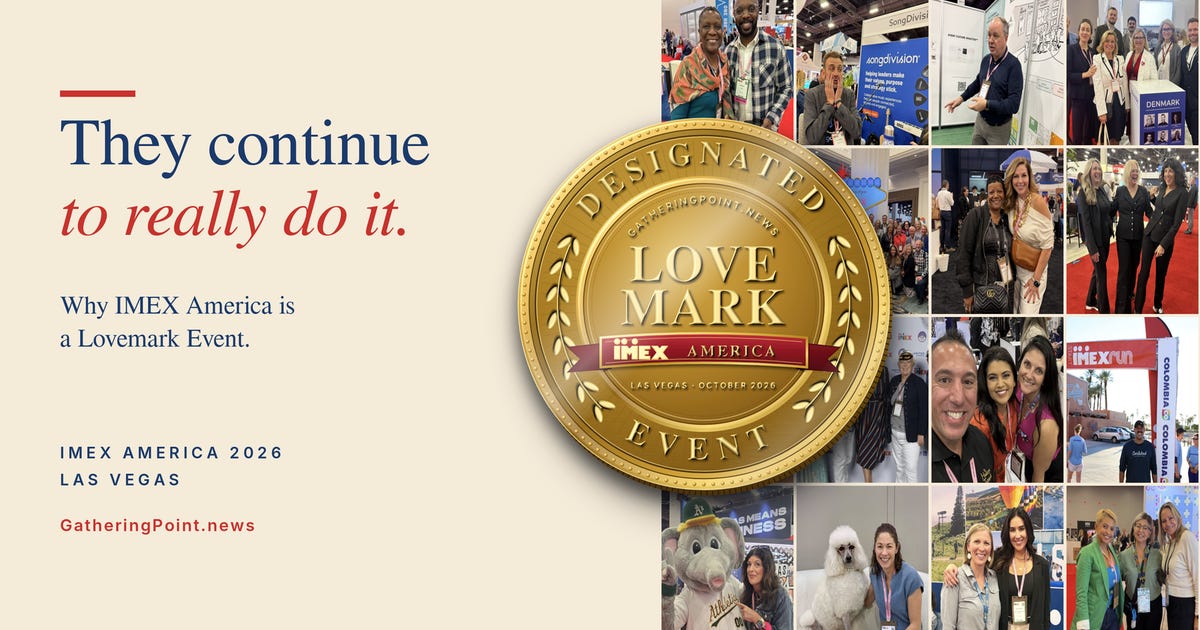
They really did it. I just got home from a week in Las Vegas at IMEX America, and I keep thinking about what the people behind it built. If you have never heard of it, IMEX is the three-day trade show where the people who plan meetings, conferences and incentive trips for companies and associations come to meet the hotels, cities and venues that host them. This industry spends plenty of time criticizing, and sometimes it should. This story does the opposite: I want to hold IMEX up as a role model, the way you point a younger colleague to someone whose work you want them to copy. We usually think of role models as people. I have come to believe an event can be one too, a character that shows the rest of us how to behave. I call an event that earns that role a Lovemark Event, and before I make the case, here is exactly what I mean by it.
A Lovemark Event is an event people love and respect at the same time, so much that it has become a character they feel they know. It is not about being the biggest or the most elaborate. It is the event people return to because going back feels like seeing someone, and at its strongest it becomes almost a lifestyle, the way PTTOW! and YPO are for the people who belong to them. You can tell you are in one when you can say what the event would never do, and when you would defend it at dinner.
I borrowed the word. In 2004 Kevin Roberts, then chief executive of Saatchi & Saatchi, made it famous with Lovemarks, arguing that the greatest brands earn both love and respect. Roberts was writing about brands. My argument is that events earn that attachment too, and may earn it more deeply, because the product is other people.
What makes it work is a bond psychologists call parasocial. A parasocial relationship is a friendship that runs in one direction: you feel you know someone who has no idea you exist. The sociologists Donald Horton and Richard Wohl coined the term in 1956 while studying television hosts. It is the bond millions feel with Taylor Swift today: you know their moods, their friends, their lives, and they have never heard of you. It also stretches past people. My argument, and it is my argument, not established research, is that people form it with events. An organizer authors an event year after year until its personality is so consistent that you can say what it would never do. You may never meet that organizer. You still feel you know the event, you look forward to seeing it, and you defend it at dinner. I was honored to author a few of these myself over twenty-five years at BizBash, starting with our first event the month after September 11th. That bond is the mechanism, and the Lovemark Event is what it adds up to.
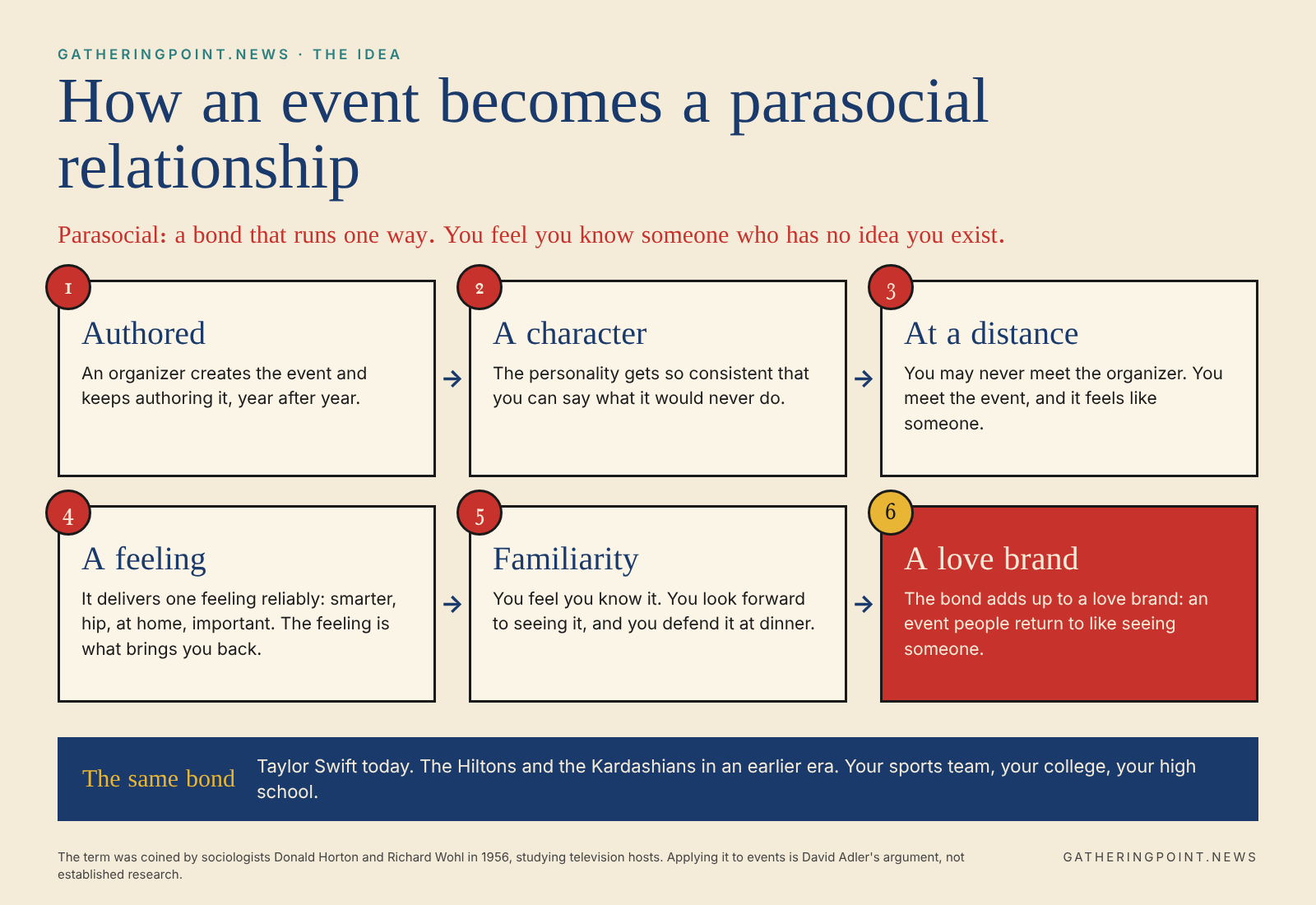
What the bond gives you is a feeling, and the feeling is what brings you back. You leave TED feeling smarter and SXSW feeling hip. It happens in every industry, even the most esoteric, and the sidebar has thirty of them.
If I were making merchandise for these events, this is what I would put on it: not a logo, but the line a regular would say about why they keep coming back. “I came for the talks. I stayed for the hallway” on a TED tee, “Stitched together by strangers” on a QuiltCon tote, “Same field. Same friends. Every year.” on a Glastonbury shirt. These are my own unofficial mockups, not endorsed by any event. When what people would wear is a sentence about belonging instead of a logo, the event has become a character they want to be seen with. The full collection, all 30, is in a companion piece, The Lovemark Event Merch Line.
30 Lovemark Events, 30 T-Shirts That Talk

Walk ten steps at IMEX America and you will run into someone you know. That feeling does not fit on a badge. It fits on a T-shirt.
IMEX's character, to me, is the reunion. I could not walk ten steps on that floor without running into someone I had known for years or had heard of for most of my career. The booths were destinations from around the world, so the hall felt like traveling it, one conversation at a time. One of them has stayed with me. In an aisle, standing with Nir Hindle, a leadership consultant, I met David Kliman, who told me how he traveled the world with no money in the 1970s and not only survived but reached places that are now considered luxury destinations, back when people like him were simply called hippies. It explained, to me, why he ended up in events: he has spent his life finding his way into places and getting people to open up. I got goosebumps, and I think that is what a hall like this makes that a screen cannot, a stranger who tells you who he is because the room feels like it can hold it. When I profiled Carina Bauer, IMEX's chief executive, last year, I called her the Secretary General of Belonging. In Las Vegas I understood why the title fit, because the event was an even better version of the United Nations.
WEEKEND WISDOM BANK: Carina Bauer

Most daughters are given a seat in the family business. Carina Bauer was offered blueprints, a blank canvas, and an open invitation to build something with her father—side by side, not one after the other.
Here is what I think the milestone is. IMEX is a temporary city, and it is built with a conscience about three things at once: content, commerce and culture. In my read, content is the education program, which gave joy a room in a hall full of buyers. Commerce is the appointment-driven business that lets the show pay for itself. Culture is the reunion, the feeling that you are among your own people. Plenty of events do one of these well; a Lovemark Event does all three on purpose. That is the behavior I think the gathering economy should reach for: care in the details, a reason behind every choice, and an awareness that you are building a place where people will spend days of their lives.
A character like that is built, not announced. Ray Bloom built IMEX, now in its 15th edition in Las Vegas, around a simple idea, that you bring the buyers as guests, with their travel covered in exchange for a calendar of pre-scheduled appointments. The organizers say it drew more than 17,800 participants and about 96,000 scheduled meetings, its biggest edition yet. I judge an event by how many conversations it facilitates, not by how many people are in the room.
The mood in the hallways was realism. The Incentive Travel Index, launched at the show by the Incentive Research Foundation and SITE, found that 62% of buyers expect their programs to stay about the same size in 2027, even as average spend per person rose 7.8% to $5,500. When every dollar gets that much scrutiny, what survives is whatever people feel is worth it, and that is the case for a Lovemark Event.
On Sunday night, October 11, I went to a dinner at Caesars Palace honoring Brian Stevens, who created ConferenceDirect and is retiring. As the magazine’s account has it, the evening began over lunch on the sidelines of a PCMA conference, where Mike Gamble, the chief executive of Searchwide, and Michelle Mason, the chief executive of ASAE, got to talking about Brian and realized that after more than four decades of building this industry, nobody had ever stopped to thank him for it. Mason put it plainly: “Why don’t we plan an event just for Brian to say thank you?” Gamble agreed it was a great idea. Within months it was a room of about 290 people, some of whom came to Las Vegas early for it, raising $1 million for the Brian D. Stevens Hospitality Education Fund, which will pay for scholarships for students entering hospitality, meetings and events. Brian spent a long career helping other people, including 19 years on the PCMA Foundation board, and the dinner worked as a living tribute: everyone was talking to everyone, and it warmed my heart.
There is one more thing I would add, and it is generosity. IMEX leaves room for other people’s events to attach themselves to its week, what Scott Schenker calls barnacle events in his book Acts of Humanity, The Power of Purposeful Events. The Events Industry Council's awards celebration, where this year it inducted six people into its Hall of Leaders, is the best example I saw: it gives the week a feature IMEX did not have to build. A show that welcomes barnacles is confident it is a place worth attaching to, and that, in my read, is part of what makes it a Lovemark Event.
That celebration was on Monday, October 12, at the MGM Grand, and it honored eleven people in all, six of them inducted into the Hall of Leaders. One of the six was David Kliman, the man I had met in the aisle, a co-founder of ELX and the owner of The Kliman Group. [What you saw: whether you were in the room, and how it felt to watch him honored. Delete this bracket if you weren’t there.] The traveler who crossed the world with no money in the 1970s had just been named one of this industry’s leaders, and I could not have scripted it better. The others inducted were Elliott L. Ferguson II of Destination DC, Robert Priest-Heck, the retired chief executive of Freeman, Kit Lykketoft of Wonderful Copenhagen, WeeMin Ong of Marina Bay Sands and Annamaria Ruffini of Events In & Out. (Full list from Northstar Meetings Group.)
The other five honorees were people earlier in their careers and people doing the work of change. The Pacesetter Awards, for emerging leaders, went to James Filtz of Cvent and Evan Nielson of AARP. The Social Impact Awards went to Anna Abdelnoor, the founder and chief executive of ISLA, and Alisson Batres, chief executive of Organización, S.A. The Adaptation and Innovation Award went to Chin-Hsun (Ken) Tsai, who directs the event management program at Iowa State University. Congratulations to all of them. (All 2026 recipients, from Travel Daily News.)
At IMEX I moderated a session in the Ideas Theater called “Can You Bottle Joy?”, with Jenn Whitmer of Joyosity Works, Panos Moutafis of Zenus and Mark Maydon of Crowd Connected. Before we started, I did what I always do and asked the audience to turn to each other and talk with the challenge always getting back to business. Getting them back takes a shush that spreads from one person to the room, and feelings travel the same way. The session opened with a video introduction song, (see video below) and not for decoration. McGill researchers found that music releases dopamine twice, once as the moment builds and again at the peak, the thing people describe as chills. Chills are goosebumps, and goosebumps are our business.
IMEX’s head of programming, Tahira Endean, literally wrote the book on this. Our KPI Is Joy argues that live events build happiness, productivity and trust, and she and the IMEX education team gave the idea a room in a hall full of buyers. (See the video I did to explain her book and to promote Joy below.)
That is why the money has noticed. Blackstone paid a reported £600 million for Clarion Events in 2017, and this month Informa agreed to pay about £2.2 billion for it. Buyers can count attendance and margins, but what they are really buying is a Lovemark Event, and a character has to stay in character. In a world of avatars and AI slop, a room full of people who are glad to see each other is the antidote, because goosebumps are the one thing a screen can’t fake.
If you run an event, treat IMEX as a role model, not a rival to beat, and ask what it would take for your event to be this deliberate. The goal is to become a Lovemark Event, a character people feel they know, not an attendance number or a sponsorship package. Count the conversations, and the sentence a stranger says about you, that it feels like coming home, will follow. If you buy events, protect the Lovemark Event, because it can’t be put back once it’s gone.
For all of that, I am designating IMEX America a Lovemark Event, GatheringPoint.news’s editorial designation for an event that has become a character people feel they know. It is my judgment, not a popularity contest, and IMEX earns it by doing content, commerce and culture all on purpose.
I am still thinking about all of it, days later. We are in the goosebump business. Thank you, Las Vegas. Thank you to Tahira and the IMEX education team for putting joy on the program, and to everyone who makes this industry feel like a family. See you next year.
If this is the kind of analysis you want in your inbox, the forces shaping how the world gathers, not the press releases, subscribe to GatheringPoint.news. It’s free. Know someone who plans, hosts or funds gatherings? Forward this to them.

Editor’s Note: A Lovemark Event is a designation GatheringPoint.news gives to an event that has become a character people feel they know and love, the way you can love a person or a place. It is my editorial judgment, not a ranking or a popularity contest, and I plan to use it again.