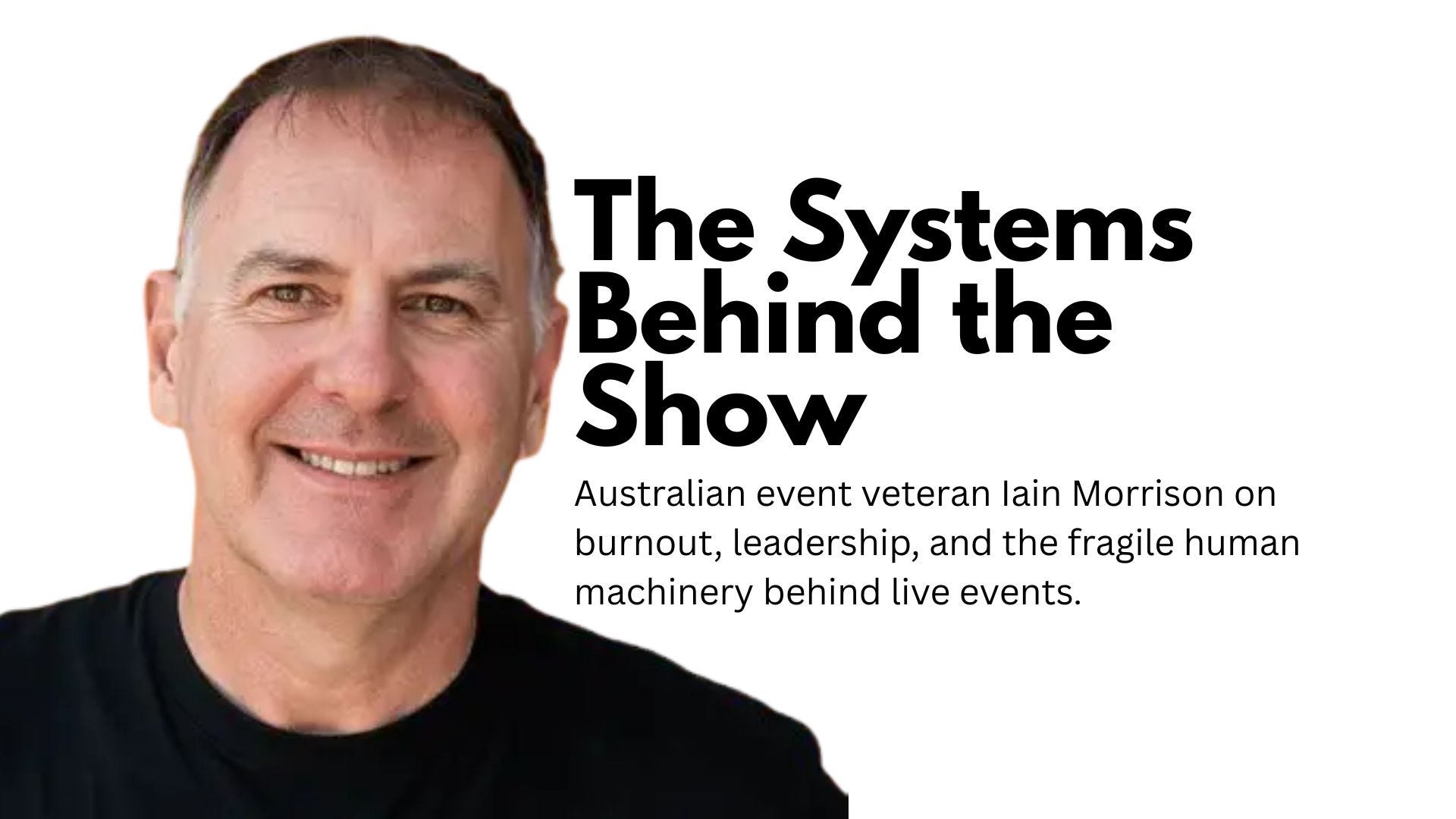
Iain Morrison and the Invisible Architecture of Events
The Australian live-events veteran has become an unexpected LinkedIn voice on burnout, operational leadership, and the fragile human systems behind concerts, conferences, and festivals.
Long before Iain Morrison was advising event organizers about operational leadership or building digital twins of stadium shows, he was a teenager crawling through the ceiling of a school theater in Australia trying to figure out how to hang more lights. The lighting rig wasn’t big enough. That was the problem. So Morrison and a few classmates climbed above the stage, located the beams that supported the roof, and cut new rigging points so they could suspend additional fixtures. They were about fifteen years old, and the goal was simple: make the school dance look bigger. “We just thought the show could be better,” he says now, recalling the moment with the kind of amused disbelief that comes from looking back across decades.
That instinct—to improve what audiences see by fixing what they don’t—would quietly shape the rest of his career.
Recently Morrison has been gaining attention in a very different venue. Over the past year his posts on LinkedIn have begun circulating widely among event professionals around the world. The posts are blunt, sometimes surprisingly personal, and they touch on subjects that the events industry has traditionally avoided discussing in public: burnout, leadership failures, and the stress of delivering high-stakes productions with shrinking timelines and understaffed teams. What might once have been private conversations between colleagues backstage are now appearing in comment threads read by thousands of practitioners who recognize the experiences immediately.
The perspective carries a geographic twist. Morrison built his career in Australia’s live entertainment industry—concert tours, festivals, and large outdoor productions where the choreography of trucks, staging crews, and technical teams is as important as the creative concept. It is a world where hundreds of technicians may work overnight to construct an environment that audiences experience for only a few hours, and where the smallest operational mistake can ripple across an entire production. “People think events are about creativity,” Morrison says. “But they’re really about systems.”
His entry into that world came early. As a teenager he began working alongside older students who had found weekend jobs pushing road cases and loading equipment trucks for touring concerts passing through Brisbane. The pay was modest—about fifty dollars and sometimes a band T-shirt—but the experience exposed him to something that most audiences never see: the enormous operational machinery required to produce live spectacle. Artists such as Pink Floyd or Billy Joel might appear on stage for a single evening, but the infrastructure supporting those performances could involve dozens of trucks, towering lighting rigs, and crews moving equipment through venues with carefully timed precision. While audiences focused on the music, Morrison found himself watching the technicians who quietly solved problems and kept the entire machine moving.
That fascination became a career. Over the next three decades he worked across the operational core of the live events industry, helping deliver concerts, festivals, and large-scale productions where thousands of moving parts must align under intense time pressure. For audiences the experience appears effortless. The lights rise, the performers arrive, and the show unfolds as if by magic. Behind the scenes the reality is far more intricate. Equipment must arrive in the correct order, staging crews must coordinate with lighting teams, and traffic plans must accommodate dozens of trucks entering and leaving venues within narrow windows of time. Leadership in this environment is rarely about dramatic gestures. It is about quiet coordination and the ability to anticipate problems before they appear.
For years Morrison says he misunderstood what leadership actually meant in that environment. Like many people in the industry, he assumed leadership meant telling people where to be and what to do. The structure of the business reinforces that assumption. Event crews assemble quickly for individual projects and disperse just as quickly afterward, leaving little opportunity for mentorship or systematic training. Knowledge moves through the industry unevenly, often passed along through experience rather than formal frameworks. “I struggled with leadership for years,” Morrison says. “I thought leadership meant telling people where to be and what to do.”
The turning point arrived unexpectedly. A few years ago he wrote a post online titled “The Dirty Truth About Burnout in Events,” describing the exhaustion many professionals experience behind the scenes of successful productions. He expected the message to attract modest attention. Instead it spread rapidly through the event community, generating thousands of reactions and comments from practitioners who described similar experiences. “Everyone is experiencing it,” Morrison says now. “Or they have experienced it.”
The timing mattered. The pandemic had devastated the live events sector, shutting down productions around the world almost overnight. When events returned, the pace accelerated dramatically. Planning timelines shortened, staffing levels shrank, and clients grew accustomed to making decisions later in the process, leaving organizers to execute increasingly complicated productions under compressed schedules. “We do a lot of things in much shorter timelines now,” Morrison explains. “That pressure never really went away after COVID.”
Morrison is quick to point out that he is not the only voice pushing the industry to confront these issues. Advocates such as Janice Cardinale and the Event Minds Matter initiative have been working to bring mental health and psychological safety into the center of the industry’s leadership conversation. Cardinale argues that the events ecosystem must move beyond treating mental health as an HR concern and instead address the systemic pressures that create stress in the first place. Emotional intelligence and psychological awareness, she believes, are not traits people simply possess; they are skills that must be learned and practiced if organizations expect their teams to function sustainably.
During our conversation Morrison returns repeatedly to a phrase that captures what he sees as one of the industry’s most dangerous habits. “Events rely on single points of failure in the human chain,” he says. In industries such as construction or aviation, large projects are designed with redundancy. Systems assume individuals may become unavailable and ensure others can step in. Live events often operate differently. A single producer may hold the entire operational plan in their head. A technical director may be the only person who fully understands the staging sequence. A show caller might coordinate every cue during a performance. When one of those people becomes unavailable—through illness, exhaustion, or simple error—the entire structure can wobble.
The personalities drawn to the industry also play a role. The work rewards speed, improvisation, and the ability to juggle multiple problems simultaneously. Morrison acknowledges this with disarming candor. “I have ADHD,” he says casually, explaining that he tends to skim long documents rather than read them line by line. The remark lands with a kind of quiet familiarity to anyone who has spent time backstage at a large event. The industry often attracts people whose minds operate comfortably in motion—people who can pivot quickly, solve problems under pressure, and somehow feel energized rather than overwhelmed when the stakes rise. In calmer professions those traits might feel disruptive. In live production they often become an advantage.
Seeking a clearer framework for leadership, Morrison began studying models outside the events industry, eventually finding inspiration in the operational principles used by U.S. Navy SEAL teams, particularly those described in Jocko Willink and Leif Babin’s book Extreme Ownership. The comparison might seem dramatic, but the underlying challenge—coordinating complex teams under pressure where mistakes are immediately visible—felt surprisingly relevant to someone responsible for large live productions. The SEAL framework emphasizes decentralized command, pushing decision-making authority down through the team so responsibility does not rest on a single individual. In practice that means technicians arrive with solutions rather than problems and departments work together rather than operating as isolated units.
Another principle Morrison often cites is “cover and move,” which encourages teams to support one another as they advance through difficult environments. In the context of live events the terrain is logistical rather than physical, but the principle translates cleanly. Lighting cannot function independently of staging, staging cannot operate without rigging, and audio systems depend on coordination across the entire technical structure. Departments that treat problems as belonging to someone else inevitably slow the entire production. When teams understand that every department shares responsibility for the success of the event, coordination becomes smoother and pressure spreads more evenly across the group.
For Morrison the attraction of these ideas lies in their simplicity. Events rarely unfold exactly as planned. Weather shifts, equipment arrives late, and small mistakes can ripple through an entire schedule. In those moments elaborate management theory offers little help. Clear systems and shared responsibility matter far more, which is why Morrison often repeats a phrase that has become shorthand for his philosophy: a schedule, he says, is leadership on paper.
Two years ago he stepped away from direct event delivery to pursue a new idea shaped by decades of backstage experience. One of the most common problems he had encountered involved imagination. Clients reviewing technical drawings or floor plans often struggled to visualize how an event would actually look once constructed. His company now builds digital twins—immersive three-dimensional models that allow producers, sponsors, and executives to walk through an event months before construction begins. Instead of interpreting technical drawings, stakeholders can stand virtually inside the environment and understand immediately how staging, sightlines, and hospitality structures will shape the experience.
Despite working with advanced visualization technology, Morrison remains skeptical that digital tools will ever replace the fundamental reason events exist. “If the metaverse was really going to take off in events,” he says, “nobody would have come back after COVID.” Live events persist for a simple reason: people still want to gather.
For those outside the profession, live events often appear glamorous. Inside the industry the stakes feel very different. When a gathering succeeds, thousands of people share a moment of excitement or connection. When something goes wrong, the failure happens in public. Yet every event begins the same way. The doors open, the audience enters, and whatever happens next unfolds in real time.
After thirty-five years behind the scenes, Morrison still believes the magic of events lies not in the spectacle audiences see but in the invisible architecture that makes the spectacle possible. When those systems function well the audience never notices them at all, which, in Morrison’s view, is precisely how it should be.
Iian Morrison Edible Profile from SmallBiteArchitecture.com
Most Events Are Built Blind
Let’s be honest: too many planners are still working off PDFs and hope. If you can’t walk your event before it exists, you’re guessing—and guessing is expensive.2D Thinking Is the Silent Killer
Flat diagrams produce flat experiences. The industry’s addiction to floor plans is why so many events feel generic, disjointed, and forgettable.Production Shouldn’t Be a Fire Drill
If your best ideas happen on-site at 2 a.m., something went wrong upstream. Great events are won in planning, not saved in crisis.You’re Not Designing Space—You’re Designing Behavior
Where people stop, gather, hesitate, or leave is not random. If you didn’t model it, you didn’t design it.The Real ROI Is Fewer Surprises
Everyone talks about “wow moments.” Morrison’s work is about eliminating “oh no moments.” That’s where the real money is.Technology Isn’t the Future—Avoiding It Is the Risk
This isn’t about being cutting-edge. It’s about not being left behind. The gap between visualized events and guessed events will only widen.Crew Experience Is a Leading Indicator, Not an Afterthought
If your crew is strained, your event is fragile. Sustainable production is not kindness—it’s performance strategy.Global Scale Demands Pre-Visualization Discipline
As events stretch across borders and cultures, improvisation doesn’t scale. Visualization is becoming the operating system of serious global events.If You Can’t Show It, You Can’t Sell It
Clients don’t buy concepts—they buy clarity. The ability to see the event is becoming the new pitch deck.