


You are at a reception and someone you have clearly met before walks up, and you have lost their name completely. You can say “Hey! Good to see you!” and keep talking, which hands them a problem. Does he know who I am, should I say my name, is he going to ask, do I rescue him. They now spend the next minute working on you instead of talking to you. Or you can say “I’m David, remind me where we met?” You took the hit, and they do nothing.
Same thirty seconds, same two people, same forgotten name. The only thing that moved was who had to do the thinking.
That is the test behind my new book, How to Behave at Events Now. Every social moment has a bit of invisible work in it, and there are only two places that work can go: you, or them. Good manners mean you do it. Bad manners mean they do it. The old protocols held up because the host did that thinking in advance. The place setting works outside in so no guest has to identify a fish fork under pressure, and the seating chart exists so forty people do not have to sort out status at the door. The room is now four thousand strangers with a badge, an app and a QR code, and most of those protocols were retired without replacement. The work did not disappear. It got handed to the guests.
Eight rules to try this week
The book has 181 of them, each with its reason attached. These are the eight I would hand to a friend walking into a conference tomorrow.
Rule 9. Say who you are before you ask. “I’m David, I write about the events business.” Offering gets you exactly the same information as asking, costs them nothing, and shows them how long an answer you are looking for.
Rule 17. Never lead with a request. A hello that ends in an ask makes someone a transaction before they agreed to be one. Let them meet you before they have to judge you.
Rule 21. Look at a badge for a second and a half, no longer. The name tag sits on someone’s chest, so past about a second and a half you are staring at them, and now they have to decide what to do about that.
Rule 20. Use their name once, not three times. Once is warm, twice is a reminder, three times is a sales technique, and everyone can hear a sales technique.
Rule 23. Leave a gap in your group so people can join. A closed circle of three makes a decision for everyone standing alone within ten feet. Stand in a horseshoe instead and people can join without doing the hardest thing in any room, which is interrupting strangers.
Rule 39. Keep the phone off the table, and if you must work, leave. Face down is not away. At an industry dinner everyone knows you are working, which makes the phone a standing announcement that this table ranks below your inbox.
Rule 45. Let what you learn travel, but leave the name behind. This is the working rule of every well-informed person in this business. Repeat the fact and you are useful. Repeat who told you and you are never told anything again.
Rule 63. Never ask a junior person to take a side in front of their boss. “What do you think, Danny?” across a dinner table is not curiosity, it is a test with his livelihood sitting in the room.
And the shortest rule in the book, number 29: if someone is looking for the bathroom and you know where it is, say so. It costs you four words.
What is in the book
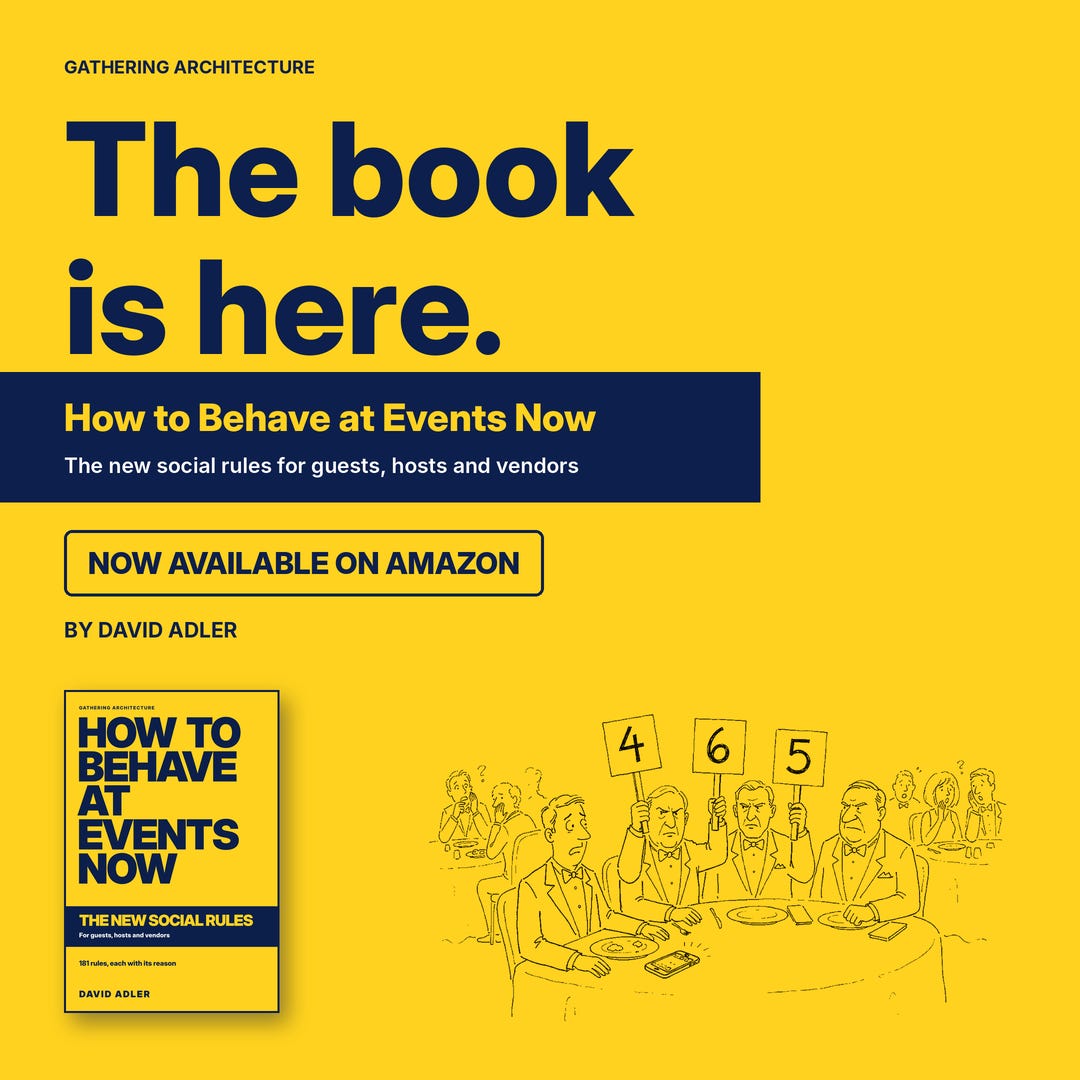
How to Behave at Events Now runs 181 rules for the guest, the host and everyone who works the room: the planner, the caterer, the band, the photographer, the lighting designer and the chef. It opens with the 25 biggest faux pas, which I will be honest is an editorial pick and not a measured ranking. It also has 19 cartoons. Rules marked Traditional are a matter of record, such as Emily Post’s turning of the table in 1922. The rest are proposed, and I have said which are which.
The book is on Amazon here: https://a.co/d/05GVqLqb
Which rule do you break most? I would like to hear the one you think I got wrong.
GatheringPoint covers the people who build the gatherings. Subscribe at GatheringPoint.news.