How Jacob Cohen Donnelly is Building a Love Brand For Media Operators
The Room is the Moat
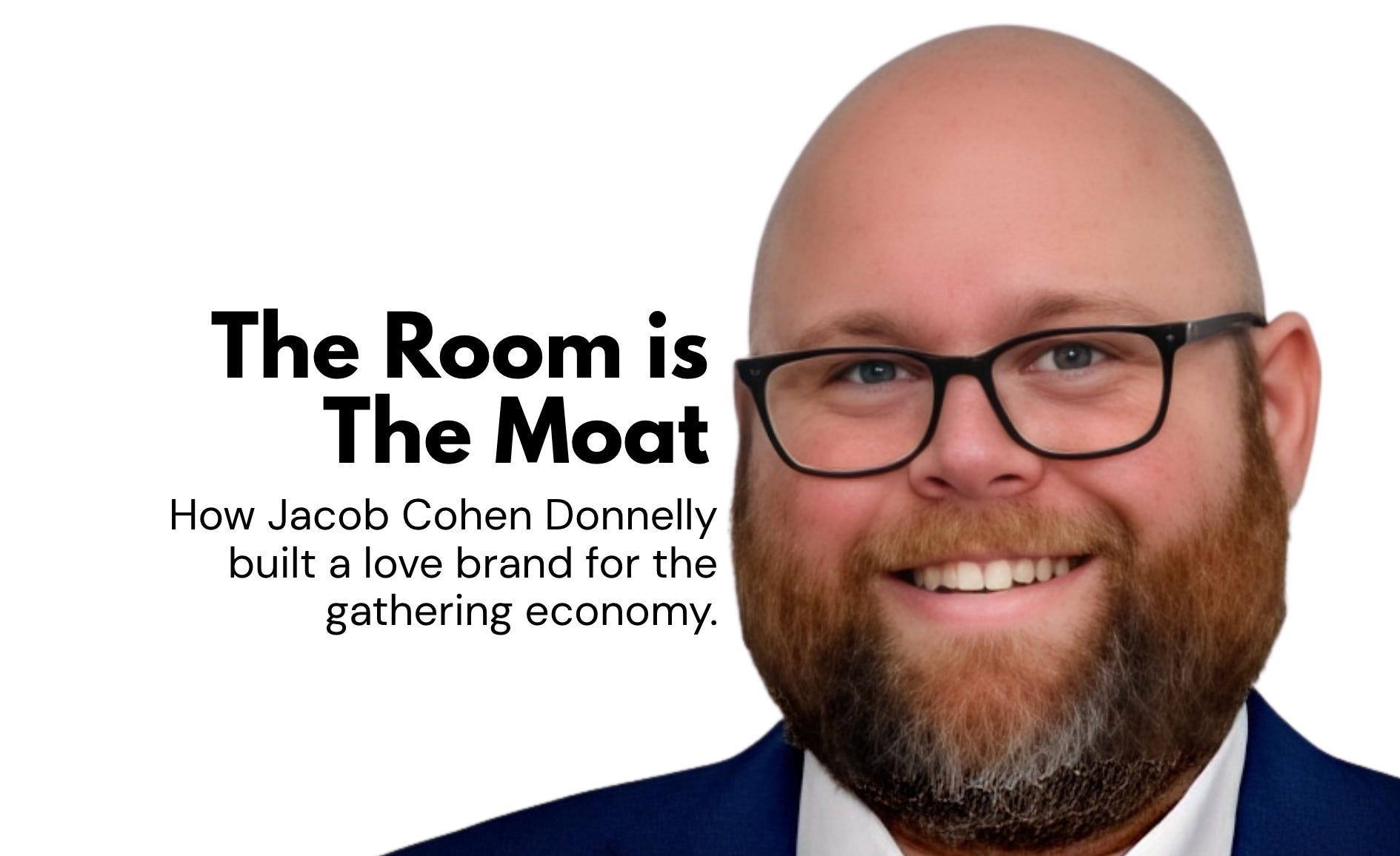
Across two days at the Times Center in October 2025, several of the most senior operators in American media voluntarily took a seat in a chair they knew would be a little uncomfortable. They were not paid to be there. They had not negotiated topics in advance. The man on the riser opposite them ran a five-person company out of New York and was younger than most of their direct reports. He was going to read their prior interviews back to them, name the math they had been deflecting, and ask the question their own boards had not. Their teams had cleared the calendar so they could fly in and submit to it. The waitlist for the audience seats had closed weeks before. This is the AMO Summit. The man on the riser is Jacob Cohen Donnelly. He has built the only room in American media that the people running American media now consider essential to be inside, and the reason is the room itself.
Events and media are cousins from the same family, and for as long as both have existed they have been each other’s quiet supplement. The newspaper ran a conference division. The magazine ran a festival. The trade publication ran a banquet. Events were where the masthead came to life for a night, the marketing arm of the editorial product, a margin layer the publisher did not depend on but was glad to have. Media was the older cousin, the better-paid one, the one with the byline. Events were the cousin who showed up and worked the room.
That hierarchy is in the process of being inverted. The media business that was supposed to anchor the family is the one bleeding margin and watching its distribution rails go dark. The events business that was supposed to be the supplement is the one carrying the brand forward, generating the disproportionate share of revenue, and producing the only kind of audience relationship that does not depend on a platform’s permission. The conference is no longer the marketing layer for the masthead. In a growing number of media businesses, the conference is the masthead, and the editorial product is the marketing layer for the conference.
Donnelly is the operator who saw the inversion early and built his entire architecture around it. He runs a media company that is also an events company, in roughly equal proportion, and the proportion is on purpose. The newsletter builds the audience. The podcast deepens the relationships. The annual Summit at the Times Center is the day each fall when the audience pays him to be in the room with the people they have been reading about. He is thirty-seven years old. He runs a five-person business out of New York that did about a million dollars in revenue last year. He has built one of the only media operations in the country whose audience would still show up if every algorithm went dark tomorrow.
What surrounds that chair, on Donnelly’s stage, is the rest of the answer. The Summit is single-track. Two hundred and fifty senior operators sit in one auditorium for a day and a half, watching the same conversations unfold in sequence, with no breakout rooms, no parallel tracks, and no AI-personalized agenda telling them where to be next. The audience is kept to peers, chief executives and founders and presidents and heads of revenue, which means the person sitting next to you is more likely to be a contemporary than a prospect. Donnelly moderates most of the interviews himself, and the interviews are conducted in the register of a magazine profile rather than a stage Q&A. He humanizes the guest at exactly one point per session, usually at the end, often with a question that has nothing to do with media. He has a metric for whether the room is alive, and the metric is auditory: he is listening for the laugh. Most industry conferences treat the stage as a marketing surface, where sponsors negotiate keynote slots and the moderator’s job is to keep things friendly. Donnelly’s Summit treats the stage as the editorial product, the conversation as the deliverable, and the deliverable as the thing that makes the next year of the newsletter possible, because every on-stage exchange becomes a reference point that runs through twelve months of coverage afterward.
The proof is the conference he sells out every October at the Times Center, the 378-seat Renzo Piano auditorium inside the New York Times Building on West 41st Street, operated by the publisher of record. Donnelly puts his event in that room on purpose. By his own published accounting, the venue is roughly forty percent of his total event cost, the single largest line item on the budget, and he keeps writing the check because the room itself does work no marketing campaign could replicate. The senior leadership of Hearst, The Atlantic, Axios, Vox, People Inc., Mansueto and Questex walks into a space whose institutional weight the New York Times spent a generation building. Donnelly is borrowing that weight for a day and a half each fall. They sit in his room while a man with a team of five reads back their prior interviews and asks them, on stage, how much money they make. Most of them came last year too. The waitlist closes weeks before doors.
The argument his industry has not yet figured out how to write down is the one Donnelly has been quietly proving for six years. In an economy where information is infinite and gatherings are scarce, the only defensible media business is one whose audience pays to be in a room with the people they have been reading about. Everything else is a tenant relationship. The Summit is the receipt that he has built the first kind.
Donnelly grew up large and was, by his own description, aggressively bullied through it. He says this matter-of-factly, at the standard pace of someone who has talked it through in therapy and has decided not to be defined by it. He was not on the inside in school. His friend group was small. A girl in high school once called him overzealous, a word he had to look up, and which he did not like the meaning of. He found out later that she was flirting with him. He had not picked up on the cue. He still does not entirely trust himself to pick up on cues like that, which is, he says, why it is any wonder that he has a long-term partner at all.
He is now thirty-seven, recently engaged to Victoria, who handles the photography for his event. He is in therapy. He prefers not to dwell on the bullying. “I refuse to have a victim mentality,” is how he puts it. “I’m 37 years old. That was more than half my life ago.” The line he keeps coming back to about the relationship between the bullied kid and the operator he became is brief and almost dismissive. “I think that’s why I’m a founder. I overcompensated for my shyness.”
He spent the back half of the 2010s running digital revenue and marketing at CoinDesk, then became Publisher at Morning Brew, where most of the industry first learned his name. He started A Media Operator in August 2019 on Substack, posting on weekends about the work he was doing on weekdays: figuring out how digital media companies actually make money. The early posts were unglamorous. Controlled circulation. First-party data capture. Lead-gen economics. Why Pacific Standard collapsed when its single benefactor walked away. He was not cheerleading the industry. He was showing his math.
By 2024, the project was a publication. Donnelly left Morning Brew, hired Christiana Sciaudone as a full-time reporter, brought on freelancers, and in January 2025 rebuilt the site from a newsletter homepage into something resembling an actual media company, which he labelled AMO 2.0. The twice-weekly cadence held. The reader base, which skews ruthlessly senior inside B2B media, held. The annual Summit, launched in October 2023 with 130 people, doubled by year three. The numbers underneath are still small. AMO will do roughly a million dollars in revenue this year, double the half-million it was doing the year before. Subscriptions are 15 to 18 percent of that. The team is five people, including him. His ambition is to grow the business to five million in revenue, which means he needs to convert the Summit’s relationships into enterprise subscriptions, launch additional verticals, and stop personally touching every line item, which he has not yet figured out how to do.
He is, in short, the operator he writes about, on the scale he writes about, working through the same questions in public that his readers are working through in private.
The most useful thing about Donnelly as a moderator is that he has named the thing he is doing on stage, and the name sounds worse than it plays. He calls the relationship between him and his guest “mildly antagonistic.” On the page it reads like an ambush. In the room the texture is different. The bite is real, but it sits inside an obvious affection for the person across the chair, and the homework he does in advance is meant to make the executive sound smarter, not smaller. That asymmetry is what buys him the bookings. The guests come back, put him on their own stages, send him their friends. If the guest is not a little uncomfortable, the audience is being cheated. Every chief executive has been media-trained. Every chief executive has a script. The job of the person with the second microphone is to break the script without breaking the room.
The style is not entirely his own invention. Donnelly is also the events-industry edition of a wider mid-thirties pattern in American journalism, criticism, and venture capital, in which a generation that watched the institutions of its twenties fail in slow motion has decided to treat the polite non-answer as a form of professional malpractice rather than professional courtesy. The room rewards him for it because the room, on some level, has been waiting for him.
The signature move is what he calls the revenue receipts. Before each session, he reads back through every interview the guest has given. If a CEO mentioned in a 2023 podcast that subscriptions were 50 percent of revenue, and in a 2024 panel said subscription revenue was twenty-five million, Donnelly walks on stage knowing the company does fifty million in total revenue. When he asks for the number and the executive deflects, he names the math out loud. I know you do twenty-five million in subscription, which is about half. Tell me about the other twenty-five. The executive has nowhere to go. The audience, which has been on the receiving end of polite revenue dodges at every conference for a decade, lights up.
The second move is the laugh on opening. He does this on purpose. At a sponsor event earlier this year he interviewed Prescott Shibles, the chief executive of Farm Journal, and the first question he asked was whether Shibles had taken the Farm Journal job for the work or just because it was a three-letter title. The whole room laughed. The session loosened. Loose rooms tell the truth.
He has a metric for this and the metric is auditory. Because he can barely see past the second row, he is listening for the laughs. He wants several of them per day. Not because he is an entertainer, but because he believes that an audience that is laughing is an audience that is awake, and an audience that is awake is one he can actually deliver something to. “It’s just, it’s my job to make them have a nice time,” he says, and the disclaimer in the middle of the sentence is the giveaway. He knows the line sounds soft. He says it anyway because he means it.
The third move is to humanize the guest at exactly one point per session, usually at the end. At the inaugural AMO Summit he closed his interview with Neil Vogel, then the chief executive of Dotdash Meredith and now of People Inc., by asking whether the Sixers were ever going to win a championship. Donnelly is a Knicks fan. Vogel is a Sixers diehard. The question had nothing to do with media. It humanized everything that came before it.
Twenty-five minutes with the chief executive of The Atlantic, twenty-five minutes with Katie Couric: Donnelly treats every booking as the chance to get something interesting from a person who would otherwise charge him a lot of money for the conversation. The reputation that gets him those bookings is the simplest version of his job description. He is not afraid to ask anybody anything.
Donnelly’s running argument with the rest of media, the one he has been making in different forms for six years, is that operators are running the wrong math on diversification. A scaled single revenue line across twenty-five industries, he has written, is operationally healthier than a company running advertising and subscriptions and events as three sub-scale lines inside a single narrow vertical. The number of revenue lines is not the question. The scale of each one is. He has admitted his own company is currently the second kind, three monetization schemes none of them yet at scale, and he is working through it. He uses the same lens to puncture other industry orthodoxies. A newsletter ad business, he has written, is just a banner ad business with some text, dressed up as a new model and headed for the same ceiling its 2005 ancestors hit.
He does not let his own theses off the hook either. He endorsed the content-to-commerce thesis for years. When Food52 fell into Chapter 11, he went back through his own archive and wrote the post-mortem on his own arguments, naming the place where the model broke: aggression on the commerce side starves the content that brought the audience in the first place. The line he keeps returning to, when watching his industry mistake activity for strategy, is that what happens when you take an operator and a financial analysis is that the two do not always align. The operators who held assets at the bottom of the cycle do fine. The financial buyers who overcorrect later pay the spread.
The asymmetry between Donnelly and the chief executives who pay to sit in his audience is not generational in the obvious way. He is not smarter than they are. They have run more revenue through more cycles than he has. The asymmetry is structural. Almost every executive in the AMO Summit room runs a business whose underlying P&L architecture was set during the algorithm decade, the years between roughly 2014 and 2022, when the operating assumption of digital media was that the platforms would move audiences to you in volume if you optimized for them well enough. Search referrals. Social distribution. Programmatic ad inventory. Paid acquisition funnels. Newsletter scale as a substitute for relationship.
That decade ended. The era of free traffic is over, Donnelly told the Alliance for Audited Media’s board of directors in August 2025, and his working assumption is that it is not coming back. The platforms have absorbed the audience. The search engines have started answering the questions themselves. The social referrals that used to carry traffic to publishers are now carrying it to AI summaries. The newsletter ad market, which he has called a banner ad business with some text, is heading for the same ceiling its 2005 ancestor hit. Most of the businesses sitting in his audience were built to run on plumbing that is being shut off.
The chief executives in the room are not unaware of this. Several of them are reorganizing around it in real time. Vox is betting on podcasts and creators. People Inc. is betting on first-party data. The Atlantic is betting on the relationship between brand and reader. Mansueto Ventures is betting on connection: at the 2025 Summit, COO Anne Marie O’Keefe described rebuilding the parent of Fast Company and Inc. around the principle that people don’t think, I’m an Innovation Festival attendee, not a website reader. They think about Fast Company as one brand experience. Each of those bets is correct in direction. The cost is that each of those bets requires unwinding an organizational architecture, a headcount structure, a margin model, and in most cases an investor expectation that all assumed the algorithm decade would continue. Donnelly inherited none of that. He started in 2019 with a Substack on weekends and built around the relationship from the first post forward. He never had a peak audience number on a search engine to defend. He never had a programmatic ad CPM to protect. He never built the layer of associate directors and vice presidents that would have to be dismantled. The advantage he has over every CEO in his room is that he did not have to undo anything to get to the place he is.
This is also the version of the gathering economy thesis that operators his audience’s age have not yet fully absorbed. The room is not a marketing channel. It is the production studio for the only kind of audience relationship that survives the next decade. Every senior executive who paid to sit in Donnelly’s room in October 2025 was, on some level, getting a look at their own future. The waitlist closes early because the people who run American media now know they need to see what the people who will run American media next are already doing.
Donnelly’s clearest framing of the next decade is also the bluntest. A media business should look like a barbell. Content team on one side, sales team on the other. Everything in between should be as thin as it can be. Audience development as a function of fifteen people is a category error. Audience development is a repeatable process. Repeatable processes can be run by an agent. If the agent runs it, you do not need fifteen people. You need one person to check the agent’s work.
This is, he says, going to be brutal for the white-collar middle class. Not because AI replaces the job, but because AI replaces the layer. The associate director, the director, the senior director, the associate vice president, the senior vice president, the line of titles whose primary function inside large media companies is the management of other titles. He is convinced that layer goes away. What he expects instead is the rise of the small business. He runs a media company with five people. He believes that within the decade, somebody else will run a similar company covering only trade shows, or only the creator economy, or only B2B information services, with three people and an agent stack, and that those companies will compound where the legacy holdings will not. He calls the trend an aggressive niche-ification of the industry. He thinks it is already underway.
He calls this the death of the large corporation, not the death of the job. He is also honest enough to admit that he is part of the same gravitational problem he is describing. When he arrived at Morning Brew, his team was four people. When he left, it was sixty-five. Some of that was real scale. Some of it was the human reflex to build empires when you are not the one signing the checks. He knows the difference. He thinks most managers do not.
He has lived inside the layer he is now arguing against, and that is the asymmetry that matters. The chief executives who pay to sit in his audience defend the layer because their org charts depend on it. Donnelly does not have to defend it. He chose, on his own company, not to build it in the first place.
He is also eating his own dog food. He recently spent a night using Claude to build a personalized cold-outreach system aimed at every senior executive in his industry, the kind of project that would have taken him weeks of agency time eighteen months ago. It is going to take him an hour. The math he is forecasting for the rest of the industry is the math he is running on himself first.
The reason this matters for the gathering economy is that everything Donnelly believes about AI funnels back to a single conclusion. In a world where information is infinite and cheap, the scarcity shifts. It shifts to trust, to relationships, and to the specific kind of knowledge transfer that only happens face to face. Information is a commodity now. The room is not.
When the question comes back around to whether the AMO Summit is the moat of his business, Donnelly does not declare it. He works it out in real time. Yes, he agrees that the room is the moat. But the reason it is the moat, he says, is friction. The Summit attendee has done two things that prove brand love. They have given him money, which is a small friction. They have also given him time, which is the larger one. Time is the only resource you cannot make more of.
The distinction he draws, when pressed, is between an audience and an algorithm. He has been asking the question in public for over a year: are you doing well because the algorithm is rewarding you, or because people love you? The metric he prefers, in the same vein, is lifetime value over reach. We need to become more focused on the LTV of every incremental person, rather than trying to reach as many people as possible, he told the AAM board in the same August speech. Plenty of media companies look successful because the algorithm is rewarding them. The question is whether their numbers would survive the algorithm being taken away. A love brand survives. A tenant of the algorithm does not. The AMO Summit is the proof he runs on his own business once a year that he has built the first kind, not the second.
This is the cleaner version of the argument he made in a January 2026 essay about Skift founder Rafat Ali’s 2026 prediction that information would be commoditized by AI and human-to-human connection would become exponentially more valuable. Donnelly elevated Ali’s quote and added the sharper version in his own voice. While others would talk about ad market volatility and revenue diversification, his focus was on the structural shift. How do you build a media business where the human infrastructure becomes the moat? That, he wrote, was the bet. Everything else was tactics.
He pairs this with a framework borrowed from Industry Dive co-founder Sean Griffey, who has been posting on LinkedIn about what he calls the connection economy. Audiences move through a four-rung ladder. Aware. Reader. Subscriber. Connected. Most media companies measure the first three rungs. The prize is the fourth. The fourth is not earned through content. It is earned through proximity, through recognition, through being in a room where someone knew your name.
There is a second tell in the way Donnelly thinks about his own room, and it is the line that pulls the entire gathering economy thesis into focus. He says that the better he does his job, the less relevant he becomes. The Summit succeeds when it stops being about Jacob and starts being about the community. Conferences that fail to make that handoff stay personality-driven and ceiling out. Conferences that make it become institutions. Paul Miller, the chief executive of Questex, who has been in the events business for thirty years and whom Donnelly recently hosted on the AMO Show, has been making versions of this argument for his entire career. Miller’s line is that pure-play events is a customer-unfriendly business model, because customers come to a media brand for a relationship, and events are one expression of the relationship rather than the product itself. Donnelly is the younger operator reading his own thesis back from a thirty-year veteran with thirty-five events. He has been listening.
There are tensions in Donnelly’s position that he has not closed. He admits, when asked, that he does not think he does a good enough job connecting attendees to each other inside the Summit. The format is single-track on purpose, because he refuses the AI-personalized-journey premise that some event technologists are pitching. He wants everybody on the same journey with him, not on twelve different ones. But the cost of single-track is that the connecting work has to happen in the gaps between sessions, and he knows the gaps need more design than he has yet given them. He is working on it.
He also has not resolved the original diversification critique that he himself raised in 2023. Three lines of business in a five-person shop is a lot of surface area. The margin on the newsletter is better than the margin on the Summit, because the newsletter runs on a calendar and the Summit runs on him for three weeks every fall. The bet he is making is that the lines reinforce each other in ways the focused-company math does not capture. The newsletter builds the audience. The podcast deepens the relationships. The Slack keeps them warm. The Summit compounds it all into a single billable day. The loop is the business. The loop has a name. He calls it the human infrastructure. The events industry has been calling it the convening economy for a generation. They are talking about the same thing.
At the end of the second day of the 2025 Summit, after the last panel and before the closing reception, Donnelly walked off stage and did what he does at the end of every event he produces, which is leave. The introvert who has spent thirty years compensating for being the introvert needs the room to himself for a stretch after the room has been working him. The main newsletter goes out Tuesday and Friday. The Events Operator edition runs Wednesday. The podcast publishes Tuesday. The Slack fills up by the end of the week with the threads that started at the bar. By the following October the same people, plus a few more, will come back.
The reason they come back is the line buried in the headline. Donnelly is mildly antagonizing American media not because he has a louder voice or a bigger platform but because he is running an operating model that does not have to undo anything to face the next decade. The senior executives who pay to sit in his audience are running businesses they have to remodel in flight. He is running a business he built on the architecture they are remodeling toward. Most of them have figured out what the room is for. A few have not. By the time all of them have, the next 37-year-old will already be selling a different room, in a different city, to a different audience. That is the actual lesson the Summit is teaching.
The room is the moat because in an economy where information is commoditized and content is infinite and the algorithm replaces the editor, the only thing left that cannot be automated is the decision to show up. They show up. He does the work to make the showing up worthwhile. And then, the better the work is, the less the room is about him at all.
He has been writing down the convening economy in operator’s prose for six years. Most of his industry has not started.
The next AMO Summit runs October 20 and 21, 2026, at the Times Center in New York. Two hundred and fifty senior leaders from the media and events industries are expected for a day and a half of single-track sessions and topical roundtables.
1. The mildly antagonistic stage.
If the chief executive on stage with you is not a little uncomfortable, you are not doing your job. Every executive has been media-trained. Every executive has talking points. The reason the audience came was to get past those.
2. Bring the revenue receipts.
Before any interview, read back through every prior interview the guest has given. If they said in 2023 that subscription was half their business, and in 2024 that subscription revenue was twenty-five million, you walk on stage knowing the company does fifty million. When they deflect, you name the math.
3. The laugh is the brief.
Open with a question that lands a laugh. Loose rooms tell the truth. The job of the moderator is, before anything else, to give the audience a nice time. Anyone embarrassed by saying that out loud has not run a hard room at the end of a long day.
4. Listen, do not watch.
The lights destroy your eyes. The audience is past the second row. Listen for the laugh, the pause, the inhale, the silence. The room is auditory before it is visual.
5. One track, not twelve.
Single-track conferences make the audience a community. Multi-track conferences with personalized AI journeys make the audience a thousand isolated journeys. Resist the technologist who wants to optimize you out of the shared experience.
6. The moat is friction.
The audience that gives you money has shown small friction. The audience that gives you time has shown the larger friction, because time is the only resource that cannot be replaced. Money plus time is brand love. You cannot manufacture it. You can only earn it.
7. AI kills the middle, not the job.
The death of the large corporation, not the death of work. Associate directors, directors, senior directors, vice presidents whose primary function is managing other titles: that layer goes away. The barbell stays. Content on one side, sales on the other, thinness in between.
8. Empire-building is gravity.
At Morning Brew his team went from four to sixty-five. Some of it was real scale. Some of it was what happens when the person hiring is not the person paying. Most managers do not know the difference. The good ones learn it the hard way and then write about it.
9. Become irrelevant on purpose.
The conference succeeds when it stops being about you. The community is the asset. The host is the catalyst. If the room only works because you are in it, you have not built a business. You have built a personality.
10. There is no harm in being optimistic.
He used to be a pessimist. He is not any more. The line he has settled on, and which has the structure of a Cohen Donnelly aphorism, is that there is no harm in being optimistic, because it will not change the outcome anyway. You might as well show up to the outcome in a useful state.