
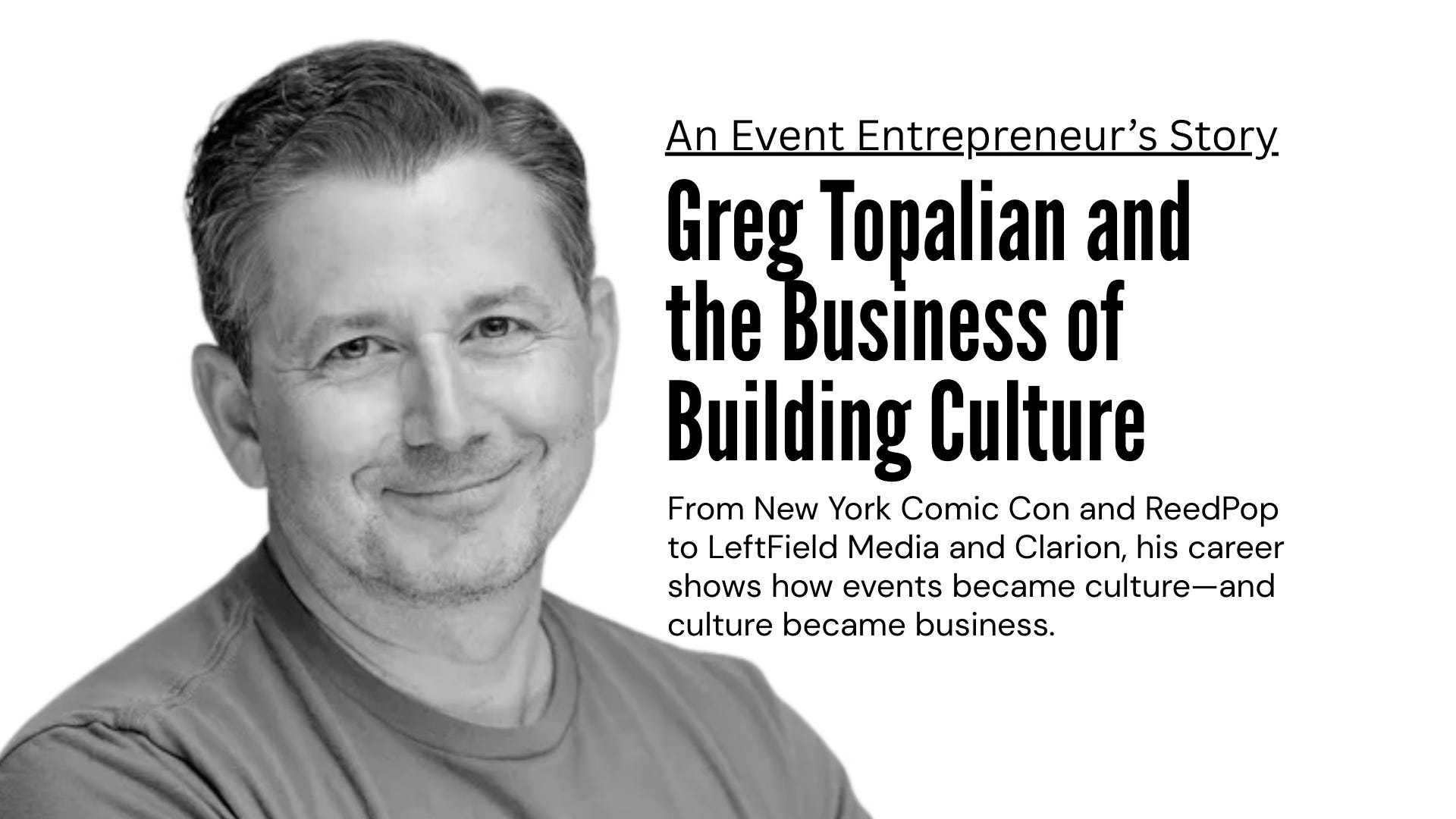
Greg Topalian and the Long Game of Instinct
From New York Comic Con to a new role spotting and backing the next generation of builders, Greg Topalian’s career tracks the rise of live events as one of the most powerful assets in modern business.
Editor’s Note:This story isn’t just about a career. It’s about a moment. Greg Topalian’s path—from building New York Comic Con inside one of the world’s largest exhibition companies, to stepping away from day-to-day leadership and quietly backing the next generation of builders—mirrors a deeper shift in the gathering economy itself. As live events became more valuable than media, as consolidation reshaped the industry, and as instinct began to matter as much as scale, Greg was often already there—testing, backing, and recognizing what others hadn’t yet named.
At GatheringPoint.News, we believe the most important stories in this industry are not told after the dust settles, but while the arc is still unfolding. Greg is entering a new chapter, and rather than waiting to see where it leads, we wanted to document how he got here—what shaped his instincts, who he elevated along the way, and why his next moves matter. This is not a retrospective. It’s a field note. — David Adler, Curator in Chief, GatheringPoint.News
Greg Topalian came of age in an industry that was quietly rearranging its own power structure. For decades, business-to-business media had been organized around magazines—glossy, authoritative, and definitive. Own the publication and you owned the niche. Events existed, but largely as extensions of editorial gravity rather than assets in their own right. By the time Greg entered the world of exhibitions, that hierarchy was beginning to collapse. Print was flattening, attention was fragmenting, and live gatherings—risky, expensive, impossible to fake—were becoming the places where real influence, real commerce, and real community still happened.
What made Greg unusually well suited to that moment is that he had been practicing for it long before he ever stepped onto a show floor.
His earliest education didn’t come from business books or internships, but from the kitchen table. His father was a food scientist and chemist at General Foods, a career that turned invention into something people actually bought and dinner into a kind of informal laboratory. New products arrived home in unmarked containers, foil tops barely hiding their experimental status. Greg was asked to taste, compare, articulate differences. Which one worked. Why. What felt right. There were no correct answers, only reactions. The lesson was never abstract: the customer holds the truth.
That ethic followed them everywhere. In a grocery store in Dover, Delaware, Greg remembers being handed the lower shelves while his father straightened a display of Jell-O boxes that had been knocked out of place. Five years old, Greg lined them up carefully, not because it was their store, but because it mattered how the work appeared in the world. Responsibility, he learned, wasn’t conditional. You didn’t wait to be watched to care.
His mother supplied something just as formative, though harder to diagram. She was older when she had him, unusually so for the time, which meant she brought patience, humor, and a calm authority that never needed to announce itself. She believed in initiative without bravado and conviction without performance. Even decades later—right up until her passing at ninety-seven—that tone stayed with Greg. You can feel it in the way he leads rooms: lightening seriousness without trivializing it, grounding intensity with ease, reminding people that rigor doesn’t require drama
By the time Greg reached middle school, those lessons had begun to organize themselves into behavior. He ran a candy business out of his backpack, buying in bulk, experimenting with pricing, adjusting inventory based on what moved fastest and when. He learned quickly that timing mattered, that scarcity mattered, that attention was finite even among twelve-year-olds. When the school eventually intervened, expecting punishment, his parents treated it as analysis instead. How much profit had he made. Which items sold best. Why did one price outperform another. The message wasn’t that rules didn’t matter. It was that initiative did.
That curiosity carried into everything he touched. He gravitated toward work that put him face-to-face with people, not because it was glamorous, but because it generated feedback. At an ice-cream shop, he didn’t just scoop; he performed. He learned that a smile, a joke, a small flourish could change the emotional temperature of a transaction. He paid attention to how long people were willing to wait, what made them impatient, what made them linger. Experience, he learned, could be engineered in micro-moments long before anyone called it experiential.
Money mattered early, not as status but as signal. He saved aggressively, tracked what he earned, and began investing young under his father’s guidance, learning patience and pattern recognition before risk-taking ever entered the picture. He wasn’t reckless. He was methodical. The through-line wasn’t ambition so much as fascination—a need to understand why something worked, and what would happen if you adjusted the variables.
Seen this way, Greg didn’t become entrepreneurial when he later left a global company to start his own. He had been practicing the posture for decades.
So when he arrived at Reed Exhibitions—now RX—in his early twenties, interviewing for a sales role tied to restaurant shows, he was entering one of the largest and most powerful trade-show companies in the world already fluent in the unspoken rules of markets and behavior. Reed was a global events empire built for scale, precedent, and discipline, the kind of organization where deviation was usually treated with caution. What made the moment consequential, though, were the people who saw him before the résumé did.
Greg was hired by Nancy Walsh and Courtney Mueller, leaders who recognized not just his competence but his curiosity and gave him room to explore rather than forcing him into a narrow lane. That early act of trust mattered. It is not incidental that decades later, both women remain part of his life. In an industry known for churn and short memories, that continuity says something about how Greg builds relationships. He doesn’t just respond to authority. He responds to belief.
Inside that space, Greg began to push. As the broader B2B media industry struggled to redefine its value in a digital-first world, exhibitions were quietly becoming more valuable, not less. Face-to-face commerce still closed deals. Communities still formed in rooms, not comment sections. Private equity noticed. Mergers accelerated. Exhibition portfolios were suddenly understood not merely as operating businesses but as strategic assets. Own the gathering and you owned the ecosystem. Greg’s rise coincided with that realization, and in many ways anticipated it.
It was inside this shift that he conceived and launched New York Comic Con, a move that at the time felt risky, even eccentric. Fandom was still widely viewed as niche and unserious. NYCC didn’t just succeed; it reframed what an exhibition could be. Its growth led to the creation of ReedPop, a dedicated pop-culture division Greg helped architect into a global platform spanning comics, gaming, film, and entertainment, proving that emotionally driven communities could scale without losing coherence. At a time when magazines were losing their grip on identity and loyalty, events like NYCC were becoming the brand.
Greg’s ascent inside Reed was not the result of a single hit, but of a pattern. He learned the machinery from the inside, climbed the ladder as an operator rather than a celebrity hire, and earned trust by pairing instinct with execution. He protected difference rather than sanding it down, understanding that fandom, irreverence, and passion were not liabilities but fluency. People followed him because he gave them room to think before they were certain.
That sensibility—culture as behavior rather than proclamation—became his defining leadership trait. In meetings, Greg listened longer than expected, let ideas finish their sentences, and asked questions that extended possibility rather than shutting it down. Cynicism disguised as realism rarely landed with him, especially the phrase he came to distrust most: “that won’t move the needle.” Everything consequential, he reminded people, once looked small. To dismiss ideas because of their current size was to miss the future while congratulating yourself on discipline.
Trust was another quiet tool. Greg trusted people publicly and corrected privately. When something failed, he looked for learning rather than blame. Over time, teams stopped optimizing for self-protection and started optimizing for progress. That approach created leaders, not just result
Some of the clearest proof of that instinct lives in the people who came up around him. Lance Fensterman arrived from Book Expo America not as a pop-culture impresario but as a bookseller by trade, someone Greg immediately recognized as grounded, emotionally fluent, and credible with fans. As Reed struggled to reconcile its B2B roots with the unruly energy of fandom, Greg made a deliberate choice not to sand that energy down. Jeans were not rebellion; they were literacy. Cosplay was not chaos; it was participation. Under Greg’s guidance, Lance learned how to build trust at scale and globalize without flattening identity, eventually stewarding ReedPop into one of the most powerful fan-event platforms in the world. Today, at Fanatics Events, Lance holds what many describe as the tiger by the tail—enormous momentum paired with enormous expectation.
Greg saw something similar in Aaron Levant, whose work with Agenda and ComplexCon reflected a different but equally potent form of cultural fluency. Levant wasn’t an events insider so much as a native of streetwear, identity, and belonging. Under ReedPop’s umbrella, ComplexCon scaled without losing edge, becoming a global proving ground for live commerce, scarcity, and brand participation.
Eventually, Greg reached the familiar inflection point of an internal innovator who had pushed a system as far as it would bend. He left Reed to build independently, co-founding LeftField Media just as the exhibition M&A market was heating up in earnest. LeftField focused on undervalued audiences and culture-first platforms—exactly the kind of properties strategic buyers were now hunting. Clarion Events noticed, acquired the company, and quickly elevated Greg into senior leadership roles, placing him at the center of the industry’s consolidation wave.
Greg didn’t remake Clarion in ReedPop’s image. He modeled curiosity inside rigor, permission inside precedent. Ideas that might once have died quietly were allowed to breathe. The effect was not chaos but momentum. There were a handful of people Greg trusted enough to call when instinct and evidence diverged, and Kelly Kimb was always one of them—the person who could slow the moment down without dulling it.
Stepping away from day-to-day operations, Greg has entered another chapter that mirrors the broader arc of the industry. As exhibition M&A matures and platforms are refined rather than merely assembled, the next advantage lies less in raw scale than in spotting talent, sensing inflection points, and knowing which gatherings will matter before the balance sheet proves it.
His involvement with Michael Weiss and Michelle Troop on an AI-focused conference followed that familiar pattern. Weiss recognized that artificial intelligence was not simply a technology story but a moment of collective disorientation that demanded a place to gather. Troop brought experience forged inside Jay Weintraub’s ventures at Connectiv Holdings, including properties such as LeadsCon that were built under intense pressure and later acquired into larger portfolios including Access Intelligence and Clarion. Greg’s role was steadying rather than directive. The conference doubled year over year because it was necessary, and when it sold, it confirmed something Greg had been testing quietly for years: recognition can be as powerful as creation.
That philosophy also underpins his involvement with Event Venture Group, less an accelerator than an alumni association for builders who understand that convening is instinct, not tactic.
Viewed end to end, Greg Topalian’s career does not read as a straight climb so much as a series of intentional sidesteps, each one placing him closer to where culture, commerce, and community intersect. He rose alongside the ascendance of events as one of the most durable assets in modern business, and now, as the industry enters its next phase, he occupies a role that feels both earned and unfinished.
If the early era of exhibitions was about owning attention, and the consolidation era was about owning scale, the next era may be about owning instinct. Greg has spent a career refining his. The industry would do well to watch where he applies it next, because history suggests that’s where the future tends to gather first.
Greg Topalian: Wisdom Bank Takeaways
1. Instinct is trained, not gifted.
What looks like intuition in Greg Topalian’s career is the result of early repetition: watching customers react, testing assumptions in real life, and trusting behavior over theory. Instinct, in this model, is a discipline built over time.
2. The customer knows more than the spreadsheet.
Data can confirm decisions, but it rarely creates them. Greg’s success reflects a lifelong habit of staying close to real customer behavior—where urgency, emotion, and value reveal themselves first.
3. Culture is shaped by behavior, not slogans.
Greg managed culture by how he listened, what he rewarded, and how he responded to failure. Teams learned values not from statements, but from lived signals under pressure.
4. Small ideas are where the future starts.
Nearly every transformative platform begins as something “too small to matter.” Greg’s career shows that dismissing ideas because of their current scale is often how organizations miss the next wave.
5. Leaders multiply when they elevate others.
Greg’s most lasting impact may be the people he developed—leaders who went on to build and run platforms of their own. Influence compounds when leadership is shared.
6. Authenticity can scale if it is stewarded.
Communities don’t lose their soul because they grow; they lose it when they are over-managed. Greg’s work demonstrates that stewardship, not control, preserves authenticity at scale.
7. Leaving can increase impact.
Strategic exits—from Reed, then Clarion—allowed Greg to operate at a higher level of influence. Knowing when to step aside can open more powerful chapters than staying in place.
8. Recognition is a form of creation.
In his current role, Greg shows that spotting the right people early and backing them thoughtfully is as consequential as building platforms yourself.
9. Humility strengthens authority.
Leadership grounded in ease, humor, and humanity builds trust that outlasts performance. Authority doesn’t require dominance to endure.
10. Timing is a competitive advantage.
Greg’s career tracks the moment when live events became a strategic asset. His edge has been sensing those shifts before they were obvious—and acting early.


