
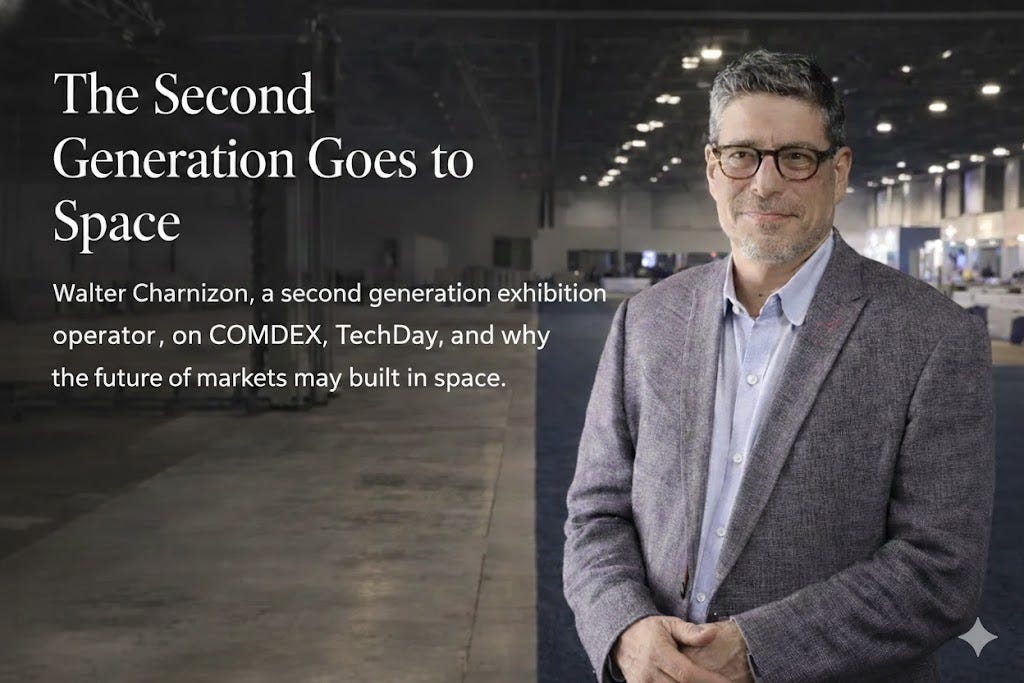
From The Show Floor to Space
Walter Charnizon, a second-generation exhibition operator, on the Past, the Present and Up/Links to the Future
Walter Charnizon is building something that very few people will be allowed to enter.
Not because it is hidden, but because it is intentionally small.
At a moment when the exhibition industry measures ambition by square footage and confidence by acquisition announcements, Walter and his partner Steve Corrick are choosing constraint and intentionality.Together they are launching Up/Link – The SpaceTech Business Summit, an invitation-only gathering capped at roughly two hundred participants. There will be no sprawling hardware floor, no theatrical spectacle designed to suggest inevitability. Instead, builders of space infrastructure will sit across from institutional buyers, capital allocators, and insurance underwriters. The premise is not volume. It is alignment. It is ROI.
Corrick’s career runs through the institutional backbone of modern exhibitions — UBM plc, Comexposium, and IDG (International Data Group) — organizations fluent in governance, portfolio logic, and global scale. Walter’s lineage is different. He has always worked in lean, entrepreneurial environments and started in this business by opening mail at his father’s startup show management company in a modest Manhattan office, by selling booth renewals face to face, by noticing how something as minor as coffee cup size alters the flow of conversation. Their partnership is less a pivot than a synthesis: founder instinct married to corporate architecture.
To understand why that matters, you have to begin well before Javits, before COMDEX, before private equity turned exhibitions into financial assets.
Walter’s father began as a trade journalist at Supermarket News, covering the supermarket industry in the early 1970s. Walter remembers reading about a grain deal between the Soviet Union and the United States and realizing that the cereal aisle was not random. It was the visible edge of contracts, negotiations, and logistics arranged in distant rooms. Commerce was not chaos; it was structure.
A recession in the mid-1970s pushed his father out of journalism and into Clapp & Poliack, one of the industrial exhibition firms founded in 1929, that defined the era. Saul Poliack, in particular, became a towering presence. Brilliant, strategic, capable of reading the Wall Street Journal and sketching the skeleton of a new event before finishing his coffee, Poliack treated exhibitions as instruments of market authority. Industry leaders like Richard Copley Smith and Peter Nathan operated in the same mold, at the same firm, building industrial trade shows for plant engineers and electrical contractors that felt like extensions of the factories they represented.
Show management offices sometimes had bars in them. Not for ornament, but for proximity. In a pre-digital world, trust was built by sitting still with someone long enough for the conversation to turn real.
And then there was COMDEX.
Las Vegas tilted toward it. If you were Microsoft, Intel, or IBM, you timed announcements around it. It had scale, swagger, and consequence. It also carried the quiet fragility that accompanies belief in inevitability.
Walter was not running COMDEX. He was answering phones in a small Manhattan office while living in an apartment that cost $484 a month and studying psychology. He was also running educational travel programs through Israel and Eastern Europe, staging debates in costume about ancient political ruptures. He believed in narrative and belief formation. Selling felt blunt.
Then the mail started arriving.
The Javits Center had just opened. His father’s electrical construction show would be only the second event ever staged there. Business reply cards — prepaid registration confirmations — arrived twice daily and stacked visibly on his desk. When the doors opened and contractors streamed in speaking their own shorthand, scanning badges for familiar names, the air changed. It was not simply attendance. It was recognition. An industry seeing itself whole.
The origin of that show had been strategic. McGraw-Hill’s trade publication in the sector had slipped from number one to number two. The solution was not another editorial push; it was a marketplace. Build the event, restore authority. The exhibition was a market-share lever. It worked.
Walter learned the trade the old way. He pounded aisles for renewals. He walked competitor floors. He watched exhibitors sit in booths reading newspapers while declaring that trade shows did not work. He learned that no event works for someone unwilling to engage. He learned that aisle widths alter perception — narrow corridors create density when numbers are thin; wide corridors create promenades when numbers are strong. He learned that gatherings are behavioral ecosystems, and ecosystems respond to detail.
When his father sold their flagship show in one of the early consolidation waves, Walter felt the generational rupture. He had imagined continuity. Instead, he confronted exit logic. Rather than take his equity and leave, he reinvested it in an ergonomics show his father had acquired from Poliack.
He signed that deal days before 9/11.
The world convulsed. Travel froze. Trade shows were labeled boondoggles in political rhetoric. He stayed.
The ergonomics audience was not glamorous. Compliance officers and safety managers attended because they needed permission to spend. At one conference, a Verizon executive stripped the romance from the room. He did not lose sleep over wrist strain; he lost sleep over stock price. Translate ergonomic insight into return-on-investment language, he said, and I will fund you. Fail to do so, and passion is noise.
That became doctrine. Exhibitions are translation engines. An attendee should leave empowered to justify their presence — to command budget, perhaps even to ask for a raise.
He built under that philosophy for fifteen years, navigating 9/11, the Great Recession, tightening travel budgets, and rising convention center costs. He absorbed a lesson from his grandfather, a furrier from Romania who sold rabbit fur — affordable and labor-intensive. When the Depression came, luxury mink sellers still sold one coat instead of two. Rabbit sellers sold none. Low-margin markets collapse first.
Trying to build a business on people who do not yet have money is fragile.After selling his ergonomics show, Walter volunteered for Hillary Clinton’s campaign in Westchester. Organizing volunteers, aligning messaging, sustaining morale — the work felt familiar. Whether compliance officers or canvassers, the task was the same: organize belief.
Then came TechDay, an event for early tech startups..
At the Pier in New York, lines wrapped around the building, founders in hoodies waiting in the wind off the Hudson. In the exhibition business, lines are applause. If you judged the event by density at the door, it was a triumph.
Inside, it felt like ignition. Startups chasing capital. Investors scanning for signal. Energy that felt combustible. Walter saw momentum and did what decades had trained him to do: he tried to organize it. He introduced lead retrieval. He considered more formal infrastructure. He straightened lines that looked chaotic to him.
What he gradually understood was that some lines are mythology. The disorder was not inefficiency; it was identity. Many founders defined themselves by resisting institutional gravity. The polish that reassures corporate buyers can feel like capture to insurgents. A line around the block signals appetite; it does not guarantee durability.
Now, with Corrick, he is building Up/Link with a different discipline. Attendance is curated. Builders are seated with buyers. Capital is placed in direct conversation with engineering. Insurance is part of the ecosystem from the beginning. The keynote is framed not as spectacle but as calibration — the note to which a market tunes itself before it accelerates.
Meanwhile, inside SISO – The Society of Independent Show Organizers, Walter serves as a board member and manages its small-business special interest group, and its small business roundtable which has evolved into the Founders Exchange. SISO was founded to represent independent show operators, long before consolidation became the industry’s dominant storyline. Walter remembers early SISO gatherings in living rooms where operators debated legitimacy and survival. From his COMDEX days he even leaders from the biggest events of the day admitted they struggled to secure meetings because exhibitions were viewed as secondary channels. The mission then was to elevate credibility. That mission never entirely ended.
Markets do not simply exist; they are convened. Legitimacy is not bestowed from above; it is constructed through translation, presence, and alignment. Exhibitions do not manufacture products. They manufacture belief.
Walter Charnizon grew up inside that machinery. Now, in an era obsessed with scale and valuation, he is rewriting it — not by going bigger, but by tuning more precisely.
And he is still listening to the hum.


