
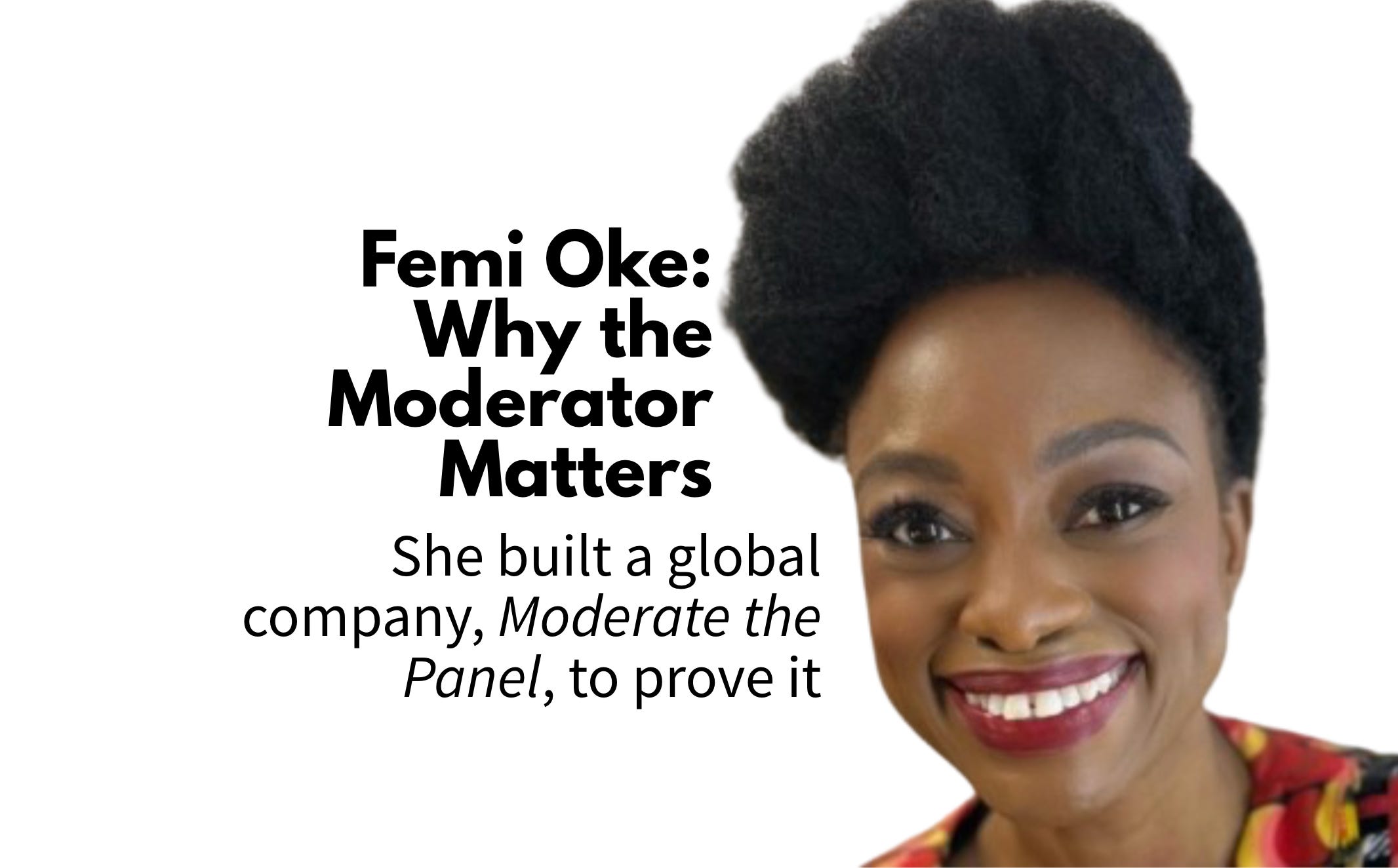
Femi Oke and the Case for the Professional Moderator
How a British-Nigerian broadcaster built a global events company on the conviction that facilitation is a profession, not an afterthought.
There is a photograph Femi Oke wants you to see. In it, she is walking stride-for-stride with the president of Ethiopia, heads tilted toward each other at matching angles, moving through a corridor toward a stage where five thousand people at Kigali Stadium are waiting. The briefing is happening in transit because Oke could not get into the VIP holding room. Protocol wouldn’t allow it. So she did what she has done for 30 years when protocol gets between her and the person she needs to talk to before they go on stage: she went around it. In 90 seconds, while walking, she laid out the arc of the session, told the president where the conversation would turn, explained that the opening question was just a warm-up, and made clear that she would need more than someone sitting politely and waiting to be asked things. The president got it. She knew Oke’s style. She knew what “more” meant.

Oke tells this story not as a flex but as an illustration of a problem she has spent her career solving: the gap between the people who plan events and the person who has to make the room work. The speakers are confirmed. The venue is booked. The napkins are folded. The sound system is tested. And then, sometimes just 48 hours before the doors open, someone thinks about the moderator. Oke, who co-founded Moderate The Panel in 2018, has made it her business to close that gap, and to argue, with increasing volume, that the person who holds the session together is not the cherry on top of the event. She is the most vital ingredient in it.
The company she built operates across six continents and fields more than 40 moderators and MCs, many of them journalists and broadcasters who learned to think on their feet in the most unforgiving classroom available: live television. The client roster reads like a directory of institutions that take convenings seriously enough to pay for them: the World Bank, the United Nations, the Rockefeller Foundation, the African Development Bank, the European Commission, Thomson Reuters. Oke herself is the lead practitioner, the company’s most requested facilitator, and the person who still sends what she calls a “moderator’s greeting note” to every panelist before every event she runs. The note is friendly and specific. It tells the speakers what she plans to do, asks them to come prepared not just with their talking points but with stories, and directs them, explicitly, to listen to each other on stage. “Your job,” she tells them, “is not only to come with what are the most important points for you, but to speak to your co-panelists.” She pauses. “Which is what I often don’t see.”
The instruction sounds almost comically simple, but Oke has learned that simplicity is the point. Good moderation, she believes, begins with giving people permission. Permission to talk to each other instead of performing for an audience. Permission to deviate from prepared remarks. Permission to react. She tells every panel she runs the same joke: “I am the laziest moderator you’ve ever met. This is the hardest I’m going to work. I don’t want to have to talk. If I’m talking, we’re in trouble.” The speakers laugh. And then, because they have been told they are in charge, they start behaving like it.
The instinct predates the career by a long stretch. Oke was seven years old when she started organizing Friday night gatherings at home, chatty and fearless in the way that oldest children sometimes are, though her version of fearless went well beyond birth-order confidence. She knocked on the windows of restaurants to wave hello to strangers eating their dinners. She walked into the middle of dance floors and started performing for no one in particular. At eight, she was collecting “news” from family members throughout the week and presenting a ten-minute broadcast she called the Oke Bulletin, delivered over steaming plates of her mother’s Jollof rice. No one in the family had a background in media. No uncle in television. No family friend at the BBC. The whole enterprise was self-generated, powered by what Oke describes, without a trace of false modesty, as enthusiasm and bounciness.
By the time she reached secondary school, the impulse had taken on an entrepreneurial shape, though the currency was never money. She rewrote the musical Grease, recruited her schoolmates to perform it, staged the production during lunchtime every day for a week, and charged two pence admission. She was on the radio at 14, one of the junior reporters on a kids’ show at LBC, Britain’s first talk radio station, writing handwritten letters to public figures and getting interviews that adult producers might not have landed, because who says no to a 14-year-old with that much nerve? By 18 or 19, she had walked into the office of the head of the BBC for a chat. Just walked in. “It didn’t occur to me that it was unusual,” she says. “It was just how I was put together.”
Oke studied English literature at Birmingham University, and the choice matters, because the way she talks about moderation borrows more from narrative theory than from communications strategy. She thinks in terms of arc, flow, story. She reads a room the way a novelist reads a draft, looking for the place where something needs to happen to keep the audience from drifting. When she was facilitating an eight-hour problem-solving session for a major foundation and the energy collapsed in the seventh hour, she didn’t call a break. She stood up and announced, “I’m going to do some brain science now. Everybody stand up.” They stood. “Your brain works better with physical activity. Sit down.” They sat. “Stand up.” They stood. “Sit down.” The room was laughing, and then the room was awake, and then the last hour of the session produced what the first six had been building toward. She had looked up the research beforehand, because she is not the kind of person who wings the science, but the instinct came first. The literature major knew the audience needed a pattern interrupt. The broadcaster knew how to deliver one.

Her path from broadcast journalism to professional moderation was not a pivot so much as a convergence. She spent a decade hosting The Stream on Al Jazeera English, a live interactive show that required her to manage multiple voices, shifting topics, and audience participation in real time, every day. She reported for the BBC, CNN, Sky, NPR. She narrated “Cursed,” a true-crime documentary series for Audible, and hosted The Negotiators podcast for Foreign Policy and Doha Debates. But the moderating kept pulling her in. Conferences would book her because she was a known broadcaster, and then something different would happen on stage, something that had less to do with her name and more to do with her ability to make a panel feel like a conversation instead of a series of interviews conducted in public.
The origin story of Moderate The Panel traces to a moment in 2006, at a forum in Brussels, where Oke watched a moderator get heckled by the audience. The moderator had lost control, and the room could feel it, and instead of course-correcting, he floundered. Oke sat in the audience and thought: this is a profession, and almost nobody treats it like one. It took another 12 years before she formalized the idea into a company, co-founding Moderate The Panel in 2018. The timing was, in retrospect, extraordinarily lucky and extraordinarily unlucky in equal measure. The company had a strong first year, was building a client base, and then in March 2020, every event on the calendar canceled within a matter of weeks.
What happened next is a testament to the logic of building a roster of broadcasters. Oke’s team knew how to look into a camera and create the illusion of proximity. They knew how to make a conversation feel real when the participants were in six different time zones staring at six different screens. While the rest of the events industry scrambled to learn virtual production, Moderate The Panel was already fluent. The company had its best two to three years during COVID, because a moderator who could run one physical event per day could suddenly run six virtual ones. The model scaled in ways that a purely in-person operation never could have.
Oke is clear-eyed about the structural problem her company exists to solve, and she does not dress it up in diplomatic language. Event organizers, she says, routinely undervalue the moderator because a good one makes the job look effortless. “It only looks hard when it’s going horribly wrong,” she says. The result is that organizations will spend on the venue, the catering, the AV, the water, and then try to get the moderation done pro bono, or hand it to the head of the association, who goes off on tangents and greets friends in the audience by name while the program drifts. Oke calls this a false economy. She is polite about it, but she is not equivocal.
The deeper argument, the one that animates her work at a level beyond business development, concerns what a skilled facilitator can do when the stakes extend beyond conference programming. She brings it up unprompted: the meeting between Presidents Trump and Zelensky at the White House that devolved into public recrimination on live television. “They really needed a facilitator in that room,” she says, and then she walks through, in specific tactical detail, what she would have done. She would have established a run of show. She would have spoken to both principals beforehand to read the room. She would have redirected the conversation before it reached the suit comment. “We are moving on here,” she says, in the voice she would have used. “We will save the sartorial conversation for a little bit later. Sartorial elegance is number three on our rundown.” A little laughter. Move things along. Don’t let the lull become the moment. She is not being grandiose. She is, without quite saying it, making the case that facilitation is a form of statecraft, and that the absence of it has consequences that extend well beyond a bad panel.
Her method with introverts is where the craft becomes most visible. She watches body language with the specificity of a poker player reading tells: the man with the beard stroking his chin is thinking. The minister writing a note on a pad heard something that triggered an idea she was saving for later. Oke will call it out, gently. “Minister, you seem to be writing an essay. Would you like to share it with us?” And the minister will share. And the point she shares will often be the most important thing said on stage all day, a thought that would have stayed in the margins of a notebook if no one had thought to ask for it.
She rearranges seating charts to put the least confident panelist closest to her, even when it conflicts with protocol. She arrives early enough to greet audience members by hand, not because she read a book about it but because she learned, through repetition, that the audience is the most important participant in any room. “If you’ve got three panelists, the audience is the fourth panelist,” she says. “You’ve got five panelists, they’re the sixth. They’re as important as somebody who’s on the stage.” She means it structurally, not sentimentally. The audience is where minds actually change. She can see it happen: the lean forward in a chair, the turn to a neighbor, the note scribbled after a point that landed. The panelists may continue the conversation on stage after the session ends, surrounded by people who don’t want business cards, who just want to keep talking. That, she says, is the evidence that something worked.

Oke attributes her confidence, when pressed, not to any single influence but to a national inheritance. She has Nigerian heritage, and she delivers the generalization with a wink: Nigerians are extremely confident. They feel anything is possible. Her mother told her to aim high. Education was the universal vaccine. Beyond that, the explanation she offers is almost tautological in its honesty. She was put together this way. She was an enthusiastic little girl who loved radio and loved TV and had no one in her family to show her how any of it worked. She figured it out by walking into rooms and starting to talk. She is still doing it, at the World Bank this Friday, for the State of the Africa Region launch, where she will host a conversation with one of Africa’s wealthiest men, several government ministers, and an audience full of people who know more about the continent’s future than any panel could convey in 90 minutes. Her job is to make sure the room hears what it needs to hear, including from itself.
If you are shouting the truth, Oke says, you have already lost to the person who is calmly telling lies. It is one of those lines that sounds like it belongs on a bumper sticker until you think about it for a moment longer and realize it is a theory of power, and a theory of moderation, and possibly a theory of everything that is wrong with public discourse in 2026. Oke delivers it calmly. She would.
Your job is not to ask questions. It’s to give people permission.
Before every event, Oke sends panelists a “moderator’s greeting note” telling them to listen and react to each other on stage, not just deliver prepared remarks. Once they know they have permission to deviate, they stop performing and start thinking.
Shouting the truth loses to calm lies.
In any exchange, the person who controls their emotional register controls the room’s perception of credibility. A moderator’s first move in a heated moment is to lower the temperature, not correct the record.
The audience is the panel.
Three panelists means the audience is the fourth. Oke watches who leans forward, who turns to a neighbor, who scribbles a note. Often there’s more expertise in the seats than on the stage, and a moderator who ignores that is running half the room.
The note-taker has the best point. Ask for it.
When a panelist jots something down mid-session, they’ve had a thought they were saving for later. “Minister, you seem to be writing an essay. Would you like to share it with us?” What follows is almost always the most important thing said all day.
You budgeted for napkins but not the moderator.
Organizations pay for the venue, the catering, the AV, then try to get the one person who makes it all come alive for free. Oke calls it the first false economy in events.
Seat the introvert next to you. Even if it breaks protocol.
Confident panelists perform from any chair. The nervous one needs proximity to the moderator. Oke rearranges seating charts to make this happen, overriding protocol if she has to.
Stories last a year. Lines last until coffee.
A polished talking point might earn applause, but an anecdote lodges in memory at a different depth. Oke always asks speakers for stories, not arguments.
Ask for 40 minutes to get 30.
VIPs asked to arrive 15 minutes early show up five minutes before. Build the buffer into the ask so you actually get green-room time with your speakers.
Never put someone on stage cold.
When protocol blocked Oke from the VIP room before a session with the president of Ethiopia, she briefed her in 90 seconds while walking to the stage. Even that was enough.
Facilitation is statecraft.
The Trump-Zelensky White House meeting devolved because no one was managing the room. Oke’s prescription: a run of show, a pre-read of both principals’ moods, and someone empowered to say “we’re moving on” before the lull becomes the moment.


