


Editor’s Note: A quick personal note before we start. It began with a question I could not shake. Why do we call it a ballroom? I book them, I write about them, I have stood in a hundred of them, and I had never once stopped to ask where the word came from. So I went looking, and the answer turned out to be stranger and better than I expected. It is the piece below.
Here is the part worth saying out loud. I did the reading the old way, chasing sources and footnotes, but I also fed the whole history into Google’s NotebookLM and let it build a short video version. Watching it assemble the story was a small marvel.
People love to catalogue everything wrong with AI, and plenty is wrong, and I stay skeptical about the real dangers. But if you keep your own hand on the wheel and point these tools at your curiosity instead of outsourcing it, this is an amazing time to be a curious person. A question that used to cost a library afternoon now opens in seconds, and it opens for everyone. Do not surrender your agency. Aim it at something you have always wondered about. The full piece follows.
How the Ballroom Lost Its Ball
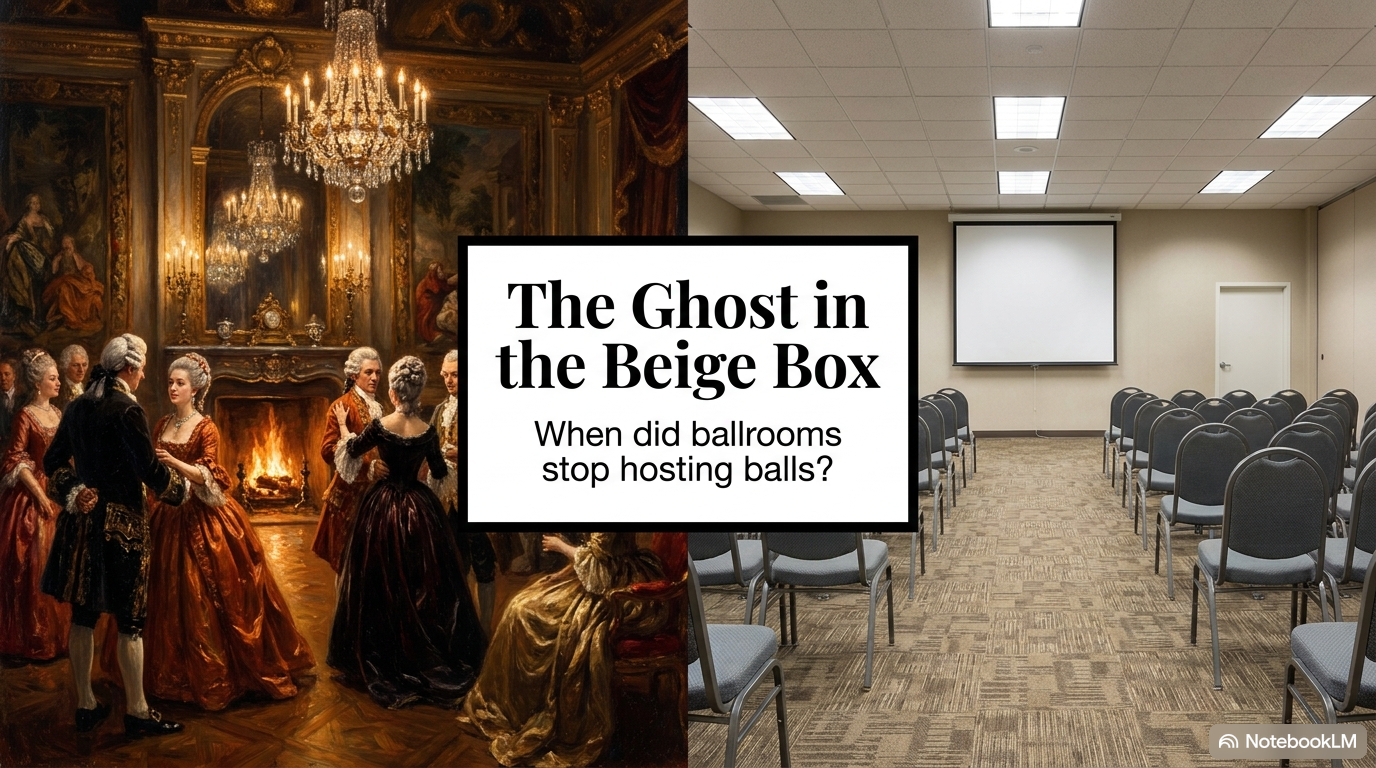
With all the popular culture talk about ballrooms, I thought it would be fun to take a deeper dive. Book a ballroom this week and here is what you will actually get: a beige room with a dropped ceiling, a carpet patterned like a migraine, a structural column in the worst possible spot, and a nine a.m. slot for a session on compliance. Nobody will dance. Nobody has danced in that room in years. And yet the word sitting on the banquet order, the word everyone says without hearing it, is ballroom. There is a ball in there. An actual one, the kind with an orchestra and a grand staircase, and it has been quietly haunting the hotel function room for about a century.
The story of how a room built for dancing became the most flexible, most rented, most anonymous box in the building is also, in miniature, the story of the whole gathering economy. It runs from a king who caught fire on the dance floor to a Gilded Age hotel that turned the private party into a public product, and it ends in a carpeted hall where the chandeliers stayed and the waltzing left. Here is how the ballroom lost its ball.
There is a ball in ballroom
Say the word slowly and the history falls out of it. Ball, meaning a formal dancing party, entered English in the 1630s, borrowed from the French bal and the Late Latin ballare, to dance, which traces back to the Greek ballizein, to leap and throw the body around. The same root gives us ballet and ballad. The room came later. Ballroom is first recorded in 1724, and for almost all of the word’s life it meant one thing only: the room where you danced. Not the room where you convened, or broke out into working groups, or plated chicken for six hundred. The room where you danced.
When a ball could kill you
And the dancing was not beige. The great balls of history were spectacles of light, risk, and power, and occasionally they were lethal. In 1393, at a royal celebration in Paris, King Charles VI of France and five noblemen danced costumed as wild men, their linen soaked in resin to hold the shaggy look together. A torch caught one of them. Four of the six burned to death. The king survived only because the young Duchess of Berry threw her skirt over him, and one dancer saved himself by leaping into a vat of wine. History files it as the Bal des Ardents, the Ball of the Burning Men, which is worth keeping in mind the next time a venue frets over an open-flame permit.
Two centuries later, Louis XIV danced his court into obedience at Versailles, where a ball was statecraft in silk slippers. And when Europe met to redraw its borders at the Congress of Vienna across 1814 and 1815, the diplomats threw so many balls that the Prince de Ligne is remembered for the quip that the Congress did not march, it danc
ed. For most of its life, the ballroom was where nations flirted and empires changed hands.
The first room you could rent
The room became a business the moment society did. The direct ancestor of every hotel ballroom on earth is the eighteenth-century assembly room, a public space you paid to enter, where the gentry gathered to dance, play cards, drink tea, and be seen. Almack’s opened in London in 1765 and invented the velvet rope. Admission ran by a nontransferable voucher, handed out by a committee of aristocratic patronesses who cared more about breeding than money, and the refreshments were famously grim: tea, lemonade, bread and butter, plain cake, nothing stronger. The first exclusive ticketed venue in the modern sense served worse food than your last conference, and it still kept a waiting list.
The Bath Assembly Rooms followed in 1771, a purpose-built suite of ballroom, tea room, and card room. This is the hinge of the whole story. The ball stopped being something a king staged inside his palace and became something an ordinary person of means could book.
Who put the ballroom in the hotel
No single genius moved the ball into the hotel. It took two moves on two sides of the Atlantic. In 1889 the impresario Richard D’Oyly Carte opened the Savoy in London, hired a young manager named César Ritz and a chef named Auguste Escoffier, and together they made it fashionable, even a little scandalous, for high society to dine and socialize in public, inside a hotel, rather than behind the closed doors of a private house. That broke the seal.
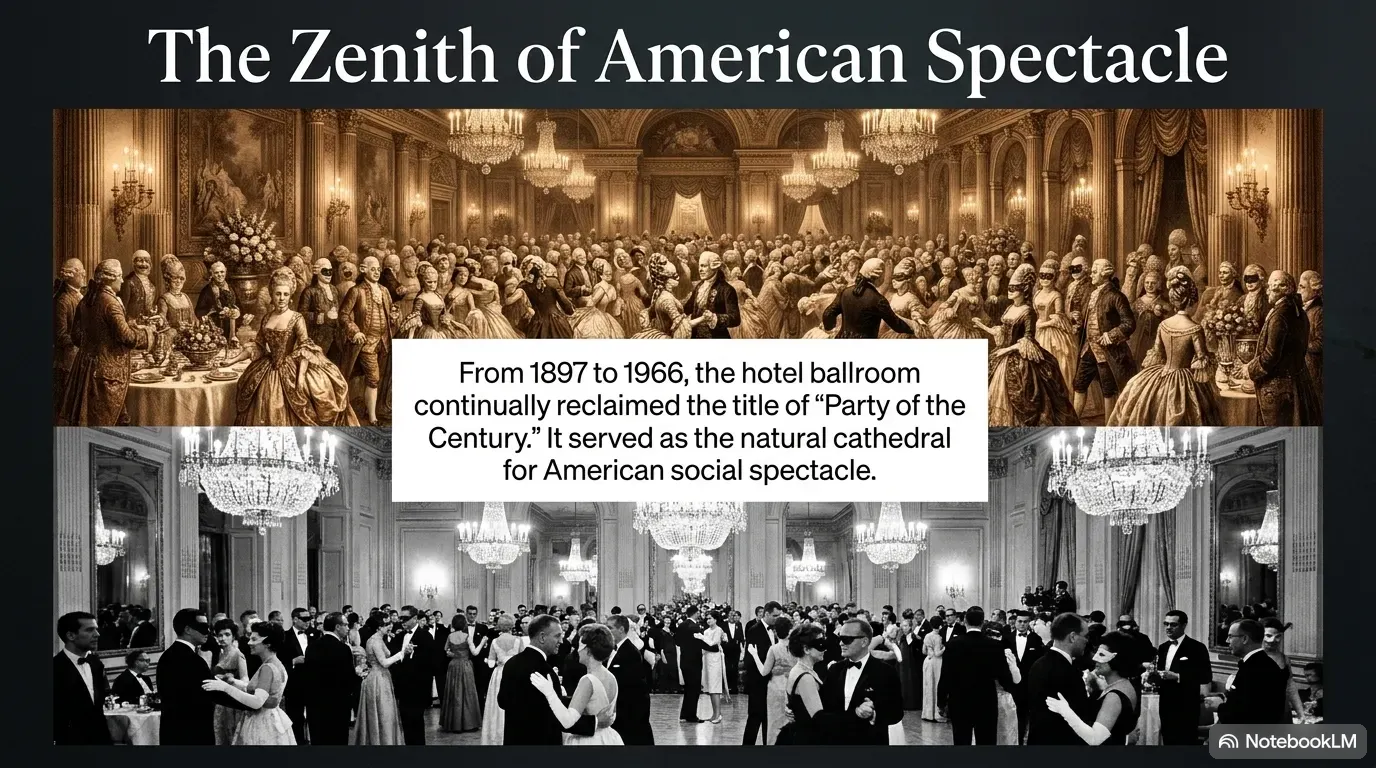
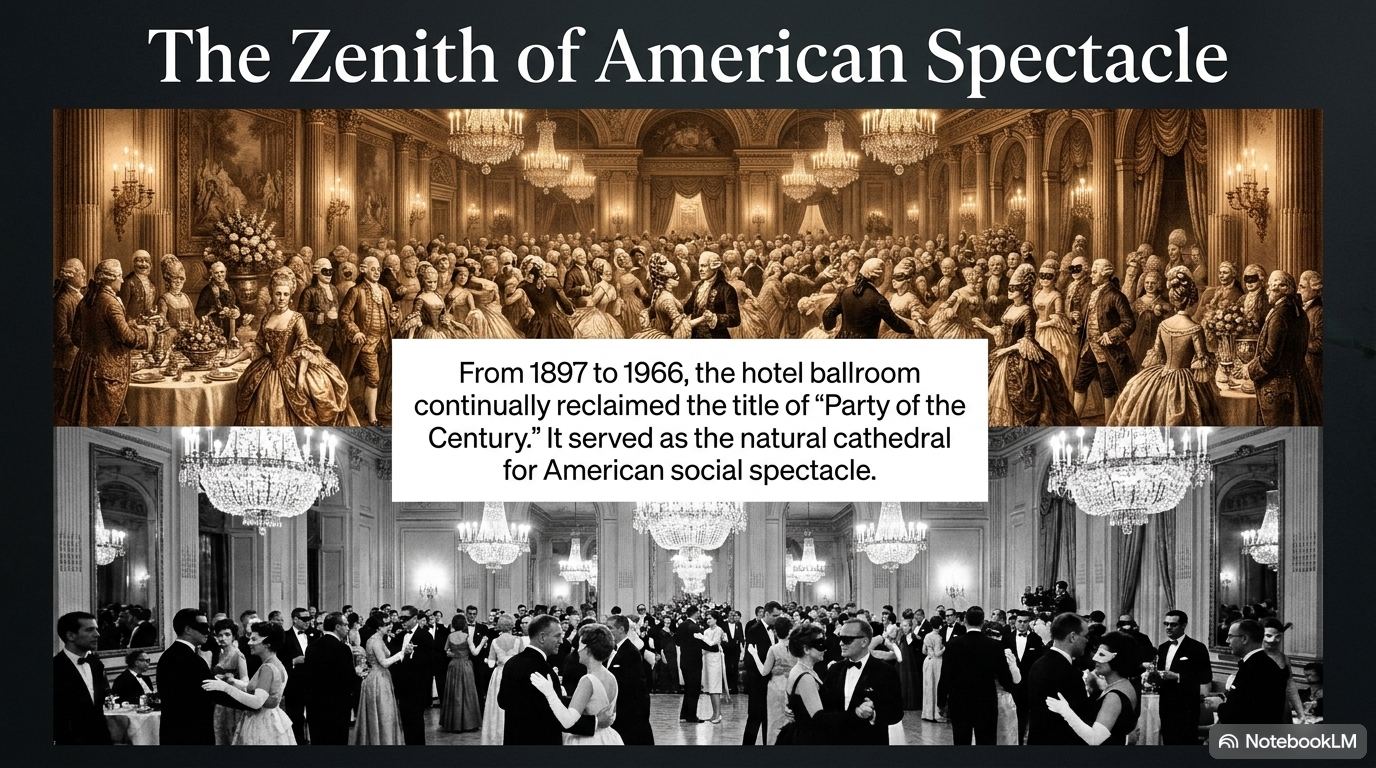
Then New York finished the job. The Waldorf opened in 1893 and the adjoining Astoria in 1897, and the combined Waldorf-Astoria’s ballroom became the stage on which the Gilded Age performed itself. The proof arrived in February 1897 with the Bradley-Martin ball, staged inside the Waldorf dressed as Versailles, hundreds of guests in period costume, a reported fortune spent in the middle of an economic depression, which is exactly why the papers covered it as both a party and a scandal. The hotel ballroom had found its purpose: the room where a city’s social ambition became visible for one night. Seven decades later, when Truman Capote wanted to throw the century’s defining party, his Black and White Ball of November 1966, he did not build a room. He booked one, the Grand Ballroom of the Plaza.
The dancing stopped and the word stayed
Then, sometime in the twentieth century, the ballroom quietly changed jobs, and almost nobody noticed. You can date the drift from the arrival of a new term, function room, first recorded in 1922. A function room is a space defined not by what it is but by what it can be made to do. The chandeliers stayed. The dancing left. The ballroom became a flexible box for banquets, then conventions, then trade shows, then the breakout session and the sales kickoff and the Saturday wedding and the Sunday memorial. Vienna still holds the line, throwing more than four hundred and fifty balls a year in its winter season and guarding the word’s original meaning. Everywhere else, ballroom became the polite, historical name for the largest empty box in the building.
Which returns us to that nine a.m. compliance session under the migraine carpet. The planner who booked it is renting, without knowing it, the faded ghost of a room where kings caught fire and empires danced. The ball is still there, sitting inside the name. We just wheeled in a projector screen and set it down in front of the staircase that used to be.
GatheringPoint covers the people who build the gatherings. Subscribe at GatheringPoint.news.


