


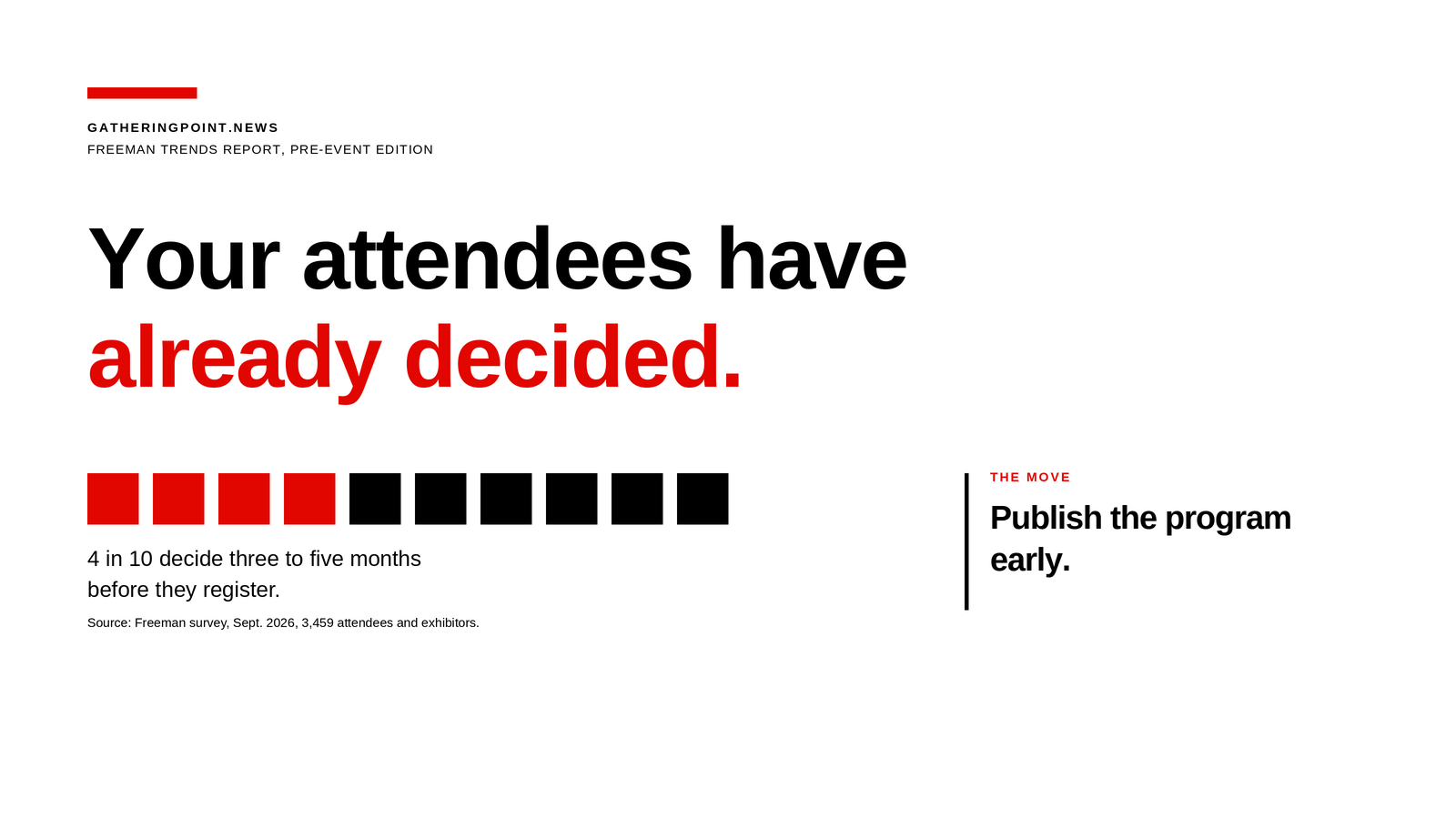
Freeman’s latest research, the Pre-Event edition of its Trends Report, finds that attendees decide whether to go months before they register, and that about half either pay their own way or have to persuade a manager. The survey of 2,272 attendees and 1,187 exhibitors, taken in September 2026, also contains a puzzle for organizers. Event organizers commonly offer flexible cancellation to win early sign-ups, but seven in ten attendees said it would let them register closer to the event, and nearly three in ten said significantly later. Those are stated intentions, not observed behavior, so the finding calls for a test, not a conclusion.
It points at something larger. Attendees are not making an impulse purchase that a deadline can pry loose. They are making a case, and a case takes time.
The decision happens early
More than eight in ten attendees say they decide to go at least four weeks before they register, and four in ten decide three to five months out. Freeman’s agency arm, mdg, reports from its own 2026 campaign averages, not from the survey, that about half of registrations arrive in the final four weeks. So the survey describes when people decide, and mdg’s data describes when they pay.
Once they have decided, more than half begin planning at least three weeks ahead. Nearly half go with colleagues and meet beforehand to divide the coverage.
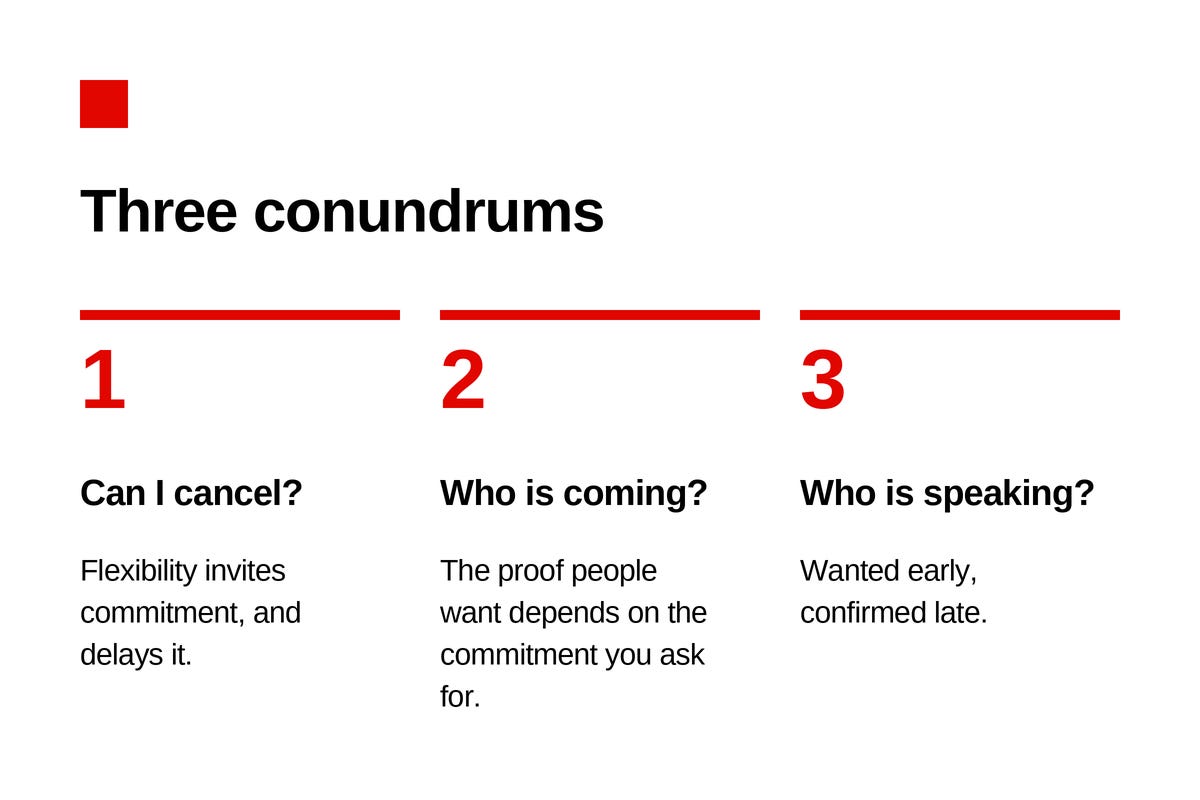
Conundrum 1: Can I cancel?
The bind. Flexible cancellation is the second most cited lever for registering earlier, named by nearly four in ten attendees. Yet seven in ten say flexible terms let them register closer to the event, and nearly three in ten significantly later.
Why it is structural. The thing that lowers the risk of committing also lowers the pressure to commit.
A way through (my inference). Test two policies at two events and compare registration timing.
What we don’t know. The report presents these two findings separately, so I can’t tell whether the same people gave both answers.
Who is being persuaded
About half of attendees say going was their own idea: a quarter paid their own way and a quarter pitched their manager. For another quarter a manager asked them to go, and for 15% it was required. Half your audience is therefore either spending its own money or building an internal argument.
What wins that argument depends on the attendee’s motive. Commerce-minded attendees lead with products that benefit the organization, learners with skills, and networkers with a partnership worth advancing. Freeman recommends giving attendees a justification kit, including a letter they can send to a boss. On these numbers, I would treat it as basic equipment.
What counts as proof
The attendee’s checklist is specific. They open the exhibitor list and floor plan (a little over half), the detailed program (nearly half), and the education sessions and networking pages (four in ten each). Their complaints are about missing information: four in ten say program detail is lacking, four in ten say the program wasn’t posted early enough, and nearly four in ten can’t tell which companies and products will be there.
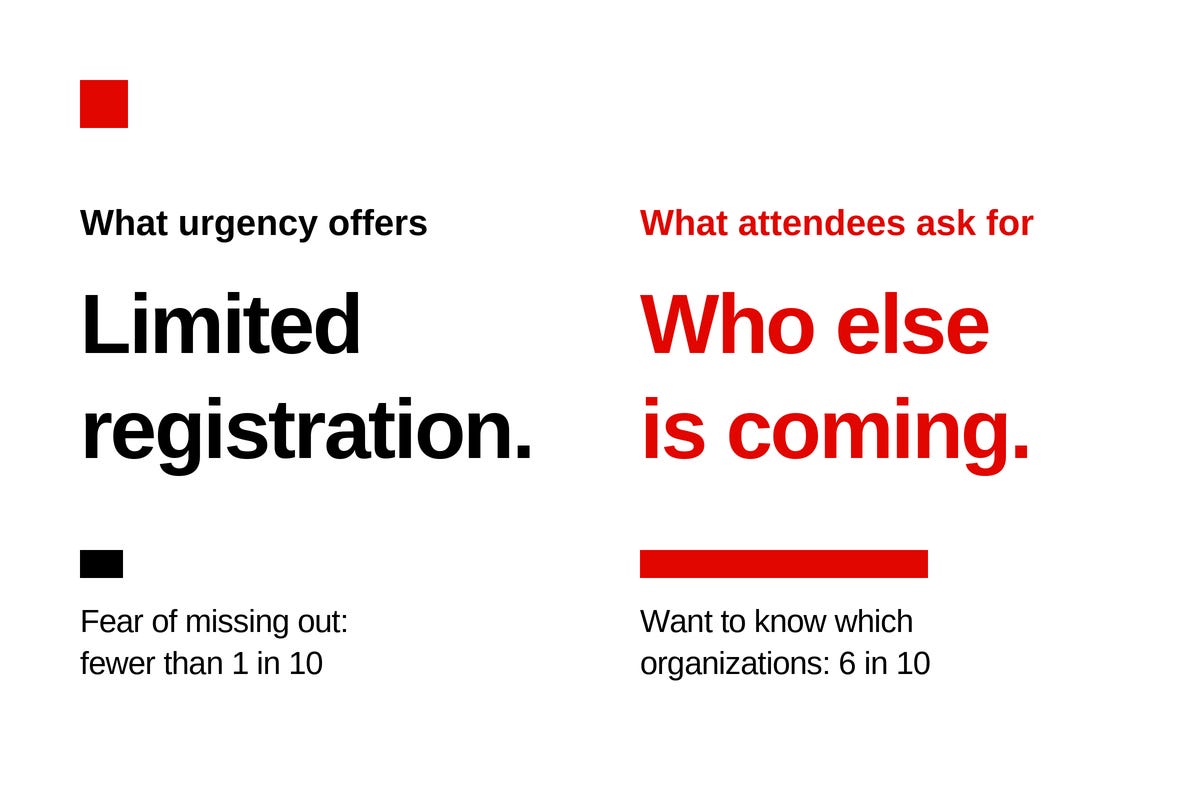
What most often compels them to register is knowing who else is coming. Six in ten want the types of organizations attending, and nearly half want named experts.
Urgency does much less. Limited registration availability drives fear of missing out for fewer than one attendee in ten, and limited early expo hours for about the same. Discounts still work, since six in ten say a discount would get them to register earlier, but cheap scarcity is working harder than the evidence supports. That last point is my inference from comparing two separate questions in the same survey.
Conundrum 2: Who is coming?
The bind. Attendees want to know who else is attending before they commit. Most register late, so the list is thin while they are deciding. Exhibitors decide even earlier: four in ten start nine or more months out.
Why it is structural. The proof people want is created by the commitment you are asking them to make.
A way through (my inference). Publish proxies: last year’s attendee mix by organization type, plus a running count of registrants by segment. Organization types are knowable from past data without knowing any individual’s plans, and they are what attendees ask for most.
What we don’t know. Freeman doesn’t test whether proxies persuade as well as a real list.
Conundrum 3: Who is speaking?
The bind. Four in ten attendees say the program wasn’t posted early enough. But the same survey says speaker names, titles and short descriptions are enough for four in ten, and only about three in ten want a detailed program.
Why it is structural. Organizers often don’t have the speakers confirmed when the first decisions begin. That part is industry experience, not survey data.
A way through (my inference, built on Freeman’s advice to post what you have). Publish confirmed speakers as you go, on a dated rhythm, so people know when more is coming.
What we don’t know. The survey shows what people say suffices, not how many registered because of it.
Exhibitors run the same test
Exhibitors apply the same standard, with larger stakes. Nearly half say organizers don’t post the roles and levels of attendees, and four in ten say they can’t easily tell whether the event will deliver a return. Only about one in six says events explain that return effectively.
Their approvals rest on concrete numbers: nearly two-thirds need expected new leads, and just over half need existing relationships advanced. Their strongest fear of missing out is competitors exhibiting, at six in ten. They also decide early, since four in ten begin nine or more months out, which is long before most attendees have registered.
AI is a tool attendees bring
Freeman calls AI “your newest gatekeeper,” but its survey supports something narrower. About one attendee in five has used AI to find events. Of those, more than eight in ten used it to shortlist, and about half say it changed which events they consider. Yet only one attendee in ten names AI as a way they learn about events, and fewer than one exhibitor in ten does, far behind colleagues, vendors and trade organizations at nearly half each.
When asked what they would use for preparation, four in ten prefer a familiar tool such as ChatGPT, Claude or Gemini, and about one in eight wants the event’s own. Only a quarter expect an event to offer one. My read is that AI helps attendees justify a trip using their own tools. Freeman’s practical advice for organizers is the cheap step: put dates, location, pricing and speakers in plain text instead of PDFs or images, so the tools attendees already use can read them.
Four readers, four moves
This is my reading of the survey. Freeman did not measure how any of these readers would react.
If you run marketing: scarcity counts for little and proof counts for more. Post last year’s attendee mix by organization type.
If you exhibit: you are deciding before the data exists. Ask for past-event benchmarks before you commit.
If you attend: you are probably building the case yourself. Lead with one reason: a product, a skill, or a relationship worth advancing.
If you are the boss: the evidence is suggestive, not proof. Approve one publishing change and one test.
What to bring your boss
If you are the person who has to persuade the executive above you, the case should be small, cheap and testable. The report gives evidence, not proof. It says what attendees say they want and how they say they behave, and it cannot tell you that changing your tactics will move your registration numbers. These are objections I would expect, not ones anyone has voiced.
“Deadlines and discounts have always worked.” The survey agrees about discounts, and nobody is proposing to drop them. It does not say deadlines fail. It cannot tell you whether your late-registration surge comes from your deadlines or from people being busy. That is a gap to test, not an argument to win.
“Show me it changes registration.” It can’t. Run a cheap experiment: publish last year’s attendee mix by organization type and a running registrant count at one event, or compare flexible and strict cancellation terms at two, and watch registration timing. The report says where to look, and your own data says whether it works.
“Our exhibitors renew anyway.” Perhaps. But nearly half say they can’t find who attends, only about one in six says events explain the return, and four in ten start deciding nine or more months out. Put a number on that renewal risk from your own data.
“We should build an AI assistant.” About one attendee in eight prefers the event’s own over a familiar tool. The cheaper step is plain text for dates, location, pricing and speakers.
“Freeman sells services.” True, and it is fair to separate the survey’s numbers from the recommendations built on them.
What to ask for: one low-cost change to publishing and one test, not a strategy overhaul.
What we don’t know
This is one survey at one moment, with no year-over-year comparison, so it describes how attendees say they behave now, not a change over time. Some questions don’t make clear who answered them, and a few of the report’s own figures disagree with its charts, so I have used the safer numbers. “Events are justified, not bought” is my synthesis, not a finding Freeman states.
Source: Freeman, Trends Report: Pre-Event Edition (Q4 2026), a September 2026 survey of 2,272 attendees and 1,187 exhibitors.
GatheringPoint covers the people who build the gatherings. Subscribe at GatheringPoint.news.