
Engineering Serendipity
How Tim Groot built Grip to help the right people meet—and why he believes the future of conferences will be measured in conversations, not square footag
The modern conference industry runs on a strange contradiction. Tens of thousands of professionals may gather under one roof, filling exhibition halls the size of aircraft hangars, yet the real value of those gatherings usually comes down to only a handful of conversations. The founder who meets an investor at the right moment, the retailer who finds a supplier across the aisle, the executive who discovers a technology partner between sessions—those encounters are what justify the flights, the hotels, and the days spent away from the office. Everything else surrounding an event, from the stages and signage to the sponsor lounges and cocktail receptions, exists largely to make those meetings possible.
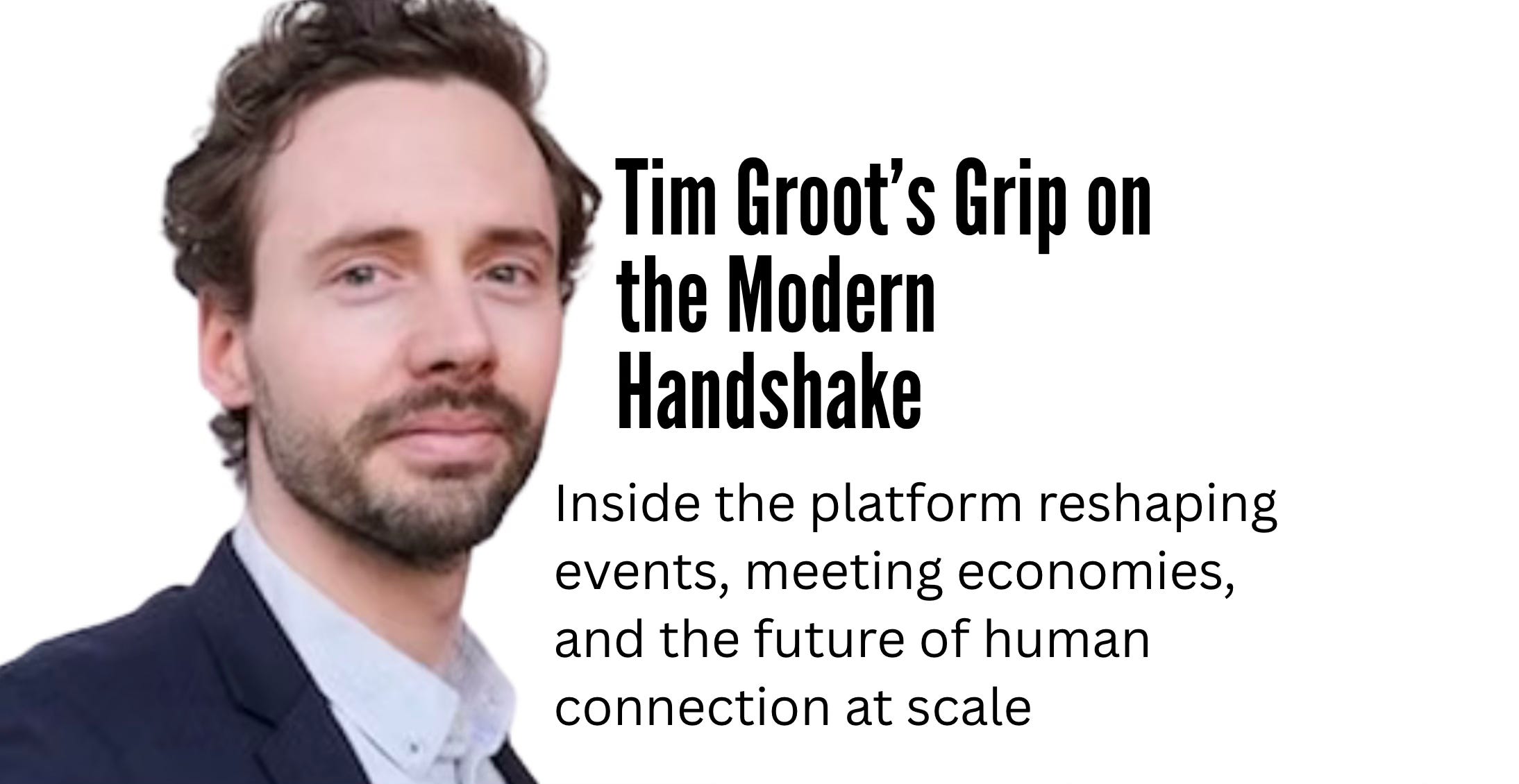
For the Dutch entrepreneur Tim Groot, that reality became the foundation of a company that now operates quietly behind the scenes at many of the world’s largest conferences and exhibitions. His firm, Grip, builds the technology that helps participants identify who they should meet and then orchestrates the logistics required to make those meetings happen. The platform analyzes attendee profiles, recommends relevant connections, and increasingly schedules the meetings themselves, coordinating thousands of introductions that might otherwise depend on luck.
Listen to the Tim Groot Grip Story in Song
.Grip’s systems now operate most visibly in appointment-driven conferences and hosted-buyer marketplaces, where the central purpose of attending an event is the series of one-to-one meetings that happen across a few densely scheduled days. Retail gatherings such as ShopTalk, fintech conferences like Money20/20, and numerous industry marketplaces across Europe and the United States rely on systems capable of coordinating thousands of conversations within limited time windows. In those environments the event floor begins to resemble something closer to a marketplace than a traditional conference, and the ability to match buyers with sellers efficiently becomes the real product being delivered.
The path that led Groot into this world began far from the conference circuit. He grew up in the Netherlands as the son of a tulip farmer, surrounded by the long ribbons of color that transform the countryside each spring. To visitors the sight feels almost cinematic—rows of red, yellow, and purple stretching toward the horizon—but to the children of farmers those fields are simply where work happens. Groot began helping on the farm around the age of eleven or twelve, driving forklifts and assisting with the routines that keep an agricultural business moving. By sixteen he had already traveled internationally with his father and the company’s sales representatives, visiting customers in Eastern Europe, Japan, and South Africa who purchased Dutch bulbs for their own markets.
Listen to the Tim Groot Story in Song
The experience exposed him early to the rhythms of global commerce. Tulips are beautiful, but they are also products that must be grown, marketed, and sold in a competitive international market. His grandfather had started the family business, and discussions about varieties, supply chains, and pricing were part of daily life. Looking back, Groot often describes those years as his first education in entrepreneurship.
Even as a teenager he experimented with ideas designed to attract attention to the family’s flowers. Inspired by the story of seventeenth-century tulip mania, he once launched a website offering what he described as the most expensive tulip bulb sold in modern times. The site offered ten bulbs of a rare variety priced at one hundred euros each when most bulbs sold for pennies. The idea attracted national media coverage in the Netherlands and eventually produced a single sale, which he still remembers with amusement. Markets, he learned early, are shaped as much by curiosity and storytelling as by supply.
Those instincts surfaced elsewhere during his teenage years. In school he remembers running small side businesses selling copied software and DVDs to classmates. Despite eventually founding a technology company, he still insists that he does not think of himself primarily as a technologist. What fascinates him most is human behavior and the patterns behind it.
The idea that eventually became Grip emerged years later during an internship at a mobile-app development agency. The firm built applications for banks and corporate clients, and part of Groot’s job involved attending conferences to search for potential customers. It did not take long for him to notice how inefficient networking at events could be. Even in rooms filled with hundreds of professionals, identifying the few people who mattered for a particular conversation often felt like searching for a needle in a haystack.
At the same time he was encountering a very different model of connection in his personal life. Like many people his age he had begun experimenting with dating apps such as Tinder and Bumble, where strangers could connect almost instantly through a simple matching interface. In his own case the experience became more than theoretical; he eventually met his wife through Bumble. Watching those two worlds side by side produced the insight that launched his company. If software could efficiently match people looking for romantic partners, why couldn’t it help professionals meet each other at events?
The earliest version of Grip was essentially an experiment built around that question. Participants created profiles describing their interests and goals for attending a conference, and the system suggested people they might want to meet. Messaging tools followed so that participants could reach out to each other directly. But when hundreds or thousands of meeting requests began arriving simultaneously the scheduling quickly became chaotic. The next step was automation. Grip developed algorithms capable of coordinating meeting calendars across entire conferences, automatically filling time slots and resolving conflicts so that participants could move efficiently from one conversation to the next.
What began as a networking experiment gradually evolved into an infrastructure system for what might be called the meeting economy of modern conferences.
One of the insights that shaped the company’s development is that technology like this only becomes essential once gatherings reach a certain scale. At small events—a dinner, a retreat, or a workshop—everyone can meet everyone else naturally. The density of relevant conversations is already high. The problem emerges when events grow large enough that participants can no longer navigate the network on their own.
At major trade shows thousands of people may attend, yet only a fraction of them are relevant to any individual participant. A founder looking for investors, a retailer seeking suppliers, or an executive exploring new technologies may discover that only ten percent of the people in the building are actually worth meeting. Grip’s technology attempts to restore the probability of those encounters by identifying relevant matches and organizing the meetings that might otherwise never occur.
During our conversation I mentioned my book Harnessing Serendipity, which explores the idea that gatherings can be designed to increase the likelihood of unexpected connections. Groot immediately reframed the idea in his own words.
“How can we engineer serendipity?” he asked.
The phrase captures the ambition behind the company’s technology. Serendipity is traditionally understood as something accidental—two people bump into each other in a hallway and discover a shared interest. But large conferences make those accidental encounters harder, not easier. When thousands of participants fill a convention center, the odds of meeting the right person randomly actually decrease. Grip’s systems attempt to solve that paradox by quietly increasing the probability that the right people find each other.
Working at the center of these networks has given Groot an unusual vantage point into how ideas move through industries. Because the platform observes what thousands of professionals are searching for and discussing at events, it sometimes reveals trends before they appear elsewhere. He remembers noticing rising interest in blockchain technology among conference attendees long before the topic became widely discussed in the broader business world. Conferences, he believes, often function as previews of the future because they gather the people who are actively exploring new ideas.
Another shift he sees emerging concerns how the events industry measures success. Traditional metrics such as attendance numbers and exhibition floor space still dominate conference reporting, but they say little about whether meaningful interactions actually occurred. Groot believes the next frontier will involve measuring the quality of meetings themselves. If technology can identify who met whom and whether those conversations lead to follow-up discussions, partnerships, or deals, organizers may finally be able to quantify the real economic value created by a gathering.
During our conversation the discussion drifted toward how the exhibition industry itself is evolving. Groot spoke with particular respect about the Belgian event company Easyfairs, which is also a customer of Grip. What he admires most is the clarity of its operating model. Easyfairs has built its portfolio around standardized event formats and strict performance metrics, creating a level of operational discipline that is unusual in a sector where many organizers produce events in dozens of different styles.
Technology may soon push events in a different direction as well. Advances in artificial intelligence could make it possible to personalize conferences at a scale that was previously unimaginable. AI systems may analyze participant interests, suggest relevant meetings, and manage logistical details automatically. Yet Groot remains cautious about allowing machines to make strategic decisions without human oversight. During a recent internal meeting, his team presented an AI-generated recommendation about which geographic market the company should pursue next. The analysis appeared convincing, and the team began executing the plan immediately. Groot stopped the conversation with a simple question: had anyone actually challenged the recommendation, or were they simply following what the machine suggested?
The moment illustrated a concern he believes will become increasingly important as automation spreads across industries. Technology can remove friction and automate repetitive tasks, but judgment still belongs to people.
His own role inside the company has changed as Grip has grown from a small startup to a team of roughly seventy-five employees. He now describes his job less as building software and more as helping the organization think clearly—ensuring the right conversations are happening internally and offering a vision of where the industry might be heading.
Near the end of our conversation he mentioned something else that had recently changed in his life. Six weeks earlier he had become a father. Holding a newborn tends to reshape how people think about the future, and in Groot’s case it reinforced a worldview he already held about humanity’s trajectory. He describes himself as a humanist who believes progress accelerates when more people participate in generating ideas and solving problems. When asked how large the global population should become by the end of the century, he offered an answer that surprised me. While the current population sits just above eight billion, he believes a world with thirty or even forty billion people could produce far greater levels of innovation and discovery.
Seen from a distance, the connection between Groot’s childhood and his company becomes easier to understand. Farmers prepare fields and plant bulbs knowing that only the right conditions will produce growth. The work of organizing successful gatherings—and increasingly the technology that supports them—requires preparing environments where conversations can begin and relationships can develop.
What Grip is ultimately building is not just software for conferences. It is infrastructure designed to increase the probability that the right people meet at the right moment.
In other words, a system for engineering serendipity.
Bonus Personalization: Tim Groot Edible Profile from Smallbitearchitecture.co


