


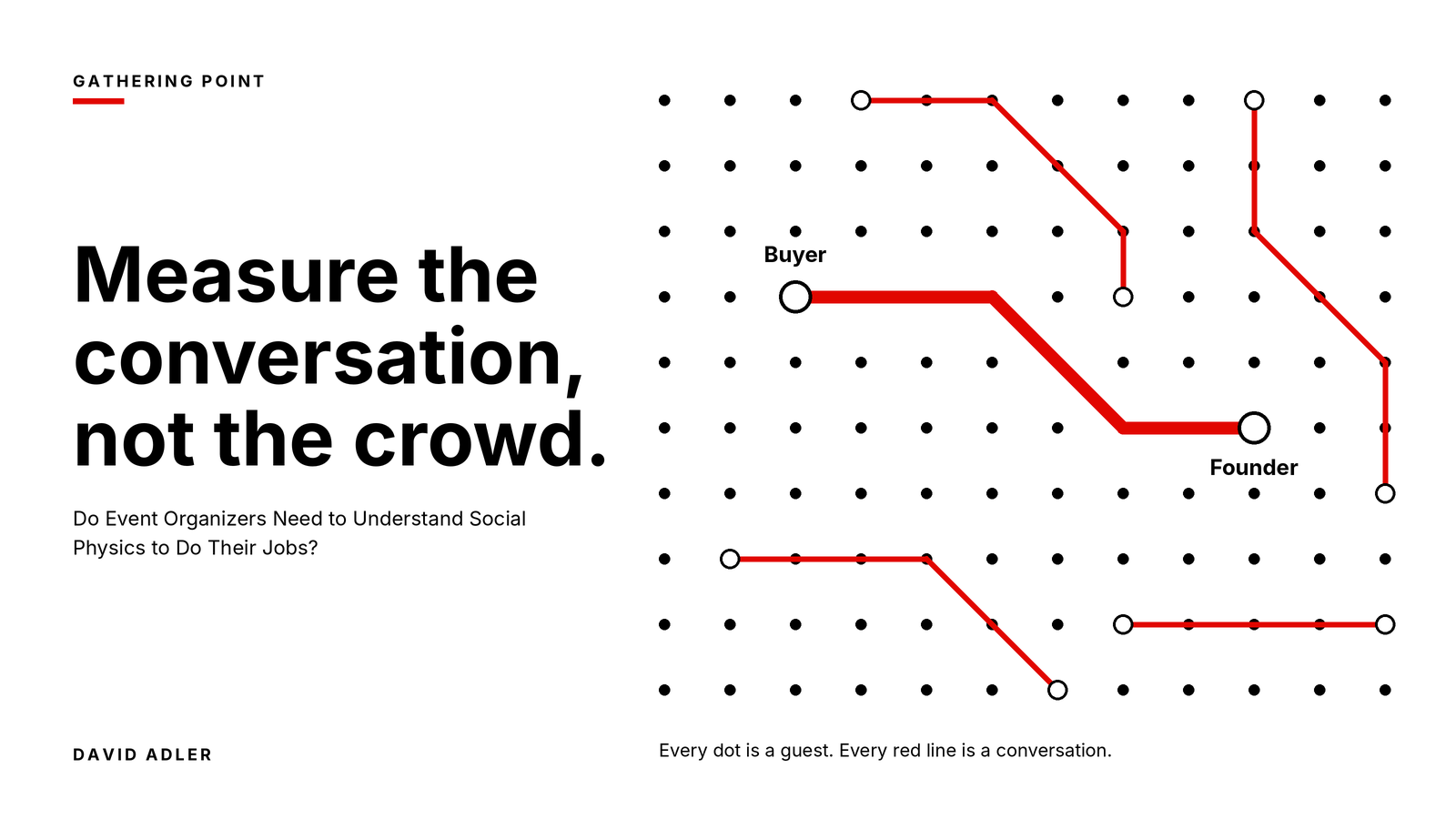
Yes, and the reason is that it separates a gathering that merely assembles people from one that makes them smarter together. Most events spend their budgets getting the right people into the building and leave the conversations to luck. Organizers who learn to facilitate those conversations turn the event into a laboratory, where strangers form the relationships that become new ideas, partnerships and products. The craft is old, and the science behind it, called social physics, comes from MIT’s Alex “Sandy” Pentland, who spent years putting sensors on people and found that the pattern of conversation in a group predicts what the group achieves about as well as its members’ intelligence, personality, skill and the substance of their discussion combined.
A smarter gathering sends people home with connections, not just content
A conventional event delivers a program and a crowd. A smarter one delivers connections that outlast the event: people who met because the organizer arranged it, who found they disagreed usefully, and who were still talking in March. The chain from connection to collaboration to innovation is the premise of this piece, and it is an argument, not a guarantee. Pentland’s research supports the first link, that the way people talk to each other shapes what a group can do, and the history of facilitation supports the rest.
The closest hard evidence comes from Freeman’s 2025 Networking Trends Report, a July 2025 survey of 4,114 people: 2,326 attendees, 1,581 exhibitors and 207 event organizers. More than half of attendees said successful networking gave them new ideas for their professional challenges, and about half said it makes them want to return to the event. One in three stayed in touch with people they met six to twelve months later. Among exhibitors, about 6 in 10 said it brought new leads, and about 3 in 10 said successful networking makes them want to exhibit or sponsor again.
The survey also shows organizers guessing wrong about what the networking is for. About 6 in 10 organizers thought attendees network to find commercial opportunities, while attendees’ top networking goals were contacts for sharing ideas (58 percent) and potential collaboration (54 percent). And in Freeman’s announcement of the report, 4 in 10 of the younger professionals it calls the NowGen cohort said networking feels awkward, and nearly half wanted curated recommendations for who to meet. One caution on all of this: these are self-reported results from networking in general, not a comparison of facilitated and unfacilitated events, so they show the size of the opportunity and not what facilitation adds.
The reason organizers are the right people to act is that they already control the scarce ingredient. Platforms can spread an idea in minutes, but only a gathering puts people with shared intent in the same room, at the same time, with a reason to listen. What they do with that hour is up to the person who designed it.
None of this depends on the kind of gathering. An association’s annual meeting, a trade show floor, a 12-person dinner, a corporate offsite, a party and a wedding are all melting pots of people, histories and ideas, and in every one of them the ingredients are present from the moment the guests arrive. What a melting pot does not do on its own is become a meal. Someone has to decide what goes in, how long it simmers, when to stir and what is ready to serve, and in a gathering that someone is the chef: the host, the planner, the facilitator, the organizer. The better the chef, the more the same crowd produces.
What a melting pot does not do on its own is become a meal.
The facilitation craft is centuries old
None of the craft involved is new, which is the encouraging part. Harrison Owen invented Open Space in the mid-1980s after noticing that the participants at a conference he had organized got the most out of the coffee breaks, and he rebuilt the event around that discovery: attendees propose the topics, choose where to go, and are free to leave any session that is not teaching or contributing. The lineage runs into the unconference and into Foo Camp. Kurt Lewin, who set up the Research Center for Group Dynamics at MIT in 1944, argued that you learn how a group works by changing it and watching, which is a fair description of what every good facilitator does. Mervin Kelly built Bell Labs with a corridor said to run 700 feet so that physicists, metallurgists and engineers would keep walking into each other, a story told in Jon Gertner’s The Idea Factory. The Lunar Society of Birmingham, a dinner club that met by the full moon between 1765 and 1813, put Josiah Wedgwood, James Watt, Joseph Priestley and Erasmus Darwin at one table and left the agenda to chance and appetite.
What they share is that none of them left the mixing to luck. Each one made a decision about who would be in the room, how they would be seated, who would speak and who would listen, and what would be carried out the door. I keep working libraries of both the people and the formats at GatheringArchitecture.com: the Format Library for choosing a structure that fits the event, and the Facilitators Library for finding someone to run it. The point is that an organizer facing a 600-person general session and an organizer facing a 12-person advisory dinner need different instruments, and there are decades of tested ones to choose from.
Three jobs for the organizer: design the mixing, facilitate, harvest
If a gathering is a laboratory and ideas move through it the way a virus moves through a population, then the organizer is the person responsible for the conditions of the experiment. A lab that is run carelessly produces contamination as readily as discovery. The responsibility breaks into three duties.
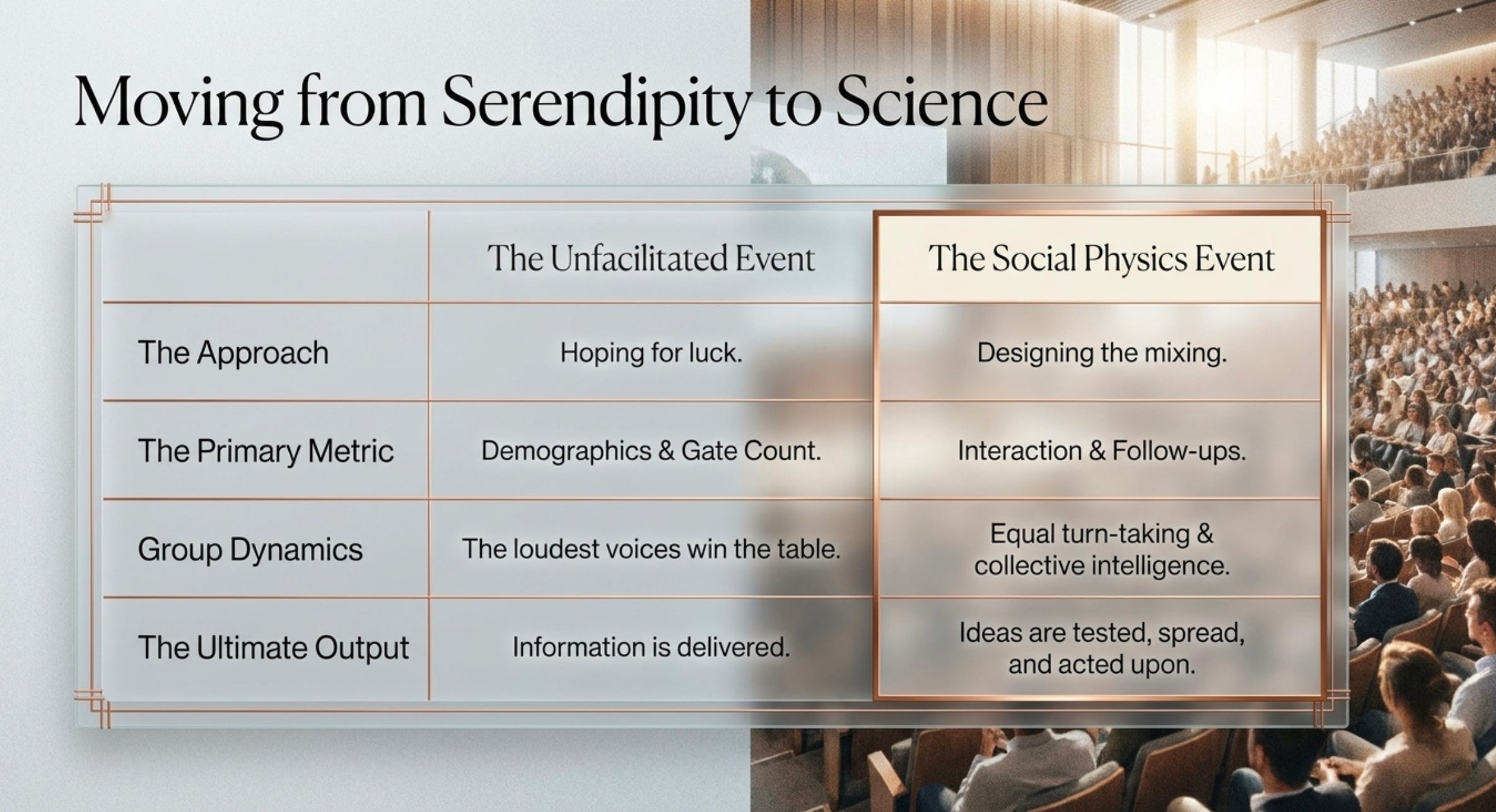
Hoping is what most events do, and they call it serendipity.
Design the mixing. Decide in advance who should collide with whom, because chance alone favors people who already know each other. Seat, schedule and route the room so that exploration (new contact) and engagement (repeated, dense contact) both happen, and keep the breaks synchronized and long enough for talk. Pentland’s evidence says the pattern of conversation matters as much as its content, so the pattern is the thing to design.
Facilitate rather than hope. Hoping is what most events do and calling it serendipity. A facilitator sets the question, protects equal turn-taking so the loudest voices do not decide the outcome, and makes sure each conversation ends in something a person will do. This is the working craft described in the previous section.
Harvest with consent. Capture what the room produced: the themes, the disagreements, the offers, the follow-ups. Do it with the knowledge and permission of the people who said it, tell them what will be done with it, and give it back to them. A harvest taken without consent is a strip mine, and attendees will stop talking freely the first time they suspect it.
A room gets smart, and its ideas spread, because of how people talk
Pentland’s research keeps returning to two ideas, and an organizer who understands them has most of the physics. The first is collective intelligence, the finding that a group can be smarter or dumber than any of its members, and that the difference comes from how people talk. In the 2010 Science paper by Anita Woolley and colleagues, a single factor predicted how well groups performed across very different tasks, and that factor tracked three things: how sensitive members were to each other’s social cues, how evenly they took turns speaking, and the share of women in the group. It correlated only weakly with the intelligence of the individual members, and not at all with how cohesive or motivated people said they felt. The implication for a room is that its intelligence is not determined by who bought a ticket. It is produced by the pattern of conversation, which means it can be designed and it can be measured.
The second idea is contagion, which Pentland calls social learning and the subtitle of his book Social Physics calls how good ideas spread. People pick up habits, beliefs and decisions from the people around them far more than from information they read alone. In the programs he describes, peer influence made exercise and diet efforts between 2 and 16 times as successful, depending on the program. The same force that makes a good habit catch on makes an echo chamber: in the eToro data, about 1.6 million traders who clustered tightly with like-minded peers did worse than those who stayed connected to a wider network.
Put the two together and the organizer’s job comes into focus. Collective intelligence tells you what a good conversation looks like inside a table or a session: balanced turns, attention to the quiet people, a mix of perspectives. Contagion tells you what happens next, which is that whatever comes out of that conversation travels to the next table, the next hallway and the next company. An event that gets the first right and ignores the second produces a smart room and no spread. An event that has plenty of spread and no intelligence amplifies whatever the loudest table believed.
Organizers report the soil, not the crop
Ask an organizer how the event went and the answer arrives in demographics: a typical report might say 14,000 attendees, 38 percent director level or above, 61 percent first-timers, a satisfaction score of 4.3. These are soil reports. They describe what was in the field before anything grew, and they say almost nothing about what the three days produced. A farmer who measured only the acidity of the dirt and never weighed the harvest would not stay in business long, and yet this is how most of the industry accounts for its most valuable output.
The harvest of a gathering with serious intent is the interaction. Who talked to whom, for how long, about what, and what happened the following week because they did. Imagine a buyer and a founder who had never met spending forty minutes disagreeing about a standard in a hallway, and six months later the standard changes. Nothing in the gate count recorded it, no badge scan caught it, and the organizer who made the meeting possible will never hear that it happened. The proposition of this piece is the one I have repeated for years: the work is to measure the interaction of the gathering, not the demographics of the crowd.
The reason to say it now is that harvesting has become cheap. Conversations can be captured with consent, summarized, clustered and compared across a thousand people in an afternoon, which was not true five years ago. The harvest was always there. What has changed is that the combine exists, and an organizer who does not use it is choosing to leave the crop in the field.
Pentland measured the conversation, and the pattern predicted the result
Pentland’s group spent years counting how people talked. In a study reported in the Harvard Business Review in 2012, badges worn by about 2,500 people recorded who spoke to whom, how often, and with what energy, and the patterns turned out to predict team performance as well as intelligence, personality, skill and the substance of the discussion combined. His shorthand for what separates strong groups is three behaviors: energy, engagement and exploration. Members of good teams talk and listen in roughly equal measure, face each other directly, and keep reaching outside the team for fresh input.

In the larger body of his work, idea flow has two halves. Exploration is the diversity of what comes in, the contact with people who think differently. Engagement is the dense, repeated interaction inside a group that turns an idea into a shared commitment. A room that only explores produces a pleasant afternoon and no action; a room that only engages produces an echo chamber. His study of eToro, an online trading platform with about 1.6 million members and 10 million trades, found that traders who sat in tight, self-reinforcing clusters did worse than those who stayed in contact with a wider network. He also reports that peer influence made exercise and diet programs between 2 and 16 times as successful, depending on the program.
One result in the badge research will interest anyone who has fought over a coffee-break budget. At a call center, giving teams a synchronized break instead of staggered ones cut average handling time by more than 20 percent among lower performers, and by 8 percent overall, because people finally had the same stretch of time to talk. Separately, a 2010 paper in Science by Anita Woolley and colleagues found that collective intelligence in a group tracked social sensitivity, equal turn-taking and the share of women, not the group’s average IQ and not how cohesive or motivated members said they felt. The room, in other words, has physics, and the physics can be measured.
The 2026 election shows what a few million conversations can do
Democrats took the House and the Senate on the first Tuesday of November, with NBC projecting 258 House seats for the party, the most since 1993. Polling analysis from Rutgers showed the swing running across almost every demographic slice, including men, who split 49 to 49, and Latino voters, who went 62 to 35. The causes reported were prices, tariffs, the Iran war and corruption. My reading is that the result also shows what happens when a shared shock, instant communications and a great many conversations line up: millions of people talk, reach the same conclusion, and it arrives at the ballot box looking like a single decision. That link between conversation and the result is my inference, not an established finding. What it shows an organizer is the scale of what talk can do, and that a room is where an idea gets tested and committed to before it spreads again.
Four conundrums that make this harder than it sounds
Speed carries bad ideas as well as good ones. The same channels that moved a shared grievance across the country in an afternoon will move a rumor just as fast. A faster network does not make rooms less necessary; it makes the quality of the room more important, because the room is where an idea is tested before it spreads again.
Someone frames the question. Whoever writes the prompt for a table discussion or an AI summary decides what counts as an answer. An organizer who frames every conversation around the sponsor’s product has built a focus group, not a laboratory, and attendees can tell.
Consent and efficiency pull apart. The cheapest harvest is to record everything and sort it later. The honest harvest asks first, says what it will keep, and accepts that fewer people will say yes. It is slower, and it is the only version that survives a second year.
Machines can help, but they are research, not product. In a 2024 study in Science, DeepMind researchers had 5,734 participants write opinions on contested topics and had an AI system draft group statements. Participants preferred the AI’s statements to a human mediator’s 56 percent of the time, and groups converged more when the AI mediated. The tool is not available to the public, and critics note that agreement on a statement is not the same as agreement on a policy. Platforms like Polis, used in Taiwan’s vTaiwan process, take a simpler route: they surface the statements that people on different sides both endorse, so the room can start from common ground. Pentland’s recent book, Shared Wisdom, argues that AI should aid human deliberation and not replace it, and that is the only version worth building a harvest around.
How the marketer, exhibitor, attendee and boss will react
The reactions below are written as plausible responses, not quotes from real people.
Reader
What they are likely to say
What the organizer can offer
Event marketer
“I can report registrations and sessions attended. Conversation is not a number I own.”
A small set of interaction measures: introductions made, follow-ups requested, themes raised, so the story of the event is more than attendance.
Exhibitor
“I want leads, not a seminar on social physics.”
Better-matched conversations. The booth that meets the right three buyers beats the booth that scans 300 badges.
Attendee
“Is someone recording what I say to a stranger?”
A plain statement of what is captured, an opt-in, and a summary returned to them afterward.
The boss who must be convinced
“What does this cost, and what do I get that I cannot get from the post-event survey?”
One pilot at one event, with one question answered that the survey could not: what did the room produce that no one planned?
Sources
Pentland, The New Science of Building Great Teams, Harvard Business Review, April 2012 (badge study, energy, engagement, exploration, call center breaks).
Woolley et al., Evidence for a Collective Intelligence Factor in the Performance of Human Groups, Science, 2010.
Pentland, Social Physics (2014), Shared Wisdom (MIT Press, 2025), and the eToro research.
Tessler et al., DeepMind, AI can help humans find common ground in democratic deliberation, Science, October 2024, and MIT Technology Review’s coverage.
Bridging Voting and Deliberation with Algorithms: Field Insights from vTaiwan and Kultur Komitee.
Election: NBC News midterm results, CNN live coverage, Fox News voter poll and Rutgers analysis. The link between conversation and the result is the author’s inference.
Open Space Technology; Kurt Lewin; Gertner, The Idea Factory; The Lunar Society of Birmingham.
GatheringArchitecture.com: the Format Library and the Facilitators Library.
Freeman, Unpacking XLNC: How to architect serendipity and connect people in meaningful ways (Networking Trends Report, July 2025; 4,114 respondents), and its press release, July 23, 2025.