
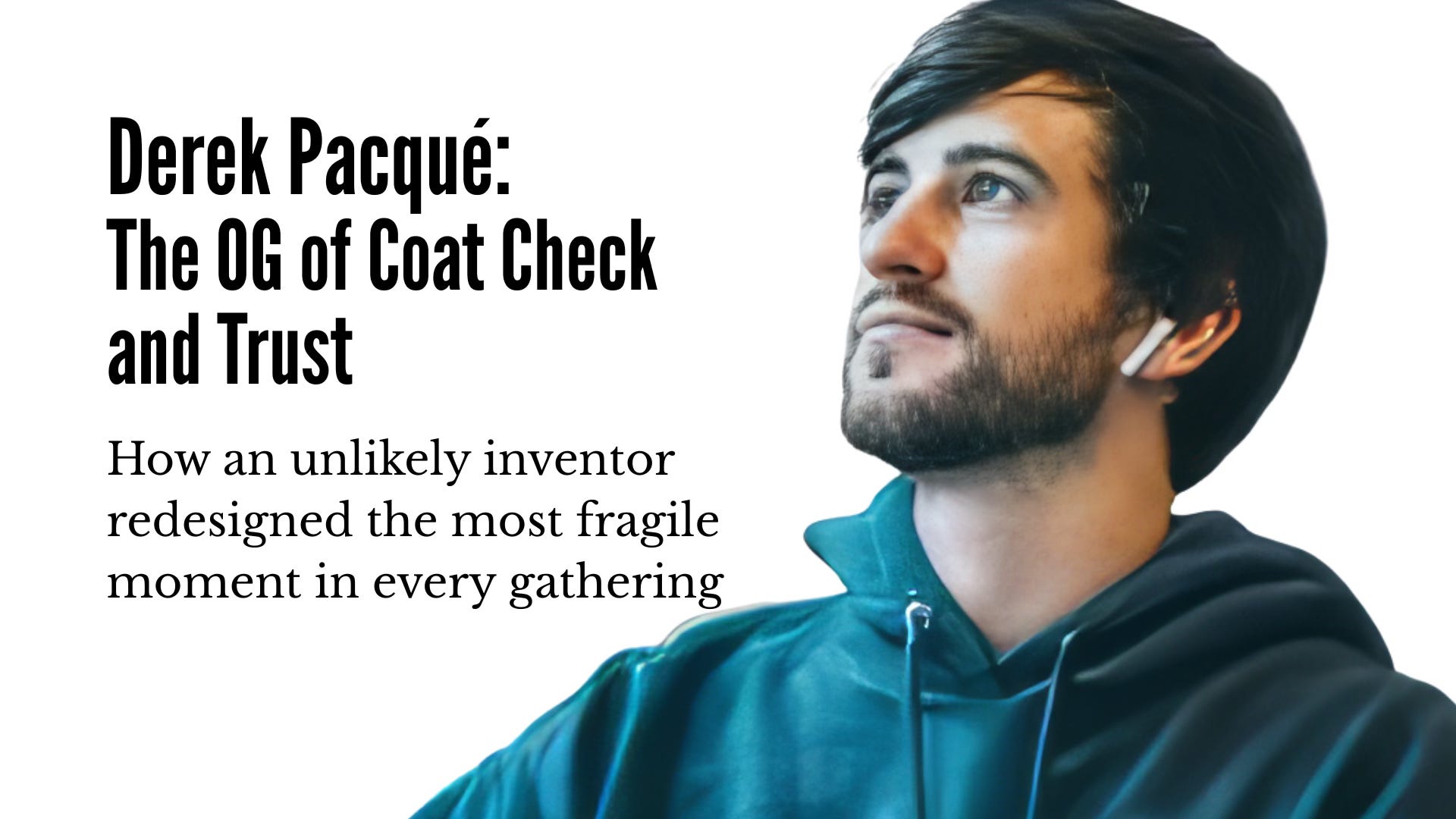
Derek Pacqué: The OG of Coat Check and Trust
How an unlikely inventor redesigned the most fragile moment in every gathering
Listen to the song about this story-
The first thing you surrender at an event is never your ticket. It’s your coat.
Before the keynote, before the cocktails, before the strategic hello or the accidental reunion, you hand a stranger the outer layer that carried you through the cold and trust—quietly, instinctively—that it will come back to you when the night is over. That trust is rarely articulated, but it is foundational. Without it, you hover. You hedge. You never quite enter the room.
For most of modern event history, that trust was a gamble.
I learned this viscerally at the Reagan inaugural in 1981, a season of balls so elegant on the invitation and so disastrous at the exit that the coat check became the story. Washington was frozen. Fur was the uniform. And when the evening ended, paper systems collapsed under their own weight—guests surging behind counters, society figures included, digging through piles of mink and sable, people literally buried under furs trying to retrieve what was theirs. Newspapers covered the glamour. Everyone who was there remembers the chaos. Every inauguration since has flirted with some version of the same failure, because inaugurals share a fatal flaw: winter, synchronized exits, temporary staffing, and paper pretending it can scale.
More recently, when I interviewed Joe Cozza about the new White House Ballroom, he framed the same lesson more succinctly. At that level, he said, a ballroom isn’t décor—it’s infrastructure, and coat check is a load-bearing system. You can survive a bad speech. You cannot survive a bad coat check. The memory of an event hardens at the exit.
I first met Derek Pacqué, the founder of what is now called Chexology (originally CoatChex), on Super Bowl parade day in New York, one of those bitterly cold afternoons when the city feels less like a host and more like a stress test. The streets were jammed, venues overwhelmed, coats not just accessories but survival gear. In the middle of that confusion, one detail stopped me cold: my coat check wasn’t a paper ticket. It was my cell phone number. No fumbling. No low-grade panic about losing a claim check in the crush. On a day like that, losing your coat wasn’t just inconvenient—it bordered on a health issue. Derek was there, visibly enthusiastic, moving through the room, explaining the system with the calm confidence of someone who knew he had eliminated a quiet but consequential risk. In the most chaotic conditions imaginable, he had made letting go feel safe. That’s when I understood this wasn’t a gimmick. It was infrastructure.
Derek Pacqué built his career inside that moment, but his instincts were formed long before New York, long before Shark Tank, long before anyone thought coat check could be reimagined.
His earliest memories of invention begin in West Africa, in a house with an MS-DOS computer and a kid old enough to type commands and feel the world crack open. He remembers being blown away by the idea that software could do things—pull up games, respond, behave—and then asking the question that always marks the beginning of an inventor’s life: how does this work? His mother told him about Bill Gates, about a person who had built something invisible that ran everything. Derek latched onto that idea with intensity. He didn’t want to be a fireman. He wanted to be Bill Gates. He wanted to invent, to push boundaries, to bring an idea into reality—and he wanted it to be tech-forward because that’s what “real” invention looked like to him.
The family story adds texture you can’t fake. Derek moved to West Africa when he was about two. His father was doing tropical medicine work on river blindness. His mother—trained as a demographer—later joined USAID. When his brother and sister were two weeks old, the family settled in Bamako, Mali, and Derek stayed there until he entered third grade in McLean, Virginia. The memories he describes from that period aren’t about hardship; they’re about freedom and exploration. Both parents worked. A kid learned how to occupy his own time, roaming and tinkering in the loose spaces life leaves behind.
When the family moved to McLean, the contrast was stark. Suddenly there were boundaries, cul-de-sacs, rules about where you could and couldn’t go. Derek remembers wanting to explore a creek and being told the other kids weren’t allowed to leave the neighborhood. It felt baffling to someone raised with more open movement. What mattered is that his parents never treated curiosity as disobedience. When he got into trouble—and he did—it was usually for improvising too freely, not for breaking things.
One of the earliest clues to how his mind worked came not from rebellion, but from arithmetic.
In middle school, the band hired a third-party fundraising company to run its annual drive. Students were given discount cards—mostly for places no one actually used in the neighborhood—and told to sell them for ten dollars apiece. Derek learned that of those ten dollars, only seven went back to the band. The rest disappeared into the machinery of the fundraising company. The student incentive was thin: sell ten cards and you earned one card for yourself, either to use or try to sell.
Derek didn’t challenge the price. He challenged the system.
He realized he could go directly to local stores, assemble a better discount card—one people would actually want—and print it himself at Staples for about a dollar per card. He kept the selling price exactly the same: ten dollars. Of that ten, seven still went to the band. One dollar went to the band friends who sold each card. One dollar went to Derek for producing it. If he sold a card himself, he made two dollars. The band was whole. The students were properly incentivized. The product was better. The middleman was gone.
Win-win-win.
At the end of the fundraiser, Derek showed up at school carrying a grocery bag full of cash, thrilled by how much money he had raised. The reaction was not what he expected. The band director was furious. He wasn’t allowed to do that, Derek was told. He had to use the official cards provided by the band’s vendor. He went home deflated.
What happened next mattered more than the reprimand. His parents didn’t punish him. They didn’t scold the ambition or the ingenuity. They supported him—recognizing the creativity, the incentive design, and the drive behind what he’d built, even if the institution wasn’t ready to accept it. It was an early lesson he would carry forward: systems resist improvement even when improvement works.
By the time he got to Indiana University’s entrepreneurship program, the obsession was no longer a childhood fantasy. It was a decision. He was surrounded by big, tech-based ideas that felt daunting because he wasn’t an engineer and didn’t have deep capital, but he needed something that could become real. The coat check problem was deceptively small, but it had a brutal advantage: it was everywhere, and everyone hated it.

In Bloomington, the biggest nightclub was actually a sports bar. On dance nights, the pool-table area became dead space, and the lack of a coat room turned winter into a scavenger hunt: coats hidden everywhere, coats lost, coats not worn at all because guests didn’t trust the room. Derek wore one anyway—and lost it. When he asked the obvious question—why don’t you have a coat check?—the answer was equally obvious: there was no room. So he made room. He proposed moving the pool table, building racks, and creating a pop-up coat check that could be set up and taken down. The venue agreed. The pop-up coat check made roughly $50,000 in five months.
Then came the problem that turned a hustle into an invention. At scale, paper fails. Drunk guests lose tickets. Staff can skim cash. Bottlenecks form the moment someone can’t produce a claim check. Derek watched it happen and knew it would keep happening. He also knew the venue hated the aftermath: when people got too drunk and left their coats behind, they called the next day. His first hack was simple and telling—have guests write their phone number on the back of the claim ticket. If they lost it, he could find the record. If they left the coat, he could text them. The calls stopped. Identity replaced paper.
That insight eventually became Chexology (originally CoatChex), but it wasn’t born as “event tech.” It was born as the simplest answer to a human problem: people don’t mind surrender; they mind uncertainty.
Shark Tank wasn’t a detour. It was a lever. Season four, episode one. Derek framed the pitch with a bit of Indiana mythology: Mark Cuban went to Indiana and started his first business at Kilroy’s; Derek went to Indiana and started his at Kilroy’s. Cuban made $30,000; Derek made $50,000. The producers liked the symmetry. After it aired, leads came in by the thousands, and Derek realized something important: New York was where the problem existed most intensely. If he wanted to build a real company, he couldn’t do it from Indianapolis.
His first big break wasn’t a nightclub buying software. It was high-end events buying into the idea that coat check—this unglamorous hinge of the night—was brand experience. Lincoln Center. Fashion Week. An American Express sponsorship aligned around values: secure, high-end, innovative, service-driven. Derek made more money on that one event than he had made in an entire year in Bloomington. More important, it validated the thesis: the first and last interaction mattered enough to finance real innovation.
In the early New York years, Chexology became its own laboratory. For a time, the company didn’t just design the system; it ran the room, scaling to roughly 250 coat checkers across nightclubs, museums, convention centers, and cultural institutions, learning the edge cases by living inside them. Only later—around 2015 or 2016—did the company feel confident enough to sell the system directly as a subscription product, letting venues staff it themselves.
His first proof that the platform could enable new formats came from an unexpected place: silent discos. Those operators had a basic problem—how do you check out hundreds of headphones quickly and reliably, then get them all back? The Chexology system solved the handoff, and suddenly silent disco could scale into thousands of people in parks and on bridges, turning public space into temporary venues. If you can make temporary custody reliable, you unlock new kinds of gatherings.
Then, in 2019, Derek stepped off the floor. Staffing was seasonal, unforgiving, and operationally heavy. Chexology handed the staffing business over to Gotham Concessions, a New York partner that took over the people side so Chexology could focus on being the system layer. Derek talks about the move plainly: he loves problem-solving, creativity, innovation, storytelling, and being with customers; he does not want to be trapped in the people business of seasonal coat checking.
That pivot clarifies what he’s actually building. He’s not trying to become a labor-heavy services empire. He’s trying to become infrastructure—the layer beneath hospitality that makes trust, speed, and return feel ordinary.
Seen from that vantage point, Derek is an unusually good observer of what’s changing in the events industry, because the coat room is where behavior shows up first. It’s where people arrive guarded and leave exposed; where impatience surfaces before it reaches the bar; where generational shifts appear early. He’s watched people stop tolerating friction as a feature. He’s watched the old nightclub logic—waiting in lines, being treated badly, chasing VIP status—lose its grip. He’s watched growth shift toward competitive socializing and activity-driven venues where coat check is complimentary and participation is the main event.
He also sees what older event design too often ignores: people judge the night at the exit. That’s why Las Vegas mirrors the inaugural problem so perfectly. Anyone who has walked out of a 30,000-person conference on the last day knows the scene—a ballroom turned into a sea of luggage, guests dragging suitcases through crowds, flights looming, goodwill evaporating. Different object, same surrender. We design obsessively for arrival and almost never for departure.
This is where Derek’s vision widens beyond coat rooms into something bigger. He talks about a future where borrowing becomes normal because the systems that guarantee return become invisible. He gets excited about wearables and other expensive tech that people will need to borrow before they own it, and he links that directly to the idea of neighborhood sheds: assets used event after event, block after block, circulating because return is documented and dependable. The same trust layer that makes coat check painless can also enable a physical sharing economy—devices, tools, equipment, hospitality assets moving freely because return is certain.
That’s the real point. The invention is never just the first object. It’s the first proof.
Derek Pacqué didn’t invent surrender. He made it safe.
The promise of his work isn’t that it eliminates human error forever. It’s that it reduces the psychological cost of participation. It replaces the gamble with a system. When return is certain, people stop hovering, stop guarding, stop leaving early. They enter more fully. They participate.
In the end, that’s what the coat room has always been: not a storage area, but a test of trust.
WISDOM BANK — DEREK PACQUÉ AND WHEN INVENTION IS ONLY THE BEGINNING
1. Invention Solves a Moment; Vision Solves a System
What Derek Pacqué built first was necessarily narrow — the larger meaning appeared only when the idea met real behavior.
2. The First Use Case Is a Doorway, Not the Destination
Coat check wasn’t the end goal; it was the most visible place where trust could be tested under pressure.
3. Scale Reveals Purpose
When an idea works on the coldest nights and the busiest exits, its deeper value becomes unmistakable.
4. The Best Inventions Change How People Behave
When guests stop hovering and start participating, the invention has done more than streamline a process.
5. Vision Grows Through Adjacency
Once trust is established in one exchange, it naturally extends to others — from coats to bags, tools, spaces, and shared infrastructure.
6. The Real Breakthrough Is Return
Ownership was never the innovation; reliability was.


The band fundraiser story is perfect framing for what comes later. What gets me is how the "trust infrastructure" insight applies way beyond coat checks, basically any temporary custody exchange suffers the same paper-based vunerability. Had a similar expirience at a conference where luggage check turned into chaos because the claim system couldn't handle 500 people exiting at once. That phone number solution is so obvious in hindsight but took someone actually living in the problem to see it.