
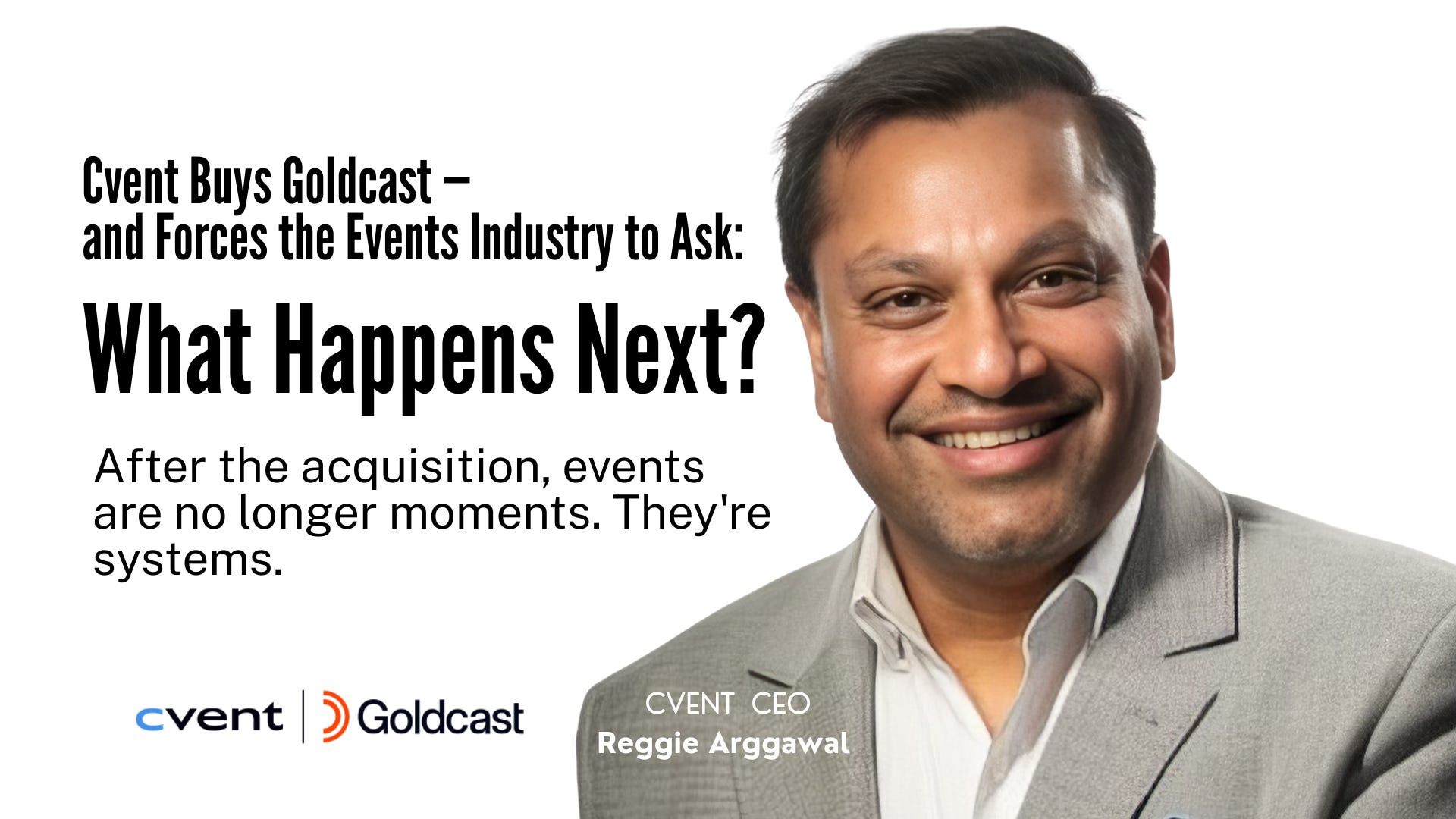
Cvent Buys Goldcast — and Forces the Events Industry to Ask: What Happens Next?
After the acquisition, events are no longer moments. They're systems.
Cvent has acquired Goldcast in a cash deal Axios reports at just under $300 million. On the surface, it looks like another sensible consolidation in a crowded event-tech market: a dominant platform absorbing a younger company that rose during the hybrid era. But that reading misses the deeper meaning of the deal. This acquisition isn’t really about video. It’s about the industry finally admitting that events no longer end when the doors close.
That realization didn’t begin with Cvent. It began years earlier, at the level of perception.
Michael Barnett saw it when he built InGo around a simple, unsettling idea: if people didn’t see that you were attending an event, you weren’t really there. Attendance only became real once it became visible. The flood of LinkedIn posts — I’ll be attending, I’ll be speaking, See you at… — wasn’t narcissism. It was signaling. Presence had become perceptual. InGo didn’t invent that instinct, but it legitimized it, turning attendance into a public artifact and perception into momentum
Once that door opened, it was inevitable that the same logic would extend beyond who showed up to a more consequential question: what actually happened once they did?
That cultural shift is essential to understanding why Goldcast exists at all.
Goldcast was founded in 2020 by Palash Soni, Kishore Kothandaraman, and Aashish Srinivas, in the middle of the pandemic’s virtual-event bonanza, when companies were suddenly producing massive volumes of webinars and digital conferences — and watching most of that effort disappear the moment the stream ended. Goldcast’s distinction was that it didn’t treat virtual events as destinations. It treated them as inputs, capturing live sessions, breaking them into usable video segments, and feeding those assets directly into marketing, sales, and internal workflows so the event could keep working long after it was over.
From the beginning, Goldcast treated events less like one-time performances and more like raw material. The real product wasn’t the event itself, but its afterlife.
Cvent’s acquisition strategy makes sense precisely because it recognizes that this layer of value had become too central to leave outside the platform. Rather than partnering or integrating loosely, Cvent pulled Goldcast inward, effectively declaring that the capture, transformation, and redistribution of event content is no longer optional infrastructure. It is core. The expansion here isn’t geographic or vertical; it’s temporal. Cvent is extending its ownership of the event beyond the live moment and into what happens next.
Strip away the marketing language and the truth is blunt. In a networked economy, an event that isn’t recorded might as well not have happened at all. Memory fades, attention moves on, and meaning evaporates unless it is held in place.
We have been rehearsing this realization socially for more than a decade. Instagram moments were the first mass expression of the idea that capture mattered. Flower walls, neon signs, skyline backdrops weren’t frivolous indulgences; they were early recognition systems, proof that you were there and that the event was real. But that language flattened quickly. Capture became aesthetic rather than consequential, answering Was I there? without ever addressing Did anything change?
The Cvent–Goldcast deal signals that the industry is done with surface proof and ready to invest in something deeper.
Running parallel to Goldcast’s focus on the afterlife of events is a different, but complementary, strategy embodied by Xcyte Digital, now a publicly traded event-technology company (TSXV: XCYT). Where Goldcast concentrates on preserving meaning after the room clears, Xcyte has focused on expanding what happens while the event is unfolding, breaking the fourth wall of the ballroom and acknowledging that the true audience is almost always larger than the people physically present.
Through a portfolio of brands spanning virtual and hybrid platforms, immersive environments, enterprise webcasting, and conference-calling infrastructure, Xcyte treats events as permeable experiences rather than closed performances. What happens live can be shared, experienced, and measured by broader audiences in real time, without reducing the event to a broadcast or draining it of its humanity.
Some will read the Cvent–Goldcast deal as a feature grab, or even as a defensive move in an increasingly crowded webinar market. But its logic closely mirrors Xcyte Digital’s acquisition roadmap, which stitches together conferencing, webcasting, engagement analytics, and hybrid and virtual environments into a single platform. Both moves are responses to the same industry gravity. Point solutions are finding it harder to survive on their own, while platforms that can own workflows end-to-end — from live moment to extended reach to measurable outcome — are the ones attracting capital, customers, and long-term relevance.
This more cynical reading doesn’t undermine the story. It strengthens it. This wasn’t private equity rescuing a tired asset. It was a dominant platform absorbing a capability that had become too important to outsource. Gravity favors systems, not features.
Seen together, Cvent and Xcyte are answering the same question from opposite ends of the timeline. One is asking how long an event can live. The other is asking how far it can reach. Both are betting that events are no longer moments to be executed and forgotten, but systems whose value compounds over time.
This is where the story becomes less about technology and more about narrative.
My father, Warren Adler, who wrote The War of the Roses, used to tell me that a story couldn’t simply land. It had to evolve. Somewhere inside it, there had to be the quiet, unsettling question: what happens next? Without that, he believed, a story wasn’t finished — it was just paused.
Years after he passed away, one of his own stories answered that question. The War of the Roses returned to the world as The Roses, finding a new audience in a different era because its core had been preserved rather than spent. The story didn’t end where people thought it had. It waited.
That, in many ways, is the lesson the events industry is finally absorbing.
Events are no longer judged solely by how they feel in the moment. They are judged by what survives them, what circulates, and what continues to shape behavior once the room empties. The applause is no longer the payoff. The afterlife is.
And with Cvent’s acquisition of Goldcast, the industry has crossed a line it can’t uncross. The question is no longer whether events should be captured, extended, and activated.
The only question left — the one every real story eventually has to ask — is this:
What happens next?


#Excellent article 🕊️ your #dad would be super excited that you're * generationally #sharing his story over & over again ~And then asking what's going to happen next #lovely 🎁 you should be really proud of yourself this 📢 #Holiday Sir