
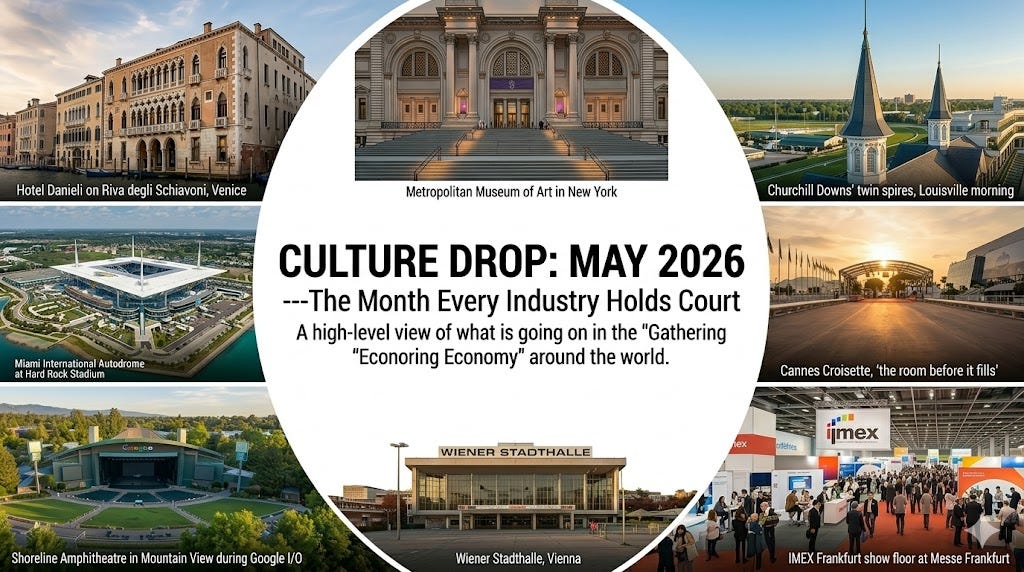
What's Happening Around the World in May- Inspiration for Event Pros
A high level view of what is going on in the “Gathering Economy” around the world
THE CALENDAR — WHERE NOTHING WAITS ITS TURN
May has always been crowded, but 2026 reaches a kind of architectural impossibility. Within a single thirty-one-day window, fashion, film, music, sport, theater, art, hospitality, horticulture, and the global meetings industry all hold their flagship moments — and several of them collide on the same days. On May 12, Cannes opens its 79th edition the same evening Vienna stages Eurovision‘s first semi-final. On May 19, the Chelsea Flower Show opens at the Royal Hospital, IMEX opens at Messe Frankfurt, and Google I/O opens at Shoreline Amphitheatre — three industries holding court simultaneously, six time zones apart. All of it lands inside the year of America 250, the country’s quarter-millennium commemoration that will define every American convention, gala, and public ceremony from now through Independence Day.
This is not coincidence. It is what happens when a calendar is built by separate institutions over a century, each defending its own date, none willing to move. May is the month the gathering economy reveals itself most plainly. Everyone shows up at once. Everyone renders a verdict. Almost no one can be in two places at the same time.
NEW YORK — FASHION ANNOUNCES ITSELF AS ART
The first Monday of May falls on the fourth this year, which means the Met Gala opens fashion’s longest red carpet against a theme that is, depending on the listener, either ambitious or overdue: Costume Art, with a dress code of Fashion Is Art. The exhibition itself, opening to the public on May 10, inaugurates the museum’s new twelve-thousand-square-foot Condé M. Nast Galleries — a permanent home for the Costume Institute, named for the magazine company whose late founder funded the gift.
Beyoncé returns to the carpet for the first time in a decade as co-chair, joined by Nicole Kidman, Venus Williams, and the indispensable Anna Wintour, who has presided over this room every year since 1995. Jeff Bezos and Lauren Sánchez Bezos serve as honorary chairs, representing the lead sponsorship. What Vogue is selling, as always, is not the dresses but the room — the closest thing the United States has to an annual coronation, where industries that do not normally share oxygen agree, for one night, to behave as if they belong to the same club.
The Met still rules its first Monday absolutely. Whatever else happens in May, this is the night the cultural elite consents to be photographed.\
NEW YORK — THE OTHER MONDAY NIGHT
A week after the Met locks in its first-Monday verdict, Wall Street holds its own. The Robin Hood Benefit fills the Jacob K. Javits Convention Center on Monday, May 11 — roughly four thousand guests, a headline musical performance kept secret until the night, and a single evening’s giving total that has reached into nine figures. The Weeknd performed in 2025. Bruce Springsteen, Coldplay, Paul McCartney, and Kendrick Lamar are on the historical bill. The 2022 benefit raised $126 million.
Robin Hood is the closest American philanthropy comes to a municipal institution, and the benefit itself is one of the most efficient single-night gathering structures ever designed. Its board of directors — finance and business leaders — underwrites operating costs in full, which means one hundred percent of every dollar raised at the gala goes directly to the foundation’s poverty-fighting partners across the five boroughs.
What event organizers should watch is not the headline performer. It is the architecture: an audience that pays to be there, a board that pays the overhead so the gift is total, and a single annual moment that compresses a year of relationship management into four hours.
LOUISVILLE — TWO MINUTES, A HUNDRED AND FIFTY-SECOND TIME
Two days before the Met Gala, the 152nd Kentucky Derby runs at Churchill Downs on Saturday, May 2, with Renegade installed as the early favorite and trainer Todd Pletcher entering his sixty-fifth Derby starter — more than anyone in the race’s history. The night before, the Kentucky Oaks airs in primetime on NBC for the first time in its 152-year history, the network having decided that fillies and a survivor parade are a Friday-night audience too.
The Derby is the rare American sporting event that still runs on its own pre-television timetable. The race itself lasts roughly one hundred and twenty seconds. Almost everything else about Derby week — the breakfasts, the parties at private estates, the hat orders placed in February — exists to fill the hours that surround it. Two minutes carry an entire weekend of commerce. Few rooms compress that ratio of attention to action.
MIAMI — THE CIRCUIT FINDS A NEW BROADCASTER
The same weekend the Derby is run, Formula 1 returns to Hard Rock Stadium for the Miami Grand Prix on May 1 through 3, the fourth round of a season that has already lost two scheduled races. Bahrain and Saudi Arabia were both canceled after the Israel-Iran war that pushed the World Economic Forum’s Jeddah meeting off the April calendar. Miami arrives carrying that disruption with it.
It also arrives on a new American broadcaster. As of this season, F1 streams exclusively on Apple TV in the United States, ending the ESPN era. The shift matters less for the racing than for what it signals — the most globally distributed sport in the world is now a tech-platform exclusive in its single largest growth market. Mercedes arrives leading the championship after Antonelli’s wins in China and Japan. Whether the audience follows Apple onto Apple is, in May, the more interesting race.
CANNES — THE FRENCH RIVIERA HOLDS COURT
Cannes opens its 79th edition on May 12 and runs through May 23, with Park Chan-wook in the jury president’s chair and an opening film, Pierre Salvadori’s The Electric Kiss, that is — characteristically — French and only mildly internationally legible. The festival’s official poster pays tribute to Geena Davis and Susan Sarandon in Thelma & Louise, which closed Cannes in 1991 and, thirty-five years later, still functions as a usable shorthand for cinematic refusal.
Honorary Palmes d’Or will go to Peter Jackson and Barbra Streisand, which is its own kind of statement about who the festival now considers ancestral. Twenty-one films sit in competition, drawn from 2,541 submissions, with five women directors in the main slate.
What no other festival can match is the geometry of the Croisette itself — eleven days of the same hotel lobbies, the same beach restaurants, the same yacht decks, every distribution executive and acquisitions agent in cinema cycling through the same compressed grid. Cannes is not a film festival the way Sundance is a film festival. It is a marketplace where verdicts are rendered in real time, in three languages, between courses.
VIENNA — SEVENTY YEARS OF UNITED BY MUSIC
The same Tuesday Cannes opens, Eurovision opens its first semi-final at Wiener Stadthalle, the venue Vienna last used in 2015 and has now reactivated for the contest’s seventieth edition. The Grand Final lands Saturday, May 16, with Victoria Swarovski and Michael Ostrowski hosting, and Emily Busvine in the green room. The Eurovision Village fills Rathausplatz from May 10 through 17, as it did eleven years ago.
It is also, less ceremonially, the smallest contest since 2003. Iceland, Ireland, the Netherlands, Slovenia, and Spain have withdrawn in protest of Israel’s continued participation as the Gaza war enters its third year — the largest wave of boycotts the contest has faced in over half a century, and the first time five Western European public broadcasters have voted with their feet over a single member’s inclusion. The European Broadcasting Union has held the line, and that is itself a position. United by Music is the contest’s tagline. What is happening on stage in Vienna is, by any honest reading, the opposite. The seventieth-anniversary edition will crown a winner. It will not resolve what the boycotts mean.
HUDSON YARDS — THE ART MARKET, RECONVENED
Frieze New York returns to The Shed for its fifteenth edition from May 13 through 17, with sixty-five-plus galleries and a deliberate emphasis this year on Latin American practice — a programming choice that signals where the secondary market thinks the next collector base will form. The fair’s collaborations extend across Chelsea, into the Whitney, the Dia Foundation, and The Shed itself, with site-specific commissions by Jonathan González, David Lamelas, and the Lakȟóta artist Kite.
Frieze does not produce the volume of Basel or the spectacle of Art Basel Miami. What it produces is conversation. For five days in May, the international gallery system reassembles in Hudson Yards and decides, through tens of millions of dollars in transactions and ten thousand quietly exchanged opinions, which artists will matter for the rest of the year. The walls of The Shed are temporary. The verdicts are not.
FRANKFURT — WHERE THE INDUSTRY MEETS ITSELF
For the meetings industry, May 19 is the date the rest of the calendar bends around. IMEX Frankfurt runs May 19 through 21 at Messe Frankfurt, bringing together more than 4,500 hosted buyers and 3,100 exhibitors representing 150 countries — the largest gathering of the people who design, sell, and operate the global meetings economy.
This is the trade show for trade shows. It is where convention bureaus court corporate planners, where venues demonstrate what their renovation budgets bought, where the technology companies that quietly run the industry — registration platforms, lead-retrieval providers, attendee-engagement software — make their case in person. The 2026 talking point is Design Matters, framed by IMEX as the proposition that design is the events industry’s overlooked competitive advantage. After three years of debating AI as a feature, the industry’s flagship room has chosen instead to argue that the problem is craft. That is a meaningful pivot.
MOUNTAIN VIEW — THE QUIETEST VERDICT
The same days Frankfurt fills, Google holds I/O at Shoreline Amphitheatre on May 19 and 20, with Gemini 4 expected, Android 17 confirmed, and the AI roadmap that will define what the rest of the technology industry sells for the next twelve months.
I/O is the smallest-feeling of these, which is a feature. Google does not stage a spectacle. It releases a product map. The verdict it renders — about which capabilities are now table stakes, which are optional, which the rest of the industry must answer — is delivered in keynote slides rather than red carpets. The room is half developers, half platform partners, and almost no consumers. By the second day, the implications are already in the trade press. By the third, they are in the next quarter’s budgets.
LONDON — FIVE DAYS, ONE GARDEN
The RHS Chelsea Flower Show runs at the Royal Hospital Chelsea from May 19 through 23, with 168,000 visitors expected across five days and the Royal Family among them, as ever. The 2026 edition is unusually loaded. Tom Stuart-Smith’s Tate Britain Garden previews the Clore Garden ahead of its autumn opening at the museum. Sir David Beckham and Alan Titchmarsh are publicly attached to the King’s Foundation’s Curious Garden. The Eden Project marks its twenty-fifth anniversary with a garden titled Bring Me Sunshine.
Chelsea is the world’s most consequential horticultural event, but its real product is taste. What wins Best in Show on Tuesday will be quoted, copied, and softened for residential gardens for the next two summers. There are not many five-day events that set design direction across an entire industry through 2028. Chelsea is one of them.
BROADWAY — THE WEEK OF NOMINATIONS
Broadway compresses an entire season’s verdict-rendering into the first three weeks of May. The Pulitzer Prize for Drama is announced May 4. Tony Award nominations follow on May 5, drawn from the thirty productions that opened by the eligibility cutoff of April 26. The Drama League Awards land May 15, the Drama Desk Awards on May 17, the Outer Critics Circle ceremony on May 21. On May 18, New York Magazine hosts its first-ever Tony Nominee Cocktail Party at Pebble Bar, coinciding with the magazine’s annual Broadway Issue.
This is judgment compressed. Five awards bodies, four ceremonies, one cocktail party, one major magazine issue, and a producer class watching its own runway lights all month. By Memorial Day, every Broadway show knows whether it has another season in it.
PHILADELPHIA — THE 250TH BEGINS IN PUBLIC
May is also when America 250 — the year-long commemoration of the Declaration of Independence — moves from preparation to public phase. Philadelphia, the city where the document was drafted, has been preparing for this year for nearly a decade, and the events economy it supports begins reaping that work in May. The 108th PGA Championship lands at Aronimink Golf Club in Newtown Square from May 11 through 17, the first major back at the Philadelphia-area club since Gary Player won there in 1962. Two hundred thousand spectators are expected. The regional economic impact projection is roughly $125 million, a number that already feels conservative for a city in its biggest year since 1976.
In Washington, the Semiquincentennial moves from foundation to flagstaff. Treasury rededicates the restored Alexander Hamilton Monument on May 7. DC250’s official program opens with Rededicate 250 on May 17, launching a calendar that runs through Independence Day and beyond. By Memorial Day weekend — Rolling to Remember on May 24, the National Memorial Day Parade on Constitution Avenue on May 25 — the 250th has unmistakably arrived in public.
For event organizers, this is the year to watch how a country mounts a national commemoration at scale. It is also, in a less ceremonial register, a once-in-a-generation reference case in civic gathering design — sponsorship architecture, public-private choreography, and how legacy institutions perform under maximum attention.
INDIANAPOLIS — THE 110TH RUNNING
[Memorial Day Sunday, May 24, brings the 110th Indianapolis 500, the first since the Fox Corporation acquired its one-third stake in INDYCAR and the Speedway last August. The race will broadcast on Fox for the first time. Practice begins May 12, qualifying lands the weekend of May 16 and 17, and Carb Day — the rolling farewell-to-the-week event with its Pit Stop Challenge and concert — happens May 22.
Indy is the rare global motorsport event that still belongs to a single venue rather than a circuit, and to a single Sunday in May rather than a season. Three hundred thousand people attend. Most do not move from their seats for hours. The race is its own argument for why people still gather in the same physical room, in the same town, on the same date their grandparents did. The 110th running suggests the argument is durable.
THE TABLE — WHERE OPENINGS MEAN MORE THAN OPENINGS
Underneath all of this, the hospitality calendar quietly reorders itself. The legendary Hotel Danieli on Riva degli Schiavoni becomes a Four Seasons following Pierre-Yves Rochon’s renovation, with one hundred and twenty rooms, fifty-two of them suites. The St. Regis London opens mid-year in Mayfair, in the former Westbury, with two added floors and a redesigned Polo Bar. The Westin Playa Vallarta debuts in May as the brand’s first Mexican all-inclusive. On the Champs-Élysées, the long-awaited Louis Vuitton hotel edges closer to its 2026 opening.
The most quietly consequential opening of the season is in a village few non-oenophiles could place on a map. Château la Commaraine, founded in 1112 and reopening this spring after a four-year restoration, returns to Pommard as a thirty-seven-room five-star with its own 3.63-hectare Clos Monopole in the Pommard Premier Cru appellation, biodynamically cultivated, with two restaurants under Meilleur Ouvrier de France Christophe Raoux and a working winery integrated directly into the hotel. It is owned by the team behind Royal Champagne. Twenty kilometers away, Les Sources de Vougeot opens this season in the Château de Gilly, the latest from the operators behind Les Sources de Caudalie — forty-nine rooms inside the former residence of the Abbots of Cîteaux. Two separate luxury operators have placed flagship bets on the same wine region in the same season. That, by itself, is a verdict.
Across the Pacific, Park Hyatt Tokyo returns to full operation after a nineteen-month renovation, with Alain Ducasse’s new restaurant Girandole on the lobby level and the New York Bar — yes, the room from Lost in Translation — restored and resequenced for a new generation of jet-lagged scotch drinkers. 1 Hotel Tokyo, the brand’s first Japan property, takes the upper floors of the Akasaka Trust Tower with views to the Imperial Palace and Tokyo Tower.
Restaurants tell the same story at smaller scale. After a sold-out 2024 pop-up at Pastis, Dishoom — the London Bombay-café phenomenon — opens its first US location in Lower Manhattan, among the most anticipated transatlantic restaurant arrivals in years. In the West Village, Cleo Downtown opens as a rotisserie inspired by Paris, London, and Montreal. In Covent Garden, Buvette returns to London — Parisian bistro by way of New York’s West Village — in the former St John Bakery space.
These are not just rooms. They are the infrastructure of where conversations will happen for the next ten years. A new flagship hotel does not announce itself by changing skylines. It announces itself by quietly capturing the dinners that used to happen somewhere else.
May is, for anyone who organizes gatherings of any size, an open seminar in how the rest of the industry does it. Every flagship room this month reveals choices a good event person will study and quietly steal: the way the Met composes a guest list around a theme without quite saying so, the way Cannes turns hotel lobbies into negotiating rooms, the way IMEX uses a single talking point to give an entire industry permission to pivot, the way Chelsea sets design direction for two summers from a single Tuesday morning verdict.
The new rooms matter too. Pommard’s Château la Commaraine, the St. Regis London, the Hotel Danieli reborn as a Four Seasons — these are where the better incentive trips, intimate executive convenings, and brand activations of the next two years will be staged. Block the dates of the flagships in your sector. Walk show floors that are not yours. Note the rooms before everyone else does. Borrow what works.
That is what makes May worth watching. If anyone has June Culture Drop ideas send them to me: David@gatheringpoint.news


