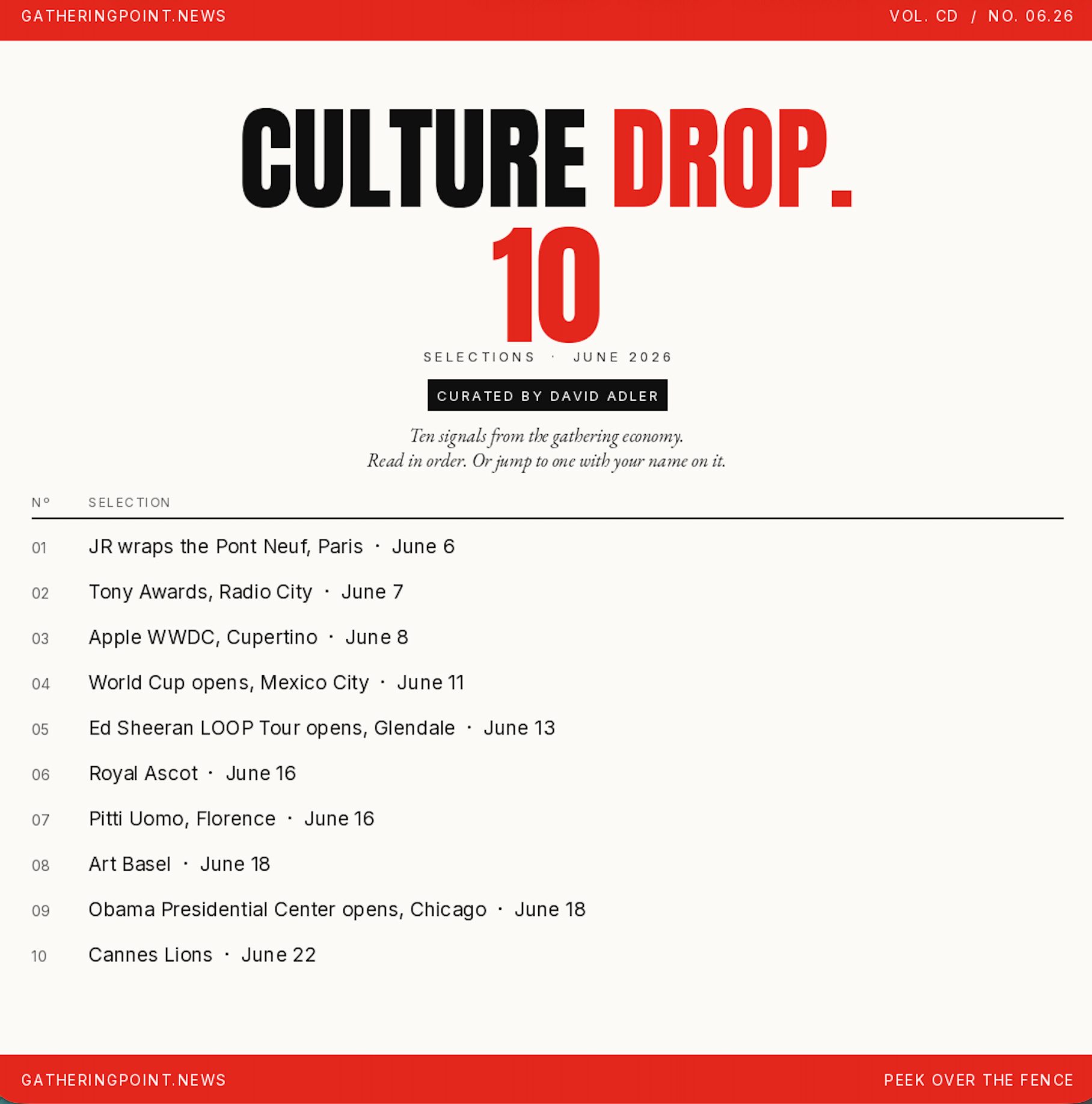
CULTURE DROP: JUNE 2026 --The Month the Tournament Begins
The cheat sheet for an industry too busy to come up for air.
THE CALENDAR — ONE EVENT TAKES THE STAGE, AND ONE CONTINENT TAKES THE WORLD
On the morning of June 6, the oldest stone bridge in Paris vanishes. The Pont Neuf, completed in 1607 and unchanged in skyline for four centuries, appears from the upstream banks of the Seine as a black-and-white limestone mountain dropped into the middle of the city. The French street artist JR has been planning this since January 2025. His crews at Atelier JR draped the 393-foot span through the night of May 23, drawing weekend crowds before the installation had even opened. La Caverne du Pont Neuf opens to the public on the sixth and runs until the twenty-eighth — three weeks, free to the public, visible day and night, a tribute to Christo and Jeanne-Claude, both born June 13, 1935, both having wrapped the same bridge in gold fabric forty years ago. Time Out has named it the single best new thing to do in the world in 2026.
That this is happening in June is not coincidence. Five days after JR’s cave opens, on June 11, the FIFA World Cup begins at Estadio Azteca in Mexico City — forty-eight teams, sixteen host cities, three countries, the largest single gathering event ever staged on the North American continent. Every hotel has been preparing rooms for two years. Every airline has rebuilt schedules. Every restaurant in a host city has been told to expect six weeks of capacity it has never seen before. American media has been selling this for a year as the largest gathering of all time. European football media has been quietly waiting to be proven wrong.
Then there is everyone else. The 79th Tony Awards take Radio City on June 7 with P!NK hosting. Royal Ascot opens June 16. Pitti Uomo opens the same day in Florence with Simone Rocha staging her first independent menswear runway. Art Basel opens June 18. Paris Fashion Week Men’s and Cannes Lions both open the week of June 22, the same week Oprah Winfrey collects her LionHeart Award. Apple stages WWDC in the second week. Monaco runs its race the first weekend. Ed Sheeran‘s LOOP Tour opens at State Farm Stadium on June 13. The Hollywood Bowl hosts the Tabernacle Choir on June 24 and 25. The Orient Express launches the largest sailing yacht ever built.
May was the month every industry held court at once. June 2026 is the structural inverse — not how the calendar absorbs simultaneous flagships, but how it organizes itself around a singular one. While Paris, in its quiet, declares it has already won.
PARIS — THE BRIDGE THAT BECAME A MOUNTAIN

[The Pont Neuf has been Paris’s “new bridge” for 419 years, a four-century joke at the expense of every older crossing the city has since destroyed and rebuilt. On June 6, JR disappears it. A 393-foot inflated mountain of printed limestone fabric, hollowed into a walk-through cave, layered with a Snap-powered augmented reality experience, scored by Thomas Bangalter of Daft Punk. Free. Three weeks. La Caverne du Pont Neuf.
The work is a tribute to Christo and Jeanne-Claude, the artist couple who in September 1985 wrapped the same bridge in 41,800 square meters of sandstone-colored fabric and 13 kilometers of rope, drawing three million visitors over fourteen days. Both artists were born on the same day, June 13, 1935 — the precise center of JR’s twenty-three-day run. A visitor walking through the bridge on the thirteenth of June is walking through a birthday card written at the scale of a French capital.
JR is doing this twice this month. He also designed the official poster for the 2026 Roland-Garros tournament — black-and-white photographic gaze meeting ochre clay-court texture — and the French Open final weekend overlaps with the cave’s opening. The city of Paris has, in effect, handed two of its largest June stages to one artist.
The Pont Neuf cave is the cleanest demonstration in years of how an ephemeral installation gives an entire city a focused identity for three weeks. It is free. It is monumental. It is finite. It pulls millions who all gather in the same place for the same reason. It costs Paris nothing and earns Paris the most photographed three weeks of its calendar year. Every principle Culture Drop preaches — scarcity, generosity, scale, ephemerality, the gift that lasts longer in memory than in physical form — is operating at maximum power on a single bridge in the middle of the Seine.
MEXICO CITY — THE TOURNAMENT BEGINS, AND THE OLD WORLD WONDERS WHY
The tournament opens June 11 with Mexico against South Africa at Estadio Azteca — the venue that hosted the 1970 and 1986 World Cup finals, now the first stadium in history to stage opening matches across three World Cups. The group stage runs through June 27 across sixteen host cities. By the end of the month, the field narrows from forty-eight teams to thirty-two.
European football still cannot quite accept this. The football establishment in Zurich, Madrid, and Munich is privately wondering whether a Tunisia-versus-Paraguay group-stage match at Arrowhead Stadium will sell ten thousand seats, let alone seventy-six thousand. The Mexican federation has carried the tournament with the kind of football culture every host should bring. Estadio Azteca is the only stadium on the bracket no European federation president has questioned. The American venues — MetLife Stadium, SoFi, AT&T Stadium, Gillette, Hard Rock — are world-class buildings designed for sports the world doesn’t watch. American media has been selling the tournament as a coronation. European media has been waiting to see whether American audiences will turn up for matches between teams they have never heard of.
For event organizers, the legitimacy debate is the wrong question. The right questions are operational, and the answers will be visible in real time. Watch how the host cities scale. FOX has invested more in this single tournament than any rights-holder has spent on an American sporting event since the Olympics came to Atlanta — and the broadcast architecture across sixteen cities is the largest live-production project the network has ever attempted. Watch the hospitality industry’s two-year preparation play out: every hotel general manager from Seattle to Mexico City to Toronto has been preparing rooms since 2024, every concierge team retrained in additional languages, every restaurant in a host city told to expect six weeks of capacity it has never seen before. The major hotel groups — Marriott, Hilton, Hyatt, Accor, IHG — have rebuilt their entire June-July operating model around this tournament.
Watch which host cities perform and which struggle. Atlanta, Dallas, and Houston have a head start because they have done this before (Olympics, Super Bowls, Final Fours). Vancouver and Toronto have built reputations as international sporting hosts. Kansas City and Philadelphia are the watch-cities for everyone in the room — both are betting that hosting a global tournament will reshape their convention-and-events economies for a decade. Watch which European federations declare the tournament a triumph and which spend July finding polite ways to call it a curiosity. Watch how FIFA itself uses the data — fan-flow patterns, broadcast viewership, hospitality spend, social engagement — to set the case for the next World Cup’s bid process.
The tournament is the largest live demonstration the industry will see this decade of how hospitality, broadcast, transportation, and ceremonial infrastructure scale simultaneously across an entire continent under uniform brand standards. Whatever the European football establishment ends up saying about the soccer, the operational case studies will be taught in event-management programs for the next twenty years.
MONACO — THE PRINCIPALITY HOLDS COURT
The Formula 1 Monaco Grand Prix runs June 4 through 7, one week before the World Cup opens — and one week, you can already feel, before half the F1 paddock catches the helicopter from Nice to Mexico City. Charles Leclerc is the local hero. Lando Norris is the title contender. Lewis Hamilton‘s second Ferrari season is the story everyone is watching. The two-square-kilometer principality bends entirely to the race for four days. Harbor packed with 250-foot superyachts. Every five-star hotel pre-booked twelve months in advance. Casino Square transformed into an open-air corporate hospitality complex by Friday morning.
What Monaco sells, more transparently than any other event in motorsport, is access. The race itself is not the product. The product is proximity — to the drivers, to the team principals, to the Liberty Media executives, to the Hollywood and finance class that flies in for the weekend and out by Sunday night. The Paddock Club is reportedly priced over ten thousand euros per person for the weekend. Every yacht in the harbor is hired by a brand or a private host. Every restaurant within a fifteen-minute walk of the circuit is fully booked by Wednesday. Prince Albert presents the trophy. Princess Charlene hosts the Friday-night charity gala.
For event organizers, Monaco is the case study in how a constrained physical environment becomes its own scarcity engine. Forty-eight hours, two-mile circuit, finite hospitality footprint. The constraint is the value.
NEW YORK — BROADWAY’S BIGGEST NIGHT
The 79th Tony Awards take Radio City Music Hall on Sunday June 7 with P!NK hosting. The season’s nominations — announced in early May — narrow across twenty-six categories of theatrical achievement, the culmination of a five-week awards cycle that began with the Pulitzer Prize for Drama and runs through the Drama Desk, Drama League, Outer Critics, and Lortel awards before landing on Sixth Avenue.
The Tony Awards is the rare live-televised event that still feels, plausibly, live. Performances are delivered from the stage with full ensembles, full sets, and full orchestras. The broadcast cuts between the ceremony itself and remote feeds from venues across the country. The host carries the room for three uninterrupted hours. CBS broadcasts. Paramount+ streams.
The craft is in the choreography. Twenty-six categories, fifteen-plus performances from nominated shows, dozens of acceptance speeches, three commercial breaks per hour — all live, in front of six thousand seated guests and a national audience. Very few live events of this complexity work on the first take. Broadway’s biggest night does, year after year.
ASCOT — THE COURT THAT WILL NOT MODERNIZE
Royal Ascot runs Tuesday June 16 through Saturday June 20, the most ritualized five days in British public life. Three hundred thousand attendees across the week. Nine of the United Kingdom’s thirty-two annual Group One races. A dress code that has not meaningfully changed in two centuries. King Charles and Queen Camilla arrive by carriage at two o’clock each afternoon. The racecard begins at two-thirty. Three days earlier, on Saturday June 13, Trooping the Colour celebrates the monarch’s official birthday on Horse Guards Parade.
Ascot is the world’s most disciplined exercise in not changing. The morning suit requirements in the Royal Enclosure are enforced by the gate. The hats are vetted by the organizing committee in advance. The carriage procession runs to the same minute it ran in 1825. The race card includes the same Group Ones your great-grandfather would have wagered on.
For event organizers, Ascot is the case study in legacy as a competitive moat. In an era when every major event is being asked to modernize, diversify, and broaden access, Ascot has chosen the opposite path with deliberate clarity. The constraint is the brand. The exclusivity is the product. The wait list is the asset.
FLORENCE AND PARIS — THE MENSWEAR FORTNIGHT
The world’s menswear industry compresses into two back-to-back European weeks every June. Pitti Uomo 110 takes the Fortezza da Basso in Florence from June 16 through 19, 720-plus brands from thirty-plus countries, forty-four percent international. Simone Rocha stages her first independent menswear runway at the Teatro della Pergola on June 18. The 2026 edition pilots an AI-driven exhibitor-buyer matchmaking platform for two hundred select brands. Confirmed retail buyers include Bergdorf Goodman, Harrods, Galeries Lafayette, Liberty, LuisaViaRoma, Nordstrom, and Dover Street Market.
Four days after Pitti closes, Paris Fashion Week Men’s Spring/Summer 2027 opens on the FHCM calendar from June 23 through 28, the same week as Cannes Lions. The collision is not accidental. Both events fight over the same global luxury-creative buyer base. Pharrell‘s Louis Vuitton continues to anchor the calendar. Jonathan Anderson‘s second season at Dior is in the spotlight.
For event organizers, the menswear fortnight is the cleanest demonstration of how a curated buyer base creates a market. Florence runs the trade. Paris runs the spectacle. Both run at scarcity. The combined ten days set the global menswear retail buy for the following spring.
BASEL — THE ART MARKET’S CAPITAL CONVENES
Art Basel returns to Messe Basel for its 56th edition from June 18 through 21, with VIP preview days on June 16 and 17. Nearly 290 galleries from over forty countries. More than 4,000 represented artists. The 2026 theme, “Global Dialogues,” reads less like a curatorial argument and more like the secondary market repositioning itself for a different distribution of collector capital. Larry Gagosian, David Zwirner, Iwan Wirth, and Marc Glimcher all on the floor as the Mugrabi family circulates. The Unlimited sector — large-scale works that do not fit a standard booth — is curated by Ruba Katrib in 2026.
Art Basel does not sell art the way an auction house does. It sells access to the conversation that decides which artists matter. The dealers are the brand. The brand has held for fifty-six years.
For event organizers, Basel is the most efficient single-week market deployment in the cultural economy. Four days. Three hundred galleries. Tens of thousands of high-net-worth attendees. Billions of dollars of transactions.
CANNES — THE OTHER CANNES (THE FULL STORY)
Cannes Lions runs June 22 through 26 and this year is its biggest, loudest, and most politically complicated yet. Oprah Winfrey takes the LionHeart. AB InBev‘s Marcel Marcondes opens the festival with the inaugural keynote for the new Creative Brand Lion. Tiffany & Co.‘s Hector Muelas sits on the Luxury Jury. Spotify runs two activations — the Beach for the public, the VIP Villa in the hills for everyone else. Bob Pittman hosts his annual dinner at Hotel du Cap-Eden-Roc. The Wall Street Journal anchors Journal House on the pier. NBCUniversal brings BravoCannes to FreeWheel Beach. TikTok Garden at the Carlton is hosting twenty creators who are quietly being replaced by AI versions of themselves on the platform that flew them there. Pinterest’s Manifestival, Meta Beach, LinkedIn Rooftop, Microsoft Gardens, Salesforce Beach, Adobe Takeover, Amazon Port, Canva Creative Cabana, Motel Yahoo!, Nikkei FT Teahouse, and the Female Quotient FQ Beach all hold the line on the Croisette.
CUPERTINO — APPLE STAGES THE NEXT YEAR
Apple WWDC runs in early June at Apple Park, the developer conference that sets the next year of iPhone, iPad, Mac, Vision Pro, and the rest of the Apple ecosystem. Where Google I/O in May was about AI infrastructure, WWDC is about consumer hardware integration — what shows up in the user’s hand twelve months from now.
The WWDC keynote is the most-watched corporate stage event in technology. The room itself is small — a thousand developers in the Steve Jobs Theater, plus the global livestream — but the production discipline is operatic. Tim Cook opens. Craig Federighi runs platform demos. The design team takes the stage for human-interface reveals. The entire keynote lands inside two hours with the precision of a Broadway opening.
For event organizers building keynote-driven brand moments, WWDC is the case study in how a controlled live event drives a year of platform narrative.
NORTH AMERICA — THE TOURS THAT TAKE THE STADIUMS
Two days after the World Cup opens, the largest North American concert tour of the year begins. Ed Sheeran‘s LOOP Tour kicks off Saturday June 13 at State Farm Stadium in Glendale, Arizona, then runs stadium dates through November in Nashville, Detroit, Tampa, and a dozen more cities. Sheeran’s signature is the solo-with-loop-pedal staging — no band, no dancers, no choreographed spectacle, one man and a guitar building each song in front of fifty thousand people in real time. He is, by some measure, the most commercially successful live performer of his generation, and he does it with the smallest physical footprint on stage of any stadium act in the world.
The June tour calendar carries others. Bad Bunny brings the DeBÍ TiRAR MáS FOToS World Tour to its first-ever UK stadium dates June 27 and 28 at Tottenham Hotspur Stadium. Gorillaz take the same stadium on June 20. Garth Brooks headlines American Express presents BST Hyde Park on June 27. Morgan Wallen‘s Still the Problem Tour rolls through its June dates on its way to wrapping in Philadelphia on August 1.
For event organizers, the contrast in June is the lesson. Sheeran proves a stadium can be filled with one person and a loop pedal. The World Cup proves a stadium can be filled with one match and three billion viewers. Two opposite ends of the live-event spectrum, both operating at the absolute top of their respective crafts in the same month.