
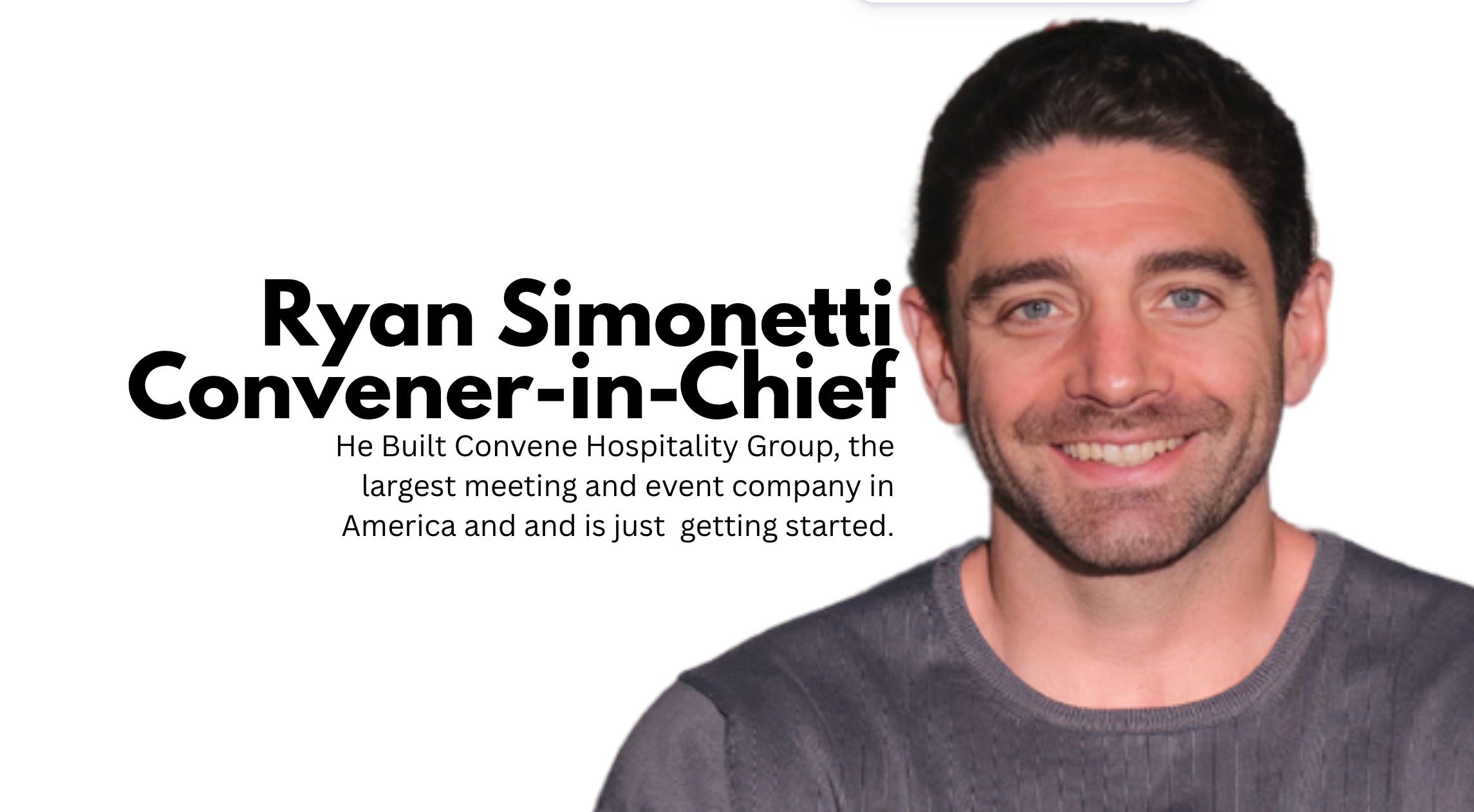
Convene Hospitality Group’s Ryan Simonetti Is Redefining Where the World Meets
He grew up in the back of a bread truck. He built the largest gathering company in America. He’s just getting started.
The lesson Ryan Simonetti carries from his father has nothing to do with real estate or hospitality or the $230 million his company just secured from Ares Management and TPG Credit Solutions. It is simpler and older than any of that. His father ran a bread delivery route in central New Jersey — Martin’s Famous Potato Rolls, the predawn shift, every morning for decades. The competitors would drop the product and leave. His father would pack out the shelves. Full shelves move product. Empty shelves lose money. Do the thing your competition is not willing to do. Show up on the days they don’t. The rest, Simonetti will tell you, is detail.
He is now President and CEO of Convene Hospitality Group, the parent company uniting Convene, etc.venues, NeueHouse, and a growing portfolio of special event venues that collectively make CHG the largest owner and operator of dedicated meeting and event space in the United States and the United Kingdom. By the end of this year, the company will control nearly three million square feet across nine cities. The plan over the next five to six years is to double the footprint from roughly 40 to something closer to 70 or 80 locations, through a combination of organic growth and acquisitions. The $230 million, backed by Ares and Brookfield, is the accelerant. But the foundation was laid in a bread truck outside Hillsborough, New Jersey, before Simonetti was old enough to drive.
He was eight years old when his father bought the delivery business. He does not describe it as a hardship, exactly, though the picture is clear enough: summers and weekends in the truck before dawn, stocking shelves while other kids slept. What he took from it was not resentment but a framework. “We control very few things in life,” he said recently. “We control our outlook. We control our attitude. And we control our effort. My dad was big on all three.” When he talks about his father treating every person the same — the store manager, the receiver, the person stocking the shelves, the owner — he is not reciting a management principle. He is describing the first business education he ever received, delivered at 2:30 in the morning in a New Jersey parking lot.
Simonetti was the first in his family to attend college. He went to Villanova on grants and student loans, working to help cover costs while enrolled, and he met his future co-founder Christopher Kelly during freshman orientation. The two of them were, by Kelly’s own accounting, among the very few students on campus without their parents’ credit cards. What they built in response was, in retrospect, the earliest version of what would become Convene. They ran buses. Hundreds of kids — at the peak, somewhere around 700 or 800 — loaded onto yellow school buses in the west lot, headed for ticketed parties at clubs in Philadelphia. The math was clean: $25 per bracelet, $5 to the bus, $10 to the club, $10 to Simonetti and Kelly. Villanova is a Catholic university. It did not want students drinking on campus. They solved the problem by moving the party off campus and charging for the solution. He has been in the gathering business, one way or another, since he was nineteen years old.
After Villanova he went to Lehman Brothers, then to Gramercy Capital, where at 26 he was running a $3 billion portfolio weighted toward office buildings and hotels. When the financial crisis arrived in 2008, the calls started coming in: tenants giving back space, buildings losing value, conference rooms sitting empty. The question he kept turning over was not how to survive the collapse but what a better model might look like on the other side of it. Why were office buildings not being run like hotels? What would it mean to layer hospitality onto a real estate asset that had been managed purely as square footage? Convene was incorporated in October 2009, and I encountered Simonetti and Kelly shortly after, at one of the massive startup meetups that defined New York City in those years. These were not small gatherings. Hundreds of people would turn up to hear founders pitch ideas that ranged from the obviously doomed to the quietly world-changing. I remember hearing a presentation at one of them about a small transportation solution called Uber. The platform economy was crystallizing in real time, and the thesis that a service layer on top of someone else’s asset could be worth more than the asset itself was the animating logic of that entire scene. Simonetti and Kelly fit perfectly inside it: two founders with a real estate and hospitality play, making the argument that the conference room was an underutilized asset waiting for exactly that kind of service layer. They had the math and they had the logic, and they had clearly done what few founders bother to do — studied how new economic models actually work before trying to build inside one.
The design sensibility came from an unlikely source. As a child he was dragged by his mother through furniture stores and antique shops in New Jersey, visits he found somewhere between tedious and torturous at the time. "My mom used to torture me and drag me around with her," he told CoStar News. "She was really into design. I think there's something about that I kind of picked up as a kid. I developed a good eye for quality. I never went to school for architecture, design or anything, but I picked up a really good natural sense for space and dimension." His team, he says, would describe him as an architect and designer trapped in a finance guy's body... "Nobody had put the two together," he told CoStar. In the early-to-mid 2000s, he could see that lifestyle and experience were going to bleed across every asset class and every industry and nobody had brought it to the office yet. Convene was the first to try.
Before getting into what Convene became, it is worth being precise about what made it different from everything that existed before it, because the distinction is not obvious from the outside and it is the whole game. A hotel meeting room is sold as a room. The price is the room. Everything else — the AV technician, the catering, the Wi-Fi that actually works, the coffee that arrives when it is supposed to — is negotiated separately, invoiced separately, and frequently surprises the event planner at the end. A Convene booking works the opposite way: one price per person, all-inclusive, with the AV, catering, technology, and staffing bundled in from the start. No hidden line items. No vendor coordination. No moment where the bill arrives and the math no longer resembles the original quote. Convene’s own research found that competitors’ hidden or delayed pricing can inflate the cost of an event by up to ten times the original figure. The per-person model did not just simplify the transaction. It signaled a fundamentally different philosophy about who the product was being built for: the planner who needed to know on day one what the event would cost, not find out on day thirty.
The company that emerged over the next sixteen years was defined less by a grand hospitality vision than by an operator’s obsession with getting the details right. The decision to embed inside Class A office buildings rather than compete with hotels directly was structural genius: Simonetti didn’t need to own the real estate, only to run it better than anyone else had bothered to try. The culinary team was built in-house. The design sensibility — which he traces, without embarrassment, to his mother dragging him through showrooms he found tedious as a child — became a signature. Each location has a lead chef. The rooms are genuinely beautiful. He once described Convene’s market position as the JW Marriott or Ritz-Carlton of meeting space, while the WeWorks of the world were Hilton Garden Inns. The comparison is not modest. He does not appear to think it is inaccurate.
The pandemic came for all of this with a ferocity that is easy to forget now that the numbers are pointing in the other direction. A hospitality company built entirely around in-person gathering watched its entire reason for existing evaporate in a matter of weeks. Simonetti has said publicly that he tells entrepreneurs you have to survive long enough to be right. The pandemic was the stress test for that conviction. CHG survived, in part through capital infusions and in part through decisions made under the kind of duress that, he says, is not entirely different from being in a losing position in a live sparring match. He has practiced mixed martial arts for 25 years. He spent the last two and a half years training in jiujitsu and recently won a competition. The discipline he describes — getting comfortable being uncomfortable, controlling your emotional response when the outcome is uncertain — is not a metaphor he reaches for lightly. He spent several years living it in the most literal business sense.
The recovery has been extraordinary. Convene recorded a 22 percent increase in demand for events year-over-year in 2024. For 2025, the company was already pacing 123 percent ahead of where it had been at the same point the prior year and have hosted 630,000 guests. The 2023 acquisition of etc.venues brought 16 UK locations and established the tiered brand logic that CHG now operates: Convene for large-format, customized events and premium workplace experiences; etc.venues for turnkey small-to-medium meetings; NeueHouse for a membership model anchored in creative culture and programming. The acquisition of NeueHouse was the move that signaled something beyond an events company scaling its core product. NeueHouse was built around a community of writers, directors, architects, and entrepreneurs who needed a room that felt like something, not just a room that functioned. Adding it to a portfolio that had been built on corporate conferencing is either a contradiction or an expansion of the thesis, depending on how you read the strategy.
Simonetti reads it as an expansion, and he makes a compelling case. What used to be a meeting is now a brand experience. What used to be a conference is now a brand activation. The spend is shifting from procurement budgets to marketing budgets, and the clients showing up are thinking about outcomes, not square footage. He has started reframing the industry’s traditional ROI as “return on experience” — what impact did this event actually have on the people in the room, not just on the organization’s quarterly numbers. In this framing, the NeueHouse acquisition is not a detour. It is the company betting that the future of gathering is not the efficient delivery of content but the intentional design of transformation, and that there is a client base willing to pay for that distinction.
The gathering grants concept he is developing inside CHG is, in some ways, the most revealing thing about where he thinks the company is going. The idea is straightforward: CHG provides not just donated space but actual funding to organizations and conference producers that need seed capital to host gatherings that matter. A foundation model, applied to the gathering economy. He also talks about using NeueHouse specifically as a platform for the most important conversations happening in culture, politics, science, and technology. Not just the venue for those conversations, but the host of them. He cites a partnership with Michael Farber’s Breakout as an early expression of this. Farber has spent more than a decade building something that resists easy categorization: since 2014, Breakout has operated across more than 20 cities, assembling a national network of over 2,000 leaders, founders, funders, organizers, artists, and civic builders who Farber describes as people who keep showing up for each other. The organization claims $25 million in economic impact and is now expanding into two distinct formats — SEE, which brings local leaders together across the dividing lines that ordinarily keep them apart, launching in New York and moving toward Los Angeles; and Breakout Builders, national sector gatherings focused on technology for public good and the future of cities. It is, in other words, exactly the kind of organization that needs a room worthy of what it is trying to do. The partnership with CHG is a test of whether a commercial hospitality platform and a civic gathering organization can find shared purpose without one instrumentalizing the other. It is an ambitious self-conception for a company that started by asking whether office buildings could be run like hotels. The answer, apparently, is yes, and also more than that.
The impact he wants to have can be had from a platform that is growing large enough to matter: nearly 3 million square feet, nine cities today, double that within five years. The people who work for him, the taxes the company pays, the conversations it hosts, the grants it funds. He ends every email with two words. Don’t stop.
The last time we spoke, he was running between parent-teacher conferences, texting about a business matter at the same time, apologizing for the chaos without quite pausing it. His kids now go to sleep-away camp, which was not a thing in his household growing up. He notices this. The phases of a life, he said, have to be maximized on their own terms, and the phase he is in now is the one where success means raising healthy and independent and kind children and not letting the professional ambition crowd that out. He is genuinely convinced of this. He is also, demonstrably, running a company he intends to double in size. He is a first-generation college graduate who built the largest gathering company in America on a thesis he was pitching to small rooms before anyone believed it, and who closes every email with a reminder to himself that the work is not finished. His father would recognize the posture immediately. Full shelves. Show up on the days they don’t. The rest is detail.
1. Do what your competition won’t. Full shelves move product. Empty shelves lose money. The edge is rarely a breakthrough idea — it is the willingness to show up on the days everyone else goes home.
2. Control only what is yours to control. Outlook. Attitude. Effort. Simonetti learned this riding in his father’s truck before sunrise and has repeated it to his own children. Everything else is noise.
3. Treat everyone exactly the same. From the store owner to the person stocking the shelves. His father modeled it without naming it. Simonetti has carried it into every room he has ever run.
4. Necessity is a better teacher than ambition. Two broke kids at Villanova without their parents’ credit cards built a bus party business that became, in retrospect, a rehearsal for everything that followed. The hustle preceded the vision.
5. Study how new models actually work before building inside one. Simonetti spent time at those early NYC startup meetups understanding platform economics before applying them to real estate. He knew what he was building and why.
6. The service layer is worth more than the asset. You do not need to own the building. You need to run it better than anyone else thought to try.
7. You have to survive long enough to be right. The pandemic tested every conviction Convene was built on. Survival was not incidental — it was the strategy.
8. Get comfortable being uncomfortable. Jiujitsu taught him to control his emotional response when the outcome is uncertain. He considers it as relevant to running a company as any business school curriculum.
9. Reframe ROI as return on experience. The question is not what the event cost. It is what it changed — in the people in the room, in the culture of the organization, in the relationships that did not exist before the gathering.
10. Don’t stop. He closes every email with it. Not as a slogan. As a reminder to himself.


