


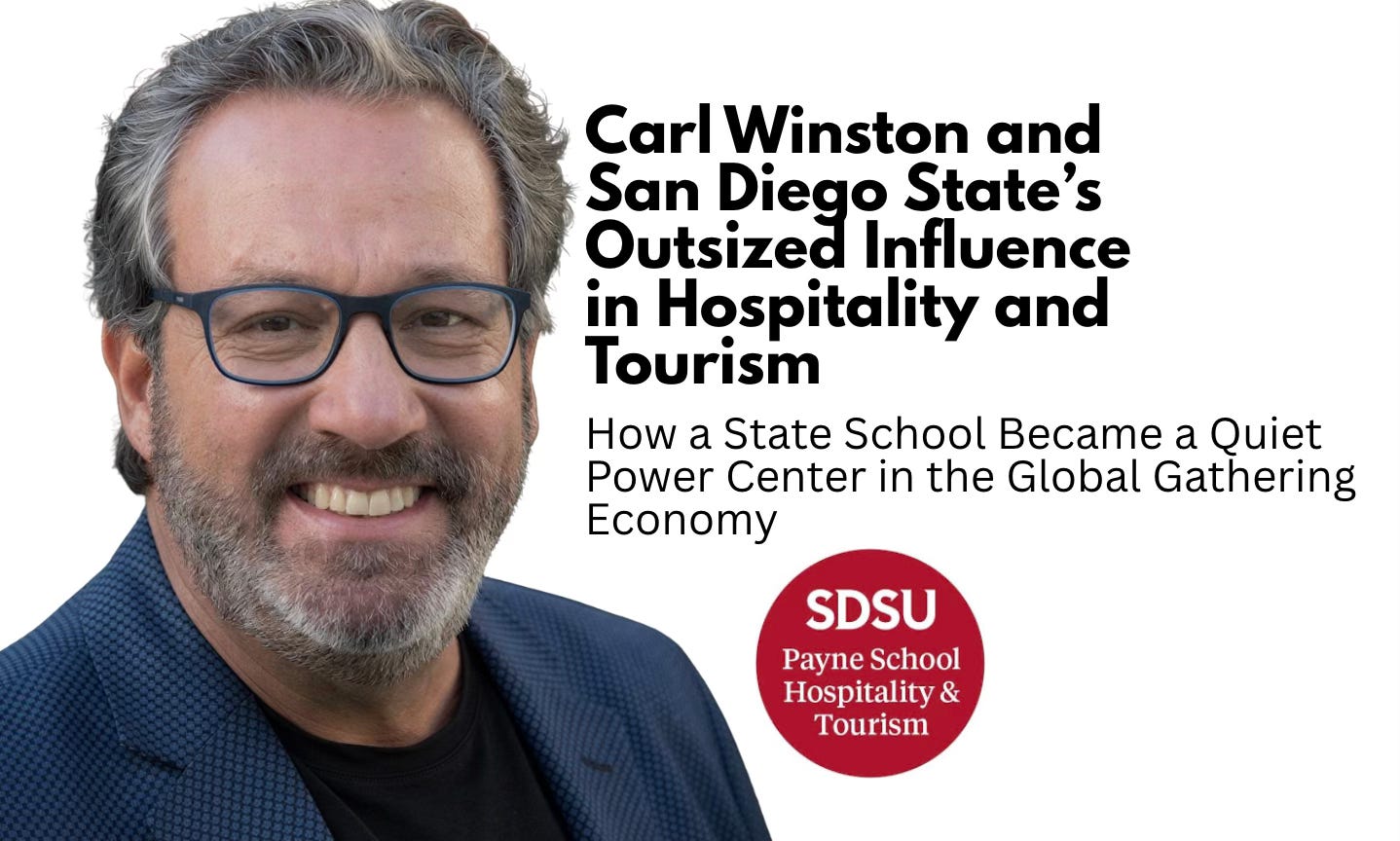
Carl Winston, the outspoken Director of the School of Hospitality & Tourism Management at the L. Robert Payne School of Hospitality & Tourism Management
College of Professional Studies and Fine Arts, does not tell his story like a man who believes he was destined to run an academic institution. He tells it like someone who learned early how institutions actually work and then decided, quietly, that he was not going to remain on the outside of their influence.
His education in hierarchy began in hotels.
As a young man working in hospitality long before he ever arrived at Cornell University, Winston absorbed a culture that was direct and unsentimental. Supervisors corrected publicly. Service failures were not softened with language. The business was physical, immediate, and accountable in ways few industries are. If revenue dipped, it was felt. If an event misfired, it rippled through payroll and reputation.
He has described early bosses who were tough to the point of intimidation, men who believed that pressure was not cruelty but preparation. The message was unmistakable: this is a serious business, and if you want to survive in it, you will not be coddled.
What he learned in those years was not simply work ethic. He learned to watch.
He saw who had operational responsibility and who had decision-making authority. He saw that the people closest to execution were not always closest to influence. Meetings filled rooms and drove margins, but the people running them were rarely invited into strategic conversations about why those meetings mattered beyond occupancy rates.
By the time he reached Cornell, he was already primed to notice structure.
Cornell did not feel like escape. It felt like exposure to a more refined version of the same hierarchy. The School of Hotel Administration carried an establishment confidence that did not need to assert itself loudly. Alumni networks were active and tight. Prestige was embedded. Students were trained to think in systems, finance, yield, operational efficiency. Hospitality, in that environment, was framed as a serious economic discipline, not decorative service.
Winston has acknowledged that he was not socially born into that world. He was not the product of inherited Ivy pipelines. He entered it with industry experience and ambition rather than pedigree. That vantage point gave him distance. He could see how prestige protects itself because he had not been raised inside it.
Cornell did not embitter him. It sharpened him.
It made clear that seriousness is not accidental. It is constructed deliberately through curriculum, alumni loyalty, and institutional repetition. If hotel management could command intellectual weight because Cornell defended it rigorously, then meetings and events could do the same — if someone was willing to build the scaffolding.
After Cornell, Winston did not retreat into academia out of necessity. He built a successful career in hotels. He operated in environments where margins were real and authority had consequences. He was not chasing refuge; he was accumulating credibility.
His relationship with San Diego State University began through volunteerism. Advisory boards. Mentorship. Industry engagement. He saw potential in the hospitality program and began investing in it without holding formal authority.
At that time, meetings and events were part of the curriculum but not central to its intellectual identity. Public universities, he discovered, move differently than Ivy institutions. They operate through committees, budget negotiations, political alignment. Prestige is not assumed; it is argued.
Winston did not try to bulldoze that system. He studied it.
He watched how proposals moved. He learned which faculty guarded which territories. He understood that in public academia, seriousness is not granted by reputation but by coalition.
When SDSU began searching for new leadership for the hospitality school, Winston was asked to serve on the search committee. He knew the industry and the institution. The committee’s mandate was to find someone who could elevate the school’s stature, deepen industry integration, fundraise effectively, and navigate public university politics.
The more the criteria were discussed, the more they resembled the man already in the room.
The comparison to a political search that ends with the search leader becoming the candidate is irresistible, though Winston’s path was far less theatrical. He did not maneuver. He was asked.
By the time he assumed leadership, he had already mapped the institution. He knew where resistance would gather. He knew which arguments would move committees. He knew that prestige could be built without Ivy inheritance if it was reinforced cohort by cohort.
He also knew he was not going to play by academic rules alone.
Winston has been candid about his impatience with certain academic conventions. He believes hospitality education cannot afford to be insular. He fundraised aggressively. He built deep industry partnerships. He invited practitioners into the classroom not as guests but as collaborators. He insisted that meetings be taught through the lens of governance, contracts, risk, and executive fluency.
His graduate program embodied that philosophy. He did not design it for inexperienced students seeking credentials. He designed it for mid-career professionals who had already felt frustration — planners who knew what it meant to execute flawlessly yet remain peripheral to strategy. He taught them how organizations actually function, how budgets are allocated, how influence moves.
This was not abstract theory. It was corrective.
Winston’s obsession has always been legitimacy. Not glamour. Not applause. Legitimacy.

He believes meetings are misunderstood not because they lack importance but because they are rarely framed in the language of consequence. He speaks often about facilitation as a serious skill — about convening as infrastructure. He sees gatherings not as production but as architecture.
That framing became particularly resonant during the pandemic, when event professionals emerged inside corporations as connective tissue. They aligned departments, managed narrative, preserved culture in shared space. What many executives experienced for the first time was the strategic dimension of convening — the soft power embedded in a room.
Fatherhood added gravity to his long game. Raising children in an industry subject to volatility stretches perspective. Watching hospitality collapse and recover was not theoretical. It reframed stability and durability.
Through it all, Winston has been building something that was not automatically supposed to matter: a state-school program without Ivy pedigree that competes nationally in hospitality and tourism. SDSU may not carry Cornell’s inherited prestige, but under his leadership it cultivated alumni loyalty, industry respect, and intellectual seriousness.
He learned in hotels that authority and responsibility are rarely aligned by accident.
He learned at Cornell that prestige is constructed and defended.
He learned at SDSU that public institutions can punch above their weight if someone understands both politics and leverage.
And he never quite lost the discomfort of being underestimated.
That discomfort, rather than ego, may explain the through-line of his career. He has spent decades ensuring that meetings and hospitality are not dismissed as decorative but understood as disciplines within what we now describe as the gathering economy.
He did not inherit seriousness.
He built it.