
Cannes Lions Got an A. The Great American State Fair Got an F.
An Event Pro Perspective: Cannes Lions proved the gathering is the future of marketing. Washington couldn't keep the ice cream cold.
The Summary: Same week. Two gatherings. Cannes Lions proved that live experience is the most powerful marketing channel alive. The Great American State Fair proved what happens when you hand a World's Fair brief to advance men who have never designed a room. One event sent people home already planning to return. The other couldn't keep the ice cream cold. This is the practitioner's verdict -- with grades. Read the full story below.
The people flying home from Cannes this weekend are in a condition every event professional recognizes. Wrecked. Sunburned in a way that will require explanation to anyone who wasn’t there. Running on accumulated rosé and roughly eleven hours of sleep across five days. Still processing a midnight conversation on a yacht that may or may not change the direction of a company. Already, somewhere over the Atlantic, calculating what they need to do differently next year to get into the rooms they missed this one.
That condition -- overstimulated, time-compressed, genuinely reluctant to leave -- is the clearest proof of concept for the argument reshaping the marketing world. The live gathering is not a support channel for the strategy. In an era where AI generates a campaign in eleven seconds and every digital channel drowns in its own content, the one thing that cannot be faked, generated, or skipped is a room where something real happens between human beings. The gathering is the strategy. The room is the last trusted channel the algorithm cannot reach.
Cannes Lions 2026 proved that argument on a kilometer of French coastline across five days. Simultaneously, on the most symbolically powerful public canvas in the Western hemisphere, the Great American State Fair proved the opposite: that a gathering built by people who have never heard of experience design produces something that ten states refused to attend, that a journalist with 71,600 TikTok likes called “a quick, painful tour,” that left visitors from Ohio wandering for an hour trying to find the entrance, and that a worker inside told the Washington Post, on condition of anonymity, had been “running behind” from the start.
This is a practitioner’s autopsy. Five categories. Two cities. One verdict. And before the categories, the credentials -- because nothing about what happened on the National Mall makes sense without understanding exactly who was responsible for it, and what the creative community concluded about them before a single tent went up.
The People in the Room -- or Rather, the People Who Have Never Designed One

Freedom250’s own press releases set the standard against which this event must be judged. They described the Great American State Fair as “a first-of-its-kind national exposition inspired by the World’s Fairs.” Their website called it “a modern-day World’s Fair.” They made the comparison. We are simply measuring them against it.
The 1964 New York World’s Fair -- the last great American public gathering of this kind -- put the Eames Office, Walt Disney and his Imagineers, industrial designer Eliot Noyes, and architect Minoru Yamasaki in the same production ecosystem. The IBM Pavilion alone was three years in the making, organized around a 90-foot theater, a Probability Machine, and a People Wall that hydraulically hoisted 500 visitors at a time into an immersive presentation projected across 22 screens. Disney treated the fair as an experiment in design and ambition whose innovations ultimately generated the conceptual DNA for Walt Disney World and EPCOT. The people who built that event understood that a World’s Fair is a gathering a nation carries in its memory for generations. They brought designers, architects, experience inventors, and creative directors who had spent careers learning how physical space reshapes human perception.
The Great American State Fair was built by Tim Unes and Justin Caporale of Event Strategies Inc. Here is the full professional record.
Unes holds a Bachelor of Arts in Political Science from George Washington University. He produced Donald Trump’s campaign announcement tour in 2015 and helped the campaign establish its operations division. In 2016 he joined the Trump campaign as its deputy director of Advance. His company’s website listed HBO, IBM, Microsoft, Morgan Stanley, AARP, and the Washington Nationals as clients. When his January 6 connection surfaced, AARP sent a cease-and-desist letter to Event Strategies demanding their name be removed, noting Unes had worked on one project for the organization twenty years earlier and had done no work since. That is the complete professional biography of the man who served as stage manager for an event billed as a modern World’s Fair. A political science degree. A campaign advance operation. A cease-and-desist from AARP.
Caporale’s record is longer and no more reassuring. Before joining the Trump orbit he served as National Director of Operations for Concerned Veterans for America, a conservative advocacy organization, where he facilitated almost 200 events for grassroots campaigns. In 2015 he founded District Programs LLC, a Washington consulting firm focused on advocacy, event management, and strategy, before joining the Trump campaign as Lead for the Advance and Operations team. He subsequently served as Melania Trump’s director of operations in the East Wing, resigned in 2018 over security clearance issues, worked for Ron DeSantis, returned as deputy campaign manager for Trump 2024, and was identified as one of two campaign staffers who physically pushed past an Arlington National Cemetery employee trying to block filming at the graves of soldiers killed in Afghanistan. His most recent White House title before the Great American State Fair was Executive Producer, Major Events and Public Appearances -- advance work by another name.
Neither man has ever worked in experiential marketing. Neither has ever designed a multi-day consumer-facing gathering. Neither has ever been responsible for a guest journey, a pavilion sequence, a food and beverage program, a wayfinding system, or a dwell-time architecture. The closest either has come to the experience design profession is Unes listing IBM on his website until IBM’s lawyers presumably noticed.
The ESI portfolio, as the company presents it on their own website, tells the story more plainly than any critic could. Scroll through it and what you find is: the Trump 2015 announcement rally, multiple Trump 2024 campaign rallies across several states, the January 6 Ellipse rally, the Commander in Chief Ball at the 60th Presidential Inauguration, the John McCain for President campaign, NRCC Majority Galas, America First Policy Institute summits and galas, Concerned Veterans for America advocacy tours including the “Defend Freedom” and “Vets for Freedom Heroes Tour” campaigns, a DC Fire Department Awards Ceremony, a Politico Women Rule Summit, a Yahoo Finance event hosting Jack Welch, a Priceline promotional activation, an American Petroleum Institute energy conference, a Small Business Administration Expo, and the U.S. Army Grand Military Parade.
The longest distance any of these events travels from a stage-and-principal format is the Priceline “Perfect Yardsale” -- a promotional stunt -- and a Brooks and Dunn performance for the Academy of Achievement. There is not a single multi-day consumer-facing experiential environment in the entire catalogue. Not one trade show. Not one festival. Not one event that required designing a guest journey lasting longer than a single evening or that asked the production team to think about dwell time, circulation logic, content architecture, sensory progression, or how the weakest exhibit in a linked experiential environment degrades the credibility of every other one.
The Great American State Fair was not merely the biggest event ESI had ever produced. It was a category of event they had never produced at all. And the National Mall -- ten city blocks, sixteen days, 56 states and territories, the nation’s 250th birthday -- paid the price for that gap in a way that is now documented in newspapers, TikTok videos, and the memory of two visitors from Ohio who wandered for an hour trying to find the entrance.
Here is the NotebookLM video of this story.
The Verdict That Came Before the Event
In the event business there is a principle so basic it rarely gets stated: if the talent won’t come, the audience won’t come. Talent is not decoration. It is the first signal a gathering sends about what it is and who it is for. When that signal fails before the gates open, everything that follows is damage control.
The Great American State Fair lost that signal six weeks before opening day -- not because of logistics or design, but because the people booked to perform discovered, after the contracts were signed, what the event actually was.
More than half the performers slated for the concert series pulled out, citing the event’s political associations. Each departure came with a statement, and each statement said the same thing in slightly different language: we were told this was a nonpartisan celebration of America, and it turned out to be something else.
Martina McBride, scheduled for opening night, said she thought the event was going to be bipartisan. “It greatly upsets me that any fan who has been moved by my music may now feel like I’m abandoning the meaning behind those songs,” she wrote. “I assure you, that is not the case.” Young MC wrote that the artists “were never told about any political involvement with the event” and that he hoped to perform in Washington “in the near future at an event that is not so politically charged.” Bret Michaels -- who had won Trump’s own Celebrity Apprentice in 2010 and could hardly be described as a hostile witness -- said the event had “evolved into something much more divisive than what I agreed to be part of” and cited safety concerns for his fans, his band, and his crew. Morris Day of Morris Day and The Time posted on Instagram: “It’s A No For Me.” The Milli Vanilli situation descended into its own particular chaos, with the original studio vocalists issuing a statement that anyone performing under that name at the fair should be considered a tribute band with no association to their sound or songs.
This is not a political story. It is a booking story. In event production, the relationship between an organizer and a performer rests on one fundamental premise: the performer knows what they are signing up for. When artists discover after contracting that the event is something other than what they were told, the walkouts that follow are not acts of political protest. They are the exercise of professional self-preservation. The artists were not told. That is an event management failure before it is anything else -- the failure to be honest with your talent about your event, which means the failure to know your own event well enough to describe it accurately to the people you are asking to stake their reputations on it.
The response confirmed everything the departures had implied. Trump declared he would instead hold “the Greatest Rally, EVER!” writing: “We don’t want singers with no talent, but big fees to put you to sleep, we’ve told them all to stay home.” The advance man’s instinct had fully reasserted itself: when the gathering fails, reframe it as a rally. The opening night of America’s 250th birthday celebration was headlined by the president himself, with Lee Greenwood and Christopher Macchio providing the music. The performer who remained most publicly committed to the fair was Vanilla Ice. The sixteen days that followed were not a World’s Fair. They were an aftermath.
Strategy: What the Gathering Was Actually For
Every serious event begins with one question: what do we want people to feel when they leave, and what do we want them to do because of it? That answer is the brief. Everything else exists in service of it.
At Cannes, the brief was clear and consistent across every brand on the Croisette. The world’s largest technology companies showed up on that beach with one shared argument: in an AI-driven world, the physical gathering is the last irreplaceable marketing channel. Canva stated the industry’s position directly -- that in an AI-driven world, human connection and creative access matter more than ever, which makes experiential matter more than ever. Every activation was built to prove that from the inside. The brief was not build a booth. It was make the people who walk through this space feel something no algorithm could have manufactured.
Amazon built Le Boulevard d’Amazon -- a French village streetscape where each storefront represented a different Amazon property. IMDb drew caricatures. Twitch served ice cream. Prime Video ran a bookshop. The central activation let visitors build an entire business from scratch using an AI agent interface, earn a physical key, and trigger a live brand campaign across Amazon’s full ecosystem. Yahoo transformed La Plage du Martinez into the Yahoo Explorers Society, a nautical world built around the spirit of Jacques Cousteau, with destinations called The Loading Bar, The Nav Bar, and The Engine Room, anchored by a giant purple submarine. Meta brought Es Devlin -- whose theatrical vocabulary has shaped some of the most technically ambitious live experiences in the world -- to build a cinema structure from scratch on the beach, anchor it with a seven-minute vertical film, and deliver what observers described as extraordinary craft at every level. These are marketing arguments made physical, built by people who understand that the environment makes the case before anyone opens their mouth.
The Great American State Fair had a brief too, though nobody appears to have written it down: produce a patriotic backdrop for the president’s semiquincentennial. That is a rally brief, not a gathering brief. A rally converges attention on a principal. A gathering distributes energy across an experience and sustains that energy after the principal is gone. The entire production architecture of Washington -- identical white boxes in rows, sixteen themed days with no connective tissue between them, no experiential logic linking one pavilion to the next -- reflects a team that never asked what the gathering should feel like from the inside. They asked what the stage would look like on television at 8:30 on Wednesday night. Roughly half of the opening crowd wore Trump’s slogans or likeness on their clothing. For them, the nation’s 250th birthday was secondary to seeing the president. When your most committed attendees are primarily there for the principal, you have built a rally. The sixteen days that follow his departure have no foundation beneath them.
Logistics: The Production Fundamentals That Weren’t
Before a gathering can inspire, connect, or sell anything, it must do three things: open on time, keep the power on, and feed the people inside it. These are not aspirational standards. They are the floor. Below them, nothing else counts.
Critics reached immediately for the Fyre Festival analogy, and it is not entirely wrong -- the gap between the marketing and the reality, the talent that wouldn't come, the infrastructure that failed on opening day. But Fyre Festival was a private con perpetrated by a failed influencer on ticket-buyers who lost money. What happened on the National Mall was something the gathering industry finds more troubling: a public failure, on federal land, organized by a White House-backed nonprofit with government resources, that still could not open its gates on time or keep the ice cream cold. Fyre at least had the excuse of being run by people who had never claimed to know what they were doing. ESI's website says they craft "moments that shape people." They had one of the most significant moments in a generation. This is what they shaped.
A fair concession here about weather. The heat this week was genuinely brutal in both cities. The Côte d’Azur in late June is not comfortable, and no production company controls the atmosphere. Real events happen in real weather, and weather is the one variable no organizer owns. What Cannes can be credited with is building an infrastructure so professionally executed that fifteen thousand people endured brutal heat for five days and their dominant emotion was not exhaustion but longing to return. The difference between the two cities was not the weather. It was what the organizers had built underneath it.
Washington had the heat and little of the infrastructure. Gates opened thirty minutes late while organizers sorted out power outages and moved the last of the construction material out of the sightlines. The food hall lost power on opening day. Vendors lost refrigeration. The entire ice cream supply melted. Some food vendors waited thirty minutes before they could resume preparing hot food. The lights kept switching off and back on in one food tent throughout the afternoon. The Ferris wheel -- the marquee anchor attraction -- operated only intermittently due to a faulty generator, leaving visitors waiting in line for a ride that may or may not run. The water station ran out of ice. Water was served at room temperature. On day two, workers in the food hall were still waiting for a fresh ice cream shipment because their entire supply had melted the day before, and multiple food options remained unavailable through lunch service.
Power infrastructure for a multi-week outdoor event in Washington in June is not a surprise variable. Generator capacity, refrigeration load management, redundancy planning -- these are solved at the bid stage by people whose professional obligation is to anticipate exactly these conditions before a single tent goes up. The heat did not defeat the Great American State Fair. The absence of professional production management defeated it. The heat simply made the defeat impossible to hide.
The Basics: Arrival, Wayfinding, and the Gate
In the event business, the entrance sequence is where the gathering makes its first and most consequential promise: we expected you, we prepared for your arrival, you are welcome here. When that promise fails, the guest arrives already depleted, already resentful, already primed for disappointment. The event spends its credibility before a single pavilion has been entered.
At Cannes, the Croisette is walkable end to end in twenty-five minutes. The design logic of the week encourages delegates to stack two or three beach activations per day, with the only navigation challenge being which of too many compelling options to choose first. The wayfinding is so intuitive that the guidebooks focus not on how to find the event but on how to sequence the abundance within it.
The Washingtonian described the National Mall during the Great American State Fair as feeling like “a maze -- sidewalks are closed, fences abound, and sometimes you just have to walk toward the Washington Monument and hope for the best,” a condition so disorienting the publication built an interactive map specifically to help people find the entrance to a free, public event. Multiple unannounced pop-up closures appeared on surrounding roads and sidewalks, with detour signs, fencing, checkpoints, and barricades on every block. The Washingtonian’s critic walked over a mile from Federal Triangle before reaching a checkpoint. Two visitors from Ohio who had traveled specifically to attend wandered for more than an hour. “And you live here,” one of them said to the reporter. “How do you think we feel?”
A vendor confirmed that nobody trickled in for at least an hour after the scheduled gate opening. The gate opening is when a gathering declares itself real. When it slips -- and when nobody comes even after it opens -- the event has already made its most important statement.
Spectacle: The Anchor and the Arch
Every large-scale gathering needs an anchor -- the element that generates the story taken home, the moment that justifies the trip, the thing people describe when someone asks how it was. At Cannes, every major brand competed to build the most compelling one, and that competition raised the quality of everything on the Croisette. Each activation was trying to earn the attention of people who had seventeen other extraordinary things to do instead.
The Great American State Fair had two anchors. The first was a 110-foot Ferris wheel supplied by Talley Amusements of Texas. Up close it looked small compared with those at more traditional fairs. It broke down on opening evening due to generator issues and was out of commission for roughly two hours. The second anchor was a plywood replica of a 250-foot triumphal arch that does not yet exist anywhere except in Truth Social renderings -- designed by Atlanta architecture firm Harrison Design after partner Nicolas Charbonneau shared a watercolor in September 2025 arguing that America needed such a monument. On opening day, visitors crowded under the replica primarily because it was one of the only sources of shade on the National Mall. The monument to American greatness, deployed as a parasol. The advance men had built the visual. Nobody had thought about what a person would actually do while standing in front of it.
The Attendee Journey: From Arrival to Memory
The measure of a gathering is not what happens on stage. It is what the person who attended carries away -- the story they tell, the relationship they formed, the idea still turning over in their mind three weeks later on a Tuesday morning. That carried experience is the product. Everything else is the production.
At Cannes, attendees were heard asking “What day is today?” not because of the rosé but because the density of encounters had compressed time into something unrecognizable. That compression is not an accident of location or weather. It is the result of an experience campus designed around how human beings actually behave -- where every surface has been considered as an opportunity to deepen the reason the person came, where the next compelling thing is always visible from where you are standing, where serendipity has been engineered rather than hoped for.
The attendee journey at the Great American State Fair began with an hour of wandering and arrived at a food court with a single operating vendor. The Washingtonian’s critic found Express Hibachi -- an unusual name for a purveyor of personal pizzas and chicken Caesar salads -- as the only available food option at noon on opening day. The lemonade was Minute Maid, sold by the plastic bottle. The food that was available was priced as though the organizers had studied Disney theme park concessions and removed the magic: turkey legs at $23, smashburgers at $20, lemonade at $9. The rodeo featured prerecorded videos between the riding acts, which wound up comprising about half the performance. A fourteen-year-old singer from Arkansas performed to an audience that mostly ignored her. A jazz band played to about ten people.
The pavilion content was the most precise failure of all, because it revealed exactly what happens when a production team hands states a blank white box and no brief. Oregon got a wall that said “the beaver state” and one wooden chair. Maine featured a drab room with lobster imagery. Connecticut, Alaska, and the U.S. Virgin Islands featured just backdrops and chairs. The North Carolina booth, staffed by a private group after the state declined to participate, displayed an altered state flag with a Confederate symbol, prompting the governor to condemn it publicly and demand it be removed. The weakest pavilion in a linked experiential environment does not exist in isolation. It degrades the credibility of the entire sequence. A serious producer would have set minimum content standards, assigned creative support to underresourced states, and understood that 56 blank boxes in a row is not a World’s Fair. It is a trade show floor that forgot to sell anything.
The Profession That Nobody Thinks Is One
There is a problem that has plagued the gathering economy for as long as there has been a gathering economy, and the Great American State Fair put it on the National Mall for sixteen days at a cost of tens of millions of dollars for the entire country to see. The problem is this: almost everyone believes they know how to run an event.
They do not.
Event organizing is among the most cognitively complex professions in the world. It operates simultaneously across disciplines that most people spend entire careers mastering individually. It requires the logistical precision of a supply chain manager, the spatial intelligence of an architect, the psychological insight of a behavioral scientist, the hospitality instinct of a five-star hotelier, the editorial judgment of a creative director, and the crisis management reflexes of an emergency responder -- all running in parallel, in real time, under conditions that change by the hour. And underneath all of it, increasingly, a working knowledge of neuroscience: how the brain processes novelty, how mirror neurons fire in shared physical space, how cognitive load determines whether a guest stays or leaves, how serendipity can be engineered rather than hoped for, how the first ninety seconds inside a room sets the emotional register for everything that follows.
None of this is intuitive. All of it is learned. The learning takes years.
A press conference is not an event. A rally is not a gathering. Moving a principal through a room is not designing a room. Running grassroots advocacy events for a veterans’ lobbying organization -- however worthwhile that work might be -- does not prepare anyone to design the attendee journey across ten city blocks of federal land for sixteen days in front of the entire world. The credential gap between those two things is not a matter of scale. It is a matter of category. One requires logistics. The other requires a complete and deeply developed understanding of how human beings experience space, time, sequence, comfort, surprise, belonging, and memory -- and how to engineer all of those things simultaneously on behalf of people who will never know the engineering happened because it worked.
The gathering economy has spent decades trying to establish itself as the serious profession it is. The Events Industry Council has built certification frameworks. Universities have built degree programs. Practitioners have built bodies of knowledge around experience design, cognitive load theory, social physics, and the architecture of serendipity. The argument for that professionalization has always been the same: what we do is too important, too complex, and too consequential to be treated as something anyone can pick up on the job. One good gathering can change how an organization thinks. One bad one can kill trust for a year. The stakes are real, the craft is real, and the profession deserves to be treated as real.
The Great American State Fair handed America’s most consequential gathering brief in a generation to two men whose deepest event credential was stage-managing a rally on the Ellipse. The result -- the melted ice cream, the plywood arch, the broken Ferris wheel, the empty pavilions, the hour-long search for the entrance, the performers who wouldn’t come, the states that wouldn’t show up, the jazz band playing to ten people on the National Mall -- is what happens when the world does not take the profession seriously. It is what happens when anyone assumes that because they have stood near events, they can build one.
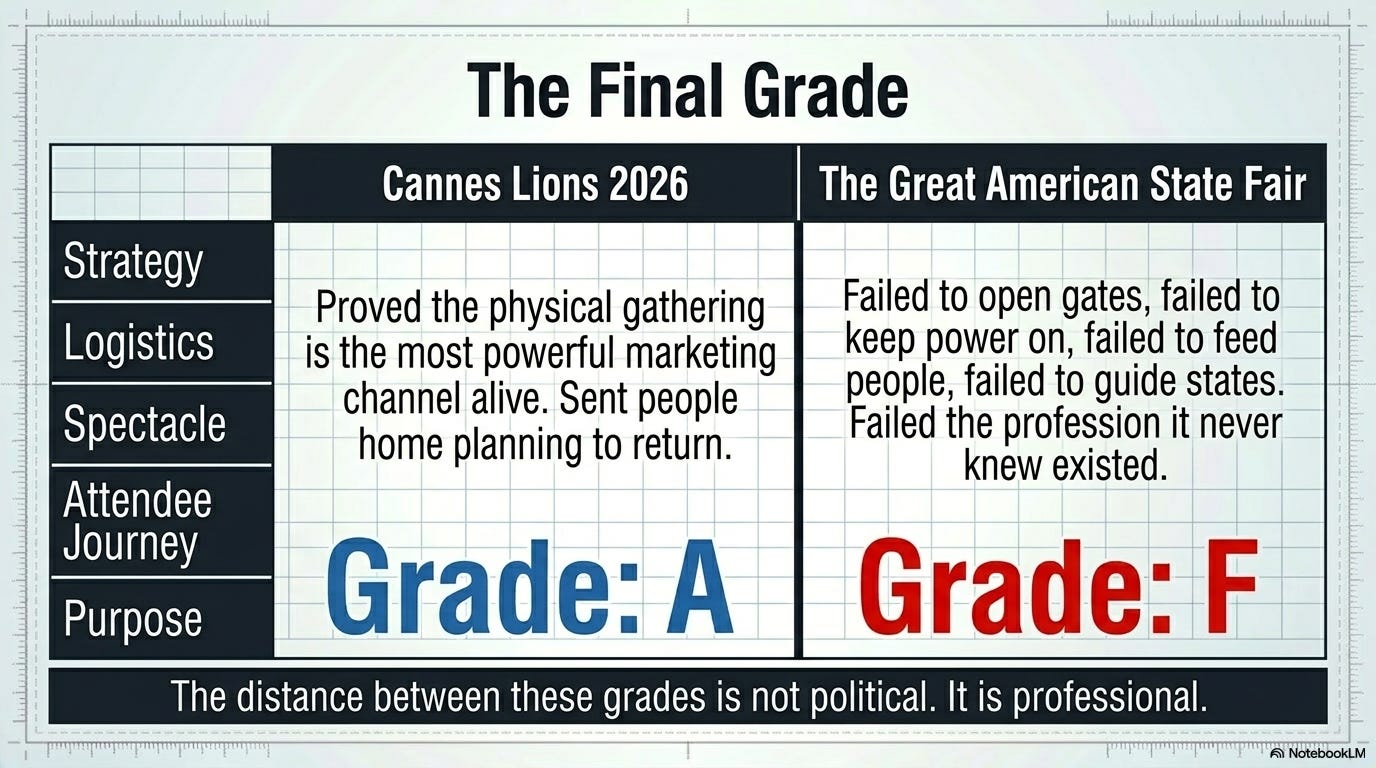
The Final Grade
Cannes Lions 2026 did what the greatest gatherings always do. It made fifteen thousand people feel that the week was worth every flight, every sleepless night, every brutal hour in the heat. It proved that the physical gathering is the most powerful marketing channel alive. It sent people home already planning to return. By every measure that matters to the gathering economy -- strategy, logistics, spectacle, the attendee journey, and the purpose it was built to serve -- Cannes Lions delivered.
Grade: A.
The Great American State Fair called itself a modern World’s Fair and handed the brief to advance men who have never designed a gathering. It failed to attract its performers before it opened, failed to open its gates on time, failed to keep the power on, failed to feed the people inside it, failed to give those people anywhere to sit in the shade, failed to tell them how to find the entrance, and failed to give 56 states and territories a framework for turning a white box into a moment worth remembering. It failed the audience it promised to serve, the occasion it claimed to honor, and the profession it never knew existed.
Grade: F.
The distance between those two grades is not political. It is professional. It is the distance between people who have spent careers learning what a gathering is for and people who have spent careers standing near stages. One group knows that the room is the message. The other group knows how to build a stage.
One can only wonder what awaits at the new White House ballroom -- a $200 million project currently under construction -- if the same creative team is involved in its debut.
This week, on a kilometer of French coastline and ten blocks of the National Mall, the world saw the difference.
David Adler is the Curator in Chief of GatheringPoint.news and the founder of GatheringArchitecture.com. He has spent fifty years in the gathering economy.
Suggested cover image: Split image -- Croisette beach activation vs. aerial of empty National Mall grass. Or the plywood arch alone. Either stops the scroll.


