
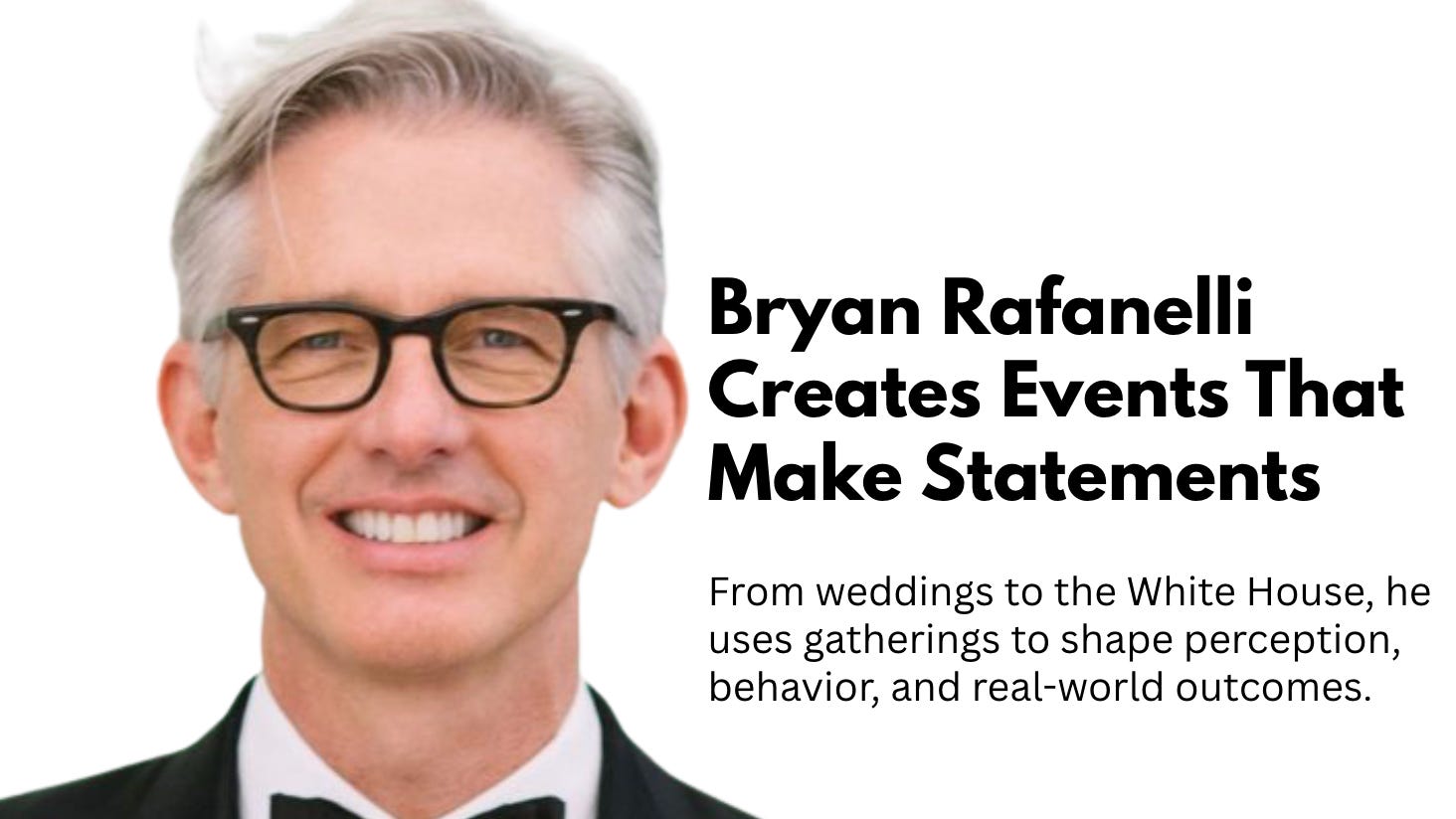
Event Design Guru Bryan Rafanelli Takes Events to a New Level
From weddings to the White House, he uses gatherings to shape perception, behavior, and real-world outcomes.
Few people in American life have spent as much time thinking about the architecture of a gathering as Bryan Rafanelli. Fewer still have done it across as wide a range of rooms. For nearly three decades, through his firm Rafanelli Events, he has built a body of work that has made him the operator other operators watch. What he brings to the work is rare in any single combination: taste, style, strategic instincts, and a command of how human beings actually behave inside a room. None of it can be copied from a deck or trained out of a junior planner. It comes from time inside the work, and the work is the discipline of gathering people for purpose.
That discipline expresses itself across more contexts than any single operator typically navigates. He is, by any serious measure, one of the most effective political fundraisers in the country, a figure whose events have helped generate significant support for Democratic candidates and causes over the past two decades. He is also, less visibly but no less seriously, among the most accomplished fundraisers operating in American philanthropy, where his clients sit far outside any partisan frame. Presidents, candidates, and party leadership rely on him not simply to organize gatherings, but to create the conditions under which people show up, engage, and give. That alone would be enough to define a career. It does not come close to capturing his.
Because the same person responsible for shaping high-stakes political environments is also the one quietly responsible for raising extraordinary sums for philanthropic causes across sectors, applying the same thinking to charities, institutions, and foundations. The difference is not the audience. It is the ecosystem. He does not separate fundraising from environment, or environment from behavior. He designs for all of it at once.
His client list reads less like a portfolio than a cross-section of American institutional life: UNICEF, amfAR, Mass General Hospital, the Breast Cancer Research Foundation, the Aspen Institute, Boston College, Project Healthy Minds. Sports has its own register, running through the NBA and MLB, the Kansas City Chiefs and the Philadelphia Eagles, the College Football Hall of Fame, the National Football Foundation, and the United States Ski and Snowboard Foundation. Hospitality runs alongside through Auberge Resorts. And then there is the political and personal work for which he is best known publicly, the part of his career that draws the most press: Hillary Clinton, Joe Biden, and Vice President Kamala Harris on one side; on the other, celebrations like Chelsea Clinton’s wedding and the wedding of actor Jesse Tyler Ferguson. It is, in practice, only one slice of a much larger operation.
What connects these worlds is not status, and it is not visibility. It is function.
What he is creating, across all of these settings, might best be understood as a form of statement event. Not in the sense of spectacle, but in the sense of intent. A wedding, a White House dinner, a hospital gala, a political fundraiser, a sports league dinner, each operates as an expression of something larger than itself. It signals how people see one another, how they relate, what matters in that moment. The design is not neutral. It frames the experience, and in doing so, shapes what happens inside it.
At Rafanelli’s level, event design is not confined to a single category. It applies wherever people gather with intention. The same thinking that shapes a political fundraiser can be seen, in different form, in a corporate summit, a cultural festival, a large-scale exhibition, or even the choreography of a major sporting event. The context changes. The audience shifts. The stakes evolve. The underlying challenge remains consistent: how do you bring people together in a way that feels coherent, meaningful, and worth their time?
Some of his most closely watched work has taken place in environments where that question carries additional weight. At the White House, where history is not abstract but physical, every decision exists in relation to what has come before. During the final years of the Obama administration, under Social Secretary Deesha Dyer, the tone of events began to shift in ways that are now widely recognized. The environment became more culturally engaged, less distant, more reflective of the broader world outside its gates.
Rafanelli’s work intersected with that shift, but it was also shaped by the people operating alongside it. Figures like Chief of Protocol Capricia Marshall and White House Social Secretary Jeremy Bernard were redefining how state events functioned, treating them not simply as formal obligations but as instruments of soft power. Under their influence, the role of design expanded. These were not just gatherings. They were signals. Who was included, how they were positioned, and what the environment suggested about openness and intent carried meaning far beyond the room itself.
By the time of the Biden administration, that instinct had become more precise. For a gratitude dinner honoring President Biden, Rafanelli turned to the South Lawn, one of the most recognizable outdoor spaces in American public life and, at the same time, one of the most difficult to activate in a way that feels immediate. Rather than treating it as backdrop, he built into it, constructing a tented environment around the fountain that drew guests inward rather than leaving them at the perimeter.

The effect was not simply visual. It altered how the space was felt. Guests who had been there many times found themselves reoriented, moving through a setting they thought they knew but were experiencing differently.
He is not trying to compete with a place like the White House. He is trying to prevent it from becoming invisible.
At the Clinton Presidential Center, where political legacy is both preserved and performed, the challenge shifts again. There, the work is not about activating a present moment, but about keeping a past one from becoming static. The environment must feel respectful without becoming frozen, contemporary without disconnecting from its history.
The role is not to overwrite meaning, but to keep it active, to allow people to feel its relevance rather than simply observe it.
Across all of these settings, the constraint is similar. You are working inside something that already matters. The task is to make people feel it again.
Over time, Rafanelli’s role has expanded well beyond that of a traditional event designer. He becomes part of the family. His clients do not behave like clients in the conventional sense. They return, and they keep returning. Often the relationship continues across generations. The wedding he designed for a family’s daughter becomes the wedding he designs for her own daughter; the foundation gala he produced for a principal in middle age becomes the milestone birthday he produces for that same principal decades on.
The relationship usually begins with a single occasion, often a wedding or a milestone birthday or a foundation launch, and then it stays. The same operator who designed the daughter’s wedding gets the call when the senator decides to run for higher office. The guest-list architecture from a fortieth becomes the muscle memory for the foundation gala five years later. The rehearsal dinner produced for the principal’s son becomes the unspoken precedent for the gratitude dinner thrown for the principal himself a decade on.
The categories the rest of the industry holds as separate collapse into one another in his hands: social, corporate, philanthropic, political. They are not separate verticals to him because they are not separate to the families he serves.
The Clintons are the example. The relationship began in 2000, when Rafanelli produced a Boston fundraiser for Hillary Clinton’s first Senate run, and from there it never stopped. He produced events around the 2004 Democratic National Convention. He worked on multiple Clinton Foundation gatherings as the foundation grew into a global philanthropic platform. In 2010 he produced Chelsea Clinton’s wedding to Marc Mezvinsky, and the same year he produced the wedding of Huma Abedin, Hillary’s longtime aide. The 2008 and 2016 presidential cycles brought him back. Events have continued at the Clinton Presidential Center in Little Rock. A relationship that began with a single Senate fundraiser has, more than a quarter century later, never stopped expanding. It has crossed every category the events industry pretends are separate: weddings, foundation galas, presidential campaigns, milestone moments, state-related dinners. The Clintons are the Clintons across all of those settings, and the call is the same call.
Naomi Biden’s wedding and her grandfather’s South Lawn dinner are not unrelated assignments separated by genre either. They are two moments in a single ongoing relationship between Rafanelli and the Biden family that already crosses two generations and shows no sign of ending.
Over nearly thirty years of practice, this produces a client base that does not behave like a client base. It behaves like an extended network of families and institutions that have brought Rafanelli inside the room and have not asked him to leave. The work moves with the family across decades, across generations, across life stages, across spheres. A wedding leads to a fundraiser. A fundraiser leads to a foundation initiative. A public moment is followed by a private one. The list of who calls Bryan Rafanelli is not a list of accounts. It is a list of relationships.
The traditional event-industry frame undersells him by a wide margin. He is not building events. He is building trust that gets handed down.
At that point, the relationship changes. Decisions are not dictated. They are entrusted.
A Rafanelli event rarely calls attention to its own construction. It unfolds with a kind of ease that suggests inevitability. Behind it sits a system that depends as much on discipline as it does on imagination.
Rafanelli operates with a duality that is often talked about but rarely held in balance. He is as comfortable in systems as he is in feeling, moving between operational precision and creative instinct without separating the two. An idea that cannot be executed is irrelevant. An execution without an idea is forgettable.
That control is not only visible in the work. It is visible in him. In environments where the margin for error is thin and the stakes are public, he maintains a level of composure that clients notice immediately. Problems are addressed, adjustments are made, but the temperature of the room does not rise with them. It is not performative calm. It is functional. The system holds because he does.
He has described himself as someone who grew up insecure, driven to lead but not always convinced he belonged. “Junior high Brian,” as he calls it, never disappears. It becomes something he manages. That tension runs quietly beneath everything. It also informs one of his core beliefs: no one is more important than anyone else.
In environments structured around hierarchy, that idea becomes operational. Rafanelli resists the instinct to segregate importance. The principal is not hidden. The experience does not build toward access. It begins with it.
When that distance collapses, behavior changes. People participate instead of observe. Generosity follows.
At a recent event for Pete Buttigieg, that thinking took a simple form. “Pizza with Pete” replaced a traditional fundraiser. The structure opened into an extended, unscripted conversation. The environment held. The audience engaged. The giving followed. This is not accidental. It is designed.
There is a way of thinking behind it, one he does not always name directly. He is drawn to what others overlook, to the space between what is expected and what is possible. Robert Kennedy once described it as the difference between seeing things as they are and asking why, and imagining what they might be and asking why not.
Rafanelli works in that space as a discipline. It is part of what draws him back, several times a year, to Engage, where designers from around the world gather not to transact, but to experiment. There, he is not directing the experience. He is inside it, observing, absorbing, recalibrating. The influence accumulates. And it shows up later.
The instincts that guide him began early. A child studying tables at church fairs, learning to choose. A student running campaigns and losing, learning that connection matters more than effort alone. A professional building systems that allow risk.
Repetition creates control. Control creates a baseline. From that baseline, you can change everything.
There is a tendency to describe what he does as creating moments, but they function more like statements, each one shaping how people understand where they are, and what follows.
The work is not the moment itself. It is everything that allows the moment to land, often invisibly, often before anyone arrives. Who feels included without having to ask. Who understands what is happening without needing it explained. Where attention gathers naturally, and where it quietly falls away.
Those are not decorative decisions. They are structural. And they determine whether something passes through people or stays with them.
That distinction runs through everything he builds. Whether the setting is a wedding, a fundraiser, a White House dinner, or something less visible, the underlying question does not change. The experience either meets people where they are, or it doesn’t.
What Rafanelli has spent a career refining is the ability to shift that equation before anyone names it. To create environments where people find themselves more present than they expected to be, more engaged than they planned, more connected than the setting suggested.
It is not dramatic when it happens. It reveals itself afterward.
In conversations that last longer than they should. In questions asked without hesitation. In the quiet realization that the distance people assumed would exist simply did not.
That is the work. The feeling that something, for a time, held together, and that you were inside it when it did.
Bryan Rafanelli: The Story in Song
Design for feeling, not form.
People don’t remember what something looked like. They remember how quickly they understood it—and how it made them feel once they did.
Collapse distance early.
Don’t make people wait to belong. The faster someone feels included, the faster everything else works.
Access is not a perk. It is a design decision.
Who is visible, who is reachable, and when that happens shapes behavior more than any program or speech.
Generosity is not extracted. It is enabled.
People give when they feel connected to something real, not when they are asked at the right moment.
Familiarity is the fastest way to lose attention.
Once something feels predictable, people stop noticing. The work is to make them experience what they thought they knew in a new way.
The reveal is rarely a single moment.
It happens in layers. Small shifts accumulate until perception changes, often before people can name when it happened.
Structure is what allows spontaneity.
The more disciplined the system underneath, the more natural and unscripted the experience can feel on the surface.
Tell the truth, especially to power.
Respect is not protecting someone from what won’t work. It is guiding them toward what will.
You are not designing an event. You are shaping behavior.
Where people move, how they interact, and what they carry forward are the real outcomes.
Belonging is more powerful than status.
People don’t want proximity to importance. They want to feel part of something that includes them.
Control what you can so you can let go of the rest.
The goal is not perfection, but stability—so something authentic has room to happen.
Make it worth showing up.
In a world where people don’t have to gather, the experience has to give them a reason to.


