
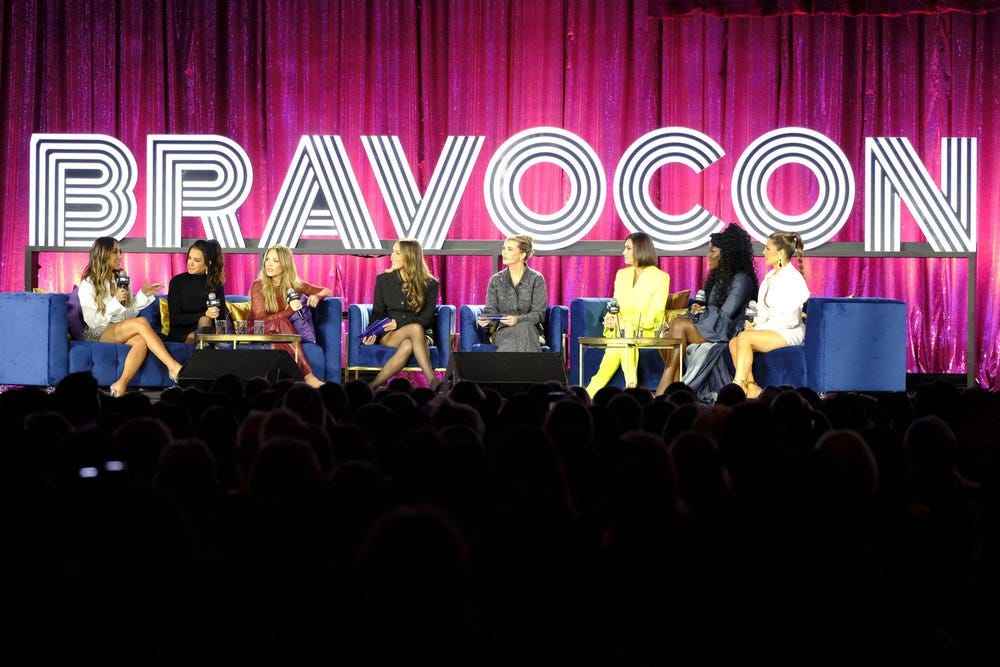
BravoCon and the Gospel of Guilty Pleasure
How BravoCon turned reality-TV fandom into a live cultural force — and what it reveals about parasocial intimacy, power, and the future of gatherings.
It almost always begins the same way.
One person in the house starts watching. Quietly. Casually. Folding laundry. Half-paying attention. They insist it’s ironic. A guilty pleasure. Something disposable. Then the language enters the room — a phrase, a look, a raised eyebrow that repeats itself often enough to become familiar. Someone who swore they weren’t watching asks a question. The volume goes up. A judgment is rendered. And before anyone notices when it happened, the household has reorganized itself around a screen.
This is how Bravo spreads — not through marketing, but through proximity.
The addiction never announces itself as addiction. It hides behind irony. What’s actually happening is emotional synchronization: people absorbing a shared grammar for conflict, loyalty, apology, ambition, and betrayal. In a society fractured by politics, geography, and algorithmic silos, Bravo has quietly offered something increasingly rare — a common emotional language. Media scholars have long described this phenomenon as the parasocial relationship, a form of one-sided intimacy that feels personal even when it isn’t (definition).
Once a year, that language finds a room big enough to shout back.
Last year, it arrived during that peculiar stretch of late fall when the calendar feels both exhausted and expectant, when Las Vegas fills with people who are not quite on vacation and not quite at work, when the city becomes a temporary container for excess attention looking for a stage. For a long November weekend, the Bravo universe — usually dispersed across living rooms, group chats, podcasts, and late-night DVR queues — condensed into a single, overheated geography at Caesars Forum.
Much of what the weekend actually looked and felt like came through in the on-site reporting by BizBash, which has long documented how experiential design shows up before the rest of the industry knows what to call it. According to their coverage, BravoCon unfolded less like a traditional convention and more like a series of overlapping branded worlds. More than 50 live events and upwards of 150 Bravolebrities were surrounded by immersive sponsor activations that functioned as extensions of the shows themselves rather than interruptions to them.
State Farm and T-Mobile anchored the environment as presenting sponsors, while Hilton, Lexus, Wayfair, Wendy’s, Carnival Cruise Line, Instacart, and TJ Maxx created stylized spaces that invited fans to step inside familiar Bravo aesthetics — shoppable houses, high-energy lounges, and photo moments engineered for social spillover. The return of the Bravo Bazaar underscored how fully the event has evolved into a form of retail theater, where fandom, commerce, and design blur into a single continuous experience.
I was thinking about all of this when I noticed, almost in passing, that Rachel Wimberly was there.
Rachel is not the obvious BravoCon attendee if you know her through her professional life. She is SVP of M&A and Business Development, US, at Easyfairs, one of the most acquisitive and strategically minded exhibition organizers operating across Europe and North America. Her job is to decide which events are worth acquiring, which deserve long-term investment, and which should be allowed to fade. She spends her days separating durable properties from disposable ones — return behavior from one-off noise.
And yet there she was, posting from BravoCon.
Her attendance, she later told me when I called her, was mostly circumstantial. No scouting mission. No diligence deck. No acquisition thesis. But even before she finished explaining how she ended up there, you could hear something unmistakable in her voice: recognition. Not professional curiosity, but personal familiarity — the sound of someone who understood, instinctively, why this room worked.
That was the moment BravoCon snapped into focus.
To call it a fan convention misses the point. It is closer to a pilgrimage, or a revival, or — more pragmatically — a finely tuned live-experience engine that converts parasocial relationships into physical belonging. Walking into BravoCon feels like stepping inside a collective subconscious that has been rehearsing for years. The jokes land instantly. The references need no explanation. The audience arrives already fluent, already bonded. There is no warm-up period because the culture has been warming itself at home for a decade.
From an event organizer’s point of view, this is the dream state: a crowd that behaves like a community before the first word is spoken.
What’s striking — and instructive — is who fills the room. BravoCon is not niche. It’s finance professionals who swear they only watch to decompress. It’s lawyers who know reunion seating charts better than court calendars. It’s couples where one partner resisted for years and now quotes confessionals mid-argument. It’s men who came reluctantly and leave with strong opinions. It’s women who built friendships entirely through shared fandom. It is cross-demographic, cross-generational, and stubbornly resistant to stereotype.
Reality television, particularly the Bravo strain — from The Real Housewives to Vanderpump Rules — works because it externalizes emotions people already live with but rarely articulate: jealousy, insecurity, status anxiety, loyalty, fear of irrelevance. The shows don’t invent these feelings. They stage them. They give them lighting, editing, and the confessional booth. They allow viewers to feel close to people they would never choose as friends — and to stay close even when those people disappoint them.
This is where the parasocial relationship becomes most revealing.
Parasocial intimacy is not about admiration. It is about familiarity. We stay in relationship not because someone behaves well, but because we know them. We recognize their rhythms. We anticipate their failures. We narrate their flaws in advance. Intimacy, once established, becomes sticky. It resists correction.
Everyone understands this dynamic in personal life — the exhausting friend, the one who dominates the room, embarrasses you in public, drains your patience, and yet somehow remains in your orbit. The asshole friend. You don’t approve of their behavior, but walking away feels harder than staying.
Bravo didn’t just allow this dynamic; it built an empire on it.
Bravo never asked its audience to like its characters. It asked them to know them. To track patterns. To feel superior one moment and protective the next. To live in the morally ambiguous space where judgment and attachment coexist. The shows thrive on ambivalence, and the audience rewards that honesty with loyalty.
BravoCon is what happens when that ambivalence becomes physical.
The goosebumps people talk about aren’t about celebrity worship. They’re about recognition. This isn’t meeting a star; it’s meeting a character who has lived in your home for years. Distance collapses. Inside jokes become collective roars. Online commentary becomes embodied reaction. Digital fandom turns into ritual.
And then there is the surprise.
BravoCon understands something most conferences never quite grasp: surprise is not randomness. It is earned disruption. Panels feel loose but are tightly paced. Drop-ins are timed to spike emotion rather than derail momentum. Conflict is not smoothed over. Tension is allowed to linger. Apologies don’t always land — and the room is trusted to sit with that discomfort.
Most events sand down edges. BravoCon sharpens them.
Andy Cohen, long the connective tissue of the Bravo universe and host of Watch What Happens Live, functions here less as a celebrity than as a translator — insider and audience surrogate at once, guiding when necessary and stepping back when not. He is not the architect alone, but he is the human interface between brand, talent, and fan.
Looking at BravoCon now, Rachel sees what many trade-show organizers miss.
“BravoCon isn’t a weekend,” she told me. “It’s every fan’s dream. A community of people who all know they have to be a part of the experience.”
From an acquisition perspective, it checks every quiet box investors look for: repeat attendance driven by identity rather than obligation; layered monetization through ticket tiers, merchandise, brand activations, and content; sponsors who want to embed rather than interrupt; and a community willing to travel, evangelize, and return. Most trade shows, she notes, start with commerce and hope community follows. BravoCon starts with community and lets commerce layer in naturally.
The year it took off suddenly makes sense in that context. The pause wasn’t about fatigue; it was about restraint. Scarcity sharpened anticipation. The return carried weight. In a culture addicted to annual cadence, absence became strategy.
Should other events do this? Only if they have something worth missing.
BravoCon also exposes the darker edge of parasocial intimacy — the part the events industry rarely acknowledges. The same mechanisms that make BravoCon euphoric now dominate political life. We follow public figures the way we follow reality stars: episodically, emotionally, obsessively.
Donald Trump is not an aberration in this system; he is its most explicit expression. He functions less like a traditional political figure than like the ultimate parasocial asshole friend — endlessly familiar, predictably unpredictable, impossible to ignore. The bond persists not because he is trusted, but because he is known.
This is the ugly truth of parasocial culture: visibility can outrun virtue.
And this is where event organizers are quietly playing with fire.
All great gatherings are designed to create intimacy. We collapse distance on purpose. We design rooms, lighting, sound, sequencing, and ritual to make people feel close — to one another, to ideas, to figures on stage. Intimacy converts attendance into loyalty and loyalty into identity. But intimacy is not neutral. It is power.
BravoCon succeeds because it understands that power and contains it. The contract is explicit. The audience knows it is entering a constructed world. The artifice is not disguised; it is celebrated. Affection does not require allegiance. Closeness does not demand obedience.
By the time the weekend winds down — when the lights come up and the crowd spills back into Las Vegas and then disperses again into homes, flights, and group chats — something subtle but enduring has happened. The language travels back with them. The judgments resurface. The phrases re-enter living rooms. The cycle begins again, quietly, domestically, one person at a time.
For one long November weekend, all of that lived in one place.
BravoCon isn’t just a fan convention.
It’s a case study in how intimacy moves through culture — and what happens when it finally finds a room big enough to hold it.
As this goes to press, BravoCon 2026 has not yet been announced. No dates. No venue. No ticket release. That silence feels intentional. After a strategic pause and a high-impact return, Bravo no longer needs urgency to maintain heat. The ecosystem keeps moving—new seasons, podcasts, social spillover—so when the doors reopen, the room will already exist before it’s built.
What is visible is expansion. In early 2026, Hayu FanFest is set for Australia, extending the same logic—parasocial intimacy made physical—into a global market. It’s not a replica of BravoCon so much as a regional expression of it: smaller, local, but powered by the same engine. The implication is a future not of one mega-weekend, but of a constellation—modular, international, mutually reinforcing.
Seen this way, BravoCon 2026 doesn’t need an announcement yet. Its influence is already circulating. When the invitation arrives, the audience will recognize it instantly—and show up fluent.


