
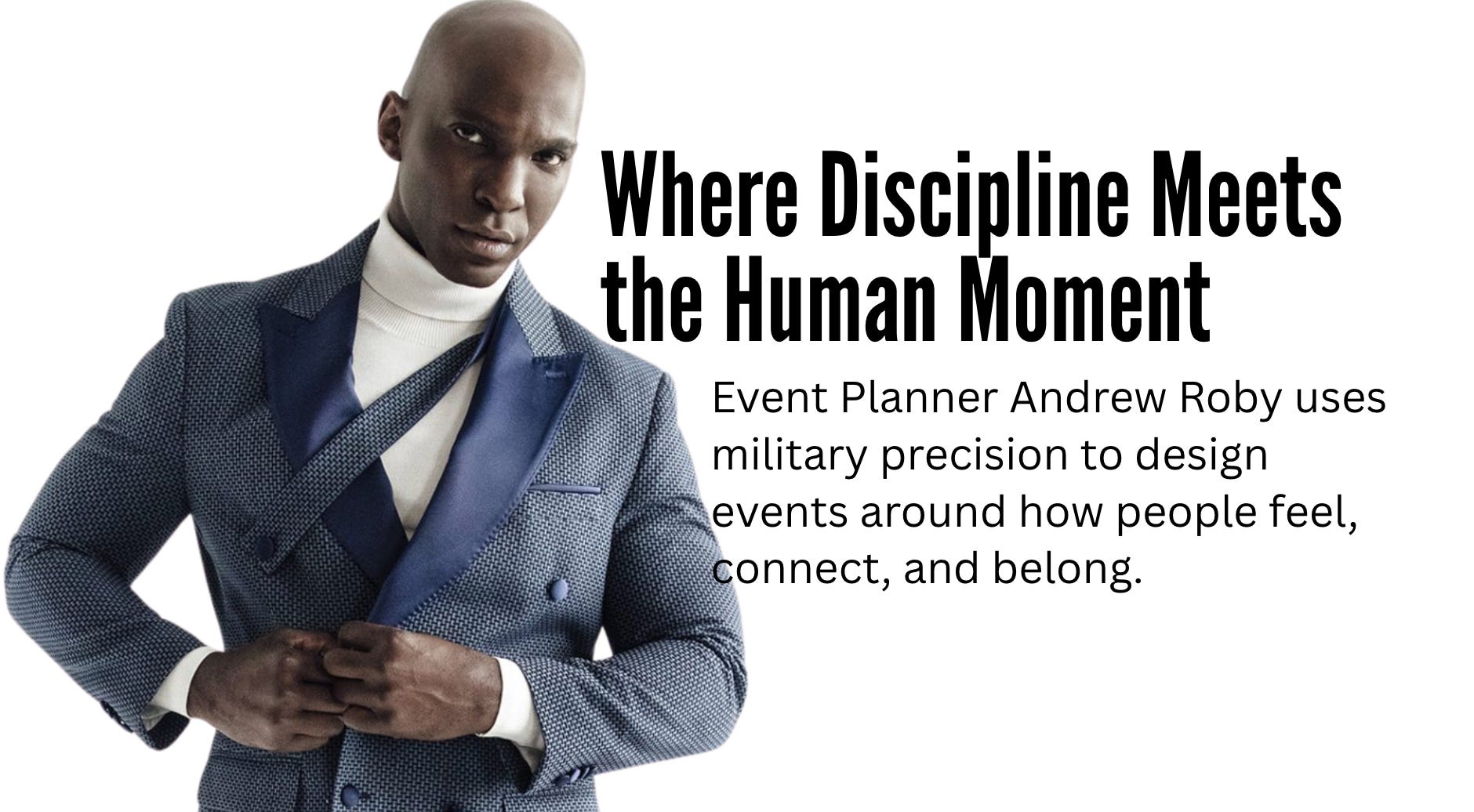
Belonging by Design: Andrew Roby and the False Divide Inside the Event Industry
For years the industry dismissed “party planners.” Andrew Roby’s career suggests it misunderstood them.
The events industry has always carried a quiet hierarchy, even if few people say it out loud. At the top sit the producers of massive trade shows, global conferences, and sports spectacles, the sectors that speak the language of square footage, registration numbers, and sponsor activations. Further down, in the minds of some, sit the planners who work in weddings and social celebrations, people occasionally reduced to the phrase “party planner,” as if their work occupies a softer and less serious corner of the business.
The irony of that hierarchy is that many of the most capable event designers move constantly between those worlds. They produce corporate programs one week and family milestones the next, shifting between audiences, expectations, and emotional stakes with the ease of someone who understands that gatherings are less about categories than about people. Andrew Roby is one of those planners. His career sits squarely in the space where corporate events, cultural celebrations, and social milestones intersect, and the perspective he brings to that work suggests that the industry’s old distinctions between “serious events” and “parties” may have been misguided all along.
Roby’s clients do not usually describe him as a specialist in one type of gathering. What they talk about instead is continuity. A couple whose wedding he produced years ago calls him again for a birthday celebration. That celebration becomes a baby shower, and eventually a graduation party. Corporate clients who first hired him to produce a conference return when they need help shaping a donor experience or a cultural event tied to their brand. Over time the planner becomes something closer to a trusted collaborator, someone who understands the personalities, histories, and ambitions of the people hosting the gathering. In that sense Roby operates in the territory occupied by many of the most successful event designers in the industry, where the work is measured not in isolated productions but in the relationships that grow around them.
The instinct for that work appeared early in his life, though he did not yet have the language for it. Roby grew up in Miami in a household where dinner happened at seven o’clock every evening without exception. His mother insisted that the family sit down together, and part of the ritual involved setting the table. Roby discovered that he loved the task. While other children might have rushed through it, he lingered over the details, pairing plates with flatware, aligning glasses, and experimenting with runners or placemats whenever they were available. The table itself was never extravagant—he grew up poor—but the modest setting sharpened his attention to detail. What fascinated him was the way small adjustments could change the atmosphere of the room.
Sometimes the curiosity extended beyond the table. Roby remembers constantly rearranging furniture throughout the house, redesigning the living room layout or reshaping his bedroom simply to see how the environment shifted. At the time he thought of this behavior as curiosity rather than design. His mother had studied interior design, and an aunt who served in the military shared similar interests in how spaces functioned. Yet the connection between those early habits and a future career in events would only become clear much later.
In high school the instinct found more structured outlets. At Miami Senior High School Roby joined nearly every organizational ecosystem available, from student government and athletics clubs to culinary programs and the ROTC unit that would eventually shape his leadership style. The campus itself left a lasting impression on him. In front of the school stretched a large plaza where buses normally dropped students off each morning. During Spirit Week Roby began imagining how that space might be used differently. Instead of limiting the celebration to sports teams, he proposed organizing a parade that would involve every club and organization on campus. Students could build floats and march across the plaza, turning the campus into something more theatrical than a typical pep rally.
The school tried the idea for several years before deciding the logistics were too complicated to maintain. For Roby the experience revealed something about his own instincts. Even then he was less interested in simply attending events than in imagining how they might evolve.
Leadership followed naturally through ROTC, where he rose from volunteer to battalion commander, organizing trips, competitions, and training exercises for the unit. The discipline that shaped his professional thinking most profoundly, however, arrived when he enlisted in the United States Army and trained as a nuclear, biological, and chemical specialist.
The role involved preparing soldiers to respond to chemical or biological threats with procedural precision. Masks had to be secured in seconds. Rooms had to be cleared methodically. Every movement depended on preparation. Soldiers studied building schematics, mapped entrances and exits, and rehearsed how they would move through unfamiliar environments before ever stepping inside.
When Roby describes how he approaches event venues today, the parallel is unmistakable. He studies the room the way a soldier studies terrain. Where will guests enter? Where might the flow break down? What logistical risks could disrupt the experience? In events, as in the military, the most elegant plan still depends on flawless execution.
That operational discipline forms one half of Roby’s thinking. The other half is creative. When a client calls about a new gathering, he does not begin by calculating budgets or production schedules. Instead he imagines what the room will feel like from the perspective of the guest. Will there be a moment that sparks curiosity or surprise? Will the environment feel alive? Only once that vision exists does he begin working backward through the practical details of venue constraints, audiovisual requirements, and logistics.
The rhythm reflects what one might call a left-brain and right-brain approach to event design. Creativity appears first, but it is immediately tested against operational reality.
This focus on the attendee also explains why Roby talks so often about belonging. For him the most important moment of any gathering occurs before the program even begins. A guest walks through the doors and quickly scans the environment for signals about whether they belong there. The signals may be subtle: the faces greeting them at registration, the imagery displayed on banners, the tone of the room itself. If guests see themselves reflected in those signals, they relax and begin engaging with others. If they do not, they often withdraw without realizing it.
Roby describes the reaction as a defensive posture. People arrive ready to network, but once they feel out of place they hesitate to initiate conversations. The room becomes smaller for them.
The solution, he believes, lies in treating belonging as infrastructure rather than symbolism. The people working registration desks, the imagery used in marketing materials, the language in welcome messages, and the diversity of vendors behind the scenes all shape the emotional architecture of an event.
Even in diverse environments, however, subtler dynamics can emerge. Roby has observed how networking events quickly develop social clusters, where attendees unconsciously filter who they approach. Appearance, confidence, and perceived status influence who gets included in conversations. Researchers sometimes describe the phenomenon as lookism—the tendency to favor people who match certain social expectations. Roby sees it play out frequently. Even gatherings designed to encourage openness can reproduce invisible hierarchies.
The conversation inevitably returns to the phrase “party planner,” which Roby believes understates the scale and complexity of what planners actually do. The irony, he notes, is that the social event world often teaches lessons that corporate gatherings are now trying to rediscover. Weddings, for example, force planners to manage intimacy, identity, and long-term relationships in ways that corporate events rarely demand.
He recalls one couple, Morgan and Kwesi, whose wedding he planned several years ago. Since then he has produced birthday celebrations, baby showers, and eventually their son’s graduation party. The relationship has evolved alongside the family’s life. In many ways that continuity represents the deeper value of the work.
Design trends are evolving as well. Roby studies award shows closely and has noticed how the traditional banquet layout—large round tables facing a stage—is gradually giving way to more dynamic arrangements. Soft seating, lounge environments, and smaller tables are replacing rigid banquet formats. Editorial-style photo environments now substitute for the traditional step-and-repeat backdrops common at corporate events. Roby admits to a particular fascination with carpeting venues to cover the patterned floors typical of hotel ballrooms, a small intervention that can transform the atmosphere of a room.
Audiovisual technology is also expanding the possibilities. Instead of relying on a single LED wall behind the stage, many events now incorporate ceiling projections, side panels, and immersive visual systems that surround guests with a unified design language.
The shift reflects a broader change in how success is measured. For years the industry defined a successful event by how many people attended. Increasingly planners are asking whether the experience itself was meaningful. Smaller, curated gatherings—particularly donor events and brand experiences—are becoming more common as organizations prioritize connection over sheer scale.
Roby himself is exploring what the next chapter of his career might look like. After years working as a third-party planner for multiple organizations, he has begun considering whether he might eventually move into an in-house event leadership role within a single global company. At the same time his entrepreneurial instincts remain strong. Earlier in his career he launched a regional fashion week and hosted cocktail gatherings open to the public. If he were given significant investment capital today, he imagines building something entirely different: a content-creation facility where brands and creators could produce events and digital media simultaneously, or immersive lounges that combine dining, live entertainment, and social gathering spaces in cities across the country.
What unites all of these ideas is Roby’s enduring fascination with how people behave in rooms. Whether designing a wedding, a corporate summit, or a future entertainment venue, the question remains the same. How do you create a space where people feel comfortable enough to connect
In a gathering economy increasingly obsessed with community, the answer may lie in the part of the industry some once dismissed too easily. The planners who learned their craft designing intimate celebrations often understand something fundamental about human behavior: belonging is not decorative. It is structural. And the rooms where people truly feel welcome rarely happen by accident.
• Belonging starts before the event begins
The first emotional decision a guest makes happens at the door. Registration staff, visual cues, and tone determine whether someone leans in—or pulls back.
• If they don’t feel it, they won’t stay
Programming doesn’t fix a room that feels off. Atmosphere beats agenda every time.
• The room is a system, not a backdrop
Seating, flow, entry points, and spacing shape behavior as much as speakers and content.
• Read the room before you design it
Great planners don’t impose ideas. They observe first—then build around what the space and audience need.
• Precision enables creativity
Operational discipline isn’t the opposite of creativity—it’s what allows creative ideas to survive execution.
• Every event carries risk
Logistical breakdowns, poor flow, and unclear leadership don’t just hurt the event—they damage the experience for everyone involved.
• Social events teach what corporate events forget
Weddings and celebrations force planners to understand emotion, identity, and human dynamics—skills now essential across all events.
• Relationships outlast events
The most successful planners aren’t defined by one event, but by the clients who keep coming back across milestones and years.
• There is no fixed format for belonging
No seating chart, agenda, or design template guarantees connection. Every room requires its own language.
• Smaller can be more powerful
The shift isn’t just toward intimacy—it’s toward intentionality. Who is in the room matters more than how many.
• Design for how people feel, not just what they see
Lighting, visuals, and décor matter—but emotional experience is what people remember.
• Technology should support the room, not dominate it
Immersive AV works best when it enhances connection, not when it becomes the point of the event.
• The “party planner” label misses the point
The skills required to design meaningful gatherings—empathy, observation, and emotional intelligence—are anything but small.Bonus Personalization from
:


