
Another Proof Point On Why Event Values are Rising: They Don’t Know They’re Making Our Case
The ritual renaissance just landed on CBS Mornings, NPR, and the Times bestseller list. The events industry should be paying attention
This week Bruce Feiler sat across from Gayle King on CBS Morning while she held up her dog-eared copy of his new book and read him his own sentences back. Gayle kept running into the green room between segments carrying her copy of A Time to Gather, reading Feiler quotes from his own book. NPR’s Michel Martin took her interview out of the studio entirely, joining Feiler and a group of seniors gathered for meditation and journaling in Washington DC. His New York Times Opinion Essay, “This Is the Antidote to the Lonely Life of Screens,” was the number one most emailed piece on the Times website the morning it ran. And Pope Leo XIV issued his first encyclical, Magnifica Humanitas, warning that artificial intelligence threatens human relationships and must be disarmed before it weakens the bonds that hold society together."
That last one bears repeating. The Pope.
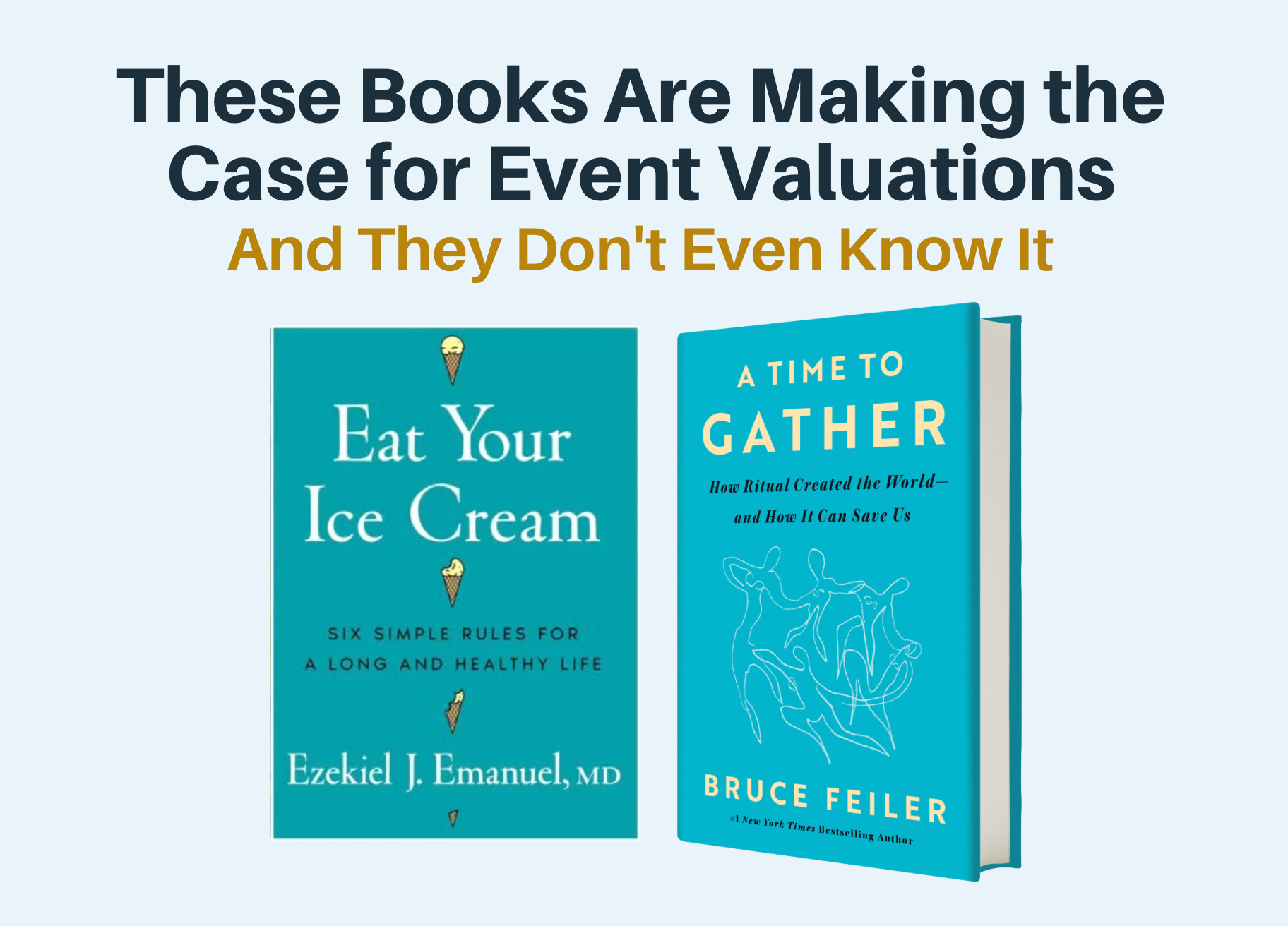
Feiler’s book, A Time to Gather: How Ritual Created the World and How It Can Save Us, published in May 2026, is the account of three years and 50,000 miles across sixteen countries asking a question that sounds simple and turns out to be urgent: why do human beings gather, and what happens when they stop? The answer took him to a mass baptism at the Vatican, a tribal bride price negotiation in South Africa, an adolescent tooth-filing ceremony in Bali, six weddings in Las Vegas, and ten funerals in Ireland. But the most powerful material he found was not ancient. The new rituals breaking out everywhere he looked included NICU graduations, sober-versaries, cancer-versaries, death doulas, loss-of-a-job doulas, mom proms, adoption ceremonies, and honor walks for organ donation.
The Honor Walk was created by Missy Holliday after her sister died suddenly and donated her organs. The ritual is simple: the entire hospital stops and pays tribute as the donor is wheeled into surgery. “I don’t consider honor walks to be huge things,” Holliday told Feiler. “But I consider them to be small things with big power. We help people write endings to stories they never want to tell.”
Then there is the chapter his wife keeps citing as her favorite: the Taylor Swift Divorce Party. A woman on Long Island whose parents and both sets of grandparents had divorced swore she would be the one who did not. She grew up, got married, had two children, and got divorced. Her husband took half their belongings. She gave the rest away and walked back into an empty apartment with two kids, no sheets to sleep on, no towels to shower with, and a toothbrush holder with four holes. She threw a divorce party. It went viral. “Divorce parties are breaking out all over,” Feiler writes. “Women are saying, I’m going to share this journey with others so that I can get up off the mat and go out and make the best of the rest of my life.”
What Feiler found underneath all of it was not a world in decline. He found a ritual renaissance pushing back against apathy, loneliness, and digital saturation. Everyday people, from boomers to Gen Z, reimagining collective rituals at a remarkable pace, inventing fresh ways to gather around life, love, health, and family, and forging thriving communities in the process. “It took us ten thousand years to establish cultural norms around how we mark collective life transitions,” he writes. “It took us fifty years to dismantle them.” A ritual, in his definition, is “a shared, unnecessary act that makes us feel at home.” Kirkus gave it a starred notice. Gayle King gave it her green room.
What Feiler does not say, because he has no reason to, is that the gathering economy has been in the ritual business the entire time. Pick any industry and you will find its annual ceremony: the rite of passage that marks membership, confirms status, and says to everyone in the room that they belong to something larger than themselves. Cannes Lions, which opens on the French Riviera next week, draws 13,000 to 15,000 senior delegates from more than 90 countries for its 73rd consecutive year, which means it has outlasted every economic cycle and technological disruption since 1953. That is what happens when a gathering stops being an event and becomes a ritual. TED is a ritual. IMEX is a ritual. CES is a ritual. The medical profession has its annual congresses, the legal profession its bar conferences, the technology industry its developer summits, and none of them would survive if they were merely delivering content. They survive because they are doing what the Balinese tooth-filing ceremony does, what the Taylor Swift divorce party does, what the honor walk through a hospital corridor does: they mark time, confirm belonging, and tell the people in the room that what they do matters and that they are not doing it alone. Feiler traveled 50,000 miles to document this instinct. The events industry has been monetizing it for decades.
The Wave That Was Already Building
Feiler is the loudest voice right now but not the only one. The cultural wave he is riding has been building since January. Ezekiel Emanuel, the oncologist who helped design the Affordable Care Act, published Eat Your Ice Cream: Six Simple Rules for a Long and Healthy Life on January 6 and hit the Times, USA Today, and Indie National bestseller lists simultaneously. Five months later he is still making the rounds. He was on WGN Radio Chicago as recently as June 1. A book about longevity does not stay in rotation for five months unless it is saying something the culture is not ready to stop hearing.
What it is saying: the single most important variable in how long and how well a human being lives is not sleep or nutrition or exercise or the supplement stack or the cold plunge. It is social engagement. “When you say wellness to anyone,” Emanuel told the Penn student newspaper, “you just say it randomly: eating well, exercise, sleep. But they don’t think of social engagement, loneliness as an aspect of wellness. And that’s really, really important just as a matter of scientific fact.” Asked by CBS Sunday Morning for his single biggest piece of advice, he said: “Build your social relationships. It’s definitely the most important thing for long-lasting health and happiness.”
Then there is Kara Swisher. The technology journalist who has spent three decades holding Silicon Valley accountable with more precision and less deference than anyone in American media launched a six-part CNN Original Series called Kara Swisher Wants to Live Forever, submitted herself to every longevity intervention the tech billionaires swear by, ketamine infusions, red light therapy, hyperbaric chambers, sound baths, and came out the other side with a conclusion that landed like a provocation in primetime: the path to a longer life runs through human connection. The woman who built her career arguing that technology changes everything tried every technology available for the purpose of living longer and concluded that the thing that actually works is the thing technology cannot replicate.
None of these people are thinking about the events industry for a single second. They are thinking about public health and cultural anthropology and the quiet epidemic of disconnection that has been reshaping modern life for fifty years. And yet what they are describing, with the full authority of medicine and journalism and the Times bestseller list, is the value proposition of the gathering economy stated plainly: human beings need to be in the same physical space with other people, repeatedly and intentionally, for their health and their communities and their lives.
What makes this remarkable is that they have no idea they are doing it. Feiler is not arguing for trade shows. Emanuel is not making a case for conferences. Swisher is not endorsing the annual offsite. The people who design the rooms, who obsess over the first ten minutes of a conference, who have spent careers engineering the conditions under which connection becomes possible, have been living this science without the vocabulary the mainstream culture is only now developing. Feiler and Emanuel and Swisher just handed the gathering economy its brief. They wrote it for everyone else.
The Curve That Explains Why Now
The science of human connection is not new. The Harvard Study of Adult Development has been measuring it since 1938. Its finding: the single most powerful predictor of a long, healthy life is the number and quality of a person’s social relationships. A Brigham Young University researcher summarizing the broader literature across more than three million subjects found that social isolation is the rough equivalent of smoking fifteen cigarettes a day. Putnam published Bowling Alone in 2000. The Surgeon General declared loneliness a public health epidemic in 2023. None of that generated a Gayle King green room moment or a Times number one most emailed essay or a papal statement.
Everett Rogers identified the explanation in 1962. His theory of the diffusion of innovations describes an S-shaped adoption curve: a long slow period when early adopters carry an idea alone, then once it crosses between ten and twenty-five percent of the population, an acceleration that becomes unstoppable. He found that mass media spreads awareness efficiently but that genuine mainstream adoption happens through interpersonal communication: a book a colleague pressed into their hands, a television segment their parents watched and called to discuss the next morning. We knew tobacco was killing people for decades before the regulation arrived. The science of social connection has been available since 1938. What has changed is not the evidence. What has changed is where the evidence is living. Feiler on CBS Mornings is not a wellness podcast reaching a self-selected audience. It is the Rogers curve’s interpersonal communication layer arriving at scale, and it is the difference between an idea that circulates among believers and an idea that crosses into the mainstream and starts changing behavior, budgets, and markets.
The gathering economy is at the beginning of exactly that restructuring. The tipping point is not approaching. It is here.
What the Gathering Economy Actually Produces
The gathering economy is not one industry serving one purpose. It is three distinct verticals sharing a single mechanism.
The largest by revenue is commerce. Trade shows, B2B conferences, industry expos: gatherings whose stated purpose is business. A buyer and a seller do not close a deal because of a product demonstration. They close it because the gathering created the conditions for trust, and trust is a byproduct of connection that no digital substitute has ever reliably produced at scale. The handshake on the trade show floor is not a formality. It is the mechanism. In a world where AI can simulate any interaction and generate any content, the room where trust gets built in person is the scarcest and most defensible asset available.
The second vertical is learning. Corporate training alone is valued at over $400 billion globally. Conferences and exhibitions generate another $400 billion. Corporate events and seminars add $335 billion more. Before counting continuing medical education credits at hospital conventions, legal certification hours at bar association conferences, and the professional development embedded in every trade show on earth, the gathering economy’s educational output exceeds $1 trillion annually. Global higher education was valued at roughly $728 billion in 2023. The conference and training industry, taken together, is almost certainly the largest educational system on earth by spending. It has never claimed the title. It operates without accreditation boards, government ministries, or a single line in any national education budget. It teaches more people more things every year than any university system in the world, and then goes home without asking for credit. It works for the same reason the commerce works: connection creates the permission structure under which learning sticks. People retain approximately ten percent of what they read alone and approximately seventy percent of what they learn in a social context. The workshop outperforms the webinar because the room is different, not the content.
The third vertical is the one Feiler documented: community, ritual, belonging. The reunion, the festival, the annual gathering of every profession and enthusiasm the ceremony that marks time and confirms membership. Here connection is simultaneously the mechanism and the outcome, and the events industry has been running this vertical since before anyone called it the events industry.
What all three share: connection is not the soft benefit of attending. It is the condition that makes the gathering’s stated purpose achievable. The gathering economy does not sell connection. It sells the outcomes connection makes possible: deals closed, knowledge retained, communities sustained.
The Only Industry Whose Product Is the Connection Itself
Religion produces human connection. So does civic life, sport, education, and the family dinner. The gathering economy does not have a monopoly on connection. What it has is something none of those other institutions can claim: connection is not the byproduct of its mission. Connection is the mission. The cathedral’s stated purpose is spiritual. The university’s stated purpose is knowledge. The stadium’s stated purpose is competition. All of them produce connection as a consequence of pursuing something else. The gathering economy is the only profession on earth for which engineering the conditions of human connection is the entire job. The cardiologist who wants her patients to build social relationships cannot write a prescription for a well-facilitated conference. But a well-facilitated conference is, in the most literal sense the science supports, exactly what she is prescribing.
Adrian Segar, a particle physicist by Oxford and London training who has designed and facilitated participant-led gatherings since 1992 and been named four consecutive years among the hundred most influential people in the global event industry, has been making this specific argument for thirty years before the culture was ready to receive it. Content delivered from a stage can be recorded, streamed, and now generated by AI at negligible cost. What cannot be replicated is the peer connection a well-facilitated room produces. The question Segar opens every gathering with is not “who are the speakers?” It is: “If this could be amazing for you, what would it be about?” The answer, in room after room across three decades, is always the same: talking to and learning from the people sitting next to me. The person who engineers that outcome is the most important person in the building. The gathering economy invented the facilitator and then forgot to make the facilitator a star.
The Entrepreneurial Golden Age Nobody Has Named Yet
Here is what the convergence of private equity validation and popular culture tipping point creates that has not yet been named: an entrepreneurial golden age for community builders who have never thought of themselves as being in the events industry.
The fitness influencer whose annual retreat sells out in four hours has a recurring revenue model, a loyal community, and a defensible competitive position that no AI can replicate. The professional who convenes a monthly dinner for thirty people in her field has created the conditions for trust that Apollo just paid nine figures to acquire at scale. The Substack writer who hosts one annual gathering where subscribers finally meet each other in person has discovered, without meaning to, that the gathering is the most valuable thing she produces. None of them have thought of what they are building as an events business. All of them are building gathering economy assets in a market that has just been told, by the smartest capital allocators in the world, what those assets are worth.
The Events Venture Group was founded in 2024 precisely because this gap existed. Co-founder Marco Gilberti surveyed colleagues and peers about whether a dedicated funding and mentorship vehicle for event entrepreneurs was needed. Eighty-seven percent said yes. EVG launched with a board of approximately 30 executives with deep industry experience, analyzed more than 100 deals in its first year, and began making investments in early-stage events that had communities, momentum, and no obvious path to institutional capital. In January 2026, EVG announced a strategic investment in The Longevity Show, a new global platform at the intersection of wellness, longevity science, and healthspan optimization. The subject matter is not a coincidence. The same cultural wave that has put Ezekiel Emanuel on every radio station in America and put Bruce Feiler in Gayle King’s green room is the wave that makes a longevity gathering a compelling venture-scale bet.
The message for anyone building a community right now has never been more clearly supported by evidence. Pick your underserved audience. Pick the transition, the profession, the passion, the identity, the life stage that does not yet have its ritual. Build the room. Make it matter. Then reach out to the Events Venture Group, because for the first time in the history of this profession, there is institutional infrastructure that knows how to value what you are building, and institutional capital that knows it is worth buying.
The divorce party went viral because a woman on Long Island needed a room and built one. The honor walk became a national ritual because Missy Holliday needed a way to mark an ending that had no ceremony and invented one. Every community that does not yet have a gathering is a gathering economy business waiting to be founded. The PE firms know it. The popular culture wave is proving it. The only people who have not yet acted on it are the ones closest to the opportunity.
Two Waves, One Conclusion
Now look at what was happening in the financial pages during the exact same weeks that Feiler was in Gayle King’s green room and Emanuel was still on Chicago radio five months after publication. On May 1, Searchlight Capital announced its investment in CloserStill Media alongside existing backer Providence Equity Partners. On May 11, Apollo announced separate agreements to acquire Emerald Holding and Questex, intending to combine them into a leading North American B2B events platform. In June, Hellman and Friedman agreed to acquire Hyve Group in a deal reported to be worth $1.8 billion. Three of the most disciplined allocators of institutional capital in the world, converging on the same category inside six weeks.
They were not reading Feiler. They were not watching Swisher on CNN. They arrived at the same conclusion from an entirely different direction: that in a world where artificial intelligence can generate any content and simulate any digital interaction, the room where people actually show up is the scarcest and most defensible asset available. The gathering economy is the category AI cannot enter. The trust that closes the deal, the learning that actually sticks, the ritual that holds a community together, the goosebump that runs through a crowd when something true happens in a shared physical space: none of it can be manufactured by a machine. All of it requires the room.
Feiler traveled 50,000 miles to say so. Emanuel spent five months on every platform that would have him saying so. Swisher went into a hyperbaric chamber and came out saying so. Apollo spent $1.5 billion saying so in the language institutions actually hear. The Pope said so last week.
The gathering economy has never had better witnesses. Not one of them was trying to help. That is exactly the point.
GatheringPoint.news covers the people who build the gatherings. Subscribe at GatheringPoint.news/subscribe
.


