
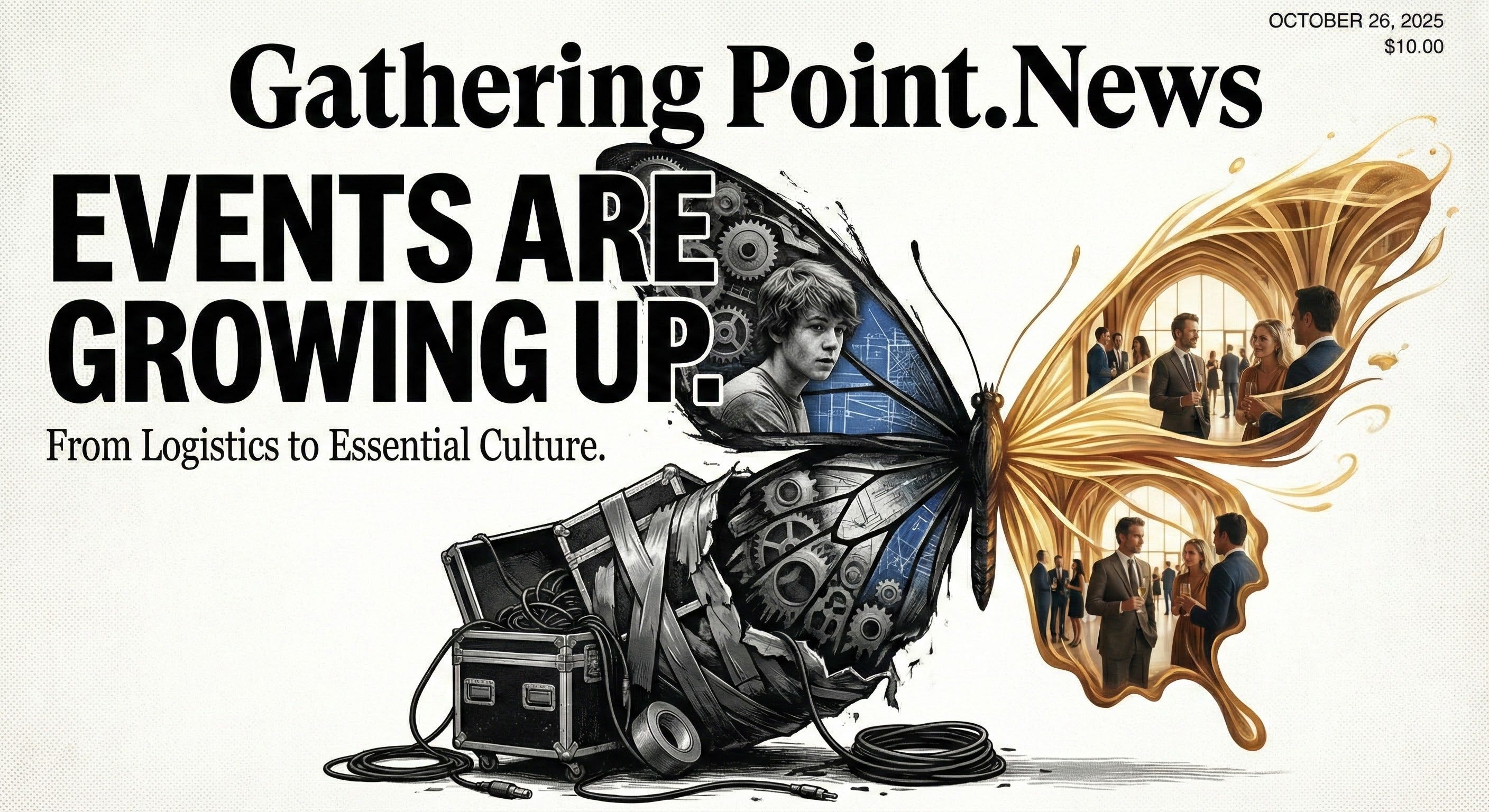
An Essay: Events Are Growing Up
The more artificial the world becomes, the more essential real gatherings are to our collective survival. What we once called “events” has grown into something much bigger: the Gathering Economy.
You can sense this maturity most clearly in the way audiences behave. The dependable six-month registration curve is gone. People no longer treat events like business trips penciled neatly into a calendar. They treat them like cultural decisions—emotional, impulsive, instinctive. The world has become too uncertain, too fast-moving, too algorithmically manipulated for anyone to commit themselves long in advance to something that doesn’t feel essential. And so today’s attendees wait until the last moment, make up their minds in a single heartbeat, and attend only when something inside them says, “This matters.”
In response, organizers are refocusing everything. Registration has evolved from a bureaucratic checkpoint into a psychological invitation. Price cliffs are honored without apology, not out of aggression but out of respect for those who commit early. Payment takes seconds. The registration form asks only what is unavoidable. In an age of relentless digital friction, events have learned that the very first touchpoint must feel like relief, not labor.
Inside the rooms, the transformation becomes even more apparent. The long, wandering panels that once passed for thought leadership belong to a bygone era. The modern mind does not respond to endurance tests; it responds to intention. Talks are shorter not because attention spans have evaporated, but because audiences want their ideas served with precision, rhythm, and vitality. Even TED, the cathedral of the monologue, has tightened its sermons. This is not dumbing down. This is tuning into the cognitive metabolism of a society that consumes information in accelerations, crescendos, and pulses.
And then there is connection, the most misunderstood component of gatherings. For decades, the industry worshipped the mythology of serendipity—the vain hope that if you put the right people in a ballroom with cocktails and lanyards, the universe would take care of the rest. But as I argued in Harnessing Serendipity, what looks like luck inside great events is actually design: the choreography of timing, touchpoints, emotional safety, and social cues. Real connection does not happen by accident. It happens because someone planned for it. The most forward-thinking gatherings now embrace this truth openly. They employ social architects. They design walk-and-talks. They use facilitators who understand the emotional structure of groups the way a conductor understands score and tempo. The future of connection is intentional, not incidental.
Perhaps the most surprising sign of all that events are entering adulthood lies in the rise of creative stewardship. The events shaping culture today operate like studios, not operations centers. They have creative directors, narrative producers, visual strategists, choreographers of space, storytellers who think in scenes and beats. A keynote is no longer just a speech; it is a broadcast moment. A breakout is no longer simply a room; it is a psychological environment. The best organizers understand that gatherings create culture—they don’t merely host it.
What’s extraordinary is that this evolution isn’t confined to the glamorous corners of the field. It is happening everywhere, especially in the industries the outside world mistakenly calls boring. Visit the annual gathering of municipal water professionals and you will witness a kind of reverence, intelligence, and urgency, because the stakes are nothing less than public safety. Spend time with asphalt engineers and you will discover innovators who quite literally shape the physical world beneath our feet. Sit with the people who work in insurance compliance, pest control, wastewater, industrial safety, elevator engineering, crop science—each of these fields has its GOATs, its rituals, its annual summit at which essential knowledge is exchanged, standards are forged, and society quietly stays intact.
And then, perhaps most illuminating of all, are the communities that outsiders treat as niche but are, in fact, full-fledged cultural economies of their own. Spend a weekend at PoleCon, the global gathering of the pole dancing community, and you will find an ecosystem as sophisticated as any major trade show: athletes, artists, entrepreneurs, choreographers, scholars, studio owners, innovators, and believers who assemble with a shared sense of purpose. Workshops run like masterclasses. Competitions resemble operatic theater. Legends are born and celebrated. What looks like subculture reveals itself, up close, as a thriving micro-economy of empowerment, strength, creativity, and identity.
When you begin to see all of these gatherings together—glamorous, gritty, blue-collar, artistic, technical, civic, sensual, sacred—you realize you are not looking at an industry at all. You are viewing a vast and interconnected system. The Gathering Economy. Not a marketing category, not a sector of business, but a societal operating system that governs how humans share knowledge, build trust, transmit culture, shape policy, innovate, collaborate, and make meaning.
And in this world of synthetic everything—infinite filters, AI clones, digital doubles, deepfakes, avatars giving speeches written by no one—the Gathering Economy has become something even more urgent: our last reliable source of the real. The warmth of applause that isn’t algorithmic. The tremor in a speaker’s voice that can’t be auto-tuned. The unplanned laugh. The shared gasp. The eye contact that travels across a room without being routed through a server. The truth that emerges only when bodies share space and time.
In a civilization increasingly suspended between the digital and the artificial, gatherings have become essential to our survival. They are where trust is rebuilt. Where meaning is reaffirmed. Where loneliness is interrupted. Where identity becomes grounded. Where communities remember themselves. Where we regain the unfiltered presence that no platform will ever replicate.
Events are growing up not because they are becoming more spectacular, but because they are becoming more necessary. In a world flooding with unreality, they are the places where we come back to ourselves. They provide emotional nourishment. Intellectual shelter. Cultural water. They have become, in a very real sense, a pillar of modern human survival.
Events are no longer the sideshow to society.
They are its connective tissue—its circulatory system, its cultural oxygen.
And if you listen closely, you can hear something stirring: gatherings are claiming their rightful place in the hierarchy of what keeps us human, alive, connected, and whole.


Brilliant Essay!