


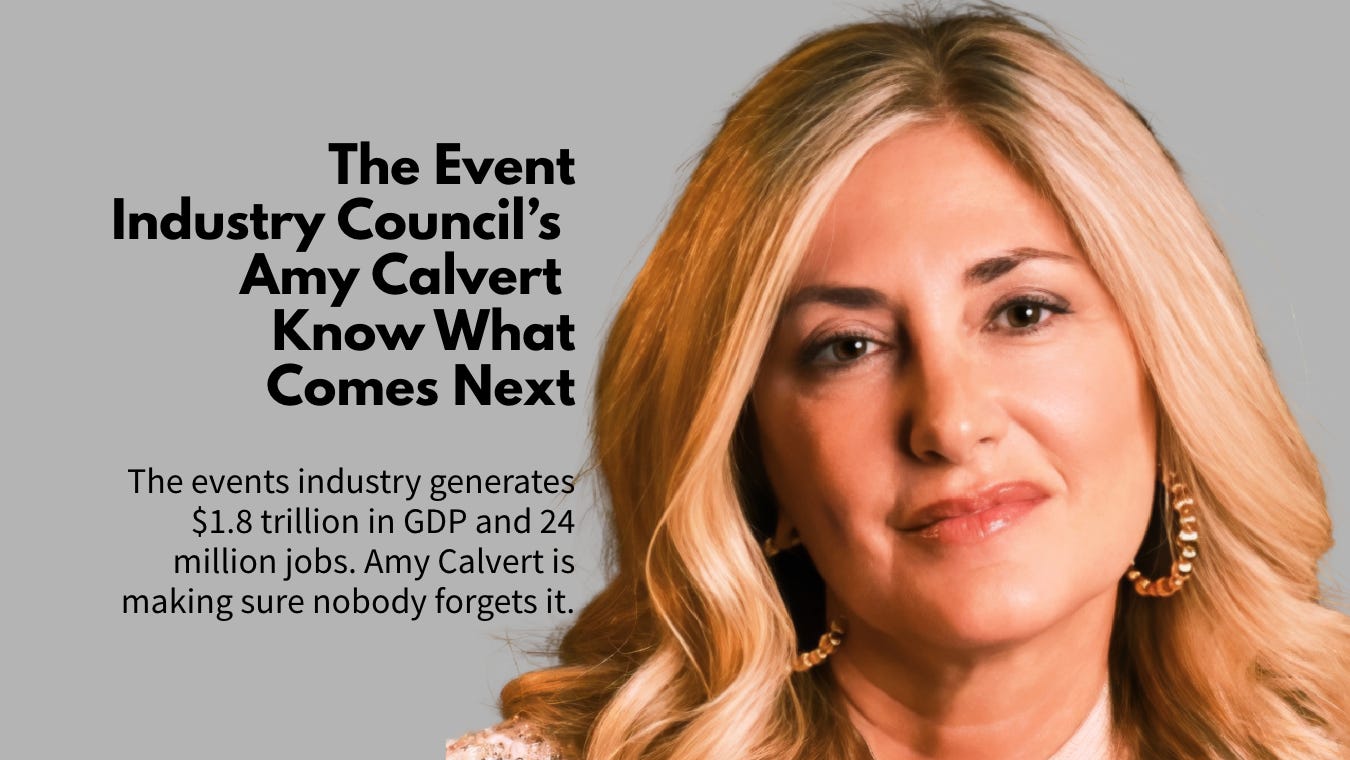
Something is shifting in the gathering economy, and Amy Calvert is the person leading the march. The Events Industry Council, the 75-year-old coalition she has run since 2019, just released the most consequential economic argument in its history: 1.65 billion participants, $1.8 trillion in total GDP, 24.2 million jobs, and a global footprint that ranks the business events sector as the sixteenth-largest economy on earth. Those are not numbers that get ignored. They are numbers that get read into the congressional record, that land on the desks of finance ministers, that change the conversation in boardrooms where event budgets have always been the first line item to go. The industry that Charles Osgood called invisible in 1996 is becoming, finally and deliberately, visible. Calvert is the coalition’s general. The march, as she would be the first to tell you, started a long time ago in a kitchen in New Jersey.
Her grandmother’s kitchen in Essex County, New Jersey, was not a large space. There was barely enough space for the stove and the prep table, let alone for the wheelchair her grandfather occupied at the edge of it, watching the woman he’d married move through the small square footage of their domestic world with the confidence of someone who understood that feeding people is not a logistical act. It is a moral one. Amy Calvert was the oldest grandchild, the first, and for years the only child in that house on Sunday afternoons, and she sat near her grandfather and listened to his stories while her grandmother cooked for fifteen or twenty people without apparent effort and without apparent anxiety, as if abundance were simply a matter of deciding to provide it.
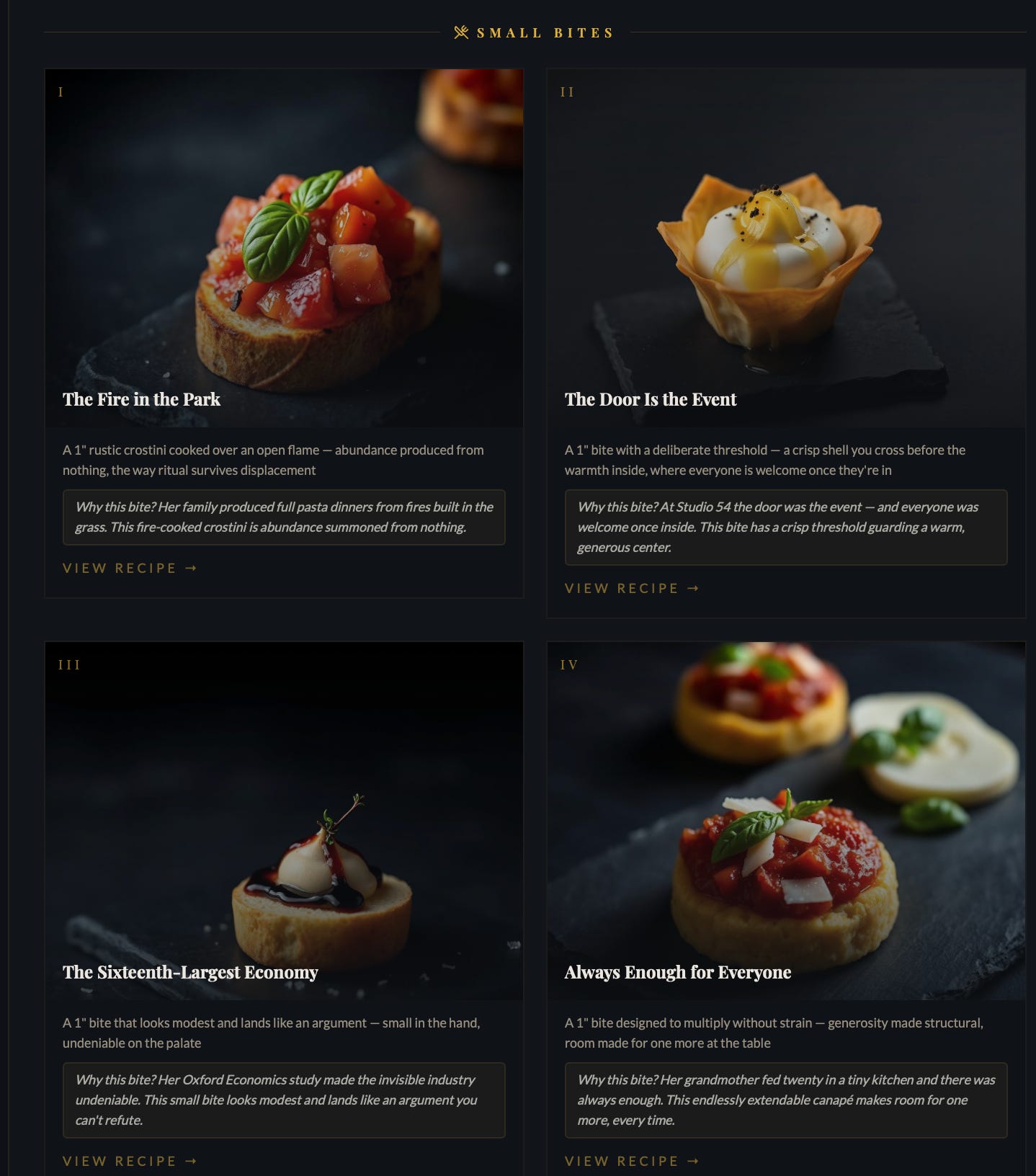
The great-grandparents on that side had come from Italy and could not speak English, and there is film footage, black and white, of them gathering in the parks of Essex County for Sunday suppers that they brought entirely from their own kitchens, building fires in the grass and then producing pasta dinners from those fires as if the displacement from their home country had not cost them any of the rituals that made home mean something. What Amy Calvert absorbed in that kitchen, and in those park films, and in the long Sunday afternoons of her New Jersey childhood was not a set of event planning principles. It was something more foundational than that. It was the understanding that the act of gathering people is an expression of what you believe about them, and that the most serious thing you can do with a gathering is make everyone at the table feel like they were always supposed to be there.
She would spend the next several decades discovering that this was, in fact, a profession.
Two Families, One Education
The Italian grandparents were not the only ones. Amy Calvert grew up between two family cultures that were, in her telling, adjacent but distinct. Her mother's side was the warmth and the pasta and the Sunday supper. Her father's side was German, more formal, more structured, WASP-inflected in the way of families whose sons go to Dartmouth and enter the textile business with their brothers. Her grandfather on that side was entrepreneurial and demanding, but also something rarer: a genuine teacher. He believed in the liberal arts with the conviction of someone who had seen what happened when people stopped thinking carefully about the world, and he passed that conviction down with the same seriousness he brought to everything else. He was committed to conservation long before it was fashionable, rooted in a work ethic that did not distinguish between what mattered and what did not, because in his view everything you did either mattered or it didn't. He was not an easy man. He was an instructive one. Amy Calvert is grateful for the difference. Her grandmother on that side was loving, and she too had people around constantly, and she had the beach house at Spring Lake, and everyone came.
Her father, who played football and sports at the high school level with her mother’s oldest brother, found his way into that Italian household and never quite left it. The warmth was different there, and he gravitated to it. Her mother always felt slightly ostracized on the other side, slightly on the outside of a culture that had not been designed with her in mind. Amy Calvert grew up watching both dynamics simultaneously, the family that opened its table and the family that required you to learn its codes, and she absorbed from that watching the thing that would become the organizing principle of her professional life: what it feels like to be on the outside looking in, and what it costs a person to be made to feel that way.
She grew up in Montclair, New Jersey, which she describes as a pretty progressive town, and she came of age in the proximity of New York City, which in the late 1970s and early 1980s was a very particular kind of finishing school for people who would spend their lives thinking about how spaces work. She went to the Limelight. She went to Aria. She danced next to Andy Warhol once in Aria with a boy she was dating, which she mentions the way you mention a thing that was ordinary in the moment and only acquires its shape in retrospect. She went to Studio 54, where the door was the event: they would pick you out of the line or they would not, and everyone knew it, and inside, once you had cleared that threshold, something shifted. “Everybody was welcome, in a way,” she says, “once you were in the door.” She would not have called it event architecture at the time. But she filed it.
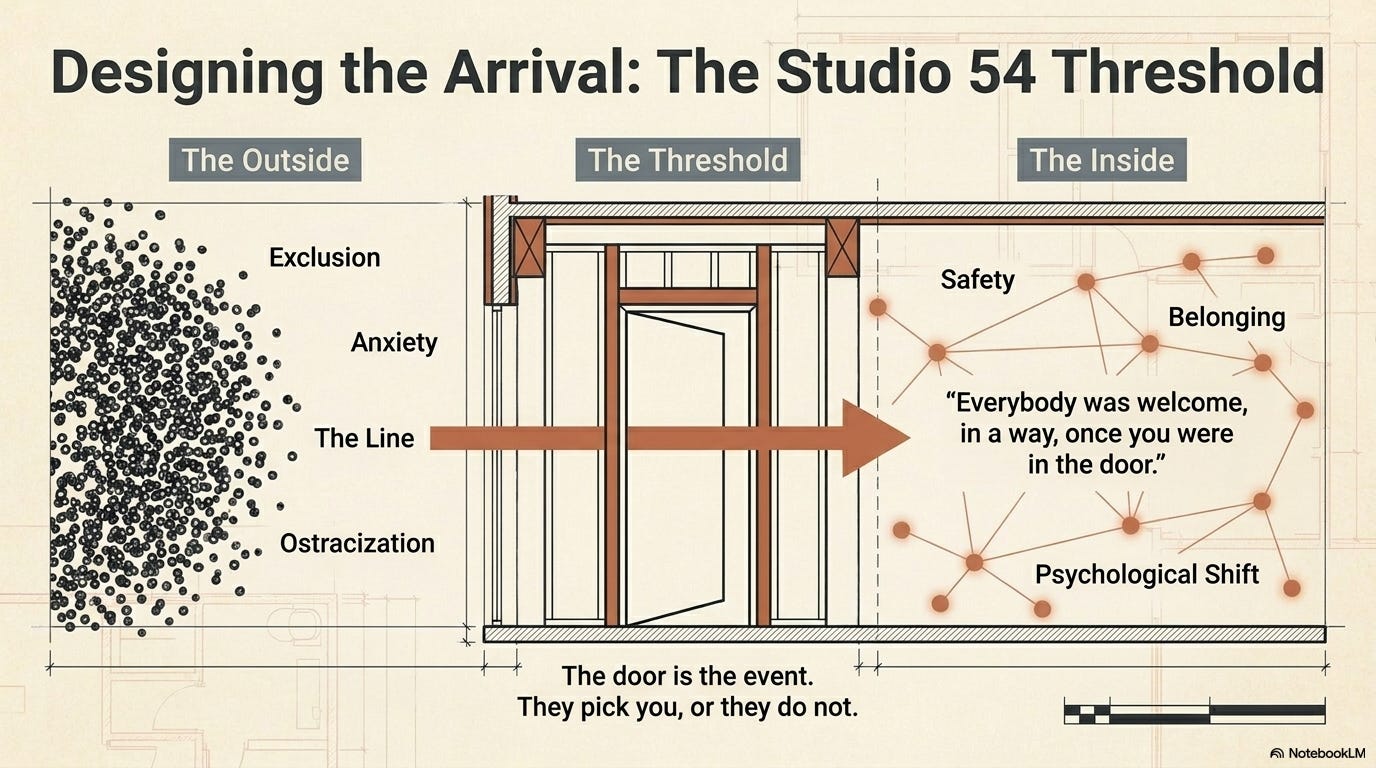
She grew up in Montclair, New Jersey, which she describes as a pretty progressive town, and she came of age in the proximity of New York City, which in the late 1970s and early 1980s was a very particular kind of finishing school for people who would spend their lives thinking about how spaces work. She went to the Limelight. She went to Aria. She danced next to Andy Warhol once in Aria with a boy she was dating, which she mentions the way you mention a thing that was ordinary in the moment and only acquires its shape in retrospect. She went to Studio 54, where the door was the event: they would pick you out of the line or they would not, and everyone knew it, and inside, once you had cleared that threshold, something shifted. "Everybody was welcome, in a way," she says, "once you were in the door." She would not have called it event architecture at the time. But she filed it. What New York taught her in those years was the same thing her grandmother's kitchen had taught her in Essex County: that the most consequential thing you can do with any gathering is decide, in advance and with intention, who feels like they belong.
The Apprenticeship Nobody Planned
She graduated from the University of Maryland with a BA in English literature and art history, having attempted a business degree and abandoned it after failing biology. She waited tables at Bentley’s in College Park and at Santa Fe, carrying high-neck tequila bottles over her head on a tray and learning what she would later identify as the irreducible core of hospitality work: the system has to work, you have to be part of it and grateful for it, and the people you are serving have to feel that care was taken on their behalf.
Her first job after graduation was in healthcare administration, which she describes in two words: “couldn’t stand.” Then she talked her way into a catering coordinator position at an independent hotel in Annapolis, persuading the general manager that she could do the job vacated by a woman going out on maternity leave. She was twenty-three. She had no formal training in events, no professional credential, and no particular reason to believe she knew what she was doing beyond the evidence of her own instincts. The woman on maternity leave did not come back. Amy Calvert got the job.
The hotel became a Loews property. Charlotte, who would become VP of sales, was there. She watched how Loews positioned itself with organizations like ASAE, how the company built strategic partnerships and became an institutional ally rather than just a vendor, and she was absorbing this the same way she had absorbed the Sunday suppers: watching, cataloguing, not yet knowing what she was building toward.
From Loews she went to the Long Beach Convention Bureau, then to InterContinental Hotels Group for nearly eleven years, selling a portfolio that ran from Staybridge Suites to InterContinental and living through at least three formal name changes of the company, including one period in which the company operated under an acronym she declines to spell out but describes with a laugh that suggests it was as bad as you think. She was part of a global sales team that was entirely remote, reporting up through a chain of people she describes with genuine affection, people she calls “before their time” in how they managed and mentored.
Then she went to Visit Baltimore as SVP of convention sales, which is where the straightforward career narrative begins to complicate itself in interesting ways. Tom convinced her to come. She insisted on doing a city leadership program that ran for about a year, specifically because she wanted to understand the real culture and history behind the promotional story she was being paid to tell. The program was designed to help people understand Baltimore from the inside, and she was in the middle of it when Freddie Gray died in police custody and the city erupted. She watched a city she had been assigned to market reveal itself as something far more contested and alive than any convention bureau pitch could accommodate. She learned from that what good leadership in a destabilized institution actually requires: you have to know what the real story is, not just the approved one, before you can tell any story honestly.
She left for the Events Industry Council in April 2019, stepping into an organization with a strong foundation that its previous CEO had carefully built over many years. The board saw an opportunity to extend that foundation into new territory: broader advocacy, deeper global presence, a more expansive vision of what the organization could mean to the industry it served. Amy Calvert was the person they chose to carry that forward. Six months later, the world shut down.
The Institution She Walked Into
To understand what Amy Calvert inherited, you have to go back to February 3, 1949, which was a cold Monday in New York City, and a table where four organizations sat down and decided to stop operating in parallel and start operating together. ASAE, PCMA, the International Association of Convention and Visitor Bureaus, now Destinations International, and HSMAI, each representing a different node of what they were calling “group business,” committed to a formal coalition. They called it the Convention Liaison Committee. Their first project was a booklet titled “Group Business Unlimited,” which they produced to help hotels understand the opportunities and challenges that convention business actually presented. It was unglamorous work. It was the right work.
What those four organizations understood, in 1949, was that the business of convening people had become serious American economic infrastructure, and that the people doing that business were operating without the institutional support that any serious profession requires. The hotel needed to understand the convention official. The convention official needed to understand the bureau representative. The bureau needed to understand the hotel. Nobody was talking to each other in a coordinated way, and the industry was growing fast enough that the absence of coordination had begun to cost everyone.
The organization renamed itself the Convention Liaison Council in 1974, formally incorporated in 1981, launched the Certified Meeting Professional credential in 1985, became the Convention Industry Council in 1999, and became the Events Industry Council in 2017. Each renaming tracks a widening ambition. Each one also tracks a problem that the previous name had not quite managed to solve, which is the problem of making an industry that touches every sector of the economy legible to the people outside it who benefit from its existence. The events industry has been the invisible industry since Charles Osgood named it that in a 1996 documentary, and the EIC has been fighting that invisibility for seventy-five years, with varying degrees of success and with better and better data.
Amy Calvert walked into that history with a specific mandate: grow the brand beyond what people thought it was. Diversify revenue. Expand membership. Do the work that the organization had been gesturing toward but not quite executing. She started a listening tour. She commissioned visioning work with her chair Paul and past chair Tina, going beyond strategic planning to ask the harder question: why does this organization exist, and what is its true purpose? She had six months of that clarity before the pandemic took everything off the table.
A Case for Leading the Business Events Industry
The Year the Industry Stopped
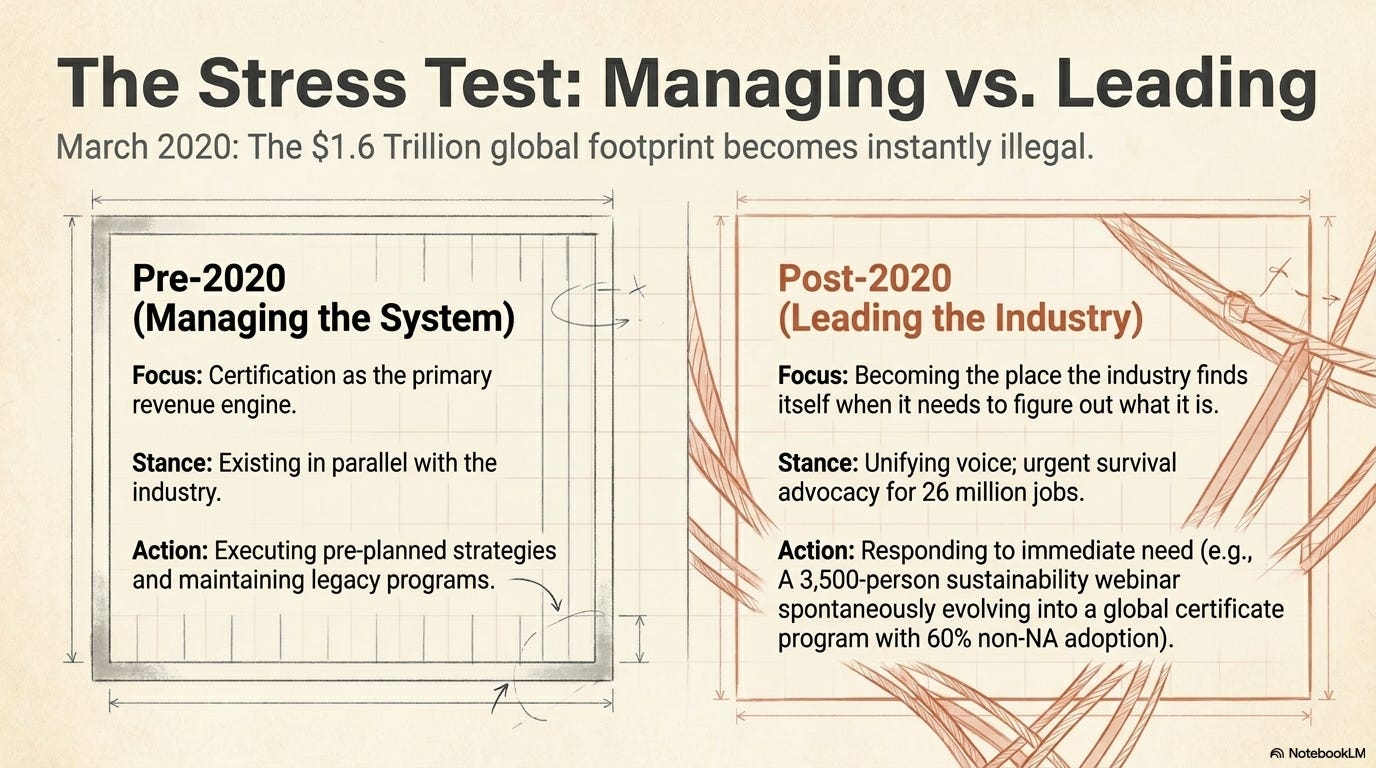
In March 2020, the Events Industry Council, the global federation that exists to support an industry whose entire premise is that people gather in person, watched that industry become illegal in most of the world. Its $1.6 trillion global footprint did not disappear overnight, but it stopped functioning in the ways that had justified its existence, and the people who had built careers in the assumption that physical gathering is permanent human infrastructure suddenly needed someone to tell them what to do next.
Amy Calvert did not wait to be asked. Within weeks she was issuing direct calls to action, sharing with the industry that it needed to unify its voice and communicate loudly to policymakers, that twenty-six million jobs depended on the capacity to make that argument clearly and immediately. The EIC’s board had just completed its vision work in the fall of 2019. She had something to anchor to. She used it.
What the pandemic revealed, in her telling, is not simply that the industry needed better advocacy infrastructure, though it did. What it revealed is that the EIC’s most important function might not be what anyone had been treating as its most important function. The certification was the revenue engine. But the purpose was something larger: to be the place where the industry could find itself when it needed to figure out what it was. “The pandemic taught us we can’t keep barreling forward with this notion that things are always going to be the same,” she says. “That was maybe one of the best things that ever happened to EIC.”
She is precise about what she means by that, and the precision matters. The pandemic did not simply disrupt the industry. It forced the EIC to become, for perhaps the first time in its history, genuinely indispensable. An organization that had been describing itself as the global champion of event professionals found out, in the worst possible way, that the description was accurate. Thirty-five hundred people attended a webinar in March 2020 to learn about sustainable event practices while the borders were still closing. Eighteen hundred people have since gone through the Sustainable Event Professional Certificate program she built from that moment, sixty percent of them outside North America. She did not plan that program. She thru the support of hundreds of global SMEs and the team responded to what people needed. The difference between those two things is the difference between managing an organization and leading one.
What She Is Actually Building
The EIC’s 2026 Global Economic Significance of Business Events Study, produced with Oxford Economics and released in May of this year, is the most important piece of research the organization has ever produced, and understanding why requires understanding what it is actually for. It is not a data report. It is a brief for policymakers, a credential for advocates, a story for every CMP and convention bureau and hotel sales director who has ever had to explain to a skeptical CFO or an indifferent congressman why what they do matters.
The numbers are extraordinary. In 2025, business events brought together 1.65 billion participants globally and generated $1.3 trillion in direct spending, a 12.2 percent increase over pre-pandemic 2019 levels. Including indirect and induced impacts, the sector supported $3.1 trillion in total business sales, $1.8 trillion in total GDP, and 24.2 million jobs worldwide. That GDP figure would rank the sector as the sixteenth-largest economy on earth, ahead of Turkey, Indonesia, the Netherlands, and Saudi Arabia. Trade shows alone directly supported $180 billion in spending. Oxford Economics projects direct spending will reach $1.6 trillion by 2028.
And then there is the number that carries the actual argument: seventy percent of survey respondents identified face-to-face relationship building as the event outcome most difficult to replicate digitally. Twenty-eight percent said they would lose revenue without hosting in-person events. This is the veracity premium, the proposition that the in-person moment is not substitutable, measured and sourced and delivered with the institutional authority of Oxford Economics behind it. Amy Calvert has been making this argument since her first day on the floor at IMEX Frankfurt in May 2019. Now she has the data to make it unanswerable.
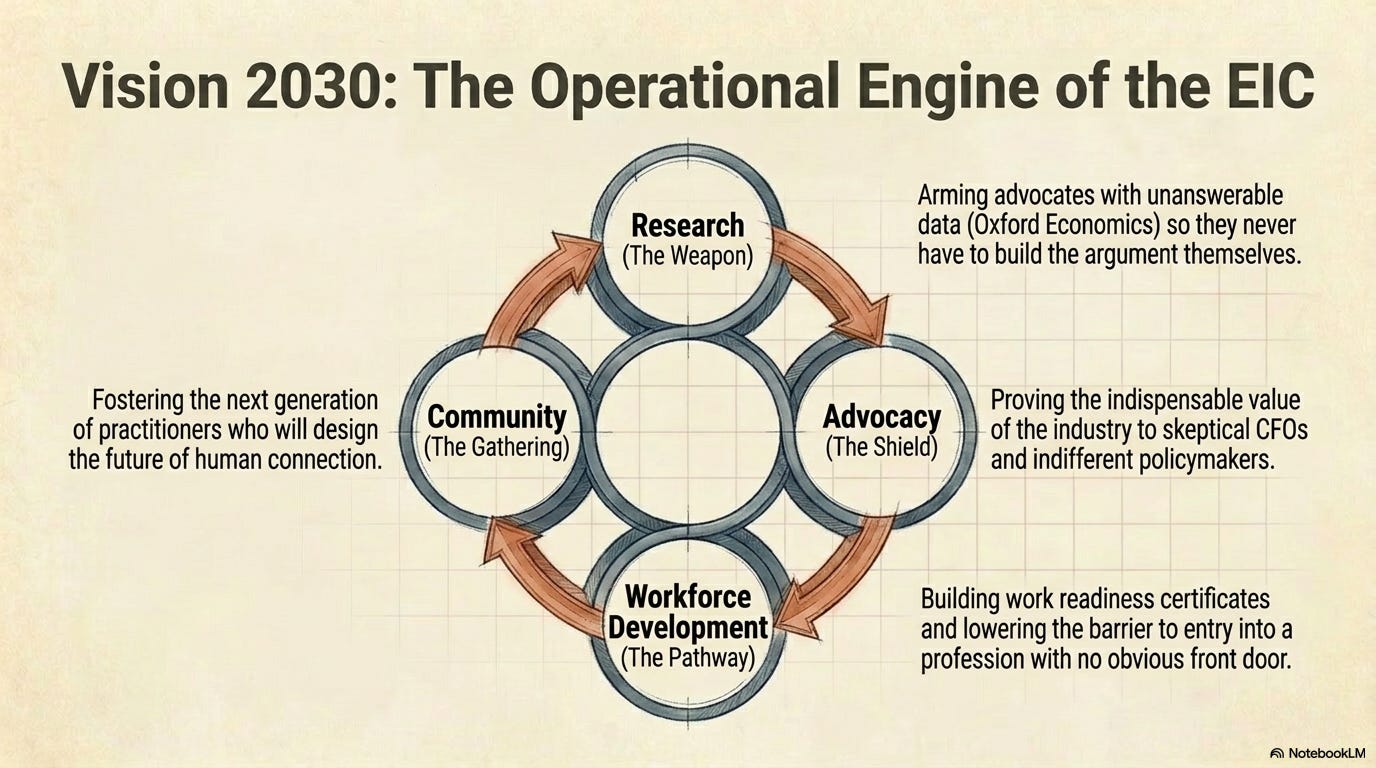
The advocacy agenda is powered by research. The workforce development agenda is powered by credentialing. That portfolio is larger than most people outside the industry realize. The CMP, launched in 1985 and now held by more than 13,000 professionals across 55 countries, remains the flagship: the only globally recognized standard in a profession with no licensing requirement, no bar exam, and no accreditation body that can tell an organizer they are not qualified to put twelve hundred people in a ballroom and run a three-day summit. The CMP-HC specialty credential extends that standard into the healthcare meeting sector, where compliance and regulatory complexity demand their own framework. The Sustainable Event Professional Certificate, the SEPC, is the newest and fastest-growing: 1,800 completions since Calvert built it from a pandemic webinar audience in 2020, sixty percent of them outside North America, eighteen hundred practitioners who now have a shared language for what responsible event practice actually requires. For long-tenured CMPs who have shaped the profession itself, the CMP Fellow tier recognizes sustained contribution at the highest level. And Calvert is building further still: a work readiness certificate grounded in CMP competencies, designed to reach people before they commit to post-secondary education and lower the barrier to entry for the next generation. The credentialing is powered by community, which is the part that the EIC had perhaps underestimated before she arrived. She talks about neuroscience the way someone talks about something they believe is about to change everything. She talks about cognitive load as a design principle for events. She talks about white space and the danger of overscheduling and the shared responsibility between organizers and participants for making the experience worth having. “We keep loading, loading,” she says. “It’s crazy.”
Her Vision 2030 framework positions advocacy and workforce development as the twin central commitments of the next chapter. The research gives the advocacy its ammunition. The credentialing gives the workforce its pathway. The question she is asking, in every direction at once, is: how do we make people who are not already inside this industry feel like they were always supposed to be here?
She learned the answer to that question in a small kitchen in Essex County, watching a woman who could cook for twenty people without making any of them feel like an imposition.
The Closing Argument
Amy Calvert will tell you she wants to open a wine bar when she retires. She will describe the menu she has in mind, small things, the kind of food her grandmother made, and she will say this with enough specificity that you believe her. She is not the kind of person who says things she does not mean.
She will also tell you that she loves this work, that the organization is purpose-driven in a way that feels genuine rather than performative, that the volunteers and the board and the member organizations show up with a generosity that she finds consistently humbling. She says this without the cadence of someone who has been trained to say it. She says it the way her grandmother said there is always enough for everyone: as a statement of fact about how she has organized her world.
When she looks back at the EIC’s articles of incorporation from its 75th anniversary, she says what struck her was the vision and the foresight of those four organizations that gathered at a table in New York City on February 3, 1949, and committed to leveling up a profession by unifying it. She is doing the same thing they were doing, at larger scale, with better data, and with a clarity about why it matters that the pandemic supplied at considerable cost to everyone. The problem they diagnosed in 1949 is the same problem she is working on in 2026: there is no single place to go to understand what your entry point into this industry is, what your credential means, why your work matters to the people who are not yet convinced.
She is building that place. She learned how from a grandmother who fed twenty people every Sunday in a kitchen that was not large enough for it and somehow always made space.

The kitchen is the curriculum.
Calvert absorbed the architecture of welcome before she had language for it, watching a grandmother who understood that the act of gathering people is an expression of what you believe about them.
Know what the outside feels like.
Her mother felt ostracized by her father’s family. She absorbed that. The instinct to make people feel included rather than tolerated is not a policy position for Calvert. It is a personal inheritance.
The door is the event.
Her Studio 54 observation is precise event architecture: it is not about what is inside. It is about what it feels like to cross the threshold. Design the arrival.
The system has to work.
She learned from waiting tables that hospitality is not a solo performance. You are part of a system, you need good relationships with the bartenders and the kitchen line, and the experience the guest receives is the product of how well those relationships function.
No challenge declined.
Loews to IHG to Baltimore during Freddie Gray to CEO of the EIC six months before the pandemic. She did not stumble into difficulty. She walked toward it consistently and emerged from each crisis with a more sophisticated understanding of what the work requires.
The vision exercise saves you.
The EIC’s board completed its vision work in the fall of 2019. When the pandemic arrived six months later, she had something to anchor to. Do the hard thinking before the crisis arrives. You will need it.
Respond to what people need, not what you planned.
The SEPC was built from thirty-five hundred people showing up to a webinar in March 2020. She did not plan that program. She heard the demand and met it. That is the difference between managing an organization and leading one.
Research is not a report. It is a weapon.
The 2026 Oxford Economics study exists so that every CMP in every conversation with every indifferent policymaker has a number, a source, and an argument they did not have to build themselves. The organization’s role is to arm its people.
Cultural competence is not a value. It is a prerequisite.
Everyone says they want to be global. Global means understanding the uniqueness of every community you are trying to reach and showing up with curiosity rather than conclusions.
Welcome intentionally.
Her single biggest stated life lesson in leadership is how to be intentional about making space for new voices. Not as a program. Not as a committee. As a daily practice of not assuming that everyone already feels welcome to the party.

Every Wisdom Bank profile gets a song. Amy Calvert's is called "Now They're Gonna Hear Our Song," a late-70s New York disco anthem that carries her grandmother's kitchen, the door at Studio 54, and the board now dragging a 75-year-old institution into its next chapter, all the way to the bridge. Listen for the moment the credentials become a chorus.

An Edible Profile of Amy Calvert ( Click )
Small Bite Architecture turns a profile into something you can taste. In a moment when so much hospitality has become standardized, a tray of identical canapés handed to a room of strangers, we believe the next era of gathering is personalization: food and drink built around the specific person being honored, not a generic menu pulled from a catering binder. Every bite here is built around a single detail from Amy Calvert’s actual story, from a fire in the park to the door at Studio 54 to the number that made an invisible industry undeniable. The result is something rare at most events: a guest of honor who feels truly seen, and a room that understands why. Have a look at what we built for her.
How neat to learn of Amy’s “Joisey” roots and her lineage. What a joy it must’ve been to have such wonderful memories with her Italian grandparents in a kitchen that sounds much like that of my parents in Ohio, one of whom was a “son of” Hillside. My great-grands, both Eastern European immigrants, lived not far from Hillside in Paterson, with other paternal family scattered in Northern New Jersey.
Kitchens in homes have, in my life, been like what some call the “back of the house” in hotels, and I learned long ago from a colleague to call what it was for Amy, me and others fortunate to have them, the “heart of the house.”
I had the honor serve as one of MPI’s 3 delegates to the then CLC/CIC “big board”: 3 delegates from each member organization. Being part of that Board provided incredible learning opportunities among the delegates and those invited to address us. Those with whom I served included many who were inducted into the (now) EIC Hall of Leaders. (I’m proud to be among them, having been inducted in 2004, primarily honored for moderating the first hospitality/meetings industry virtual community, founded by Rod Marymor, the MIMList.)
The education at our board meetings included attorneys from ASCAP and BMI addressing the brouhaha of the industry-negotiated licensing flat fees for music to be _heard_ at meetings. Another was Cricket Park, then with AHEAD (now a retired Episcopal priest) who, just after the ADA passed 36 years ago, talked with us about the meaning of the law and the steps venues, destinations, meetings and trade shows were required to take to be in compliance. More she addressed the moral and hospitable obligations to accommodate disabled people. (As with all language uses, the words once used for those with disabilities was harmful, pejorative. Some use “people with disabilities.” With our greater presence in the world, with July now Disability Pride Month, “disabled” is used by many first.)
To Amy, who I hope reads and provides this link to others, this newly released economic impact study, like those before, will, we again hope, have an impact especially in government. Not long ago, Geoff Freeman, CEO of the U.S. Travel Association, met with a delegation, oddly, many of us
thought, of all men - or so it appeared from the photo, in the Oval Office with Donald Trump, promising to increase the number of visitors to the US from other countries to an astronomical number by 2030. Those EIC represents will, from the EIC report, be critical to reaching those numbers.
My wish, Amy, of EIC, is to make inclusion and accommodation of disabled people a far greater focus of the CMP study. Most countries have disability accommodation laws that include hospitality. Like your grandfather in his wheelchair, all want to participate fully at destinations, in venues, at attractions. Whether mobility, hearing, sight, language, neurodivergence or a combination thereof, disability, look to what the big board learned, update it and move it forward before you retire to your sounds-charming, wine bar.
Onward!
PostScript: “Being Heumann”, a film based on the memoir of Judith (“Judy”) Heumann, the “mother of the ADA”, she now sadly of blessed memory, debuted. It will air on 15 November on AppleTV. Let it inspire and guide.