


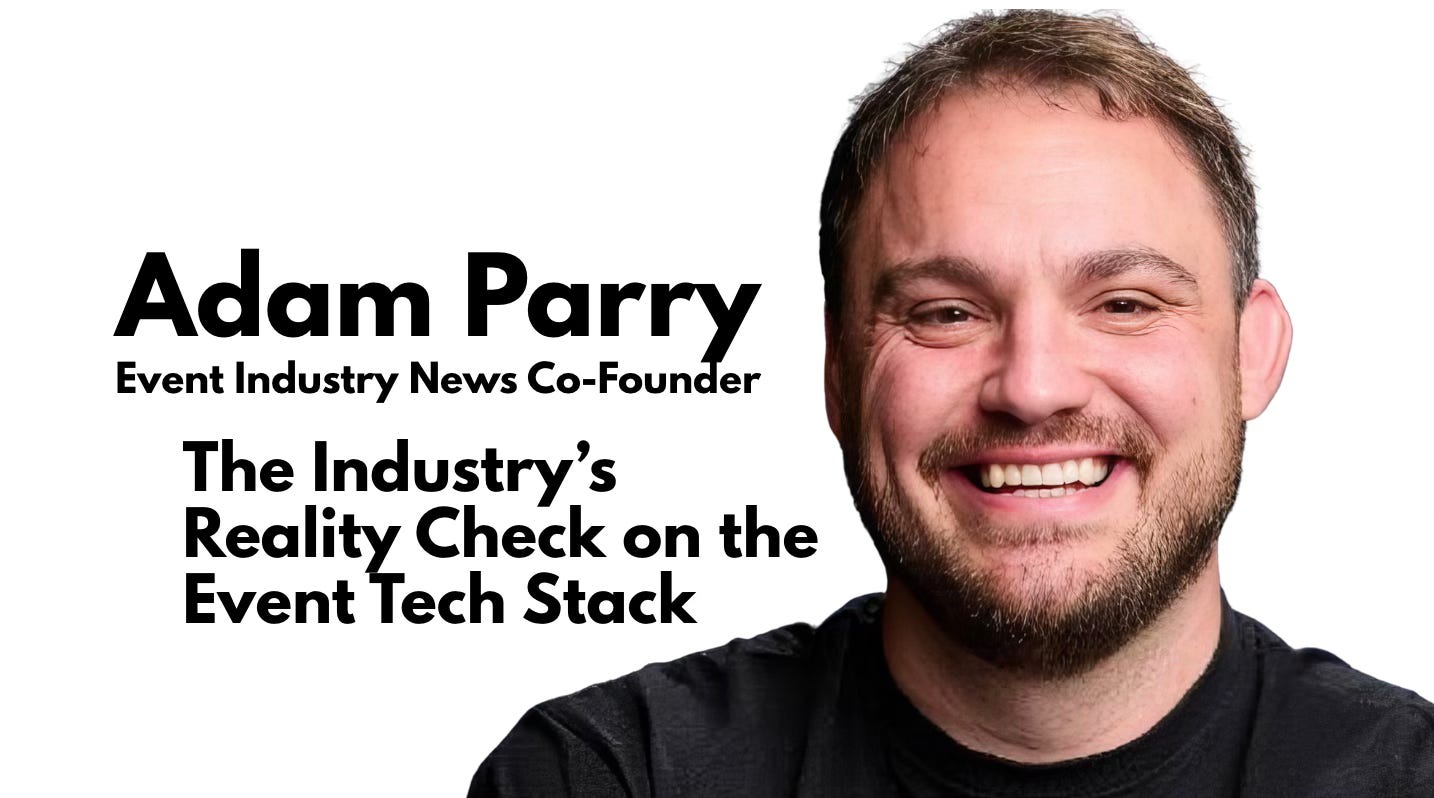
Editors Note: This is the latest installment in Gatekeepers, a series about the editors and conveners who have shaped the events industry’s shared narrative. Rather than forecasting trends, the series focuses on perspective—what becomes clear when those who once framed the conversation step outside it. Adam Parry’s story offers a rare long view, spanning media, events, technology, and geography. It’s less about what comes next than about what has already changed.
For much of the last two decades, the global events industry looked smaller than it actually was if you were standing in London. The center of gravity felt close at hand, reinforced by a dense circuit of trade shows, agencies, publishers, and organizers who knew one another well enough to argue in shorthand and move on. From inside that ecosystem, ideas radiated outward, credibility was tied to proximity, and the rest of the world—important but distant—was typically described as “emerging.”
Adam Parry spent more than fifteen years inside that system, helping narrate it to itself. As co-founder and longtime editor of Event Industry News, he built a publication that functioned less like a glossy magazine and more like a daily briefing for people who needed to know what actually mattered. Looking back, he describes the mindset plainly: “London wasn’t just a city. It was a system. If something mattered in London, we assumed it mattered everywhere else.”
But observation was only half of Parry’s role. He also wanted to know whether ideas survived contact with reality. Event Tech Live, which he co-founded, was conceived not as a traditional trade show but as a working laboratory where tools, formats, and assumptions could be tested in front of real audiences under real pressure. Launching in London was intentional: Parry wanted the experiment to unfold where conversations about technology were already happening. Over the years, the event proved memorable not for its stage parties or keynote names, but for the patterns that emerged edition by edition.
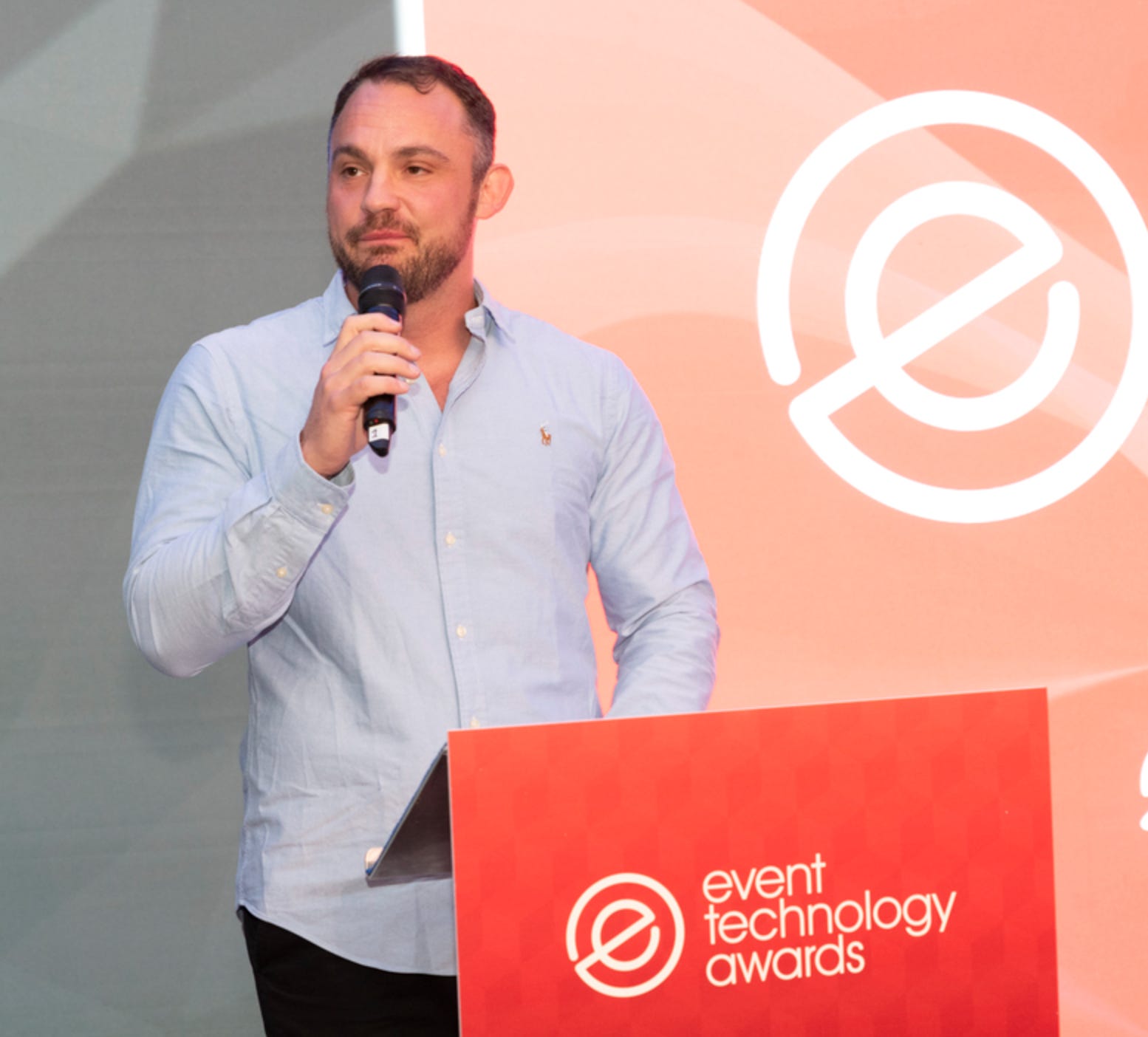
In the early years, Event Tech Live spotlighted platforms promising sweeping change. As the years progressed, winners at the Event Technology Awards — which take place as part of the show — began reflecting a more mature ecosystem. The 2024 ceremony honored innovators like Pablo Bonales as Rising Star and companies such as Just Attend and Boxbar Tech for new products and engagement solutions. The 2025 awards further highlighted this arc: solutions recognized included vFairs for visitor registration and management platforms, Bizzabo for data analytics, and Sitka and Blink for sustainable tech and personalisation — underscoring how the industry’s definition of “innovation” had shifted over time from novelty to utility and integration.
Event Tech Live even expanded beyond its London origin with editions in Las Vegas, reflecting both the U.S. industry’s gravitational pull and the need to see whether the same conversations translated across cultures. What Parry learned there was instructive: tools travelled easily, but context did not. Technology behaved differently when filtered through different expectations about scale, risk, and return.
For years, London felt permanent, investable, structurally central. The idea that the global events calendar might meaningfully reorganize itself beyond a handful of legacy markets was acknowledged in theory, then quietly set aside.
What was less visible from the outside was how uneasy Parry had always been inside any system that dictated how people should think. He does not describe himself as someone with “event DNA,” and his path into the industry was never driven by a love of staging or spectacle. “I don’t have event DNA,” he says. “I have people DNA.” His interest, from the beginning, was in how confidence moves through rooms, how participation is shaped, and why some voices surface while others remain silent.
That interest was not abstract. In his late teens and early twenties, Parry struggled with acute social anxiety that made ordinary public situations feel physically overwhelming. “I had massive social anxiety,” he says. “I couldn’t even sometimes be in the same public space as friends and family without feeling physically sick and sweating.” Restaurants, cinemas, even casual gatherings could provoke an urgent need to leave. “It felt extremely irrational,” he adds. “I had no reason to be fearful of anybody around me.”
What followed was not retreat, but a decision. “I remember thinking, only I can fix this,” Parry says. “The only way to get over flying is to get on a plane.” Instead of avoiding public situations, he began placing himself deliberately inside them—first as an attendee, then as a participant, and eventually on panels and stages. “I started to seek out public events,” he says. “Then panels. Then standing on stages. I forced myself into the thing that I was most fearful of.”
Events were not his natural habitat; they became his training ground. Over time, repetition replaced panic, and observation replaced fear. What he learned was not how to perform, but how rooms actually work—where tension gathers, how attention shifts, and why some people speak while others withdraw.
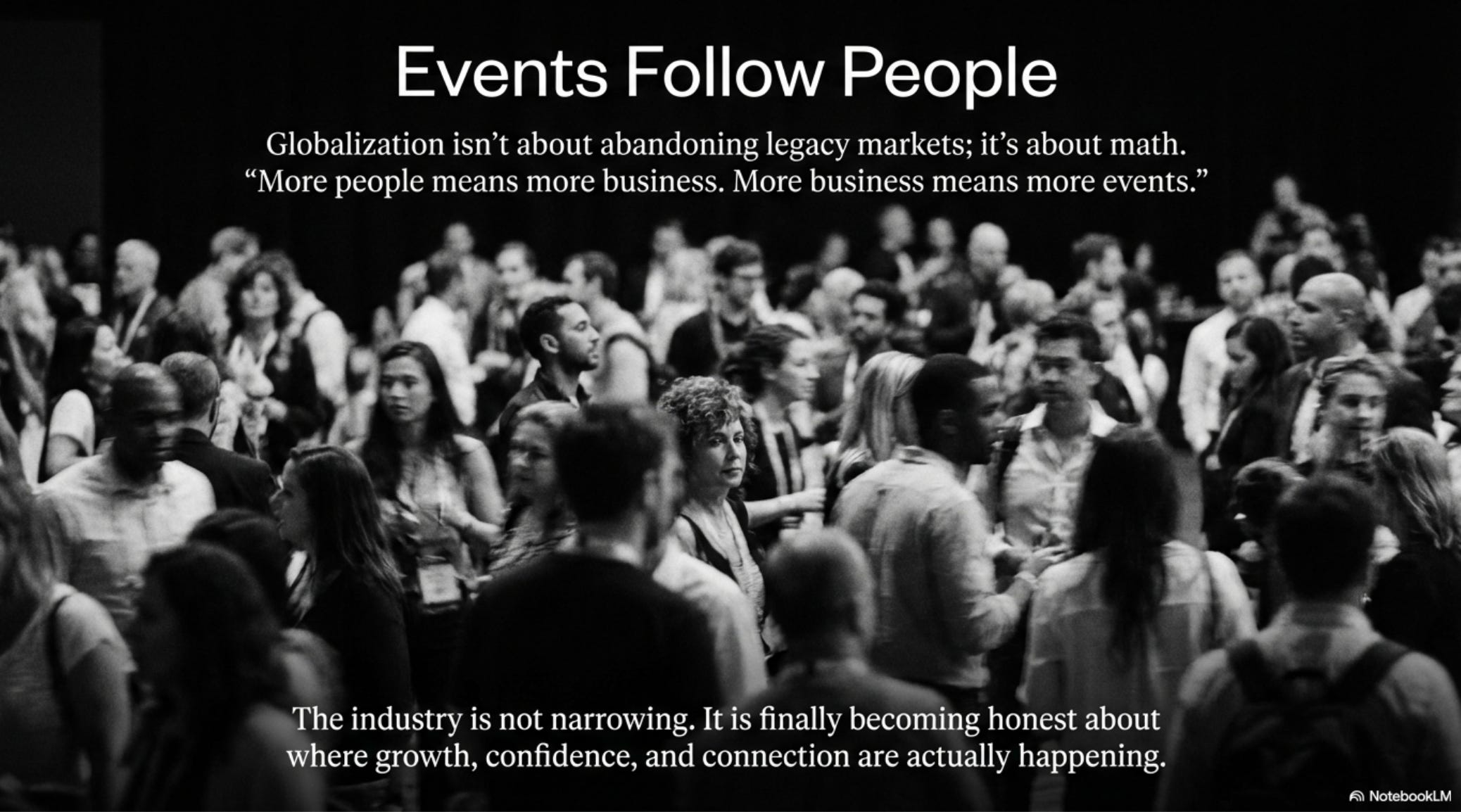
Technology played a role in that transformation, but not as spectacle or distraction. For Parry, structure itself became a stabilizer. “I don’t think technology is getting in the way of people connecting,” he says. “I think it’s an enabler.” Slides, prompts, and later AI tools were not replacements for connection but scaffolding—ways to make participation survivable before it became instinctive. “As attendees, we’re very forgetful,” he adds. “Technology should help people recall, reflect, and actually show value.”
That insight eventually reshaped how he viewed the broader industry. Long before he relocated anywhere, Parry noticed that technology had quietly redrawn the global events map—not by flattening it or equalizing power, but by puncturing old gatekeepers. Digital publishing, online registration, remote sales, and global distribution meant that being outside London or New York was no longer disqualifying.
Participation widened. Power did not. “Technology democratized access,” Parry says. “It didn’t democratize power.” Large organizers adapted; agencies extended reach. Governments learned how to pair technology with incentives and infrastructure. Geography did not disappear—it became strategic.
Parry’s vantage point on this shift was unusually clear because he straddled media and operations. He could see which ideas sounded compelling in editorial copy and which ones actually changed behavior in rooms. His relationship with the Middle East developed during this period, not as a reaction to stagnation elsewhere, but as a parallel line of sight.
“We first visited the country literally fifteen years ago,” he says, referring to Dubai. “We’d been coming out here for years. This wasn’t a sudden thing.” Over time, he watched an events ecosystem take shape under very different assumptions: population growth treated as a given, government involvement explicit rather than disguised, ambition underwritten rather than apologized for.
After Covid, life in Manchester thinned. Friends moved away. Family dispersed. Parry had already been running a remote-first business for a decade, and his wife stepped back from her UK role as their son’s education became central. “Post-Covid, everybody we used to hang around with had moved away,” he says. “Everything became an effort.”
Professionally, his role was also changing. When his co-founder stepped back from the business for health reasons, Parry separated from day-to-day editorial oversight. For the first time in fifteen years, he was no longer required to speak as an institution.
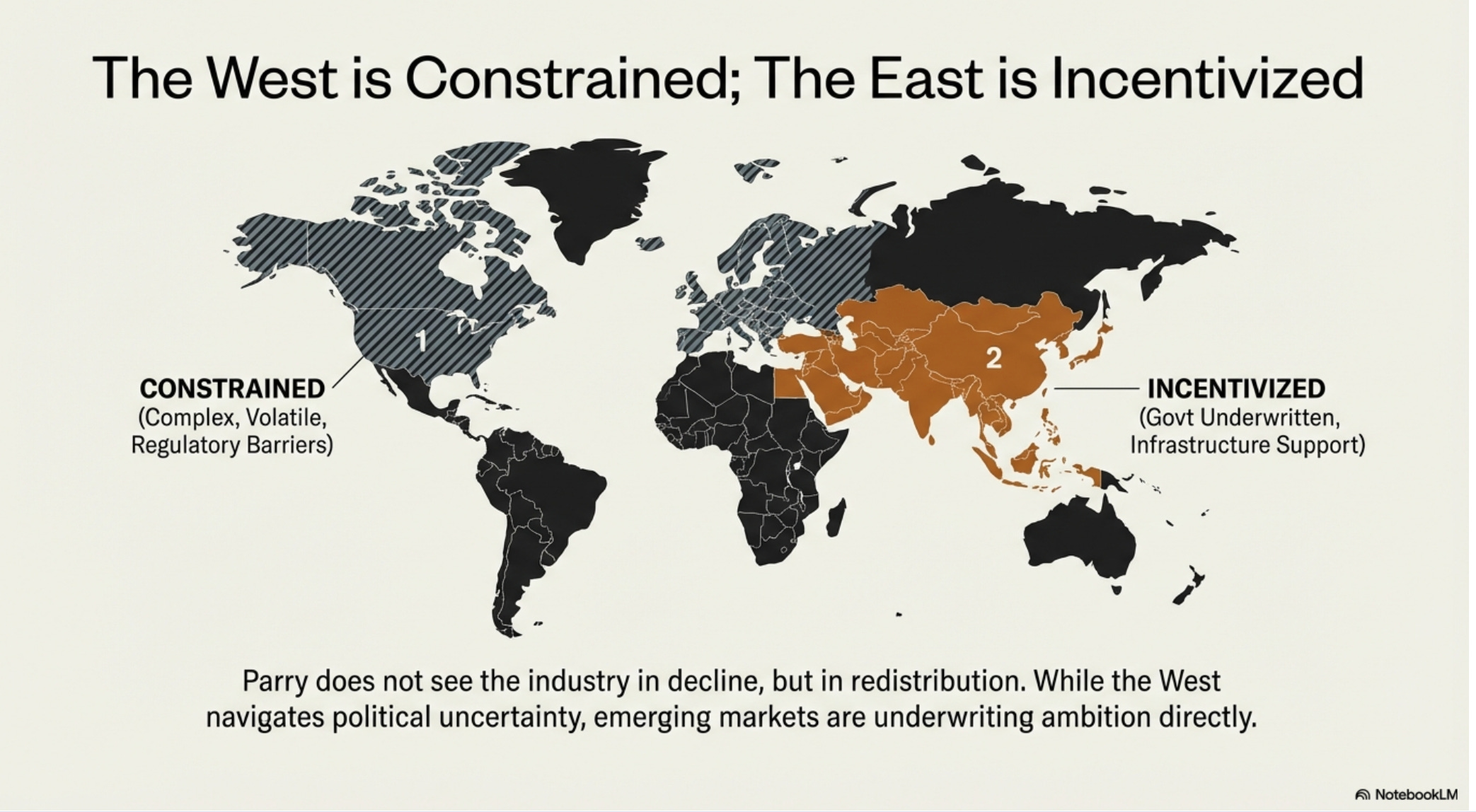
From where he sits now, Parry does not describe the industry as being in decline. He describes it as redistributing. The UK feels under-incentivized. The United States remains powerful, but increasingly complex. Elsewhere, governments are underwriting ambition directly.
What excites him most is not scale, but authorship. Audiences, he believes, are no longer drawn to cookie-cutter formats. They are drawn to founder and creator DNA—to gatherings where intent is legible in the room.
A Bonus Song about Adam Parry
This is why he sees a golden age of the event entrepreneur taking shape. Influencers and creators bring reach and trust; event professionals bring structure, safety, and execution. Together they are beginning to build a new class of gatherings—global, personal, and unmistakably human.
The next chapter of Event Tech Live reflects that philosophy. On 11–12 November 2026, the show returns to ExCeL London, drawing hundreds of event brands, corporations, and builders who understand that the center no longer holds—but the gathering does.
For an industry built on bringing people together, that feels less like disruption than alignment. And from where Adam Parry now stands, the map looks bigger, not broken.