
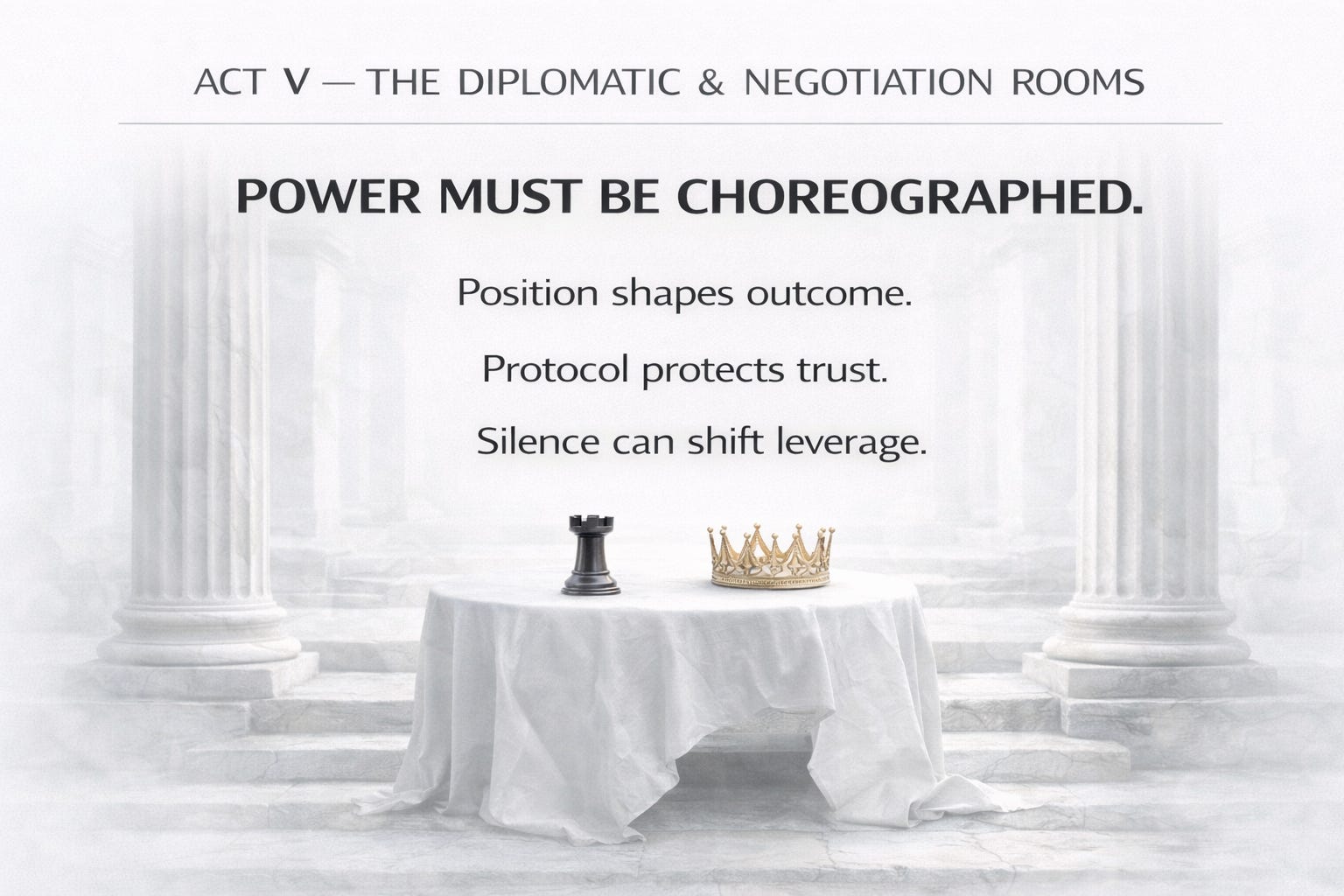
Act V – The Diplomatic & Negotiation Rooms
Where disagreement becomes design.
Diplomatic rooms are slow rooms.
They trade adrenaline for oxygen, volume for nuance.
Their choreography matters: lighting, seating, pacing.
The best ones regulate emotion before logic.
🧠 Science: Lowering cortisol reactivates the prefrontal cortex — empathy and reasoning can finally coexist.
1. The Camp David Model
Form: Three wooden cabins hidden among Maryland pines, connected by walking paths and guarded silence. Leaders take turns walking, cooling off, returning with new words.
Context: 1978 — Carter, Begin, and Sadat rewriting peace in the woods.
Like This: A political marriage retreat with armed security.
What Happens Here: Isolation breaks performance; proximity builds perspective. By the third day, stubbornness softens into fatigue, and fatigue into honesty.
Robin Take: “Sometimes the smartest policy move is a cabin with no Wi-Fi.”
David Take: “Camp David proves peace is architecture—three cabins, one path, infinite patience.”
🧠 Science: Natural light and repetitive movement reduce amygdala activity by ≈ 30 %.
2. The Oslo Method
Form: A modest farmhouse outside Oslo; firewood stacked high, tablecloths wrinkled from endless meals.
Context: 1993 — secret Israeli-Palestinian back-channel talks.
Like This: Kitchen-table diplomacy without the cameras.
What Happens Here: Confidentiality becomes safety; informality becomes courage. When the stage disappears, sincerity shows up.
Robin Take: “Every conflict needs an off-record room; performance kills sincerity.”
David Take: “Oslo is intimacy misread as conspiracy.”
🧠 Science: Private dialogue lowers limbic threat; empathy circuits engage more easily.
3. Principled Negotiation
Form: A round table with name cards replaced by shared problem statements in the center. Papers covered in circles and arrows instead of positions.
Context: Harvard Law’s Getting to Yes (1981).
Like This: Couples therapy for countries.
What Happens Here: People separate from problems; curiosity replaces combat. Winning becomes finding overlap.
Robin Take: “If Congress tried this, C-SPAN would become unwatchably effective.”
David Take: “Negotiation as mindfulness practice.”
🧠 Science: Framing discussion around interests activates reasoning, reducing cortisol spikes.
4. The Restorative Circle
Form: A circle of chairs with no center but the object passed between them — a stone, a stick, a truth.
Context: Indigenous justice adapted for schools and courts.
Like This: A courtroom that whispers.
What Happens Here: The talking piece democratizes power; apology replaces accusation; witness becomes healer.
Robin Take: “Policy failure is usually process failure; circles fix both.”
David Take: “The oldest technology of fairness—and still the most graceful.”
🧠 Science: Turn-taking synchronizes breathing; calm spreads through mirror neurons.
5. Shuttle Diplomacy
Form: A mediator’s briefcase stuffed with notes and airline tickets; empathy traveling at 35,000 feet.
Context: Kissinger’s 1970s Middle-East peace efforts.
Like This: Emotional FedEx between enemies.
What Happens Here: Translation becomes transformation; distance cools tempers enough for clarity.
Robin Take: “Sometimes you need emotional insulation before reconciliation.”
David Take: “Empathy on layover—exhausting, essential.”
🧠 Science: Gradual exposure reduces threat response; tolerance grows with repetition.
6. Mutual Gains Approach
Form: A whiteboard full of overlapping Venn diagrams; calculators and empathy sharing the same table.
Context: MIT–Harvard Public Disputes Program.
Like This: Business-school math applied to human feelings.
What Happens Here: Trust built through transparency; value created instead of divided.
Robin Take: “Trust through math—a rare miracle.”
David Take: “When everyone edits the same spreadsheet, ego loses the cursor.”
🧠 Science: Reciprocity triggers dopamine; collaboration becomes intrinsically rewarding.
7. The Back-Channel Dinner
Form: Two rivals in a quiet restaurant corner; clinking glasses muffling classified talk.
Context: Lobbyists, diplomats, and journalists’ favorite table.
Like This: Peace talks disguised as a steakhouse reservation.
What Happens Here: Shared food dissolves distance; human need precedes headline.
Robin Take: “Never underestimate a well-timed bottle of wine.”
David Take: “Bread and salt—the oldest handshake.”
🧠 Science: Eating together releases serotonin; tension measurably drops.
8. Interest-Based Relational Negotiation (IBR)
Form: Chairs angled inward, not across; flip charts mapping feelings and facts separately.
Context: Workplace mediation model expanded for governance.
Like This: Marriage counseling scaled up to a boardroom.
What Happens Here: Respect is restored before the math starts. Problems shrink once people feel safe.
Robin Take: “IBR should be required in every HR manual and treaty.”
David Take: “Compromise painted with empathy looks like art.”
🧠 Science: Recognition cues serotonin; safety sustains honesty.
9. The Truth & Reconciliation Circle
Form: A half-lit auditorium; victims and perpetrators seated in the same glow, stories overlapping like hymns.
Context: South Africa, Canada, and community-healing movements.
Like This: Church without clergy, justice without verdicts.
What Happens Here: Testimony replaces punishment; narrative becomes repair.
Robin Take: “Justice that listens heals longer.”
David Take: “A circle is a courtroom with a heartbeat.”
🧠 Science: Collective storytelling raises oxytocin, reducing trauma recurrence.
10. The Mediation Cabinet
Form: A standing room of facilitators with coffee cups instead of gavels; problems addressed before they ignite.
Context: Emerging city-governance model.
Like This: A diplomatic emergency room.
What Happens Here: Continuous conversation prevents crises; empathy institutionalized.
Robin Take: “Permanent empathy department—that’s real infrastructure.”
David Take: “Cabinet meetings that start with breathing, not briefing.”
🧠 Science: Regular exposure to managed disagreement strengthens neural tolerance for dissent.
“Diplomacy,” Robin said, “is choreography—people moving until their nervous systems stop fighting.”
“Peace,” I told her, “is what happens when cortisol leaves the room.”


