
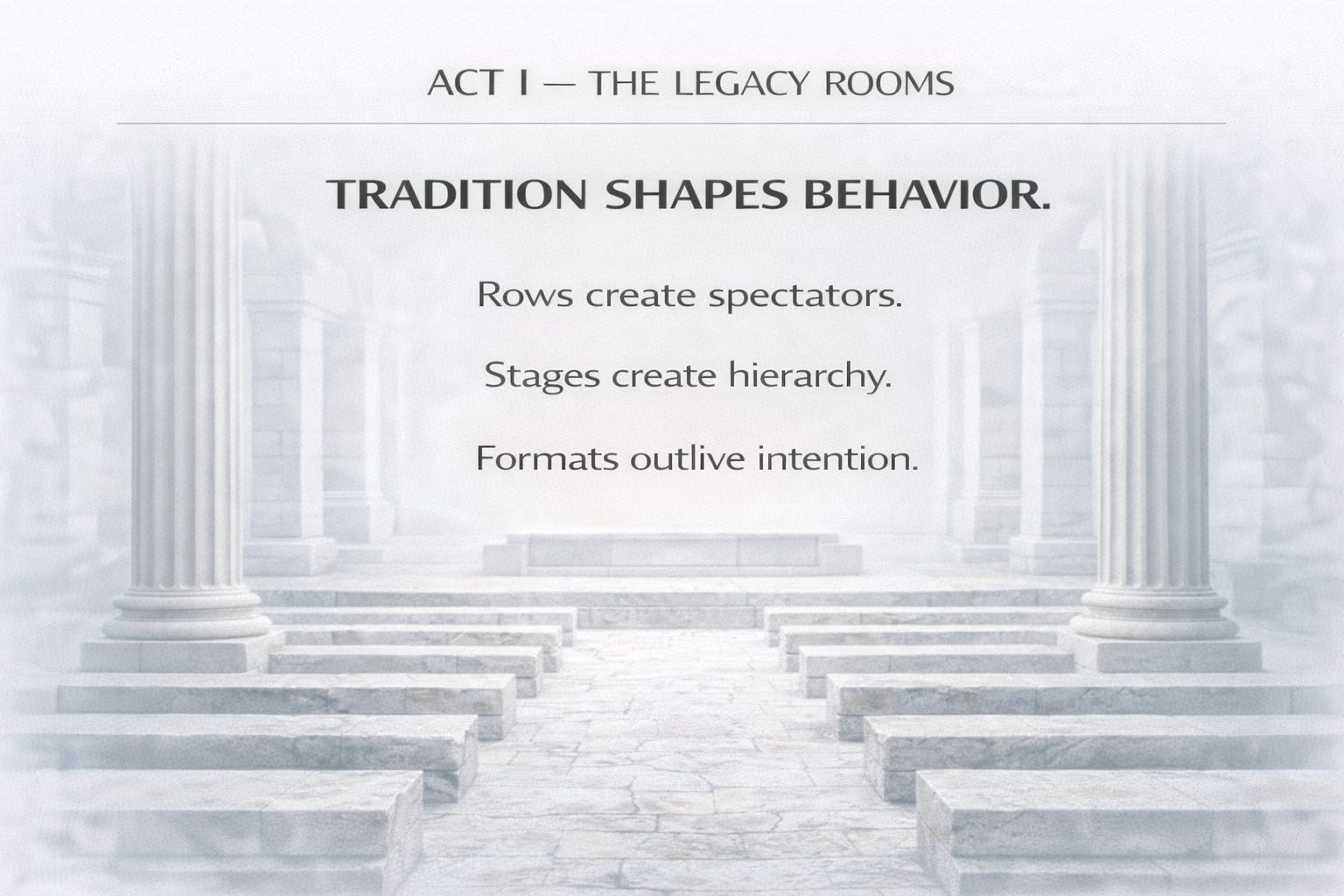
Act I – The Legacy Rooms
Where control still sits on the stage and everyone else sits quietly in rows.
The Legacy Rooms are monuments to hierarchy — built for command, not connection.
They still dominate conferences, parliaments, and corporate HQs because they look like power.
But neuroscience tells us what intuition already knew: when the room tells you to be quiet, the brain does too.
🧠 Science: Hierarchical elevation triggers mild threat responses, lowering creative recall by roughly 25 percent.
1. The Stage and Rows
Form: A raised platform washed in light, endless chairs facing forward, air thick with expectation.
Context: Church pulpits, classrooms, campaign rallies.
Like This: The TED Talk’s ancestor — command performance as conversation substitute.
What Happens Here: Focus flows one way; authority expands while empathy collapses. Great for speeches, fatal for strategy.
Robin Take: “If policy still preaches from pulpits, we’ll keep mistaking obedience for consensus.”
David Take: “The most efficient layout ever devised — and the least human.”
🧠 Science: Power distance elevates cortisol, suppressing creative cognition.
2. The Boardroom Table
Form: A long rectangle of polished wood; chairs graded by proximity to the head. Sound behaves hierarchically too.
Context: Corporate and cabinet culture.
Like This: A chessboard disguised as furniture.
What Happens Here: Position replaces contribution; fear of speaking outweighs insight.
Robin Take: “Hierarchy may keep minutes, but it kills ideas.”
David Take: “Geometry of intimidation — mahogany as muzzle.”
🧠 Science: Unequal sightlines cut collaborative talk by about 35 percent.
3. The Panel Discussion
Form: A dais of experts under stage lights, water bottles lined like trophies.
Context: Academia’s gift to event planners.
Like This: Group therapy with microphones and no therapist.
What Happens Here: Inclusion performed, interaction denied. Five people talk so no one else can.
Robin Take: “Policy theatre — and the audience already knows the script.”
David Take: “Panels are karaoke for intellect — familiar songs, no improvisation.”
🧠 Science: Passive listening halves retention after ten minutes.
4. The Press Conference
Form: Podium, flashbulbs, tension. Questions pre-screened; answers pre-memorized.
Context: Government ritual turned corporate reflex.
Like This: Theatre in bullet points.
What Happens Here: Optics replace dialogue; performance masquerades as accountability.
Robin Take: “Communication as containment.”
David Take: “A stage built from fear of follow-up questions.”
🧠 Science: Threat cues (lights, cameras) raise cortisol more than 20 percent.
5. The Rally Stage
Form: Floodlit platform, crowd fenced by barriers, sound bouncing like adrenaline.
Context: Religious revival meets campaign trail.
Like This: Worship with slogans.
What Happens Here: Emotion synchronizes briefly, then evaporates; unity without understanding.
Robin Take: “Great for morale, useless for decision-making.”
David Take: “Theatrical serotonin — feels like unity, fades by morning.”
🧠 Science: Chanting releases endorphins; absence of feedback prevents learning.
6. The Hearing Room
Form: Raised dais, witness table below; microphones like boundary markers.
Context: Judicial and legislative procedure.
Like This: Accountability by intimidation.
What Happens Here: Transparency masquerades as humiliation; performance outweighs persuasion.
Robin Take: “Designed for oversight, delivering only optics.”
David Take: “A civic aquarium — everyone visible, no one heard.”
🧠 Science: Public scrutiny heightens anxiety, narrowing cognitive flexibility.
7. The Lecture Hall
Form: Tiered seating, professor elevated like a conductor, light aimed forward only.
Context: Industrial-age education.
Like This: A factory for facts.
What Happens Here: Information flows; imagination stalls. Obedience graded as understanding.
Robin Take: “We trained memory instead of curiosity.”
David Take: “The architecture of memorization, not imagination.”
🧠 Science: Questioning doubles retention versus passive note-taking.
8. The Summit Ballroom
Form: Round tables under chandeliers, stage screens flanking the buffet line.
Context: Corporate diplomacy with dessert.
Like This: A wedding where the bride is ROI.
What Happens Here: Optics of intimacy at industrial scale; networking as ritual.
Robin Take: “Policy by banquet — too polite to disagree.”
David Take: “A photo op pretending to be a conversation.”
🧠 Science: Poor acoustics increase mental fatigue ≈ 30 percent.
9. The Cathedral Setup
Form: Center aisle, pew-straight rows, light from above instead of between.
Context: The religious DNA of authority still haunting secular rooms.
Like This: Awe engineered as compliance.
What Happens Here: Reverence replaces participation; hierarchy becomes holy geometry.
Robin Take: “Even secular leaders crave worship layouts.”
David Take: “Beautiful, yes — but reverence is a lousy substitute for relevance.”
🧠 Science: Spatial grandeur boosts dopamine (awe) but suppresses debate impulses.
10. The Broadcast Studio
Form: Cameras, anchors, glass walls; conversation edited in real time for unseen viewers.
Context: Television’s architecture colonizing everything from classrooms to summits.
Like This: A mirror ball for information.
What Happens Here: Rooms start performing for outsiders, not insiders; optics eclipse outcome.
Robin Take: “When optics rule, outcomes freeze.”
David Take: “Rooms that face the lens forget the people.”
🧠 Science: Performing under observation elevates self-monitoring and reduces empathy.
“Legacy Rooms aren’t evil,” Robin said. “They’re just obsolete.”
“Like dial-up,” I answered. “Still technically functional—incapable of bandwidth.”


