
The Gathering Economy Is Now an Asset Class
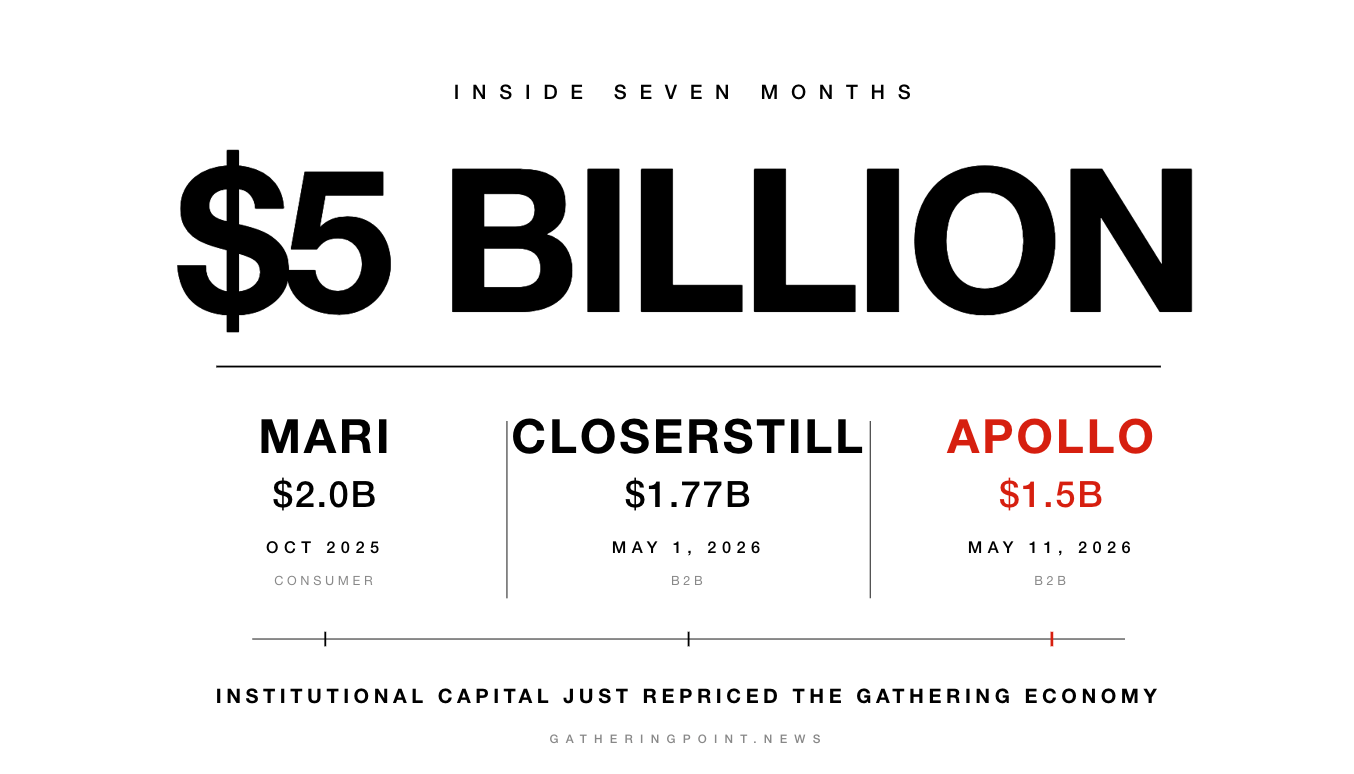
Apollo bought 140 trade shows. Searchlight bought CloserStill. MARI bought the consumer side. $5B, seven months. (113 chars, over) Tightened: Apollo, Searchlight, and MARI just spent $5 billion on live events in seven months.
Picture an independent conference organizer in Cleveland or Austin or Charlotte. She owns one good event in a vertical she knows well, maybe two if she has been at it long enough. She has fifteen employees, a venue contract she renegotiates every year, a sponsor list that took a decade to build, and a community Slack channel that lights up the week before the show and stays warm for the month after. She read the Apollo announcement on her phone Monday morning about buying Emerald and Questex, between her first coffee and her first call, the same way most of the events industry did. The press release talked about $1.5 billion enterprise values and 365-day digital engagement and Park Avenue partnerships. It did not talk about her. It should have. Because everything in that announcement, and in the Searchlight-Providence deal on CloserStill Media ten days earlier, is about her business too, even if no one inside the Apollo conference room would put it that way.
Three billion dollars in two B2B events deals inside ten days, and five billion dollars across the broader gathering economy if you count the seven months since MARI. Here is what it means for the people who build the gatherings, rather than for the people who buy the platforms that own them.
The plain-language version of the math is this. Seven months ago, in October 2025, Ariel Emanuel raised roughly $2 billion in outside equity and launched a new holding company called MARI, named for himself and his longtime lieutenant Mark Shapiro. Emanuel is the talent agent who built William Morris Endeavor into the dominant Hollywood agency, runs the publicly traded TKO Group that owns the UFC and WWE, and has been the most aggressive consolidator in sports and entertainment for the better part of fifteen years. MARI is his vehicle for live consumer experiences. It consolidated Frieze, the international contemporary art fair; the Miami Open, the tennis tournament on Key Biscayne; Barrett-Jackson, the Scottsdale-based collector car auction house; and Hyde Park Winter Wonderland, the seven-week Christmas carnival in central London that draws roughly three million visitors a year. That was the consumer-side opening move.
The B2B side caught up in the first two weeks of May. On May 1, two private equity firms called Searchlight Capital Partners and Providence Equity Partners agreed to co-own a London-based B2B events company called CloserStill Media at a valuation of approximately $1.77 billion. On May 11, a much larger private equity firm called Apollo, which manages approximately $1.03 trillion in assets across the global financial system and had not previously been a meaningful investor in B2B events, announced it would take Emerald Holding private at an enterprise value of about $1.5 billion. At the same time, Apollo agreed to acquire Questex from another private equity firm called MidOcean Partners. The combined Apollo platform will run approximately 160 B2B events a year, from gift shows to medical conferences to hospitality summits. Five billion dollars of institutional capital moved into the gathering economy across seven months, on both sides of the consumer-and-B2B divide, on both sides of the Atlantic.
Here is the part of the story the press releases will not tell you. Consumer live events are getting just enough institutional love right now to make the valuation case for everything else in the gathering economy. MARI got the headlines and the Ariel Emanuel cachet. Frieze sells out in Seoul, Hyde Park Winter Wonderland draws three million visitors, the Miami Open commands premium pricing, Coachella moves in real time on the calendar of cultural relevance, the Eras Tour grossed more than two billion dollars worldwide. These are the public proof points that allow institutional capital to value the much less glamorous B2B trade show in the same conceptual neighborhood. The consumer side gets the attention; the B2B side gets the capital; both get repriced together because the buyers are using the same story to explain why they paid. The independent operator in Cleveland or Austin or Charlotte is benefiting from the cultural moment Coachella and Frieze created, whether or not she sells a single consumer ticket.
Here is the second part the press releases will not tell you. AI is quietly making the boring half of the events infrastructure irrelevant. Registration, data collection, content production, personalized agendas, real-time translation, matchmaking, post-event reporting, the back-office layer that used to require enterprise contracts with Cvent or Bizzabo is now accessible to a smart operator with a laptop and a couple of subscriptions. That same commoditization is what lets B2B and consumer events start running on increasingly indistinguishable plumbing. It also flattens the moat the big platforms used to have. What AI is not commoditizing, and is in fact making more valuable, is the human convening infrastructure: the relationships, the trust, the community, the cultural authority of the room. Apollo did not pay $1.5 billion for Emerald’s AV contracts. Apollo paid for the audiences, the buyer-seller relationships, and the convening rights. The boring infrastructure is commoditizing fast. The differentiating infrastructure, the part the everyperson actually owns and the part Apollo actually bought, is appreciating.
Start with the most concrete change. The value of a strong event just went up. When Apollo pays a 42 percent premium for Emerald and Searchlight pays $1.77 billion for CloserStill, every other event company in the country gets repriced in the eyes of the buyers who are circling. A well-run vertical conference with steady sponsor renewals and a defensible audience is now worth more than it was last Friday. An operator with two or three good events in adjacent verticals is suddenly an attractive tuck-in for a platform that has hundreds of millions of dollars of dry powder to deploy. The numbers in the press releases are not the everyperson’s numbers. The implication of those numbers, on the multiples and the appetite of the buyers, very much is.
Within weeks, the phone is going to start ringing. Apollo, having just spent $1.5 billion on Emerald and an undisclosed sum on Questex, now has to deploy capital into bolt-on acquisitions to make the combined platform thesis work. Searchlight and Providence have the same assignment at CloserStill, and the same pair already owns Hyve, which has the same assignment. Clarion, whose Blackstone-led sale process is in flight, will have a new owner with new capital and the same imperative. The independent operator with one strong vertical show is going to get a call. Some of those calls will be from real strategic acquirers. Some will be price-checking exercises that go nowhere. Many will come from intermediaries who get paid to circulate names. The operator who thinks she is too small to be of interest is not too small. The platforms need throughput, and a single good event in a defensible vertical, with a clean cap table, is now a target.
What Apollo paid the premium multiple for is also a clue to what kind of business commands a premium going forward. Apollo did not pay for an annual-show model. It paid for the 365-day community-and-data model that Paul Miller built at Questex over the past several years, where the event is the spine and the calendar year is the system. The platforms valued Questex because Questex has a data layer, a media engine, intelligence products, and a calendar of touchpoints that runs from January to December. The independent operator who runs one show a year and goes dark for the other eleven months is not what the platforms paid premium multiples for. To stay competitive in the world the deals just created, even the smallest operator has to start thinking about the year, not just the week. What is the data you collect at the show, and how do you use it for the eleven months between editions? What is the community conversation you host between events? What is the editorial product or the intelligence brief that keeps your audience engaged in February and June? This is no longer the difference between an ambitious operator and a comfortable one. It is the difference between a salable business and a discounted one.
The two CEOs Apollo just bought are worth studying, because they did the work the everyperson now needs to do. Hervé Sedky took the Emerald top job in January 2021, in the deepest trough of the pandemic, with the company’s events business effectively shut down and the public-market valuation trading in single dollars. Sedky did not come from the traditional exhibitions pipeline. He spent twenty years at American Express, where he ran the company’s $1 billion Global Business Travel division and sat on the Amex senior management team, then six years as President of Reed Exhibitions Americas, where he oversaw more than 100 events across North and South America. He brought a credit-card-and-loyalty operator’s instincts into a trade show business that had been managed for decades on a strong calendar with a thin understanding of the customer between editions. Under Sedky, Emerald started buying data infrastructure, executive peer networks, and adjacent intelligence products on top of the exhibitions backbone, while reorienting the company around what it knew about its buyers rather than what it knew about its show floors. The 42 percent premium Apollo just paid is the back-end of that thesis.
Paul Miller arrived at Questex in September 2018 to find a company organized as twenty small independent businesses with disparate data systems and no shared platform. He had spent his career across UBM, Penton, and Informa, and had been on the executive team that sold Penton to Informa for $1.6 billion in 2016. He grew up in B2B media before pivoting into events, which made him fluent in the audience-and-data side of the business in a way most career exhibition operators were not. At Questex, Miller centralized the databases into a single platform, consolidated product development and operations across the portfolio, and built Q Activate as the unified customer data layer that allowed every Questex brand to serve content, events, and intelligence products against the same audience year-round. Both leaders came at events from outside the traditional pipeline. Both took over organizations in the middle of severe transitions. Both built the kind of business that institutional capital eventually decided to buy. The everyperson lesson is not that you need a former American Express SVP or a UBM-trained operator to run your conference. The lesson is that the people Apollo paid the premium multiple for were the ones who refused to manage their business the way the previous generation managed it, who built a data and community layer that ran through the calendar year, and who came to the work with a perspective the legacy industry did not have.
The math runs in the opposite direction for everyone in the supplier ecosystem. The AV companies, registration platforms, F&B operators, signage vendors, freelance production crews, and regional convention bureaus that make large-scale gatherings possible do not benefit from consolidation the way the asset owners do. When 160 events sit inside a single Apollo holding company, that holding company negotiates with the supplier base as a single buyer, and it negotiates hard. Margin gets squeezed. Independent venues, especially second-tier convention centers, find themselves competing harder for the same dates as the platforms move shows between cities to optimize the calendar. A trade show that lived in Las Vegas for fifteen years can be moved to Orlando in eighteen months if the spreadsheet says so. The supplier and venue community should be reading the deal coverage with at least as much attention as the organizers, and probably more.
Inside Emerald and Questex, the integration story begins on Tuesday. Eighteen months of leadership reorganizations, redundancy reviews, and brand portfolio rationalizations are now scheduled, whether or not anyone says so publicly. Some senior people will leave with packages. Some will be reassigned. Some will start things of their own, which is historically how new generations of independent operators get built. For the everyperson at a mid-size shop, this is a recruiting opportunity. For the senior leader inside the deal, the next eighteen months will determine whether her career goes up or sideways inside the new structure. The talent market for experienced event leaders is about to get more liquid than it has been in years. That is good news for the operators who can move quickly and read the room.
Step back from the operational consequences and the larger shift comes into view. Live events has been a quietly second-class industry to capital markets, business media, and elite professional culture for a generation. Private equity did not seriously cover it. The Wall Street Journal did not track it as a beat. Top MBA programs did not recruit into it. That changed inside seven months. MARI in October, CloserStill on May 1, Apollo on May 11. Three institutional moves across consumer and B2B, $5 billion of capital, two of the largest private equity firms in the world, with the prospect of more to come as Blackstone markets Clarion. The events industry just stopped being something the rest of the financial economy condescended to. Anyone who has spent a career explaining to a college reunion classmate what her job actually involves should mark the date. The work has Wall Street credibility now. That credibility, over the next decade, will change who enters the industry, how brand marketing budgets allocate against activations versus advertising, and how senior event leaders are paid.
What the deals do not fix is the question the everyperson in the gathering economy actually cares most about, which is the craft. Private equity values throughput, recurring revenue, and the data the platform can sell back to its customers. It does not value, or pay extra multiples for, the facilitator who designs a room that produces three real relationships instead of three hundred shallow ones. It does not value the conference architect who structures a two-day agenda around emotional arcs instead of session blocks. It does not pay a premium for the producer who chooses harder food over easier food because the chewing matters to the conversation. If anything, the financial discipline of the new owners will press against the parts of the craft that are most expensive and least measurable. The validation that arrived this month is real and overdue. The work to defend the craft from the spreadsheet is just beginning.
The thesis is correct. The capital is real. The thirty-thousand-foot view, that trusted in-person gatherings are infrastructure for trust and idea flow and consequential decision-making, is the view one of the largest pools of capital in the world has decided to back. The everyperson in the gathering economy should feel two things at once. The first is vindication, finally and properly earned, for a job the rest of the economy has been slow to take seriously. The second is responsibility, because the work of proving the thesis right, every day, in every room, in every city, still belongs to the people who actually build the gatherings. Apollo bought the platform. The work still belongs to you.
ADDENDUM
What else does Apollo own in gathering and hospitality.
Apollo’s other holdings sharpen the picture. The firm has operated The Venetian Resort Las Vegas and the 2.3-million-square-foot Venetian Expo since February 2022, where it is mid-stream on a $1.5 billion property renovation; it controls the merged IGT and Everi gaming-technology platform after a $6.3 billion acquisition in 2025; and it provided the hybrid capital financing for the $2.7 billion MCR-led take-private of Soho House that closed in February. In the same quarter Apollo agreed to sell Invited, the 200-plus-club private club platform it took private in 2017 as ClubCorp, to KSL Capital Partners for roughly $2.6 billion, which reads as the cleanest possible signal that the firm now believes the recurring-revenue gathering economy sits inside trade shows and convention floors rather than golf courses.
GatheringPoint covers the people who build the gatherings. Subscribe at GatheringPoint.news.


