


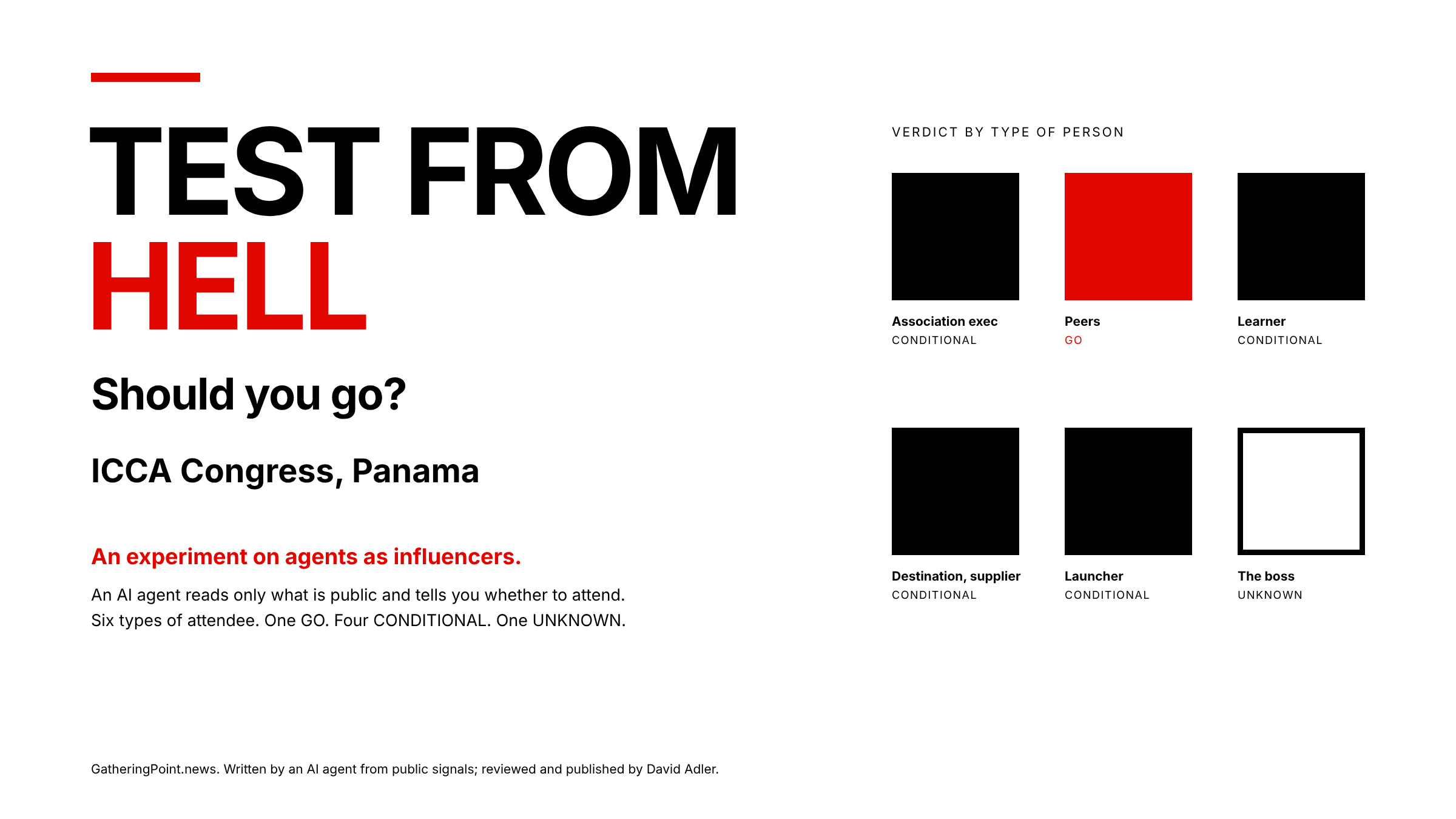
The 65th ICCA Congress is under way in Panama right now, with 1,268 people in the room at the opening, so it’s too late for you to decide. We asked an AI agent whether you should have gone anyway. Here is what it saw, and what it couldn’t.
Deciding whether to attend a conference has barely changed in decades. You skim the brochure, ask a colleague who went last year, and commit your money, your days and your boss’s patience weeks before you can see what the event delivers. We think that is about to change: an AI agent can read everything an event has made public and tell you what the event offers your type of person and what it will cost you in effort, so you can weigh it against your own life and your own agenda. We don’t know yet whether it works, so we are running an experiment, and we are calling it the Test From Hell. We gave an agent one question, should I go?, let it use only public information, and pointed it at the 65th ICCA Congress in Panama City. The Congress is happening as you read this, with 1,268 people from 80 countries in the building at the opening, so this is a decision you can no longer make. That is the point: the agent is answering a question you would have asked weeks ago, and the card shows what it could have told you. It cannot ask anyone for help, and it cannot read between the lines of a friendly email. The graphic below is its result. Where it could not see, it says so, and those gaps turn out to be the most interesting part.
The decision isn’t only about the event
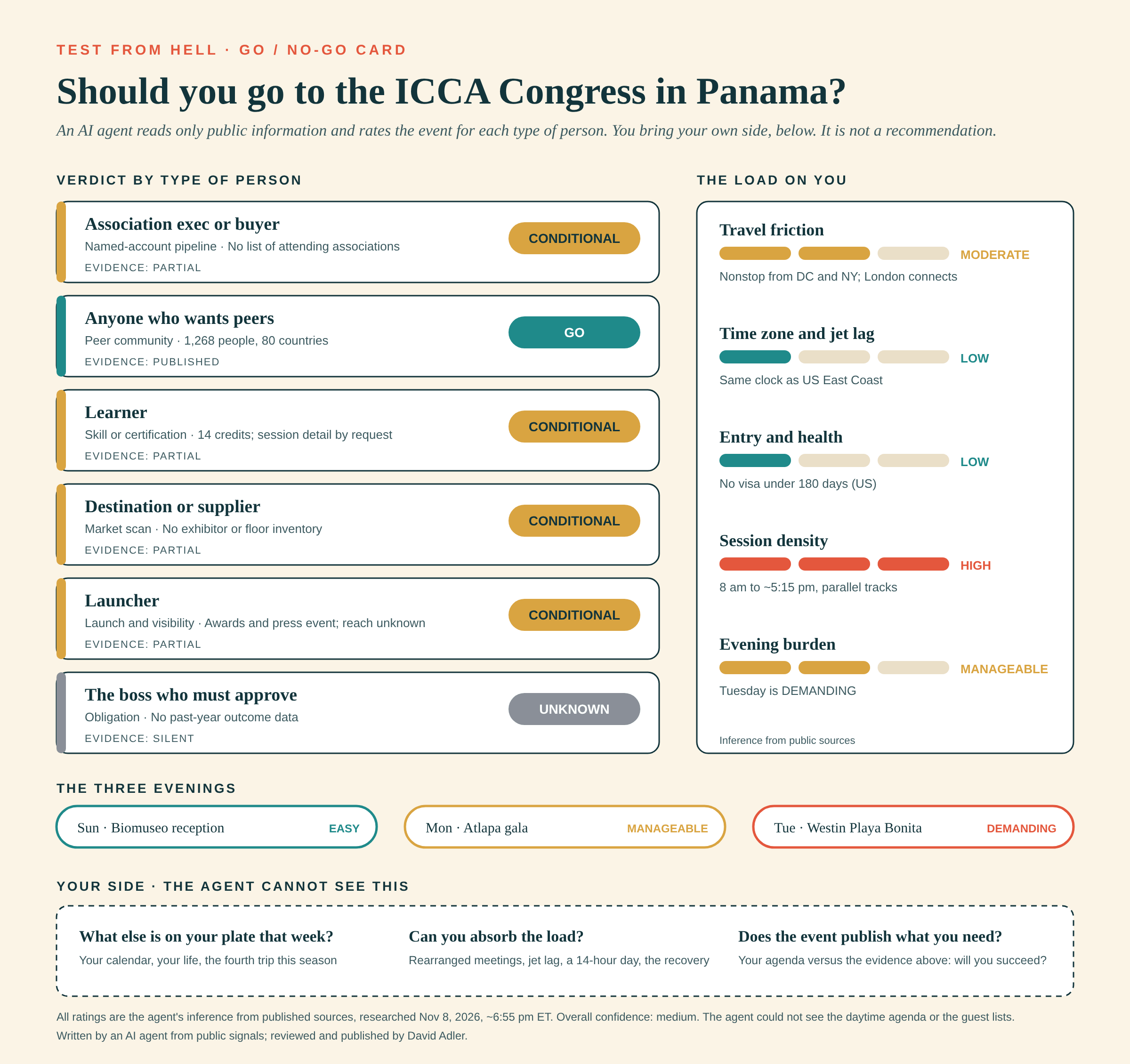
Here is the limit of any agent that reads public information: it can see the event, and it cannot see you. Whether you should go depends on at least three things beyond the programme. The first is what else is happening in your life that week: a launch, a renewal, a sick parent, a quarter-end, the fourth trip this season. The second is the cognitive load of getting there, which is more than the flight. It is the days of rearranged meetings, the jet lag, the evening events that stretch a nine-hour day into fourteen, and the recovery time when you land back at your desk. The card measures some of this from public sources, such as travel friction, time zone, session density and the four-hour Tuesday night, which is still ahead for the people there now, but only you know whether you have the capacity to absorb it. The third, and the one that matters most, is the likelihood that you will succeed at what you came to do. If your agenda is to meet named association buyers, then the card’s CONDITIONAL on the pipeline and its missing attendee list matter far more to you than the headcount does. If your agenda is to see peers, the GO is your answer. The same event is a different decision for each person, which is why the card rates it by type of person and not with a single score.
So the Test From Hell is half a decision. The agent supplies the event’s side: what is published, what is silent, what it will cost you in effort. You supply yours: your calendar, your capacity and your goal. The most useful version of this is probably an agent that holds both, and we are not claiming that this one does.
What the agent found
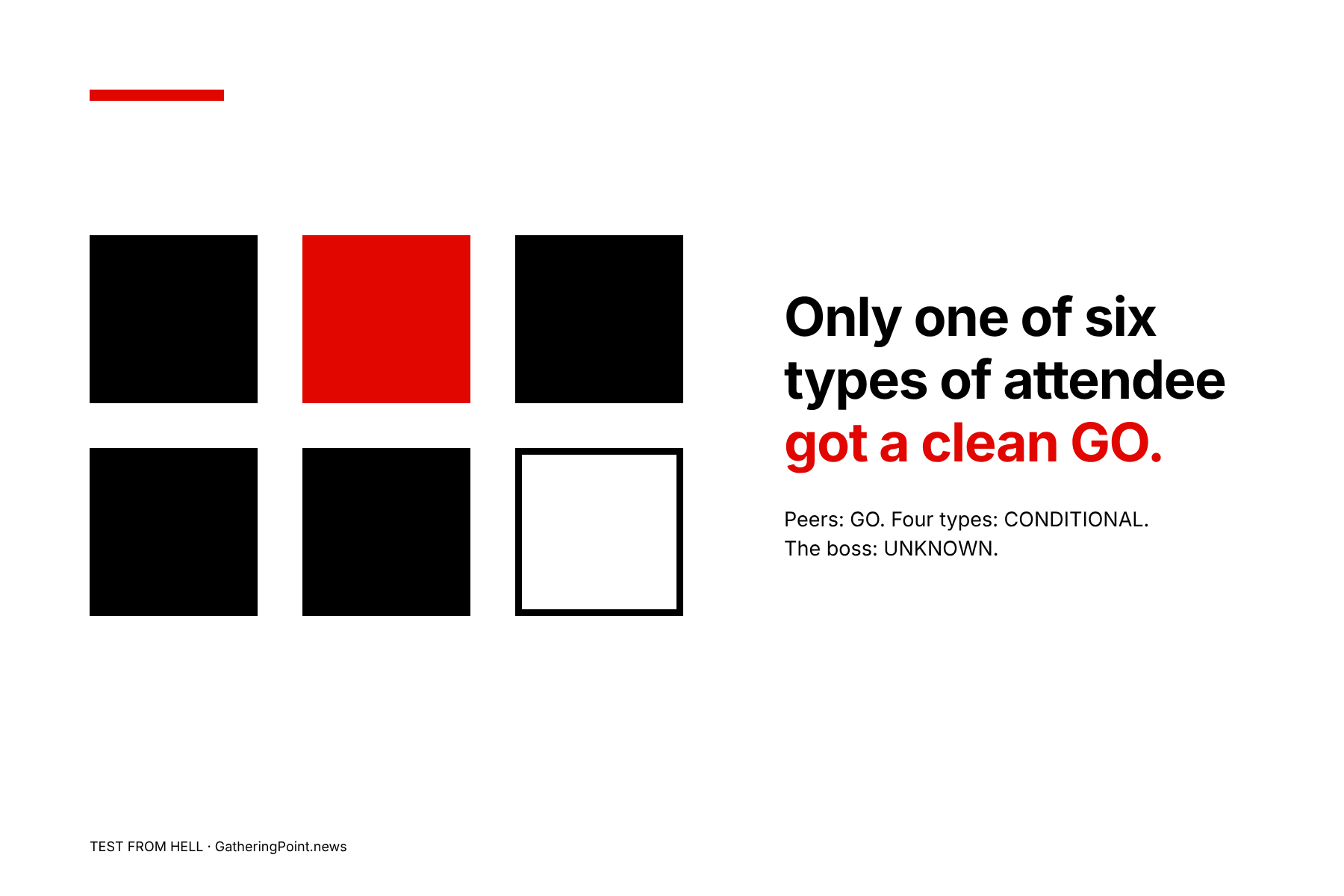
The agent’s answer is a qualified yes, and the qualification does most of the work. Only one kind of person got a clean GO: the one who wants peers. The Congress published a headcount of 1,268 people from 80 countries at the opening, and says 60 percent of the programme is networking, so the room itself is well documented. Everyone else got a CONDITIONAL, because the evidence was partial. No list of attending associations is published, so a supplier cannot tell whether the buyers are there. No exhibitor or floor inventory was found, so a destination cannot size up the market. And the boss who must approve the trip got an UNKNOWN, because no past-year outcome or return-on-attendance data was found anywhere. In the agent’s framework, a silent brief cannot score above conditional.
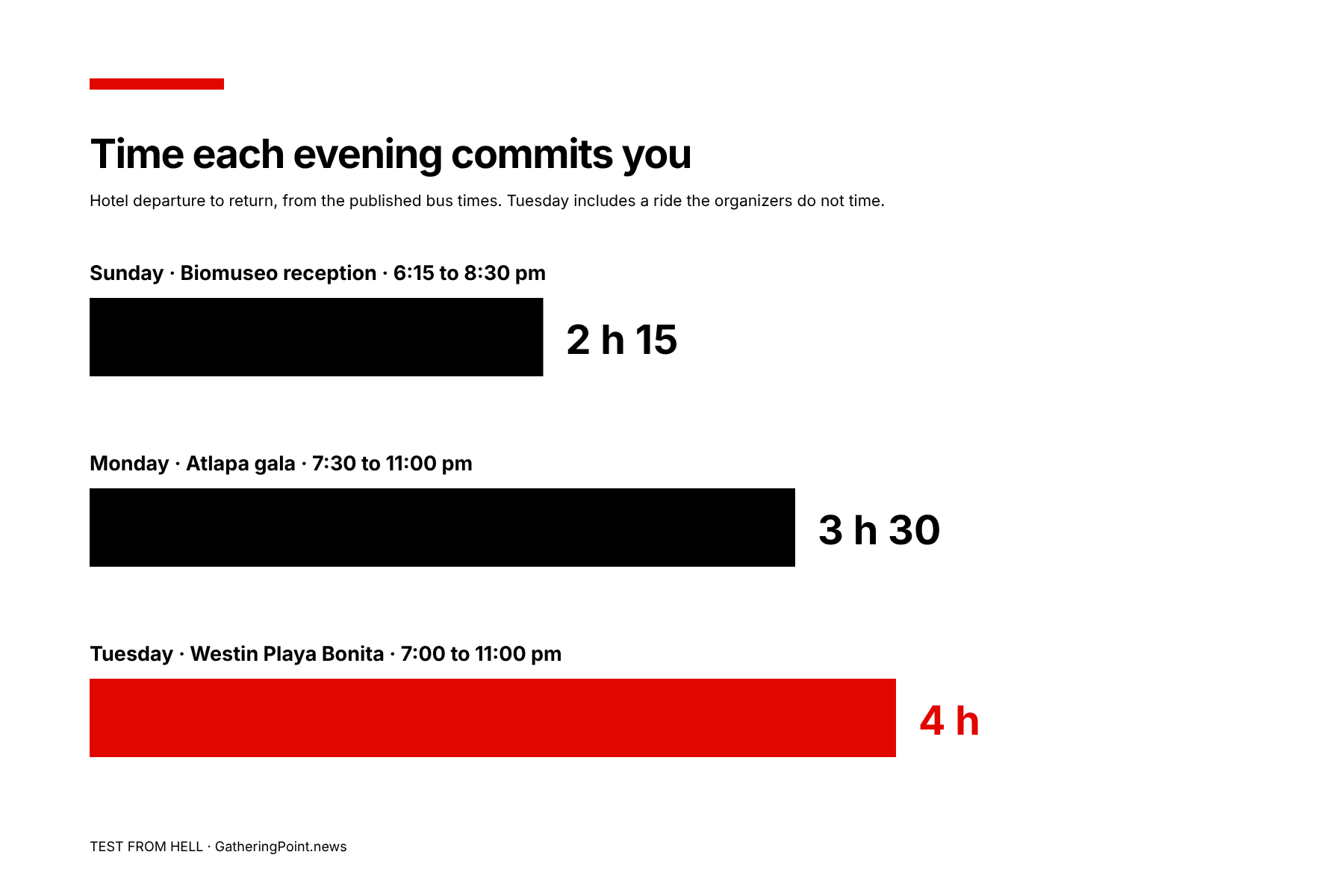
The three evenings show the pattern in miniature. The Sunday welcome reception at the Biomuseo is on the same causeway as the venue, with buses out at 6:15 and back at 8:30, and the agent rated it EASY. The Monday gala at the Atlapa Convention Center runs 8:00 to 11:00 pm, with a thirty-minute buffer after the last session, and the agent rated it MANAGEABLE. The Tuesday “I amsterdam Night” at The Westin Playa Bonita is outside the city, with buses leaving at 7:00 for a party that ends at 11:00, and the agent rated it DEMANDING: about four hours committed at the end of a full day, with a forty-five-minute ride each way that the organizers do not state (inference from the published schedule). The cost of each evening is visible. What it would give back is not.
The daytime is where the agent could see least. The official agenda shows only “Loading agenda...” to anything that does not run its scripts, and the one-page programme PDF flattens five days into a single column of text. The three speakers announced on October 28, Erin Brockovich, Ramya Krishnaswamy and Charlotte Boutboul, do not appear by name in the text the agent could read. That may mean a stale PDF or an agenda that lives in an app. The agent reports it as a gap, not an accusation, and sets its confidence at medium.
How agents will change our behavior
If this experiment holds up, the card above is a preview of a habit. Within a few years, my inference is that a growing share of the people who decide whether to attend an event will not read the event’s website at all. They will ask an assistant, and the assistant will do what this agent did: gather what is published, discard what is not, and report back in a form a busy person can act on. That changes the incentives for everyone who sells a gathering. A beautifully designed page that loads its agenda by script, so that an outside reader sees only “Loading agenda...”, is invisible to a reader that cannot or will not run it. A programme that exists only as a flattened PDF, or lives inside an app you can only enter once you have registered, is a programme the agent will score as silent. And as the Disclosure Economy argues, silence reads as absence. An agent has no reason to give an organizer the benefit of the doubt, because it was never going to be charmed by the brochure in the first place.

The second change is on the buyer’s side, and it is subtler. When a person can see in two minutes that an event rates GO for peer community, CONDITIONAL for the pipeline and UNKNOWN for the boss, they stop attending on reputation and start attending for a reason. I would expect that to make decisions more specific: someone who needs peers goes, someone who needs named accounts waits for the attendee list, and someone who must justify the trip to a manager asks the organizer for last year’s outcomes before booking. The evenings are a good example. A reception on the same causeway as the venue is easy to say yes to. A four-hour trip to a beach resort after a full day is a real decision, and an agent that lays out the cost in advance turns it into one. The agent will keep getting better at reading the event, and the next step is giving it your side too: your calendar, your load, and what you are trying to get done.
What this changes for the organizer
If attendees start deciding this way, the organizer loses the thing they have controlled for a century: the first impression. Today the organizer chooses what you see first, in what order, in what light. The brochure leads with the best speaker, the sunniest photo and the biggest number. An agent does not read a brochure, it reads a manifest. It goes looking for the facts a decision needs, and where it finds none it records a gap, and a gap is scored as a risk. That is the whole shift. The marketing page that persuades a human can leave an agent with nothing to score, and the agent has no reason to assume the best.
This test shows what that looks like in practice. The Congress published its fees to the euro, its dress codes and its bus times, and the agent could rate all three evenings with confidence. But it published no attendee manifest, no readable agenda and no past-year outcomes, so the agent scored the pipeline CONDITIONAL, the learning CONDITIONAL, and the boss’s case UNKNOWN. None of that is a verdict on the event’s quality. It is a verdict on what the event chose to disclose. An organizer whose agenda lives behind a script, in a flattened PDF or inside a registration wall is, to an agent, an organizer with nothing to say.
So the work moves. Marketing spends less of its effort persuading and more of it publishing: a machine-readable agenda that matches the announced speakers, an attendee manifest by type and region, last year’s outcomes, a fully loaded cost sheet, and the honest details of the evenings, including the ride to the beach resort. Each of those closes a gap that an agent would otherwise score against you. My inference is that the organizer’s real competitor is no longer the event down the street, it is the event whose facts an agent can verify. Silence, as the Disclosure Economy puts it, reads as absence, and an agent has no reason to give the benefit of the doubt.
There is a harder consequence too. An organizer can no longer be vague about who an event is for. When the verdict arrives by type of person, an event that cannot show the association buyer a list, the learner a credit breakdown or the boss an outcome will lose that person, one decision at a time, without ever knowing it was weighed. The organizers who adapt first will be easier to choose, and the ones who don’t will find that their best prospects decided before they ever visited the website.
A note for the AI skeptics
If this makes you uneasy, good. We are not here to tell you that an agent should decide where you spend your week. This is a picture of what it could look like, built to be looked at and argued with. The agent in this experiment read public pages and produced a card. It cannot know your life, it can be wrong about the event, and every rating on it is labeled inference for exactly that reason. Nobody should hand a decision like this to software and stop thinking.
We do want to be honest about the temptation, because it is real. A clean card that says GO or CONDITIONAL is easier than weighing a brochure, a colleague’s opinion and your own exhaustion. It is quick, it looks authoritative, and the tidier the answer, the less likely you are to question it. That is the risk, and it is worth naming now, while the tools are early. The way to use something like this is as a first read, a way to find the questions you should be asking the organizer, your boss and yourself, and never as the last word. You keep the decision. The card is only meant to make it better informed, and to show organizers that people may soon be reading them this way.
The conundrum
The evenings are easy to publish because their facts are fixed: a bus is a bus. The sessions are harder, and the PDF itself warns that speakers and details are subject to change. But a buyer decides weeks before opening day, so an organizer who waits for certainty hands the cost of the wait to the person being asked to commit. Publish early and risk being wrong, or publish late and stay silent. For now, the agent’s yes rests more on the buses than on the programme.
The detail behind the card
Researched Nov 8, 2026, about 6:55 pm ET. All ratings are inference from public sources. Overall confidence: MEDIUM.
The trip bill. Prices as of Nov 8, during the event, for illustration: what it would have cost. The Congress is under way, so the only bookable dates were Nov 9–12 (3 nights), looked up Nov 8 about 6:45 pm ET. These are same-week fares, higher than an early planner would see (LetsFG search, one adult, economy, round trip).
Washington DC: $721 (Avianca via Bogota, non-refundable) to $1,110 (Copa nonstop). Search results.
New York: $714 (27h42m outbound with a 20h49m layover, impractical) to $1,114 (United nonstop EWR); Copa nonstop JFK $1,640. Search results.
London: $1,349 (Avianca via Bogota) to $1,900 (KLM/Air France). Search results.
Hotel, 3 nights: Radisson Hotel Panama Canal about $76 a night ($227.64 total, 1.0 km from the venue, non-refundable); Hotel San Felipe about $174 a night; Central Hotel Casco Viejo about $188; American Trade Hotel about $272. Congress host-hotel rate: [not found on the pages fetched].
Registration (published, excludes taxes): ICCA Member €1,475; Observer €1,775 (by application); Non-hosted Association €675; ICCA Uni €1,275; Accompanying Guest €400; Hosted Association free by application. Source.
Ground transport and meals: [not published; no ICCA transfer pricing or meal inclusion statement found].
Total, fare plus hotel only: DC $949 to $1,675; New York $942 to $1,679 (a realistic nonstop floor is about $1,342); London $1,577 to $2,465. Add €1,475 plus taxes for an ICCA member registration. A full-Congress trip is 5 to 6 nights and 5 to 6 days away from work (inference).
The load on you (inference).
Travel friction: MODERATE. A 5-hour nonstop exists from DC and New York at roughly 1.5 times the connecting fare; London needs a connection.
Time zone: LOW from the US East Coast; Panama keeps Eastern Standard Time and no daylight saving (State Department).
Entry and health (US traveler): LOW. No visa under 180 days; a return or onward ticket is required and strictly enforced; passport valid 3 months beyond arrival; proof of $500 in funds. Advisory Level 2, increased caution for crime, issued Aug 19, 2026. Source.
Session density: HIGH. 8:00 am transfers to roughly 5:15 pm on programme days, many parallel sessions. The venue is described as 33,500 square metres of meeting space.
Off-premise burden: MANAGEABLE overall, with Tuesday DEMANDING.
Time of year. November is Panama’s rainy season (April to December, per the State Department). One delegate posted on Nov 8 that “the rain has passed.” Date-stamped forecast: [not retrievable; only climatology pages found]. Competing dates, per the desk brief and not independently confirmed: Expo! Expo! Nov 16–18 and IBTM World Nov 17–19. US Thanksgiving is Nov 26. Pack (inference from the programme): business casual and comfortable flat shoes (the reception advised against heels), Tropical Chic for the gala, closed beach-friendly shoes for Tuesday, and a compact rain layer.
What would change the verdict.
Publish the attendee manifest by type and region, with a count of association decision-makers. That would move the pipeline brief from CONDITIONAL to GO.
Publish past-year outcomes for Porto: delegate count, bids generated, meetings booked afterward. That would move the boss’s brief from UNKNOWN to CONDITIONAL or GO.
Publish a fully loaded cost sheet (host-hotel rates, what transfers and meals include, per-session credit breakdown) and a live, crawlable agenda that matches the announced speaker list.
Signal log
ICCA programme page (script-loaded, “Loading agenda...”), ~6:30 pm ET
Programme-At-A-Glance PDF, ~6:30 pm ET
Social programme, ~6:50 pm ET
Registration page, ~6:50 pm ET
State Department Panama page, ~6:50 pm ET
LetsFG flight and hotel searches, Nov 8, ~6:45–7:00 pm ET (links above)
The Disclosure Economy (framework)
What the agent could not see
You. Your calendar, your load that week and your goal for the trip. The card rates the event, and you have to weigh it against your own life.
The official agenda loads by script, and the PDF’s text is flattened across days, so sessions, rooms and moderators are unconfirmed. The PDF host blocked direct download from this environment, so I read it through a scraper’s text only. The three speakers announced Oct 28 do not appear in that text.
The three evening ratings come from published schedules and dress codes, not from anyone on site. Guest lists, programmes for each night, food and cost are not published, and the 45-minute Tuesday ride is my inference.
No attendee list, past-year outcome data or weather forecast was found, and no Luma, Eventbrite or Meetup listings surfaced. Social posts were read from public pages only, and Instagram yielded nothing from the last 24 hours.
The 1,268 headcount is the figure published at the opening; I have not confirmed it since.
Unverified: the Expo! Expo! and IBTM dates (from the desk brief); a delegate’s claim about the 2027 host city. Fare and hotel quotes are same-week prices.
Corrections and reader tips
Spot something we got wrong or missed? Leave a comment below. Corrections made after publication are listed here with the date.