
A New Era of Event Agencies: Inside Invision, Where Culture Becomes the Strategy
Editor’s Note: This is not a traditional agency profile. It’s part of a broader editorial approach at GatheringPoint.News to examine organizations the way we examine people—through temperament, behavior, and lived practice rather than headlines or scale. I met Invision’s creative directors at PCMA, and what I observed was not just a way of designing events, but a way of working together that feels increasingly consequential. This piece explores how culture now permeates the work of event agencies—and how ownership helps keep that culture aligned when it matters most.
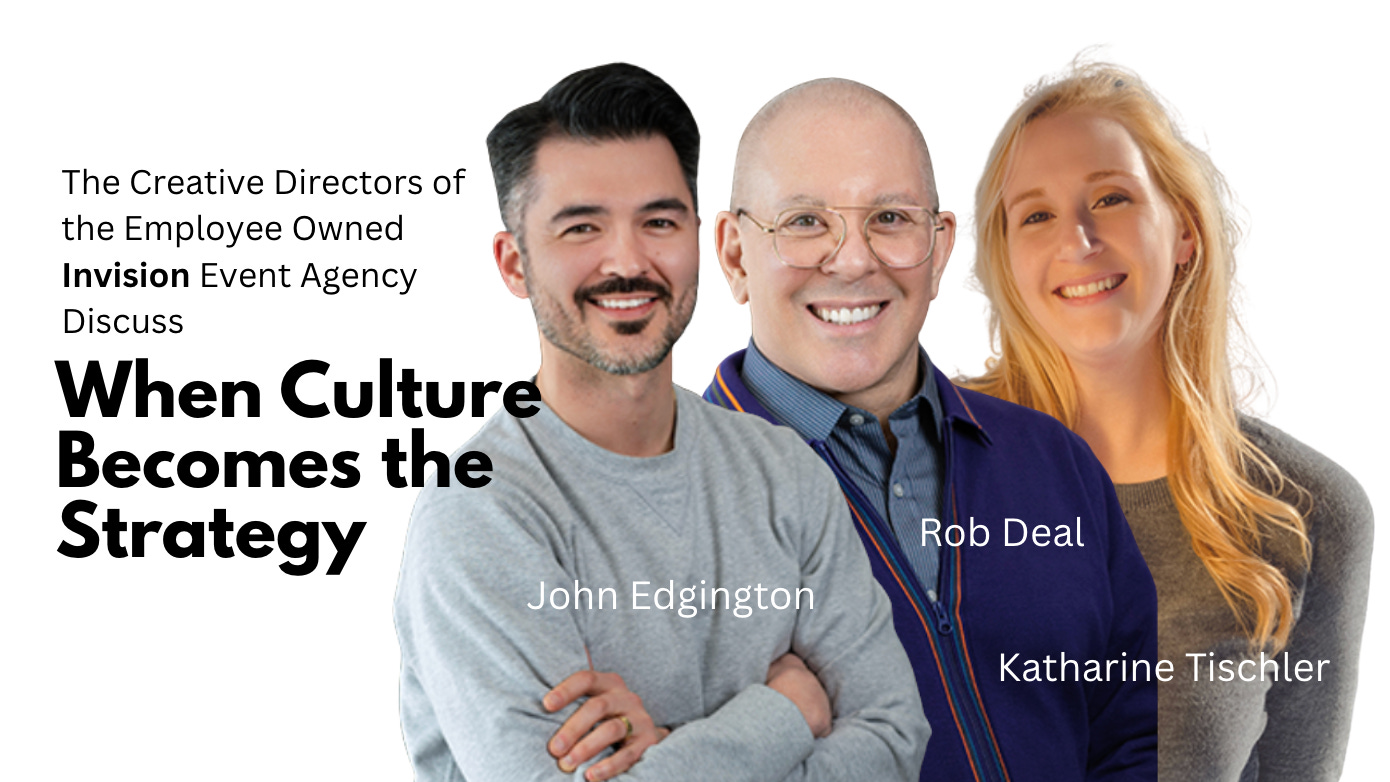
I met them at PCMA at the conclusion of their session on Inclusivity, innovation and Generational change, not onstage and not presenting a framework.
They were standing slightly off to the side, mid-conversation, the way people do when they’ve already been through pressure together and don’t need to perform alignment. Rob Deal would begin a thought and pause. Katharine Tischler would instinctively shape it, not by repeating his words but by clarifying what the moment underneath was. John Edgington would jump in next, not to contradict, but to test the idea against how an audience might feel when it landed.
There was no jockeying for credit. No visible hierarchy. Just a shared cadence that felt practiced, not polished.
What struck me wasn’t simply how they talked about the work. It was how they talked about each other.
In an industry that often mistakes confidence for volume and leadership for dominance, this felt almost disarming. A creative triad operating less like a chain of command and more like a band that already knows where the downbeat is. When one spoke, the others listened. When an idea landed, it belonged to all of them.
Only later did I realize that what I was witnessing wasn’t chemistry. It was culture.

That culture belongs to Invision Communications.
Invision behaves less like a marketing agency and more like a creative studio that happens to operate at enterprise scale.
The events industry is quietly entering a new era. For decades, event agencies were built around production. Scale was the differentiator. Execution was the profit center. Bigger stages, tighter turnarounds, more deliverables. But that model is under pressure now. Attention is fragile. Trust is expensive. And AI is compressing execution across every creative discipline faster than most organizations are prepared for.
What is changing is not the need for events, but the nature of value.
The agencies that will matter most going forward will still be producers—but they will no longer rely on production as their primary source of worth. Production can be automated. Logistics can be optimized. What cannot be compressed is judgment. Taste. Sequencing. Emotional intelligence. The ability to read a room and know when a moment needs care.
At Invision, production remains a capability. It is not the business model. Interpretation is.
That distinction is rooted in the company’s origins. Invision was founded in 1991 by Rod Mickels and Drew Hagen, at a time when agencies were still studios rather than platforms. Their early belief was simple but demanding: if people were the ones doing the work, people should matter structurally.
In the years that followed, Invision earned credibility the old-fashioned way, through execution and trust, working with early enterprise and technology clients such as Oracle, Genentech, Dell Technologies, and DuPont. Those relationships required more than logistics. They required judgment—an early signal of where the agency’s real value lived.
Decades later, that belief was formalized when the founders chose not to sell to a holding company or financial buyer but instead transitioned the firm to an Employee Stock Ownership Plan, making Invision fully employee-owned. Today, the agency is roughly 200 people, globally distributed—large enough to handle complexity, small enough to protect creative intimacy.
The ESOP did not create Invision’s culture. It aligned it.
Culture at Invision doesn’t live in slogans or value statements. It permeates. You feel it in how meetings unfold, in who is invited into authorship, in how credit is shared and how carefully moments are handled when pressure rises. What employee ownership does is pull behavior back toward intention when deadlines compress and stakes climb. It changes the question from “what’s fastest” to “what lasts.” From “who decides” to “who carries this with us afterward.”
Ownership doesn’t make decisions easier. It makes them more honest.
Leadership continuity has mattered here as well. Leadership continuity has mattered here as well. When Mickels and Hagen stepped back into advisory roles, they passed the CEO mantle to Angie Smith, a longtime experiential leader with deep roots inside the organization and the discipline itself. Smith didn’t arrive to optimize the agency out of its personality. She arrived to protect it—while also widening its aperture. Her mandate was not preservation alone, but progression: growing the agency’s strategic relevance, expanding its creative and advisory scope, and ensuring that as Invision took on more complex, higher-stakes work, it did so without losing the judgment that made it valuable in the first place. What scaled under Smith was not volume, but confidence—internally and with clients—about how far the agency could stretch without breaking its center.This context helps explain why a phrase like Own every moment took hold so quickly inside Invision.
The language didn’t emerge as branding. It emerged as a diagnosis. Rob Deal, coming from theater, had spent years noticing how outcomes were decided before anyone acknowledged them. In theater, the audience decides how they feel before the first line lands. The silence matters. The lights matter. Miss that moment and you spend the rest of the show trying to recover something already lost.
Inside the agency, Rob saw the same pattern. Pitches lost not because ideas were wrong, but because the room never felt oriented. Teams burning out not from the work itself, but from the accumulation of small moments that signaled they were unseen. Own every moment became a way to name what the agency already knew but hadn’t yet articulated: moments are not outcomes. They are inputs.
The phrase stuck because it was useful.
Creative directors heard it as permission to design beyond the stage. Strategists heard it as validation that emotional sequencing is part of strategy, not decoration. Producers heard it as a reminder that logistics are never neutral. Leaders heard it as a standard against which decisions could be measured, not just results evaluated. Employees heard something else entirely—that their moments mattered too.
Katharine Tischler understands this instinctively, because she learned it early. From the ages of nine to fourteen, she was a competitive gymnast. At first, routines were compulsory. Then choreography entered the picture. What captivated her wasn’t the tumbling passes, but the transitions—the dance between the hard parts. She helped teammates choreograph their routines. Younger girls lined the edges of the mat, quietly mirroring the older gymnasts’ movements, learning what mattered by watching what got attention.
That’s how culture works.
You don’t learn it from mission statements. You learn it from observation. From which moments are designed and which are rushed. From whom is invited into authorship and who is expected to execute silently.
John Edgington brings a different but complementary sensitivity. His background in sports and political environments trained him to read rooms where authenticity is tested instantly. He knows the moment a room starts to pull away—not loudly, but subtly—and once that moment passes, no amount of content will bring it back.
Taken together, these creative directors don’t just design experiences. They notice them. And that noticing has become the most valuable skill in a new era of event agencies.
Nowhere is this more evident than inside Invision itself.
Internal events are not treated as perks or morale boosters. They are treated as cultural infrastructure. The company’s internal gathering, Visions, isn’t about motivation. It’s about alignment. Openings are designed. Participation is intentional. Recognition is specific. People who don’t normally hold the microphone are invited to lead moments. Long tenure is honored not as endurance, but as contribution.
In an employee-owned company, these moments are governance. They tell people what matters.
The mirroring is deliberate. The way Invision treats its internal moments is identical to how it treats client moments. You cannot design belonging for others if you don’t practice it yourself. You cannot claim that moments matter externally if they are disposable internally.
That integrity shows up in the work.
At Citizen Con , where belief already existed, Invision understood that the task was not amplification but stewardship. At Y Combinator’s AI Startup School , where audiences were still forming, the task was access, not spectacle. Across projects, clients consistently describe the same thing in RFP feedback: clarity, alignment, the sense that Invision “got us” before trying to impress us. In a process often dominated by theater, the agency is remembered for something quieter confidence without bravado.
This is why event agencies no longer fit neatly beneath other marketing disciplines. Events are not media buys. They are behavioral environments with human consequence. Even the largest experiential firms are reorganizing around this truth.
Invision is not alone. Firms like George P. Johnson have also long moved to employee ownership. Jack Morton has stepped out from under holding-company ownership to re-emerge as an independent experiential organization. These are not cosmetic changes. They are structural acknowledgments that culture, judgment, and authorship are now the real assets.
In this new era of event agencies, culture no longer sits beneath strategy. It is the strategy.
Own every moment works at Invision because it isn’t aspirational language aimed outward. Its operational language aimed inward first. It governs how meetings are run, how feedback is given, how people are seen. The ESOP doesn’t create that culture. It keeps it aligned when pressure hits.
And in an industry built on gatherings, where moments shape memory and memory shapes belief, that alignment may be the most future-ready decision an agency can make.
Because events don’t just reflect culture anymore.
They deliver it.


