


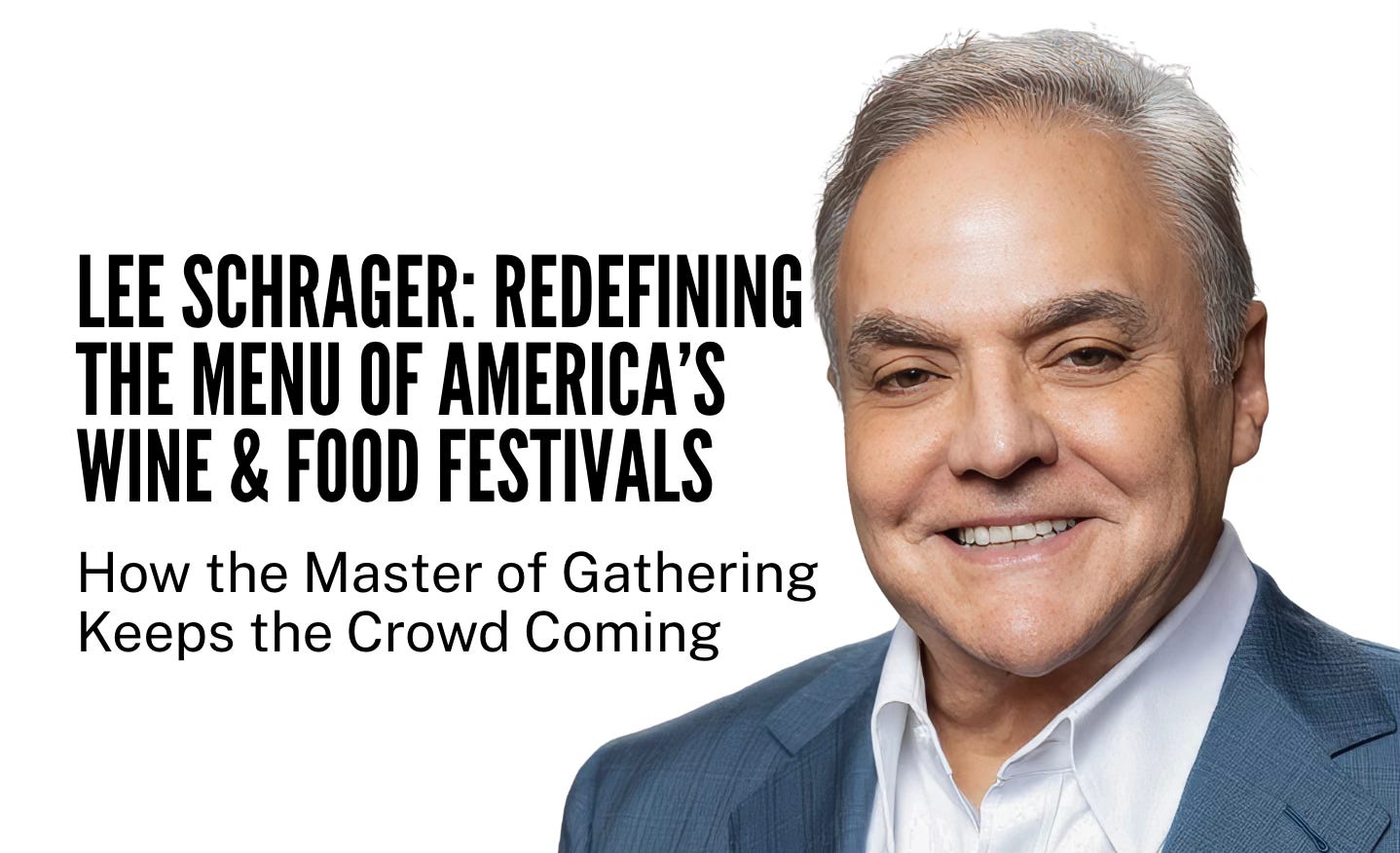
For more than a quarter century, Lee Brian Schrager has occupied a singular, slightly enigmatic position in the American gathering economy—not a chef, not a media personality, not a restaurateur, but the person who decided where the food-and-wine world would assemble, who would be seen once it did, and which cities—if only for a few charged days each year—would become the temporary capital of appetite.
He still carries the cadence of Long Island and the impatience of New York—direct, unsentimental, and allergic to wasted motion—which turns out to be an ideal temperament for running live experiences at scale.
If you work anywhere near food, wine, hospitality, or live events, you don’t need his résumé explained. You’ve been inside it. You’ve flown to it, staffed it, poured at it, complained about the lines, sworn you wouldn’t return, and then booked the same dates the following year anyway. Schrager is the architect behind the Food Network South Beach Wine & Food Festival and its New York counterpart, and more quietly, the steward of a format that evolved from a one-day campus fundraiser into something closer to civic infrastructure—part cultural ritual, part commercial engine, part annual proof that people still want to gather in real life.
What is often misunderstood, however—especially by those who only experience the festivals as indulgent spectacles—is that from the beginning they were never just parties.
They were conceived, quite deliberately, as marketing engines for Southern Glazer’s Wine & Spirits, a company whose business depends less on advertising than on relationships, reputation, and presence inside the cultural moments that shape taste. Long before “experiential marketing” became a buzzword, Southern understood that there is no more persuasive sales environment than one where pleasure, place, and aspiration converge in real time.
That strategy is embedded even in the name. It has always been Wine & Food, not the other way around.
Wine led because wine was the business—the relationship currency, the margin driver, the category that needed narrative, context, and emotional reinforcement at scale. Food was the magnet: the reason chefs, media, and consumers came into the tent and stayed long enough for wine to be discovered rather than sold.
For Schrager, the festivals were never about moving cases directly. They were about shaping perception—creating live, immersive showrooms where Southern’s portfolio could be experienced through food, place, and human pleasure, and where suppliers, buyers, chefs, sales teams, media, and consumers all occupied the same physical story at the same time.
Inside Southern, the festivals became something more powerful than promotion. They evolved into relationship accelerators, internal rally points for a vast sales force, and proof-of-strength moments that quietly reinforced why brands wanted Southern distribution in the first place. No single festival moves the revenue needle inside a $30-billion company, but it moves something more durable: gravity.
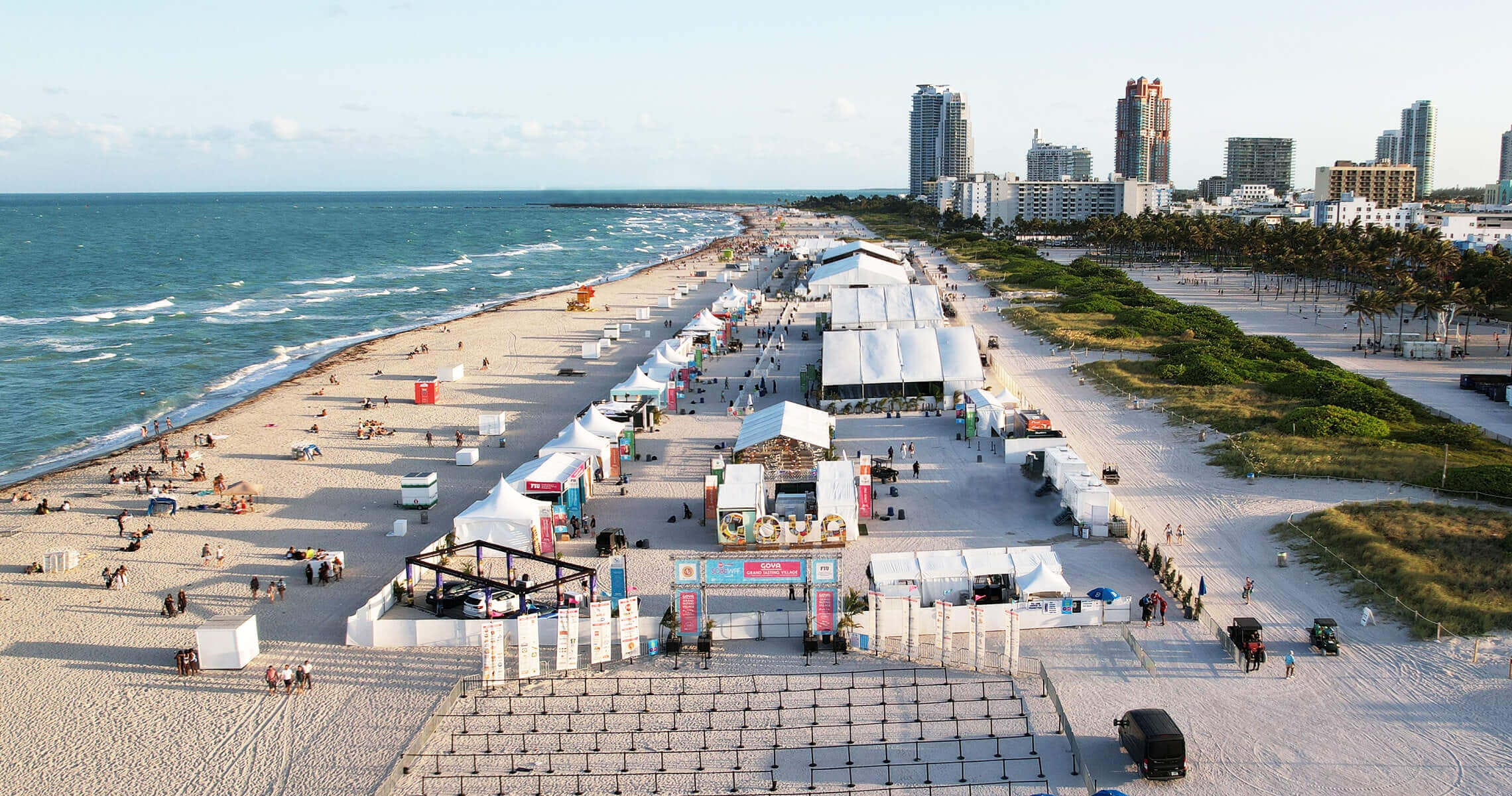
To attend South Beach Wine & Food is to step into a carefully choreographed collision of indulgence and logistics that begins before the first sip. You approach the beach and see the tents rising against the Atlantic like a temporary white city stretched along the sand, the air already thick with basslines, salt, sunscreen, and grilling meat.
Entry is brisk by design—no one wants to spend hundreds of dollars waiting in line—and once inside, the experience unfolds as controlled abundance. Everywhere there is sampling: chefs plating bites meant to be eaten in two or three standing chews, wine poured generously rather than reverently, spirits splashed over ice as music swells and crowds circulate.
You move instinctively, pulled by smell, sound, and motion, catching a glimpse of a chef you recognize, a brand you know, another you don’t but suddenly associate with a good moment. It is festive, yes—but also highly intentional. Bar placement, tasting rhythm, music tempo, and lighting as day slides into night are tuned to keep people open, receptive, and lingering. This is not accidental pleasure; it is designed pleasure, the kind that embeds brands without ever asking to be sold.
New York delivers a different sensation the moment you arrive. The energy is tighter, more compressed, the crowd sharper in dress and demeanor, the setting architectural rather than elemental. Where Miami seduces with horizon and heat, New York asserts itself through skyline and edge, its Wine & Food Festival feeling less like a beach party and more like a citywide takeover stitched together by ambition, appetite, and the particular intensity of a crowd that believes it knows what good tastes like.
Schrager has always understood that these differences are not cosmetic. They are behavioral. They determine how long people linger, how they drink, how they talk, and how they remember.
Over time, South Beach Wine & Food became one of the defining anchors in Miami’s cultural calendar, part of a small constellation of gatherings—alongside Art Basel Miami Beach—that helped transform the city from seasonal playground into global cultural capital. Basel brought art-world credibility and global money. Wine & Food brought hospitality credibility, signaling that Miami was not just a backdrop, but a serious culinary city capable of attracting chefs, media, and brands at the highest level, year after year.
Schrager is careful not to claim sole authorship—“not because of us, but with us,” as he puts it—but the acceleration is undeniable. What began as a distributor-driven marketing strategy became, almost inadvertently, part of the city’s emotional infrastructure.
Only after establishing that foundation does the rest of Schrager’s story fully click.
The wine business itself is under pressure in a way it hasn’t been for decades, and Schrager does not soften the diagnosis. This is not a cyclical dip; it is a structural recalibration driven by culture, chemistry, and generational behavior colliding at once.
“Young people aren’t drinking,” he says, matter-of-factly. “They’re taking CBD, THC, drinking low-alcohol drinks, energy drinks, taking mushrooms. And older people? They’re on Ozempic. They’ve lost their appetite for alcohol.”
For Southern Glazer’s, the impact is no longer theoretical. The company is down an in typical Schrager innovational thinking he will turn a seismic shift into an opportunity.
What makes the moment revealing, however, is the paradox sitting beside it. Even as wine consumption wobbles—forcing distributors to hedge into tequila, ready-to-drink, energy beverages, and adjacent categories—the festivals themselves have not collapsed. If anything, they have become more emotionally necessary.
If wine is the product under renegotiation, festivals have become the diagnostic.
Schrager’s instincts were formed long before Aspen or South Beach, in Massapequa, behind snack bars, movie-theater concessions, ice-cream counters, and hot-dog grills, places where hospitality is stripped of romance and reduced to behavior.
“What I learned was how to treat people,” he says. “I worked for a lot of bad managers and a few great ones. It made me more sympathetic. Everyone has something going on in their life.”
Those lessons followed him into hotels and restaurants, into late nights and holiday shifts, into a professional life where mood becomes currency and one misjudged detail can sour an entire experience. Hospitality stopped being a job description and became a sensory discipline.
The catalytic insight came later, at the Aspen Food & Wine Classic—elegant, aspirational, and logistically brittle. Flying home, Schrager wondered whether the format was right but the setting wrong. South Beach, meanwhile, was ascendant—warm when the rest of the country froze, accessible, cinematic.
When Southern asked him to elevate a one-day Florida International University tasting, he didn’t optimize the model; he reinvented it—off campus, onto the sand, layered with chefs, media, and spectacle. “It wasn’t a hard sell,” he says. “They wanted something big.”
What emerged wasn’t just a successful festival, but a blueprint.
Schrager is candid about food festivals today. The category is saturated, expensive, and professionalized. Chefs expect to be paid. Talent arrives with teams. Sponsors want deliverables. He wouldn’t want to start one now.
And yet, he does not believe they are fading. He believes they have changed function.
What festivals no longer do well is novelty. What they still do exceptionally well is convene—creating temporary centers of gravity where suppliers, chefs, media, sponsors, distributors, and consumers all occupy the same physical narrative. Inside Southern, festivals are not side projects; they are live operating systems for the business.
No festival moves revenue directly. But it moves gravity.
New York exposed another lesson. Unlike Miami, where the beach itself provides continuity, the New York festival moved too often, chasing space and economics. Attendance didn’t collapse, but it softened.
“I think we pissed people off by moving it around too much,” Schrager says. People wanted to know where they were going.
Festivals, he learned, behave like rituals. People return to places as much as programs. Settling at the Seaport finally gave New York a home, and the response was immediate. Diagnose the problem, name it plainly, fix it, and move on.
That directness—the clipped shorthand of Long Island and New York hospitality—runs through everything he does. “When it doesn’t start good, it doesn’t end good,” he says, describing deals he has walked away from without drama.
For all the scale, his method remains stubbornly analog. He listens. He walks the grounds. He watches lighting, lines, bathrooms, bar placement. Festivals are fragile systems, and Schrager has learned how to make them feel inevitable.
He does not own them. He does not profit personally from their upside. That neutrality earns trust and allows him to say no early.
What he is proudest of is not attendance or revenue, but the aftereffects: chefs launched, careers built, cities repositioned.
“We’re still here,” he says.
In a moment when wine is anxious and appetite is chemically mediated, the persistence of these festivals makes something clear. People are not showing up for alcohol. They are showing up for each other.
Lee Schrager did not just build festivals.
He built emotional infrastructure.
Lee Brian Schrager — Wisdom Bank Takeaways
Gathering is a sensory craft, not a marketing function.
Schrager’s festivals succeed because they are engineered through light, sound, flow, and pacing rather than slogans or campaigns. The experience is felt before it is understood.
Wine may wobble, but appetite migrates—it doesn’t disappear.
Consumption shifts, but the human desire for shared pleasure and belonging remains constant.
Events have terroir.
Miami and New York behave differently because place is an active ingredient, not a backdrop.
Clarity outperforms cleverness.
Burger Bash works because it is legible. People should never have to decode an invitation.
Every festival has a vintage.
Some years require adjustment, humility, and real-time intervention.
Listening is leadership.
Walking the floor and absorbing friction without ego keeps events alive.
Operational details shape emotional outcomes.
Bathrooms, entrances, ADA access, and bar placement determine mood.
Festivals are rituals, not pop-ups.
Continuity builds loyalty; movement erodes memory.
Directness is an advantage.
Saying no early protects the ecosystem.
Trust compounds faster than scale.
Clean motives keep chefs, sponsors, and partners returning.
Belonging outlasts the product.
Guests remember how the night felt more than what they drank.
You cannot spreadsheet your way to magic.
Atmosphere must be designed for patiently and intuitively.