


After fifty years in this business, I assumed I knew everyone worth knowing. I was wrong, and I can prove it. Every time we research a new corner of the gathering economy, I find people doing brilliant work I had never heard of, in fields I thought I understood. If that is true for me after half a century, it is true for all of us.
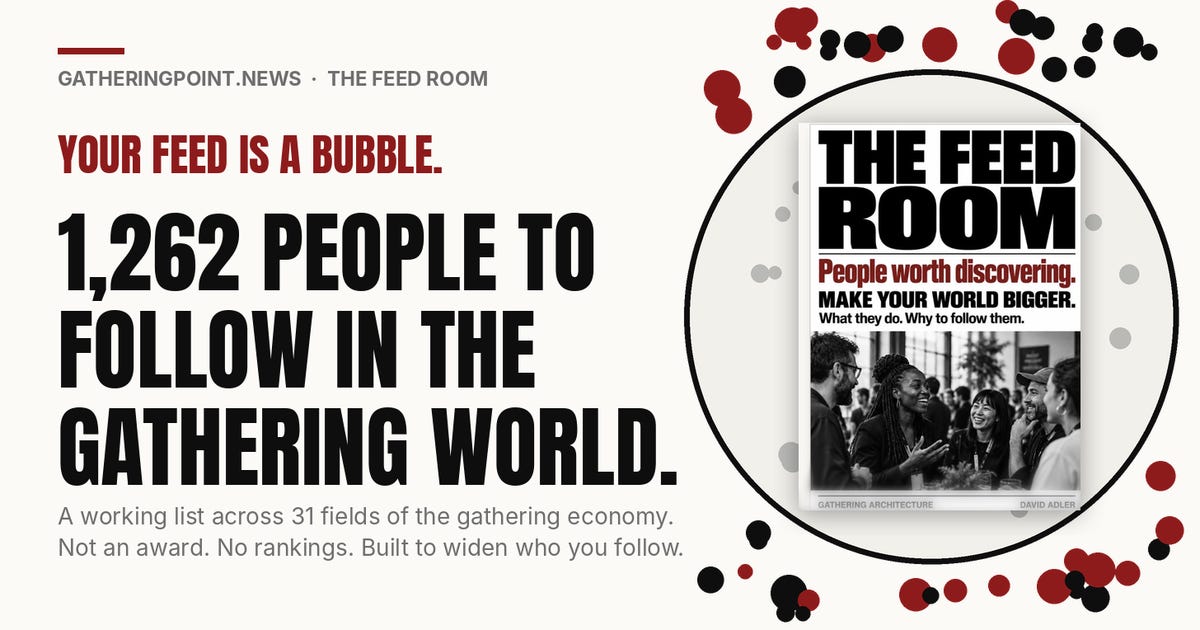
So we built a list. It is called the Feed Room, it holds 1,262 people across 31 fields, and you can browse it at gatheringarchitecture.com/feed-room.

Even the best feed is a bubble
Your feed shows you more of the world you already know. That is what it was built to do. The trade show executive follows other trade show executives, the wedding planner follows other wedding planners, and the festival producer follows the people who book the same headliners. Everyone is well informed about their own corner and nearly blind to the rest.
The sectors of our business live side by side without knowing anything about each other, yet they do the same work. Social planners built an entire discipline around how people feel at a wedding or a celebration. The corporate world discovered that feeling years later and renamed it engagement. Festivals, associations, trade shows and hospitality each solve the same human problems in different vocabularies, and almost nobody is translating.
Explore the Feed Room
What is in the Feed Room
Look at the breadth. A scientist who studies how neurodivergent audiences experience a conference sits a few names from a chef who thinks about how a room tastes. The United Nations’ Chief of Protocol, who manages the most complicated guest list in the world, is listed beside a keynote speaker who spent years as a police detective and now treats fun as a leadership tool. A founder who grew home mahjong nights into public parties and corporate experiences is a few lines away from the executives running the largest exhibition companies.
Each entry says what the person does and why they are worth following. The 31 fields run from conferences and trade shows to festivals, weddings, ritual, technology, measurement and the economics underneath all of it. You can search the whole list, browse by field, or read it as plain text.
Why strangers beat friends
The research behind this is older than the internet. In 1973 the sociologist Mark Granovetter showed that new information and opportunities tend to reach us through weak ties, the people outside our close circle. A study of 20 million LinkedIn members, published in Science in 2022, confirmed it at scale: moderately weak connections were the most useful for changing jobs. And Ronald Burt found that people who bridge separate groups are more likely to have their ideas judged valuable.
The point for our industry is practical. The next idea that changes how you run a room is unlikely to come from the person you already follow. It will come from someone in a world you have never looked at.
What this list is not
It is not an award, and it is not a top anything. There are no rankings, no winners and no annual class of honorees. Those lists tell you who has already arrived. This is a working list that keeps growing as the gathering economy keeps producing voices worth hearing, which is why the number on this page will be larger next month. Being on it is not a prize. It is an invitation to be discovered, and to discover.
How to use it
Pick a field that is a blind spot for you, not the one you already live in. Tap the website or LinkedIn link under a name, choose the matching profile, and follow. Do that for five to ten people across two or three fields, and within a week your feed starts serving you their thinking.
If you would rather have it done for you
You can do all of this yourself, or we can do it for you. Low cognitive load is the new luxury, so there is a Done For You edition: the full list in one spreadsheet, the ten people to follow first, and ready-made instructions for loading everything into your own AI.
Whichever way you go, the ask is the same. Follow a few people from a world that isn’t yours, and let this list show you how much is out there.
GatheringPoint covers the people who build the gatherings. Subscribe at GatheringPoint.news.